
Si vs. Ni: Which One Do You Use? What’s the Difference?
So you’ve figured out your personality type and you’re anxious to know more! But all of the sudden you’re hearing words like Si and Ni and Fi and Fe.
What does all this mean?

The deeper you look the more confusing it may seem. At first, you may have just thought you were an introvert with a preference for sensing and feeling, but now you’re seeing words like Introverted Sensing and Extraverted Sensing, or Introverted and Extraverted Feeling. You may also be unsure of your type. Perhaps you feel torn between sensing and intuition and aren’t sure which one resonates more with you.
Two of the most confusing functions to explain are Introverted Sensing and Introverted Intuition. These functions are referred to as Si (Introverted Sensing) and Ni (Introverted Intuition). If you’re an ISFJ or an ISTJ you would be called Si-dominant. If you’re an INFJ or an INTJ you’d be called Ni-dominant. These preferences create major differences in how these four types view the world.
Table of contents
- Intuition and Sensing as Perceiving Functions
- Where Did the Concepts of Introverted Sensing and Introverted Intuition Come From?
- Characteristics of Si Types:
- Characteristics of Ni Types:
- How the Introverted Sensor Thinks
- What Si-Users Trust:
- How the Introverted Intuitive Thinks
- Is One Type Better Than the Other?
- Feel Like Sharing Your Thoughts?
Estimated reading time: 14 minutes
Intuition and Sensing as Perceiving Functions
Each personality type has a more natural perceiving function and a more natural judging function. The perceiving function determines how we absorb information and which things we notice and trust. The judging function determines what we consider when we make decisions. SJ types naturally absorb information through Introverted Sensing, while NJ types naturally absorb information through Introverted Intuition.
Where Did the Concepts of Introverted Sensing and Introverted Intuition Come From?
If you’ve ever wondered why you keep seeing words like “Introverted Sensing” and “Introverted Intuition” thrown around like everyone just naturally knows what they mean—don’t worry. You’re not alone. These ideas come from Carl Gustav Jung, the Swiss psychiatrist who spent way too much time wandering around the human psyche and then had the audacity to write it all down.
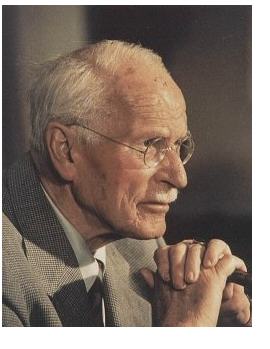
Jung was trying to figure out why people seemed to think, feel, and notice the world so differently. Why one person is obsessing over whether the curtains match the couch while another is staring at the curtains like, “What if they’re a metaphor for the collapse of civilization?” Instead of deciding that half of humanity was broken (the way some people in his era did), he said: no, these are just different operating systems. Different ways of taking in the world and making sense of it.
So he split these mental “functions” into categories—Sensing, Intuition, Thinking, and Feeling—and then said, “Hey, each of these can either turn outward toward the world (extraverted) or inward toward your own mind (introverted).” That’s where “Introverted Sensing” and “Introverted Intuition” come from. They’re not mystical woo-woo terms. They’re basically Jung trying to explain why your Aunt Millie is sentimental about the smell of her grandmother’s apple pie (Si) while your friend Dave is predicting humanity’s eventual merger with AI by 2035 (Ni).
Characteristics of Si Types:
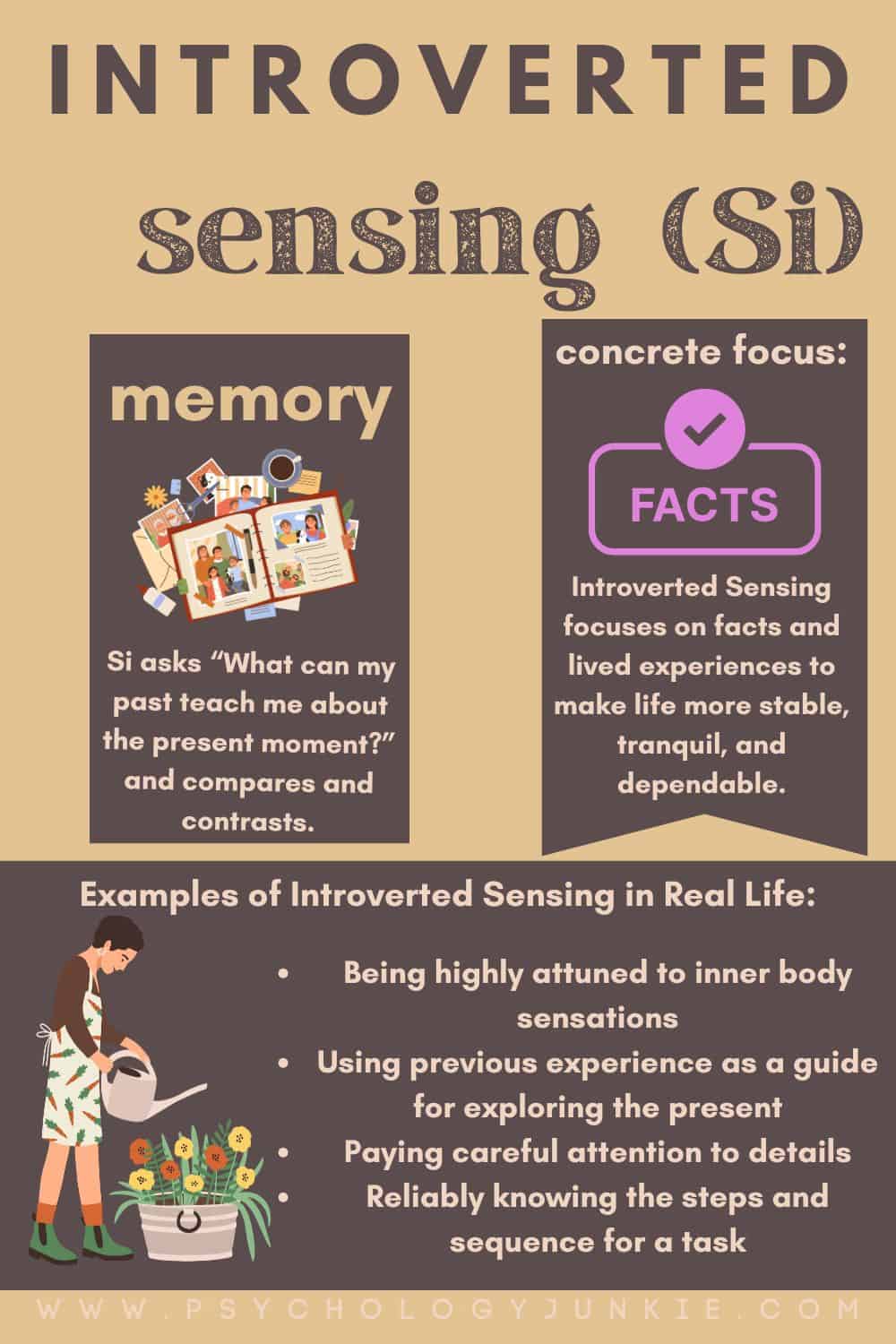
- They don’t just notice details—they experience them deeply. Carl Jung, the father of psychological type, said Si isn’t about the object itself but about the impression it leaves. For example, two people might taste the same soup, but the Si-user remembers exactly how it compares to Grandma’s recipe ten years ago.
- They see reality through a personal lens. Jung noted that Si adds a “subjective factor” to perception. This means what they notice carries meaning and past experience beyond just the raw data. A chair isn’t just a chair—it’s the chair Dad sat in every morning.
- They are guided by memory and impressions of the past. For Si-users, experiences don’t fade quickly. Jung described it as sensations “developing in depth.” That’s why they might vividly recall the smell of their childhood home or a teacher’s exact words decades later.
- They often seem calm, steady, and rational. Jung observed that their rich inner impressions can make them appear outwardly restrained, even passive. They may not gush about what something means, but inside, it can feel profound.
- They trust what has been proven to work. Because impressions are built layer by layer over time, Si-users tend to respect traditions, rules, and tested methods. Novelty isn’t as appealing as familiarity that carries meaning.
- They create stability and continuity. Si-types smooth out extremes—raising the low, lowering the high—to keep things balanced. They look for homeostasis; a sense of comfort, familiarity, and “home.”
- They forecast the future by looking backward. Isabel Briggs Myers pointed out that they project what’s likely to happen based on what’s already happened, so their predictions often feel grounded and realistic.
- They’re sensitive to bodily signals. Si isn’t just about external impressions; it’s also about inner sensations—like noticing subtle signs of fatigue, hunger, or illness before anyone else does.
Characteristics of Ni Types:
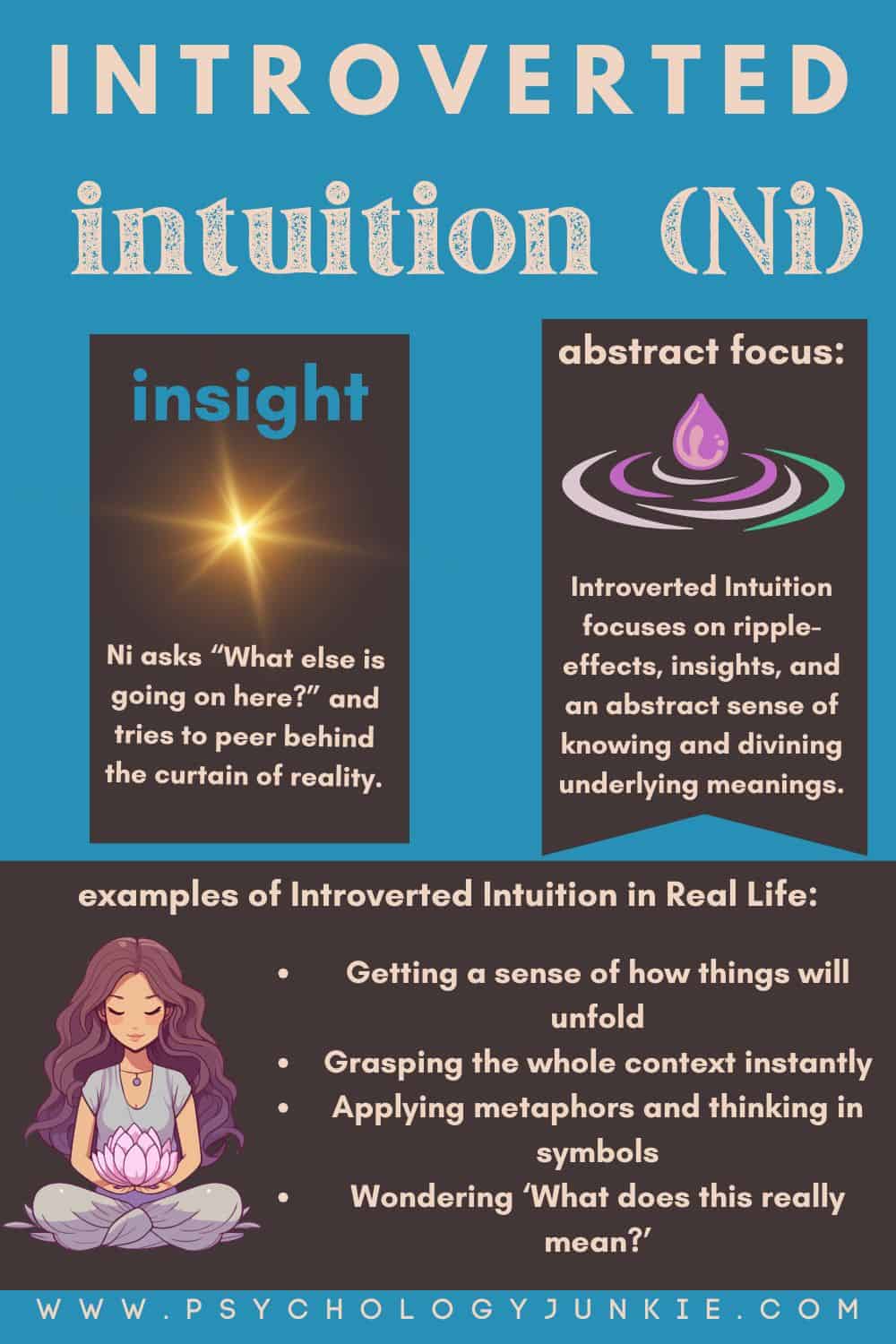
- They focus on inner images and symbols rather than outer facts. Carl Jung said Ni perceives the “inner object”—the unconscious images and archetypes that shape how we experience life. These often feel more real to Ni types than the external world itself.
- They see behind the surface of things. Where Si attends to the concrete details, Ni looks at what those details point to; the hidden meaning, the unfolding pattern, the “why” behind events.
- They live with a sense of inevitability. Ni gives a strong impression of “this is where things are headed,” even without clear evidence. Jung called this its “prophetic foresight.” Ni types often sense outcomes before they’re visible to others.
- They often feel detached from the present moment. Because their focus is on what is behind or beyond the immediate, they may seem aloof, absent-minded, or lost in thought. Jung said others may accuse them of “fruitless fantasies.”
- They are oriented to the big picture, not the details. Ni can miss or even dismiss concrete, sensory facts in favor of the vision it sees emerging. What matters is not what is, but what it means and where it’s going.
- They can seem mysterious—or misunderstood. Jung described Ni types as “mystical dreamers and seers” or, in some cases, “fantastical cranks.” Because their insights come from within, they may sound cryptic or strange to those who live more in the external world.
- They wrestle with the meaning of their visions. A morally-oriented Ni type asks, “What does this mean for me, for the world? What am I called to do with it?” Others may not see the same weight or significance, leaving Ni types feeling isolated.
- Their blind spot is sensation. Jung emphasized that when Ni dominates, sensation gets repressed. This can lead to clumsiness with details, hypersensitivity to the body, or being swept away by crude sensory impulses when stressed.
How the Introverted Sensor Thinks

Introverted Sensors (Si-users) are like walking libraries of lived experience. Every detail, every impression, every fact gets stored away and cross-referenced so that when they’re making a decision, they’re not guessing. They’re pulling from a well of memories, lessons, and “don’t do that again” moments. The result? Their viewpoints often feel rock-solid, grounded in something real.
And Si isn’t just comparing to the past in a cold, clinical way. Si types live in relationship with the past. Experiences don’t fade, they deepen, like wine aging in a cellar. A childhood home isn’t just remembered—it can be felt, sometimes decades later, down to the smell of the air and the tone of the light in the windows. That’s why they make careful, grounded decisions: everything new is filtered through a rich web of impressions, compared to the countless impressions of what’s come before.
Si-dominant types aren’t impulsive. They move carefully, like someone double-checking a map before they take a step forward. Mistakes, education, hard-earned lessons, all of that becomes raw material they use when making choices. That’s also why they’re the people who bring stability into their families, friend groups, or workplaces. They crave stability for themselves, too. Routines, familiar traditions, and tried-and-true methods aren’t “boring” to them, they’re reassuring, like a well-worn sweater or a favorite meal.
One of the core things about Si is the way it constantly compares the present with the past. New information doesn’t just get taken at face value. Instead, it’s instantly tested against the backlog of stored impressions. Did it match? Did it clash? Does it remind them of that one time back in high school when someone promised something and didn’t deliver? Slights, kindnesses, promises kept or broken—these things stick. Which is why Si-users place such a high value on dependability. If they keep their word, they expect you to keep yours. If you don’t, they’ll remember. Maybe forever.
Ask a Si-user about a painting, and you’ll probably get the details: “Three pine trees, sky fading purple, woman in a blue dress on the cliff’s edge.” Ask an Ni-user, and you’re more likely to hear: “This is about longing. She’s debating a leap into the unknown.” Both are true in their own way, but Si’s lens is rooted in what’s there, the concrete facts, not the abstraction.
And here’s the beauty of it: if you’re overwhelmed by choices and facts, a Si-dominant can be a lifesaver. They’ll recall the important details you’ve forgotten, warn you about pitfalls you can’t see, and ground you in reality when your head’s in the clouds. They’re careful. Responsible. Practical. The type least likely to make reckless, forgetful blunders. Unless, of course, you mess with their routine—and then, well, let’s just say they’ll notice.
What Si-Users Trust:
Introverted Sensors trust what they can see, touch, taste, smell, or what they know through experience. They also trust authorities and place value in credentials. They especially trust their own past experiences.
How the Introverted Intuitive Thinks

Ni-dominant personality types (INFJs and INTJs) live with one foot in tomorrow and the other in the unseen. Where Si-users keep careful track of what is and what has been, Ni-users can’t stop pulling at the threads of what’s hiding behind the curtain. Carl Jung described introverted intuition as peering into the inner world of images, archetypes, and symbols; the kind of raw material the unconscious churns out. So while an Si-user might notice the soup tastes salty compared to Grandma’s recipe in 2005, the Ni-user is more likely to think, “This soup feels like a metaphor for regret. What does it mean?”
These types are natural pattern-hunters. They see the invisible string tying events together. Jung said Ni can even have “prophetic foresight,” because the unconscious images they perceive often line up with the larger flow of life. In modern-speak: INFJs and INTJs are the friends who can look at your messy love life or your job situation and calmly tell you how it’ll all unravel in six months. And frustratingly, they’ll usually be right. They’re less interested in authority, rules, or the “tried-and-true” than their Si counterparts. They’ll respect the past, sure, but they don’t trust it. They’d rather forge their own way, even if it means reinventing the wheel just to make sure it spins the way they envision.
Here’s the way I picture it: Si is like watching an old home video. The colors might be a little faded, but the moment is there — the smell of birthday candles, the sound of your cousin’s laugh, the exact wallpaper in Grandma’s kitchen. It’s not just “I remember that day,” it’s “I relive that day.” Ni, on the other hand, is like a giant table full of puzzle pieces. Each piece on its own looks random or useless, but given time and solitude, the Ni-user suddenly clicks them all together and bam: an entire picture of how things are going to play out. Both functions need quiet to work, but where Si comes back with lived, concrete details, Ni comes back with a vision of what’s next.
Introverted Intuitives are strategic to the bone. Once they lock onto a vision, they’re already laying out the steps, the contingencies, the fallback plans to get there. They’re constantly scanning for how every choice today shapes tomorrow. If you want to know where your current choices are heading, talk to an INTJ or INFJ. Give them the details, and they’ll tell you what it means long-term.
Where Si trusts the known and the tangible, Ni trusts impressions, themes, and symbols. They put their faith in the “pattern behind the pattern.” Jung once said Ni-dominants can become the “mystical dreamer or prophet,” sometimes even to the point of seeming aloof or incomprehensible to others. That tracks: they’re the ultimate big-picture people, obsessed with ultimate truth and meaning. But it comes at a cost. Just as Si-users sometimes miss the forest for the trees, Ni-users sometimes miss the trees for the forest. They can overlook the obvious because they’re staring so intently at what it all means.
The magic — and sometimes the madness — of Ni is this: they don’t just want to know what’s happening. They want to know why it matters, where it’s heading, and what the future is asking of them. And once they’ve glimpsed that vision, they’ll hold onto it with unshakable resolve.
A personal example:
I once coached a Si-dom/Ni-dom couple. One partner was a strong Si-dominant type (ISTJ), the kind of person who wanted familiarity, facts, and proof before trusting anything. If they were making a big decision, they wanted to look back at what had worked in the past, gather the evidence, and lean on what felt tried-and-true. For them, stability came from repeating what was reliable.
Their INFJ partner, on the other hand, was living in Ni-land. They weren’t looking backward so much as forward, sketching out a constantly evolving hunch about what was coming. They’d say things like, “I just know where this will lead,” even if there wasn’t hard evidence yet. For them, the “truth” was in the pattern underneath the surface, not in the receipts from yesterday.
You can probably guess how this dynamic caused tension. The Si-dominant wanted to know, “Where’s the proof?” The INFJ wanted to say, “Trust the vision.” Neither was wrong, they were just tuned to different frequencies. Coaching them meant helping the Si partner understand that not everything meaningful can be proven right away, and helping the Ni partner slow down and ground their insights so they didn’t feel like floating guesses. And ultimately, both needed to have patience and compromise when working together to make decisions so that one partner’s perspective wasn’t being railroaded or dismissed by the other.
Is One Type Better Than the Other?
Short answer? Nope. Long answer? Still nope.
When people first learn about Introverted Sensing (Si) and Introverted Intuition (Ni), they sometimes start sneaking into comparison mode: “Well, Ni sounds mystical and future-seeing, so maybe that’s more impressive,” or “Si sounds practical and dependable, so maybe that’s more useful.” But that’s like asking whether a compass is better than a map. They do different things, and if you’re stranded in the wilderness, you’d probably like to have both.
Si brings us the comfort of memory, stability, and a clear connection to what’s proven to work. It’s the voice that says, “This has meaning because it lasted. You can count on it.” Ni, on the other hand, scans the horizon and says, “Here’s where this is all leading. Here’s the story behind the story.” One isn’t “better” — they’re complementary lenses. Without Si, we lose touch with continuity and wisdom. Without Ni, we lose sight of possibility and meaning.
The real challenge isn’t deciding which one is superior, but learning how to respect the gifts of each, especially when you’re wired for one and tempted to roll your eyes at the other. Si and Ni together remind us that we need both roots and wings.
Feel Like Sharing Your Thoughts?
I’d love to hear from you in the comments!
Find out more about your personality type in our eBooks, Discovering You: Unlocking the Power of Personality Type, The INFJ – Understanding the Mystic, and The INFP – Understanding the Dreamer. You can also connect with me via Facebook, Instagram, X, or YouTube!





Hello, my name is Kimberley. I have a question, or 12. I have taken the MB test twice. Once for a job & again online, most recently. Both times I received the same results. My “N” was scored at 54 & my “S” scored at 46. My “I-T-J” were all scored 97 or higher.
What does it mean that my N & S are scored so closely, other than I use both of them.
Reading about both of them gets confusing & I get the feeling that i dont even fit in with the weirdos sometimes, because im even weirder than they are, lol!!
How often does this happen & what does it mean about my personality & how i put things together? Is this why it is so hard for me to make decisions sometimes & other times I make compulsive decisions?
This is the only article I have found that compares the two “N” & “S”. I have yet to find any about if the scores are not “hard” & you lie between two designations. Any information or insight would be greatly appreciated!!
Thank you,
Kimberley
I’m the same way (S and N very close in percentages) while I-T-J very high. When I do MB testing, it shows me as an INTJ yet I feel that ISTJ also fits. Also looking for further insight into how the S or N functionality works. ie maybe under stress I flip from INTJ to ISTJ?
I love this article! I’m an ISTJ and my husband is INTJ so it’s always neat reading about the differences in our dominant functions. I know we tend to annoy each other when I bring up a detail from 5 years ago or he’s talking in the abstract, but this also how we help compliment each other. He comes up with grand plans and I help execute on them. This has worked well for us many times. I’ve often described my mind as a filing cabinet with neatly organized folders. It always amazes me too when we’re talking about something and he’ll just whip off with some ‘random’ comment when I’m trying to focus on concrete details. Such as, I was wearing some bee socks and the bee has a face. We’re talking about something and then he just says “it looks like he’s in excruciating pain.” Say what?! Who’s in pain and where and when? He’d glanced at my socks while we’re talking and was coming to a conclusion (like you mentioned above) about what he saw. Personalities are fascinating! Thanks for sharing this article with us.
I’m a 17yr old guy (kid?). My personality test gives me a result with an high amount of I-T-J percentages, but the S/N dilemma is really kind of confusing to me. The test said I slightly prefer Intuition over Sensing (If you want to know the scores, Intuition has 52 and Sensing has 48). I’m not sure how to type myself, an ISTJ or INTJ?
I refuse to believe I’m an INTJ to the core (despite it being really cool-sounding but that would be a false claim if I turn out to be otherwise), and what would be more realistic that it would be somewhere closer to ISTJ; although I really think of abstract topics just out of nowhere, even when I’m doing stuff that I’m supposed to do by the routine. (like going on a tangent while studying and doing kind of non-practical equation solving to ensure something is correct, mathematically and theoretically instead of just accepting that it is observed in the nature. It kind of irks me when textbooks claim that, to be honest. Lot of times there are exceptions, and I can’t help but accept the experimental stuff, as theories are never perfect.)
Some of the qualities you mentioned about INTJs and ISTJs in the article, are kind of common with me. It’s like having qualities of both type in a person. I can’t help but feel like the qualities were mentioned from a stereotypical standpoint and that’s why I’m unable to relate completely to a single type. Stereotypes are never always same to the actual observation, making them as accurate as a theory can be. But still, I enjoy reading this and I do want to know what type I actually am. Believe me, I’m researching (nothing grandiose, just browsing and trying to encounter some genuine articles instead of memes which I love by the way) about this for almost two months now.
Any heads-up would be amazing, by the way. I love clarifications, and I hate not knowing. Lol
Hi! It can be SO hard, so I don’t blame you for feeling a little frustrated. I wrote an article to help differentiate between ISTJ and INTJ once. It might help! Here it is:
https://www.psychologyjunkie.com/2017/06/23/istj-intj-clarifying-common-mistype/
Following Hurricane Irma, which hit the Caribbean island my family has financial investments on, I as an INFJ have lost my ability to be ‘determined and single-minded.” I have found myself being like my ESFP sister, who often is ‘scatter-brained and indecisive.” With so many things going on, she does none of them. I often help her with things. Talking to people I was like ‘ah ah ah’ – slow to make a point, ungalvanized. I guess there are seasons for things, and being single minded is one of them. I’ve been letting things go lately. My chores are mounting up; I haven’t written them down. I feel so behind now; I’ve lost track. The wind has been knocked out of my sails. Where as ‘determined and single-minded’ for me means being proactive, lately I’ve just been ‘towing the line.’
I hope things get better for you soon!
As an INFJ, also having one of my closests friend veing INFJ aswell.
Being determined and single-minded is not close to being us. Actually more of the opposite. Twisting and turning to see everything from different angles and perspectives, makes it just so much more difficult to be determined of something. Everything/most (intresting) is just so complexed.
Thanks for a good intresting read.
Magnus
I’m a Ni user, but trust me when I say so, I like things organized too (Si). I want to be so organized with all the waypoints set, that all the GPS has to do is steer the boat from A to B to C, while I sit in the cockpit and relax.
Introverted intuition is the ambient processing of information over time for the identification of trends and patterns, and ultimately formulation of predictions of the distant future. Introverted sensing retains memories as perennial images, crystalline in persuasion, and absolute in authority.
When facing uncertainties Si users will find consolation in the past, believing what has worked before will always work. Conversely Ni users see the intangible glue holding everything together. This glue, for lack of a better description, is the existential dark matter which constructs reality yet can not be directly experienced. By observing patterns and connecting seemingly unrelated events/ objects, the Ni user is able to visualize the unseen, which guides their premonitions. Everything we see is generated by abstract processes. Concrete reality is a mere symptom of invisible machinations. We can only make sense of the veil of reality if we consider the underlying lattice on which it is spread. This lattice work is the patterns and abstract concepts which hold everything together. (This is really hard to explain as I do it naturally as a centipede coordinates its appendages ‘intuitively’.)
I find an easy way to identify Ni or Si function is in the description of one’s ‘happy place’. A Si user would likely dwell on a pleasant memory, or a time period, and access this ‘memory’ whenever they are distressed. Personally I prefer to contemplate the vastness of the future. I see indeterminable information growing as coralline trees, converging through perspective (a metaphor for time) into multiple singularities which represent potential future events. I let my intuition guide me through this endless forest of information and discover how the future will play out. I ask why things worked in the past, not what. By asking ‘why’ I can devise what will work in the future and for eternity.
Thank you for this article! I was unsure whether I was INTJ or ISTJ, but this showed me that I definitely prefer Ni over Si, yet I also have a strong Si for an INTJ.
@Kimberly
Somebody correct me if I’m wrong, but here is what I know.
INTJs I have known in my life graduated honor students in college LOL 😂. Some of them whom I have seen taking the MBTI test scored N & S almost equally same as yours, maybe because of the logical, efficient traits of INTJ that might be mistaken to be Sensing.
To know whether you’re an ISTJ or INTJ, you might want to consider knowing your inferior function.
INxJs have Inferior (Se) Extraverted Sensing, this is what makes them insecure about how they look, how they sound, how they smell; anything that can be perceived through external sensations ;generally they are afraid that they might give a bad experience to the people around them caused by unsatisfactory or unpleasant external sensations that comes from them.
Almost all INxJs appear and sound meek to the people around, they display this demeanor as they want to play safe, and again, avoid giving a bad experience.
Having deficient (Se) Extraverted Sensing is also where the performance anxiety or low confidence of INxJs coming from.
So, if these things manifest to you (deficient Se) then you’re quite right you are an Ni-dominant; INFJ or INTJ.
The aforementioned are just my personal experiences on how inferior extraverted sensing manifested. You can research, there are lots of information to know more about the inferior function 🙂 Cheers!
Question…how can anyone be either S or N “dominant”? As an INTP my “dominant” function is Introverted Thinking (Ti), whereas if I were an INFP my dominant function would be Introverted Feeling (Fi). It’s the third letter that reveals the dominant function, and this is always an T or an F, with S/N being in the “passenger’s seat,” as it were. Or by “dominant” do you mean relative to each other, as a person leans more strongly toward S or N?
Fwiw my tertiary function is Si, and I do strongly lean on past experience to make future decisions, which leads to a lot of possibilities being nixed due to past negative outcomes. I’m also very aware of things going on in my body, even if I don’t understand or know how to interpret them. My ISTP husband uses Extroverted Sensing (Se) and definitely relies on facts and personal experience to make choices or be convinced. It might be interesting to see how/where Si and Se interact and overlap.
Hi Terry! That’s a great question! So the first letter in your code shows your preferred world (I/E, inner or outer), the second shows your preferred perception process (S/N), third shows your preferred judgment process (T/F), and fourth shows your orientation to the outer world (J/P). The third letter doesn’t reveal the dominant function, it just reveals your preferred judging process. There’s a whole process you can go through to determine what the code means and how to tell which function is dominant.
First, you want to look at the last letter of the code. It tells you which of the middle letters is extraverted.
– If it is a J, then that would tell us that the T or F is extraverted (used in the external world).
– If it is a P, then that would tell us that the N or S is extraverted (used in the external world).
Next, the remaining middle letter would be introverted. So if you’re an INTP, as in your case, the P would tell us that your N is extraverted (Extraverted Intuition). Then we’d also know that your remaining middle letter (T) is introverted, so Introverted Thinking would be the attitude of thinking you’d use.
Next, we look at your first letter. If it’s an E (like ENTP), then the extraverted process you figured out in step 1 is your dominant function. So an ENTP would have dominant Extraverted Intuition because the middle with an extraverted nature is that N.
For an introvert, we’d look at the middle letter that is introverted in nature. For an INTP, that letter was T so Thinking would be the INTP’s dominant function.
The other middle letter would be auxiliary. The dichotomous opposite of the dominant function would be the inferior. So for INTP with Ti dominant, the dichotomous opposite is Fe (Extraverted Feeling), so we can know that is inferior.
The dichotomous opposite of the auxiliary function would be tertiary. So because INTPs have Ne for their auxiliary the dichotomous opposite would be Si.
I hope that helps! INFJs and INTJs are Ni-dom, ISTJs and ISFJs are Si-dom. Here’s an example of how:
The “J” in INFJ points to the F being extraverted. That would mean the other middle letter (N) is introverted. So that tells us that INFJs have Introverted Intuition (Ni) and Extraverted Feeling (Fe) as their top two functions. But which is dominant? We look at the “I” in INFJ to tell us. Since there’s an “I” there, the introverted function would be dominant. So Ni would be dominant. Fe would be auxiliary. We look for the dichotomous opposite of Ni and that would be Se, therefore, that’s inferior. The dichotomous opposite of Fe is Ti, so that would be tertiary.
Let me know if it makes sense! It really does get confusing.