
When INFJs and ESTPs Fall in Love – The Joys and Struggles
Let’s get real: pairing up an INFJ with an ESTP can feel like mixing fire and water. One lives in a world of meanings and visions; the other lives in the present, soaking up life’s experiences. They’re opposites in a lot of ways—but that’s what makes this relationship so compelling.
The INFJ brings depth and purpose. They’re always looking for the bigger picture, the why behind the what. They see life as a story waiting to be written, with every detail hinting at some deeper truth. The ESTP? They’re the spark that lights up the room, living for the moment and grabbing opportunities with both hands. Where the INFJ ponders and plans, the ESTP jumps in and figures it out as they go.

When these two meet, there’s an instant fascination. The INFJ sees in the ESTP someone who can shake them out of overthinking and bring their dreams to life. The ESTP sees in the INFJ a mystery, a depth that challenges them to see beyond the obvious. It’s a powerful draw, even if it can be confusing at times.
But let’s not sugarcoat it: these two have very different ways of moving through the world. The INFJ tends to be lost in their head, always searching for meaning, while the ESTP tends to get lost in the excitement of the moment. They’ll need patience, curiosity, and a willingness to learn from each other if they want to build something that lasts.
At its best, this relationship is a beautiful balance—one partner grounding the other, one partner lifting them higher. At its worst, it can feel like they’re speaking two different languages. But for those willing to lean in and learn, it can be a journey that transforms them both.
As an MBTI® practitioner, I’ve encountered this relationship pairing many times. I’ve coached dozens of couples in this relationship set that are both overjoyed and overwhelmed (sometimes in equal measure) by each other. From those experiences, I’d like to give you not just the technical insights, but the real, lived experiences of others who’ve been in your shoes (if you’re thinking of, or are already in, this relationship!).
Not sure what your personality type is? Take our personality questionnaire here. Or you can take the official MBTI® here.
Overview of the Two Types
The INFJ: The Visionary Counselor
INFJs are the dreamers of the personality world. They’re introspective, always turning ideas over in their minds and looking for the deeper meaning in everything. If you’re an INFJ, you’re probably used to feeling like an observer in the world—watching, listening, and making sense of things beneath the surface.
At the heart of an INFJ is Introverted Intuition (Ni). It’s what drives them to see patterns and connections that others miss. They’re always asking themselves, “What does this mean? Where is this going?” This can make them incredibly insightful. If you’re married to an INFJ you’ll probably have to get used to them waking up and writing epiphanies and dreams and insights down in a bedside journal. Let them. It’s good for them.
Supporting this is Extraverted Feeling (Fe). INFJs care deeply about people and creating harmony. They’re tuned in to the emotional tone of a room and often know how to make others feel understood. But they also need those warm connections to feel at home in the world.
Next is Introverted Thinking (Ti). This gives them a quieter, analytical side that loves to pick ideas apart and see how they fit together. Finally, there’s Extraverted Sensing (Se)—their least comfortable function. It’s what helps them appreciate life’s immediate, sensory experiences, though it can feel overwhelming if they’re caught off guard or things get too noisy.
What drives INFJs? Purpose. Authenticity. A sense that their life has meaning. They’re always trying to connect their actions to something bigger—some vision of how life could be.
The ESTP: The Daredevil
The ESTP (Extraverted, Sensing, Thinking, Perceiving) is often called “the Daredevil” or “the Promoter.” They’re known for their love of action, adventure, and living in the here and now. If there’s a thrill to be had, an experience to be savored, or a challenge to be tackled, the ESTP is all in. My husband is an ESTP, so I definitely know this from personal experience.
The ESTP’s superpower is Extraverted Sensing (Se). They have an intense awareness of the world around them, noticing every detail, every change, every opportunity for action. They’re natural improvisers and love testing the boundaries of what’s possible. Where others might hesitate, ESTPs dive in.
Supporting this is Introverted Thinking (Ti). ESTPs love figuring things out—how something works, how to make it faster, sharper, more efficient. They’re logical but in a hands-on, practical way. They want to do something with their ideas, not just sit around and analyze them.
Extraverted Feeling (Fe) comes next, giving ESTPs a kind of social grace. They may not be as emotionally attuned as INFJs, but they’re usually good at reading a room and making others feel comfortable—at least on the surface. Often they have a certain charm and laid-back humor that puts people at ease.
Last is Introverted Intuition (Ni)—their least developed conscious function. This is what makes ESTPs skeptical of abstract theories or future predictions. They’d rather deal with what’s real and in front of them than chase an invisible dream.
ESTPs deeply want excitement and variety. They want to experience life directly, with all its color and chaos. But they can also get stuck in short-term thrills, missing the bigger picture or feeling adrift when the excitement fades.
5 Pros of the Relationship
- They Balance Each Other Out
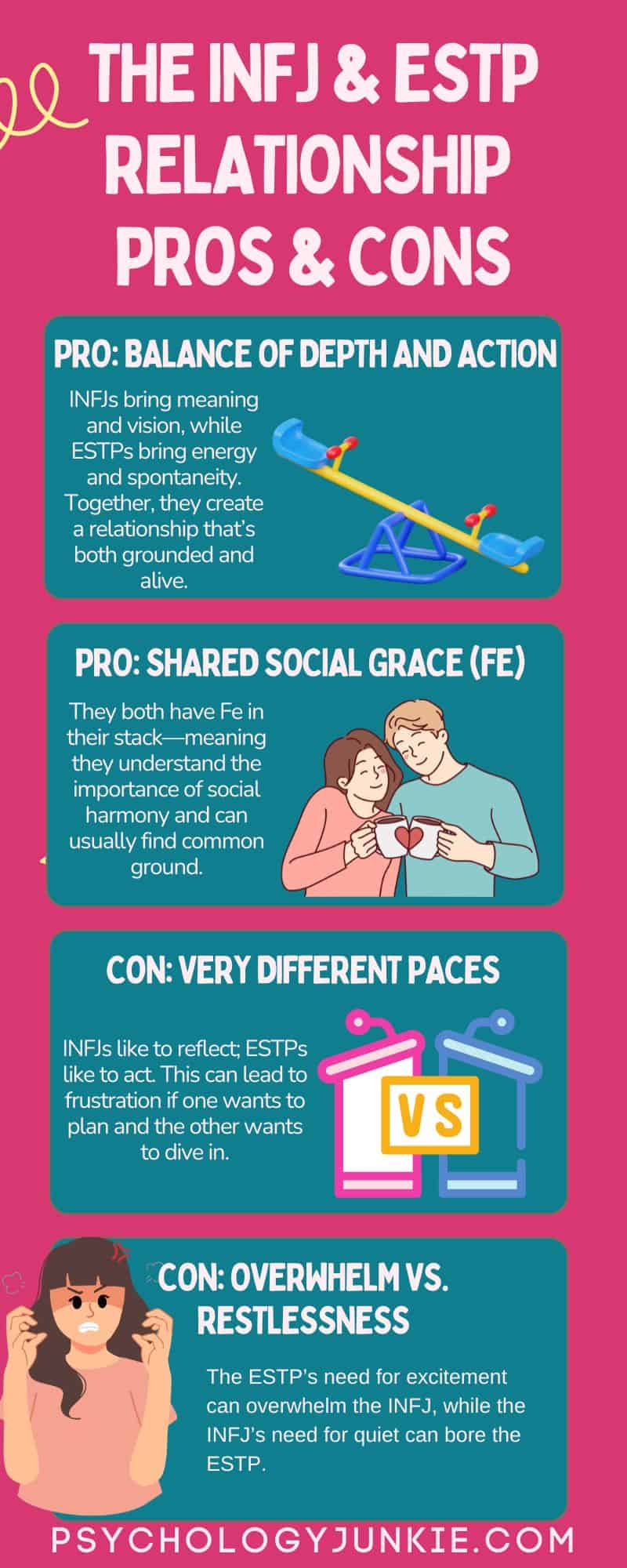
Think of this relationship like a seesaw. The INFJ brings depth and purpose—like, “Here’s what this means,” while the ESTP says, “Cool story. Let’s actually do something about it.” One partner dreams, the other acts. When they trust each other’s strengths, they create a dynamic that’s way more balanced than either of them alone. - They Open Each Other’s Eyes
The INFJ has a tendency to overanalyze, turning life into an endless game of “What’s the meaning of this?” Meanwhile, the ESTP can get caught in the here-and-now and miss the bigger picture. Together, they help each other see what they’ve been missing—like swapping a telescope for a microscope and realizing both have a place in life. - The Chemistry is Off the Charts
It’s true: these two can have a magnetic attraction. The INFJ is drawn to the ESTP’s energy and fearlessness, while the ESTP is fascinated by the INFJ’s insight and mystery. There’s something electric about seeing the world through your opposite’s eyes—and it can keep things feeling fresh, especially at the beginning. - They Challenge Each Other to Grow
INFJs can get stuck in their heads, feeling unsure how to move forward. ESTPs have no problem moving forward—sometimes even without a plan. Put them together, and they challenge each other to stretch beyond their comfort zones. INFJs learn to take more risks, and ESTPs learn to slow down and consider the long game. - They Share a Desire for Connection
Even though they’re different, both types care deeply about their relationships. INFJs want harmony and understanding, while ESTPs want to enjoy the moment with someone they trust. If they can find a shared language (and some patience), they can create a connection that’s grounded and alive.
5 Cons of the Relationship
- They Speak Different Languages
The INFJ might want to talk about meaning and purpose—why we’re here, what it all means—while the ESTP is just trying to figure out what’s for dinner or how to make the weekend more fun. This can lead to a lot of “Wait, what?” moments, where they’re not sure if they’re even in the same conversation. - The INFJ Can Feel Overwhelmed
ESTPs live fast and loud. They’re doers, thrill-seekers, sometimes pushing the INFJ into experiences that feel overstimulating or chaotic. The INFJ, who needs quiet time to recharge and think, can end up feeling like they’re just along for the ride—and not always in a good way. - The ESTP Might Get Restless
On the flip side, the ESTP can get bored or restless if the INFJ spends too much time in their head. Too much talk about feelings or big-picture stuff can feel heavy or slow to them. They might start looking for the next adventure if the relationship feels stuck in place. - Conflicts Can Escalate Fast
When disagreements happen, these two often use very different approaches to resolve them. INFJs want to talk it out, find meaning, and connect emotionally. ESTPs? They want to fix it now—or move on. If they’re not careful, conflicts can feel like speaking two different dialects, with both sides feeling misunderstood. - Inferior Function Clashes
Here’s where it gets tricky: each partner’s weakest function is the other’s strength. The ESTP’s tendency to live in the moment (Se) can feel shallow or reckless to the INFJ, while the INFJ’s long-term focus (Ni) can feel like a buzzkill to the ESTP. When these inferior functions are triggered—like when stress hits—it can feel like they’re pulling each other in completely different directions.
A Shared Language of Fe: The Hidden Bridge
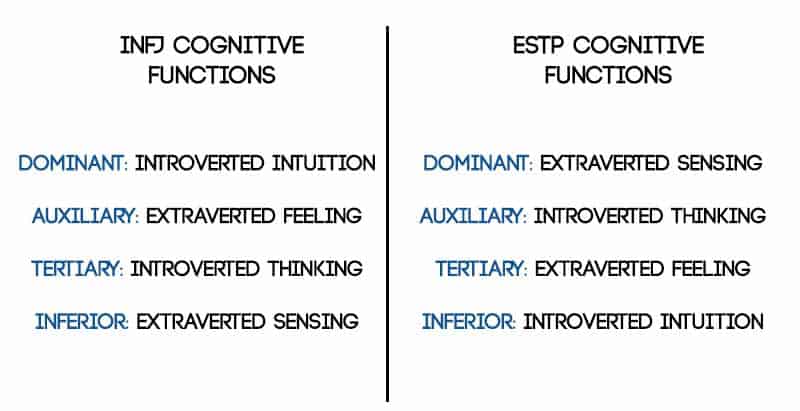
One of the secret superpowers in the INFJ-ESTP relationship is that they both have Extraverted Feeling (Fe) in their function stack. It might not always be obvious, but it’s like a hidden bridge between them—one they both instinctively understand, even when everything else feels upside down.
For the INFJ, Fe is in the auxiliary (second) position. This is the “parent” energy of their personality. It’s how they nurture, connect, and show they care. When an INFJ uses Fe, they’re like the wise parent making sure everyone’s needs are met. They’re tuned in to what people are feeling, ready to offer a warm smile, a kind word, or a gentle hand on your shoulder when you’re down. This is how they show love—by making sure the emotional environment is calm and safe, and that everyone feels understood.
For the ESTP, Fe is in the tertiary (third) position—often called the “child” function. This is how they want to be cared for. ESTPs might not always talk about their feelings, but they light up when someone notices them, includes them, or shows that they matter. They don’t need a long talk about feelings, but they crave warmth, humor, and a sense that they’re part of the team.
This dynamic can feel surprisingly natural between them. The INFJ’s Fe instinctively wants to take care of people—create an emotional bubble where everyone’s okay. The ESTP’s Fe wants to be in that bubble, to feel included, to have someone who sees them and values them, even when they’re off chasing the next big thing.
So even when the INFJ is deep in their head and the ESTP is flying by the seat of their pants, Fe is like the gentle glue that holds them together. It’s the warm laugh they share after an argument, the quiet moment of understanding when they both know they’re still on the same team.
The Ti Connection
If Fe is the bridge of warmth between them, Introverted Thinking (Ti) is the quiet bond of precision and clarity—like a secret handshake they both understand, even if they use it differently.
For the ESTP, Ti sits in the auxiliary (second) position—right behind their bold, action-first Se. Ti is the ESTP’s cool-headed, logic-loving side. It’s the part of them that wants to figure out how things work, sort out the details, and make things run smoother. It’s a bit like the wise parent in the backseat saying, “Hey, let’s think this through for a second.” Even though ESTPs love to live in the moment, their Ti is always working behind the scenes, analyzing and tweaking the situation until it feels just right.
For the INFJ, Ti is the tertiary (third) function—the playful child of their personality. It’s the INFJ’s way of testing ideas and seeing if they hold up, but without the same level of depth or consistency as the ESTP’s Ti. For the INFJ, Ti shows up as little flashes of curiosity—like wanting to understand how something fits together or finding a new theory and wanting to know all the ins and outs of it. But because it’s a child function, INFJs can sometimes feel unsure of their logic, second-guessing themselves if they’re challenged.
This is where the magic happens. ESTPs can gently show INFJs how to play with ideas without getting too bogged down in “what ifs.” They help INFJs trust their own logic, giving them the confidence to say, “You know what? This idea actually does make sense.” Meanwhile, INFJs bring a lighthearted curiosity to the ESTP’s problem-solving—they enjoy testing ideas together or learning just a bit more about how something works that intrigues them.
When they both lean into Ti, there’s a sense of mutual respect—like two people sharing the same puzzle and seeing how their pieces fit together.
Relationship Health Must-Dos
Alright, so you’ve got an INFJ and an ESTP—two people who see the world in completely different ways. How do you make this work without feeling like you’re in a constant tug-of-war? Here are some must-dos to keep your relationship grounded, alive, and growing:
- Respect Each Other’s Tempo
INFJs like to take their time—ponder, reflect, feel things out. ESTPs? They’re ready to jump in and see what happens. If you’re the INFJ, don’t be afraid to let the ESTP set the pace sometimes. If you’re the ESTP, remember that slowing down doesn’t mean stopping—it means giving space for meaning to grow. - Make Room for Recharge
ESTPs might not always get why INFJs need alone time, but it’s non-negotiable. INFJs need quiet to sort through their thoughts and feelings. So let them have it—no guilt trips. And INFJs? Don’t forget that ESTPs recharge by doing—by moving, exploring, and engaging. Let them run wild (a little) without taking it personally. - Communicate Like You’re On the Same Team
You’re going to have misunderstandings—no getting around it. But if you can both remember you’re on the same side, even when you’re at odds, you’ll find your way through. INFJs, speak up when something bothers you—don’t assume the ESTP can read your mind. ESTPs, listen without rushing to fix or dismiss. Sometimes, INFJs just want to be heard. - Use That Shared Fe
You both have Fe in your stack—it’s your secret weapon. Make use of it. Show appreciation, offer small gestures of care, and find ways to bring a little joy to each other’s day. ESTPs, this might mean noticing when your INFJ is feeling off and offering a kind word. INFJs, this might mean making space for the ESTP’s humor and energy, even if you’re feeling more low-key. - Celebrate the Differences
Instead of seeing your differences as a threat, see them as a gift. The INFJ’s insight can give the ESTP a sense of purpose beyond the moment. The ESTP’s action can help the INFJ live more fully in the present. When you can appreciate what the other person brings to the table—rather than wishing they were more like you—you’ll find a lot more harmony and a lot less frustration.
Your Turn—Let’s Hear From You
Alright, so that’s the INFJ-ESTP rollercoaster in a nutshell—part thrill ride, part deep dive, always something new. But let’s be real: no article can capture every nuance of your relationship. That’s where you come in.
Are you an INFJ with an ESTP partner? An ESTP who’s dated an INFJ? Or maybe you’re just curious about what makes these two types click (or clash)? Share your thoughts in the comments below. What’s been your biggest challenge? What’s surprised you the most? What advice would you give to someone in this pairing?
Other Articles You Might Enjoy:
The Weak Spot of Every Myers-Briggs® Personality Type (and How to Strengthen It!)

Get Your Free INFJ eBook

As a thank you for subscribing to my newsletter I will send you this free eBook PACKED with self-care tips, creativity hacks, and more! You'll also get a 3-day email course for understanding your personality type better!







Hi. I just read your article and I can say that it’s extremely on point! I have one dear friend, she’s ESTP. I’m fully aware we have the same way of thinking, but also aware that we’re in fact opposite of each other. I’m struggling to cope with her inabillity to express herself. She’s reserved when it comes to say her ideas/opinions out loud. It stresses me. Despite of her family and children background, I fathom that she’s indeed insensitive – she’s sometimes not aware with her surrounding’s condition. As an INFJ, I must admit she’s by far the only person who knows me deeply and are willing to listen everytime I’m rambling about my thoughts. Are you experiencing the same? How do you deal with it as a fellow INFJ? Thanks in advance!
Hi there, fellow INFJ here,
I get where you’re coming from. My ex is (probably, she hasn’t done a test but as far as I can say from my perspective) an ESTP and her not being able to communicate her thoughts and feelings well was what brought us to break up even tho in other parts we were perfect for each other. Obviously that doesn’t mean that it never works out! I hope your friend will find a way to communicate her feelings, if the go to things like music or art don’t work there are other ways. A friend of mine for example oftens posts a lot on his whatsapp status. He isn’t good at communicating his feelings with his own words but in the quotes, tweets and pictures he posts on his status I can often read how he is feeling and step in to help when needed. I hope you and your friend find a way of communication. Good luck
-N
Hi Susan!
I’m a big fan of your website and value your insight! I’ve studied cognitive functions for the past 7 years now and am constantly hoping to suck up new dregs of information!! The internet has tons of it, but few morsels teach and explain how each function manifests through daily thoughts and actions. So, thank you!
I’m interested to hear more about your perspective on comfort – how our tertiary function is the function we prefer to seek reassurance from. My husband is an ESTP as well and, while I have some questions on how you came to this conclusion on comfort- I recognize that this is absolutely true in my experience! Never noticed that before!
You mentioned:
ESTP’s like to engage with Fe for comfort or with someone who uses Fe as their auxiliary function or “parental role” (IXFJ’s)
Why, for instance, would Bob prefer to engage with Sally, whose 2nd function is Fe, instead of Nancy, whose dominant function is Fe? Would Nancy not be most equipped/experienced at wielding her Fe comforting skills?
Ni Se Fe
Fe Ti Ni
Ti Fe Se
Se Ni Ti
(INFJ vs ESTP vs ENFJ)
Is this simply because Sally’s introverted dominant function softens and steadies what would have been a gush of dominant Fe from Nancy? As a dominant perceiver, Sally would first look through the lense of Intuition to see in what ways it would guide her aux Fe to respond, whereas dominant judger Nancy would not have the filter of perception first?
Thanks again for your thoughts! ☺️
Hi Andrea!
Thanks so much for enjoying the article and for your good questions! I got most of the information on comfort through reading Depth Typology by Mark Hunziker. This book is AMAZING if you want to get far deeper into type dynamics and psychology than most books cover. Each of our cognitive functions has an associated archetype which kind of symbolizes how we use it. The dominant function is the hero, the auxiliary is the mother/father role, the tertiary is the “eternal child”, the inferior is the “anima/animus”, etc,. The mother/father role is instinctively how we comfort others. EXFJs are more likely to comfort using Ni or Si because that role fills the nurturing mother/father role. IXFJS are the ones who have Fe in that position. EXFJs use Fe in a “hero” position, so they are likely to “lead the charge” with this function and although they may us it to nurture from time to time, they are more comfortable nurturing with aux. Ni or Si. I see this in ESFJs in that they comfort by being consistent, practical, and finding concrete acts of service to help others. This is a brief explanation, but I hope this helps!
This makes a lot of sense- I’ve heard of those archetypes, but in different terms. The way you explained it is more meaningful/relevant to human relationships than descriptions like the “car model,” which seems to be prevalent online.
So an Si “child/tertiary” wants the comfort of a “parent/aux” that speaks its language.
Interesting to imagine an intimate relationship with someone who can comfort you in your preferred manner, but also one who is not equally comforted by your parental function, i.e.; ESFJ woman and an ENTP man.
Fe Ne
Si Ti
Ne Si
Ti Fe
It does make me curious to dig up older, dustier questions I’ve had about where Jungians came up with Type Relationships (advisor, pedagogue, cohort, neighbor, anima, enigma, etc. -typelogic.com). I know these pair dynamics are based on where each function is located in a stack comparison, but it sounds like the book you recommended would help with that investigation.
Thanks again! ☺️
Thank God, finally an article that talks about the functions and how they actually are. INFJs are natural soul mates for ESTPs for all the reason that you have given, and these dynamics are spot on in the real world. I am convinced that most things on INFJs just do not ring true (or on all types for that matter), because of the lack of understanding of individual functions in comparison to the I/E, T/F etc. I am an INFJ woman, falling in love with an ESTP man, and do not understand why, even though all my instincts say that it is the case.When one is a functional opposite, it is interesting how the detriment function is engaged and stimulated by the other’s dominant, and it can be scary, making one uncomfortable with aspects of themselves that have been suppressed and under developed.But these are the most trying, testing, making and breaking relationships, and they really grow an individual, even if it does not work out in the end. On a personal note, I really like your article. Yours, Evi.
Alexander Avila thinks also that ESTP male is one of the best partner for INFJ female with INFJ INFP and INTP.
This man take in account the genre.
this just helped me get a lot of inside into my possible future (fellow INFJ here), thank you. Now I know why I tend to be attracted to ESTPs
Thank you so much for the article.(Fellow INFJ) A friend forwarded it to me when I told her about my relationship issues. This helped me understand what is actually going on and being an opposite is not a bad thing and when I think about it that it can really be a good thing. I was always doubtful of myself (maybe I’m surrounded with too many ESTPs on a daily basis) but I realise that my input is actually valid for all the good reasons as much as theirs are. I need to keep an open mind. Thank you so much.
ESTP here.
Interesting read indeed. Now I know why I feel like INFJS understand me, and I them.
Recently I’ve spent a lot of time with an INFJ, and we just got along so well.
I’m an infj. I had an estp friend before. I can’t relate to this article at all! We could never get along. Most of the time she was trying to manipulate me or my other friends. She would easily ditch her friends if they stood in her way to get what she wanted. She even cheated on some of her friends with their boyfriends. At the same time she was upset that she could never stay friends with someone for a long time. I also knew another female estp. She cheated with her friends’ boyfriends too. I don’t believe every estp is disloyal or manipulative but i don’t think i’d fall in love with an estp.
Yikes! Those are some really terrible experiences! I can imagine you’d have trust issues with ESTPs after all that. Some people, regardless of their type, just turn out to be jerks. I’ve known some wonderful ESTPs and some not-so-great ones. I’m sorry that you’ve had bad experiences with them!
Hi, Susan thanks for the writeup. Mine is a different story. I am an infj married to an estp for 22 horrible years, from where I came from, divorce is not all that accepted. He is so manipulative for my liking. I wallowed in sorrow all these years,my only comfort is my children. I would like to know how you manage to get along. Please I need to know,maybe there’s still a chance to happiness.
I’m an INFJ and my husband Is an ESTP. This article describes us perfectly. I emailed it to him and titled it: The Story of Us. We have been married for 32 years.
I’ve been with my ESTP for 8 years and I’m so happy that I seen this! I always thought we were the exact opposite but after seeing how you compared the functions it makes sense now. It’s like we balance each other out perfectly. Thank you!
“Keep in mind: Most people who type as INFJ from online tests are actually INFPs or ISFPs, so these particular pros and cons may be very different if you’re dealing with mistypes.” Okay, may I ask what’s the evidence behind this statement?
Good question. I’ll probably go in and re-write this to make sure it’s clear that this is my own experience as an MBTI practitioner, as well as the experience of every other type profiler or MBTI practitioner that I know. Most people at the moment are getting their type results from a web site called 16 Personalities. The questionnaire is highly inaccurate and tends to skew intuitive for everyone. When I’ve worked with individuals who want help finding their type, most started at a site like 16 personalities, then realized things weren’t fitting for them, then they took the official MBTI questionnaire or worked with a profiler and found out they had a different type. In many cases, people who got an INFJ result in an online questionnaire wound up being ISFPs or INFJs.
ESTP female here – met INFJ male on a 4 day trip to Rio de Janeiro Sept 1992. Instant DEEP CONNECTION. Together 33 years. He passed Nov 2025 – and I immediately thought: WTH have I been DOING the past 33 years? I had to do a deep dive into personalities (I had no idea about MBTI previous to his death) – we were both in our early 30s when we met and had both spent approx 7 years in long-term relationships that we knew weren’t ‘right’ for us. We balanced out each other perfectly. I’m the risk=taker. He knew this and he ‘protected’ me from going too far ‘out on the ‘ledge.’ It’s taken me 8 months to calm my brain down to be ‘reasonable’ – 33 year roller coaster ride is difficult to ‘unwind’ in just a few months. Our relationship was not always ‘easy’ but I admit, it was so fabulous. I think being more mature helped a lot. Also having a long-distance relationship (me in AZ, him in Rio) for the first 2 years helped solidify our fates. Miss his intelligence, quiet gentlemanly, witty, sarcastic personality every day. Amor de mi vida.