
18 Ways Tertiary Ne Shows Up for ESFJs (Some Might Surprise You!)
If you know an ESFJ, you probably know what it feels like to be cared for. These are the people who remember your birthday, bring you soup when you’re sick, and notice when you’re a little quieter than usual. They’re often described as “the glue” of families, classrooms, and communities, the ones who hold people together with warmth, loyalty, and a powerful awareness of what others need.
At their best, ESFJs are practical nurturers. My mother-in-law is an ESFJ and I see this with her every time we visit! She’s always got a hot meal ready and waiting and makes sure I have a cool glass of water as well. She’s constantly scanning for practical needs that may not be met and making sure those are taken care of. As a midwife, she loved taking care of women’s and infant’s needs, monitoring their well-being, and providing comfort and emotional support.

For ESFJs, it’s not enough to dream about helping people, they do it—organizing meals, giving encouragement, showing up in times of crisis, and creating traditions that make life feel stable. I’ve had ESFJ clients tell me things like, “I can’t relax unless I know everyone else is okay first.” That deep alignment with others is part of their superpower.
But every gift has a shadow. Sometimes ESFJs overextend themselves, pouring so much energy into others that they neglect their own needs. Their desire to maintain harmony can make them avoid conflict until resentment builds. And when their balance slips, they can swing between being the ultimate party host and being weighed down by insecurity or self-doubt.
Still, there’s a reason ESFJs are often beloved by their communities. They embody a paradox: they are grounded and dependable, but also fun-loving and playful. They can make you feel safe and cared for, while also lighting up the room with humor or generosity. That paradox has everything to do with their cognitive function stack—and in some cases, the quirky, childlike influence of their tertiary function: Extraverted Intuition (Ne).
Not sure what your personality type is? Take our personality questionnaire here. Or you can take the official MBTI® here.
The ESFJ Function Stack (For Beginners)
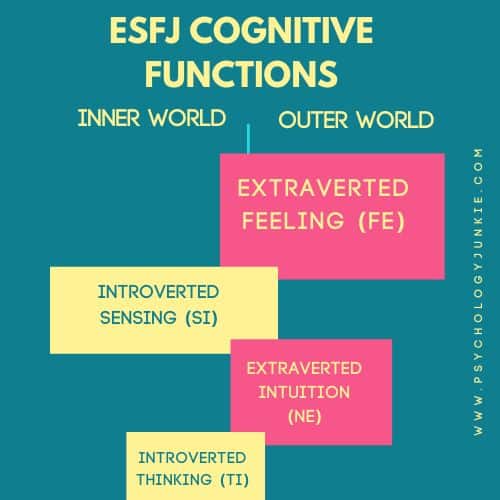
If you’re new to type theory, don’t worry! You don’t need a psychology degree to understand how ESFJs work. Personality typology describes each type as having a “stack” of mental preferences, kind of like a set of tools they naturally reach for.
Here’s the ESFJ’s toolkit:
- Dominant Function: Extraverted Feeling (Fe)
This is the captain of the ESFJ ship. Fe is all about harmony, connection, and responsiveness to others’ emotions. It makes ESFJs tuned in, conscientious, and on the radar of every emotional fluctuation in the room. It also gives them a preference for shared values and an awareness of social customs and tact. - Auxiliary Function: Introverted Sensing (Si)
This is the steady co-pilot. Si grounds ESFJs in tradition, routine, and responsibility. It helps them remember details, honor rituals, and bring consistency to their caregiving. - Tertiary Function: Extraverted Intuition (Ne)
Here’s where things get colorful. Ne is the playful, childlike passenger in the backseat, tossing out new ideas, exaggerating stories, and chasing possibilities. At its best, it gives ESFJs flexibility, humor, and imagination. At its worst, it can spiral into drama, suspicion, or scattered thinking. - Inferior Function: Introverted Thinking (Ti)
Ti is the quiet critic stowed away in the trunk. It cares about logic, precision, and truth. For ESFJs, it’s often underused, but when tapped, it helps them pause, analyze, and make decisions with more balance.
In other words, ESFJs live most of their lives through a combination of Fe and Si—caring for people and creating reliable structure. But every now and then, their tertiary Ne bursts out like an eternal child, bringing play, imagination, and sometimes chaos. That’s where the fun (and frustration) really begins.
Zeroing in on the Tertiary Function – Extraverted Intuition (Ne)
Now let’s talk about the real star of this article: the tertiary function. For ESFJs, that’s Extraverted Intuition (Ne).
Psychologist John Beebe called the tertiary function the “Eternal Child” (Puer Aeternus/Puella Aeterna). He described it as “the brilliant but volatile side of ourselves that is by turns the seemingly immortal Prince or Princess and the helplessly vulnerable wounded boy or girl.” In other words, the tertiary function brings a childlike spark into the personality; playful, carefree, imaginative, and fun. But it can also be moody, overly sensitive, and defensive when threatened.
If an ESFJ brainstorms some creative ideas and you shut them down or act condescending, just watch that wounded child show up. Actually don’t do that, because it’s generally mean to act that way. But ESFJs reading this, you’ll know what I mean! When you bring out that Extraverted Intuition, it can feel exciting, but it can also feel devastating when people dismiss you for it.
For ESFJs, Ne shows up as bursts of possibility and excitement. It’s the energy that makes them playful storytellers, enthusiastic idea-generators, and spontaneous party planners. Ne loves to make connections between things, imagine new adventures, and lighten the mood when life feels too serious. When it’s working well, ESFJs come across as flexible, fun-loving, and full of life.
But Ne is also vulnerable. When ESFJs feel insecure, stressed, or stuck, Ne can flip into its wounded-child mode. Instead of playful imagination, it starts spinning out worst-case scenarios. Instead of open-mindedness, it creates drama or suspicion. This is especially true when ESFJs fall into what’s known as the Fe–Ne loop—when they lean on their dominant Fe and tertiary Ne while neglecting their grounding auxiliary Si. In this loop, they can lose touch with stability and fall into a cycle of chasing excitement, projecting blame, or creating chaos to distract themselves from deeper insecurities.
I’ve had ESFJ clients tell me things like, “I get restless when everything feels too routine. Sometimes I stir up drama without realizing it, just so something is happening.” Another admitted, “When I’m insecure, I imagine the worst about people’s motives, feeling like everyone is against me.” That’s Ne acting out as the eternal child, swinging between carefree fun and anxious overreaction.
But here’s the hopeful part: when ESFJs integrate their Ne with balance and care, it becomes a source of creativity, flexibility, and resilience. It helps them see possibilities beyond their routines, embrace new ideas, and imagine brighter futures for themselves and the people they care about. When paired with their steady Si, Ne transforms from a mischievous child into a spark of inspiration that helps them grow.
18 Ways Tertiary Ne Shows Up in ESFJs
The Playful, Creative Side
- Spontaneous Adventures
An ESFJ friend might suddenly say, “Let’s drive to the beach right now!” and pack snacks before anyone can object. Ne injects novelty into their otherwise steady routines. - Colorful Storytelling
When ESFJs tell a story, Ne adds color. One of my clients joked that her stories “grow wings,” turning a minor hiccup into a hilarious tale with unexpected twists. - Connecting People with Ideas
Ne loves to link things together. ESFJs often play matchmaker; introducing friends who share quirky interests or sparking conversations where unexpected connections blossom. - Playful Humor
ESFJs can be masters of silly jokes, wild exaggerations, or witty what-ifs. Ne gives their humor a lighthearted, imaginative spark. - Novelty Traditions
While Si grounds them in familiar rituals, Ne enjoys tweaking them. I worked with an ESFJ who started “Waffle Wednesday” in her office, delighting everyone with both comfort food (Si) and a playful spin (Ne). - Optimistic Brainstorming
When balanced, Ne helps ESFJs think outside the box. One client loved using brainstorming games to find creative solutions for her volunteer group, saying, “It’s like ideas just pop like fireworks once we get going.” - Artistic Bursts
Ne may inspire sudden dives into painting, photography, or creative writing. Even if the ESFJ doesn’t consider themselves “artistic,” they can surprise themselves with moments of playful creativity. - Lightening the Mood
If a gathering feels too serious, ESFJs may toss in an unexpected idea or suggestion to make things lively again. Ne gives them a sense of when to sprinkle in humor or excitement. - Open-Minded Flexibility
When well-developed, Ne helps ESFJs be more adaptable. Instead of clinging to “the way it’s always been done,” they become curious and willing to explore new possibilities. - Creative Hosting – When planning events, Ne helps them dream up playful themes, decorations, or games that make gatherings memorable.
- Imaginative Gift-Giving – ESFJs are experts at brainstorming quirky, meaningful presents that connect unexpected dots (like giving a friend tea that reminds them of a trip they once took together).
The Vulnerable, Wounded Side (Fe–Ne Loop)
- Jumping to Conclusions
Ne can run ahead too quickly, making ESFJs assume motives without evidence. One client told me, “If someone cancels plans, my brain builds a story that they secretly dislike me.” - Drama for Excitement
When routines feel stale, Ne can stir the pot. ESFJs may unintentionally create drama just to feel a buzz of new energy. - Over-Explaining Choices
Ne can make ESFJs second-guess themselves, so they pile on too many “what ifs” when justifying a decision to others. - Manipulating Information
In wounded mode, Ne can exaggerate or twist information to justify conclusions. It’s less about lying and more about unconsciously “bending” reality to fit their fear. - Chasing “Shiny Object” Relationships
They may get temporarily fascinated by new friendships or social circles, only to realize the connections are shallow or unstable. - Mental Whirlwinds
At night, Ne can bombard them with racing thoughts and possibilities, making it hard to sleep or focus. - Repeating Mistakes
When ESFJs don’t slow down with Si reflection, Ne can push them into repeating the same errors. One client laughed (and winced) as she admitted, “I date the same type of guy over and over again, different names, same drama.”
Balancing Ne with Si
For ESFJs, the sweet spot comes when Extraverted Intuition (Ne) and Introverted Sensing (Si) work together like willing dance partners. On their own, each can cause trouble: Si clings too tightly to “the way it’s always been,” while Ne runs wild chasing excitement or imagining disasters. But when they’re balanced, they create a harmony of stability and possibility.
Think of Si as the reliable anchor and Ne as the colorful kite. Too much anchor, and the kite never lifts off. Too much kite, and it flies off untethered. But together, they create a dance between grounded traditions and fresh imagination.
I once worked with an ESFJ client who admitted, “I get stuck doing things the same way every year, and then I feel restless and bored. But when I try something new, I sometimes make a mess of it.” What helped her was learning to bring Ne and Si into conversation: honoring traditions (like her annual holiday dinner) while letting Ne add playful twists (new recipes, creative themes, or unexpected surprises). Suddenly, the routine felt both safe and exciting.
Here are some simple ways ESFJs can let Si and Ne support each other:
- Pair the Old with the New. Keep comforting traditions, but add small twists. Example: watch the same holiday movie (Si) but serve a new, silly themed snack (Ne).
- Ask Two Questions. When facing a decision, try: “What worked before?” (Si) and “What new possibilities exist?” (Ne). Balancing both helps you avoid repeating mistakes while staying open-minded.
- Let Ne Refresh Si. Instead of feeling trapped in routines, allow Ne to bring variety. For instance, keep your exercise habit (Si) but try rotating the setting—park, beach, living room dance party (Ne).
- Let Si Ground Ne. If Ne is spinning out wild “what ifs,” Si can ask: “What do I actually know from experience?” This grounds fears and reins in exaggeration.
When Si and Ne work together, ESFJs move from rigidity or chaos into a balanced rhythm. They become not only the caretakers of traditions and harmony, but also imaginative creators who bring freshness and play to every community they touch.
Adding a Dash of Ni
John Beebe believed that the “Eternal Child” (Ne, for ESFJs) gains resilience when its opposite-attitude sibling—the Trickster (Ni)—is brought into awareness. Ni can feel slippery or confusing for ESFJs, because it’s not part of their conscious strengths. It’s “shadowy,” and feels more out of reach or hard to wield. Where Ne throws out a flurry of possibilities, Ni narrows them down into a focused vision. Where Ne says, “What if we tried this, and this, and this?” Ni strategizes, “But what is the deeper meaning here? What direction is this pointing toward?”
For ESFJs, dipping into Ni can help balance and improve Ne. Instead of chasing dozens of potential scenarios, Ni helps them pause and consider long-term themes or symbolic insights. I had one ESFJ client say, “When I force myself to ask, ‘What’s the big picture here?’ it slows me down. I don’t get lost so much into every little possibility.” That’s Ni at work—providing an anchor for Ne’s restless scatter by asking for focus.
Here are a few gentle, non-overwhelming ways ESFJs can integrate Ni into their lives:
- Journal Big-Picture Reflections. After a busy day of bouncing between people and tasks, pause to ask: “What is the larger pattern here? What’s the lesson life is trying to teach me right now?”
- Practice “Theme-Spotting.” When Ne wants to chase every idea, Ni invites you to look for the underlying thread. For example: instead of worrying about every possible way an event could go wrong, ask: “What’s the overall purpose of this event? What do I want people to feel when it’s over?”
- Meditation & Stillness. Ni grows when you create space for quiet reflection. Even five minutes of sitting with your thoughts, without distraction, can help the bigger picture come into focus.
- Symbol & Story Work. Ni often speaks in metaphors. Writing down dreams, noticing recurring images, or reflecting on stories that resonate can help ESFJs develop more comfort with this function.
By adding just a dash of Ni, ESFJs give their Ne a helpful counterbalance. Instead of scattering energy in all directions, they learn to channel their imagination into meaningful paths. Ne remains playful and creative, but Ni helps tether that play to vision and purpose. Just be aware that Trickster Ni can feel overwhelming when you’re stressed or tired. During those moments it may make you feel gloomy about the future or stuck in an inevitability you don’t want to face. So make sure you have a good bandwidth of energy before trying to tap into it!
Loving the Eternal Child in ESFJs
Tertiary Ne may not be the loudest function in the ESFJ stack, but it’s one of the most colorful. It’s the youthful side; the spark that brings laughter to the dinner table, surprise twists to old traditions, and a sense of adventure to everyday life. Without it, ESFJs might become too rigid, too bound by “the way things have always been.” With it, they stay lighthearted, creative, and open to fresh possibilities.
Of course, the eternal child also has a tender side. It can stir up unnecessary drama, leap to conclusions, or imagine the worst when insecurities creep in. That doesn’t mean something is broken, it simply means this part of the ESFJ needs compassion, balance, and guidance. When Ne is paired with Si’s steady grounding and Ni’s quiet big-picture focus, it becomes less chaotic and more inspired.
I’ve seen this again and again in coaching: ESFJs who once felt restless or stuck in loops of “what if” discover that their imagination is actually a gift. One client told me, “When I learned to ground myself with routines but also leave space for play, I felt like I could finally breathe.” I loved hearing this example and really enjoy seeing the many ways tertiary Ne shows up for ESFJs and makes them far more creative, humorous, and innovative than most stereotypes would imply!
At the end of the day, your Ne isn’t here to sabotage you. It’s here to remind you that life is more than duty and tradition. It’s possibility, play, connection, and wonder. And when you learn to balance that childlike energy with your grounded wisdom, you become a bringer of joy, imagination, and hope.
🌟 Curious about your own type journey? 🌟

Reading about tertiary Ne might have stirred up some recognition, or maybe even some questions. Every person’s type shows up in unique and personal ways, and sometimes it takes an outside perspective to really see the patterns.
If you’d like to dig deeper into how your functions work (and how to grow with them, not against them), I’d love to help. In a one-on-one session, we’ll explore your personality type, your function stack, and the challenges or “loops” you might find yourself in. Together, we can uncover the strengths you may be overlooking and the growth paths that will bring you balance.
✨ Book a type clarification session with me here.