
The Myers-Briggs® Personality Type of Jimin: A Mind That Seeks Harmony
Park Ji-min is someone who has always drawn my curiosity. On one hand, he’s expressive and warm, often seen as the charmer of the Korean K-pop group, BTS. On the other hand, I can always see something simmering under the surface. Emotional depth, uncertainty, and a certain vulnerability that makes him even more endearing than your everyday superstar.
I’ve watched hundreds of hours of BTS interviews over the last several months, and Jimin seems like the kind of person who listens closely, who reacts quickly to other people’s moods, who makes small adjustments in tone or expression that signal, “I see you.” It’s easy to understand why people feel drawn to him. He has an innate gentleness, mixed with a kind of careful awareness that makes interactions feel personal, even in a crowd.

Today I want to dive into my theory about his personality type. But before we get into that…
A Disclaimer:
As an MBTI® practitioner I’ve spent over eleven years working with people who have complex personalities and are struggling to find their type. That said, I have never profiled Park Ji-min so take my analysis here with a grain of salt. I’ve analyzed countless interviews and articles, but with celebrities it’s hard to know how free they are really allowed to be in expressing themselves. I would absolutely love to profile Jimin, but at this point that’s not a possibility. But I always want to say that nobody knows him better than he knows himself. All I can do is try to gauge what’s likely based on publicly available information.
The Case for ENFJ: A Life Oriented Around Others
If you’re trying to understand Jimin through a personality lens, you have to start with where his attention naturally goes. Some people move through the world anchored in their own internal reactions first. Others are constantly scanning the emotional environment, adjusting, responding, shaping themselves in real time. Jimin falls very clearly into that second category, and that’s where the case for ENFJ begins to hold real weight.
Jimin tracks people’s moods, their struggles, the subtle shifts in energy that most people miss entirely. And more than that, he cares about what he sees in a way that feels active rather than passive.
He’s said:
“One thing I’m always curious about, about our fans, is what’s the hardest thing in their lives. What each of them is struggling with, what’s making them happy—I’m really curious to know.”
In this statement, he’s orienting outward, toward other people’s experiences, almost instinctively. His focus lands on them first. That’s a common quality of Extraverted Feeling, the cognitive function at the core of the ENFJ personality.
You see it again in the way he frames his purpose:
“I just hope my emotions come across. I just want the emotions I put into my dancing, actions, and singing to be felt.”
This isn’t about self-expression in the abstract, like “this is what I feel and I want to share it.” It’s more relational than that. It’s about transmission. He feels something, and then he actively works to make sure you feel it too. That extra step is the difference between expressing emotion and bridging emotion. Even the way he approaches his work reflects this outward orientation:
“If you’re exhausted mentally and physically, the work becomes a chore, and then your relationships will inevitably suffer. That’s what I was afraid of.”
Notice what he centers on. Not just the work itself, but the relationships that might be impacted by it. For someone wired this way, connection isn’t a side effect of success. It’s the point.
“Remember there is a person here in Korea, in the city of Seoul, who understands you.”
But there’s another layer here that adds nuance, and it matters if you want to understand the full picture.
The Hidden Cost of Extraverted Feeling and Enneagram 3 Combination: When Self-Worth Depends on Others
That same outward focus that allows Jimin to connect so deeply also creates a vulnerability that’s harder to see at first glance. When your sense of direction comes from other people’s reactions, approval can feel stabilizing and criticism can feel destabilizing in a way that goes beyond the surface.
Jimin has been unusually honest about this:
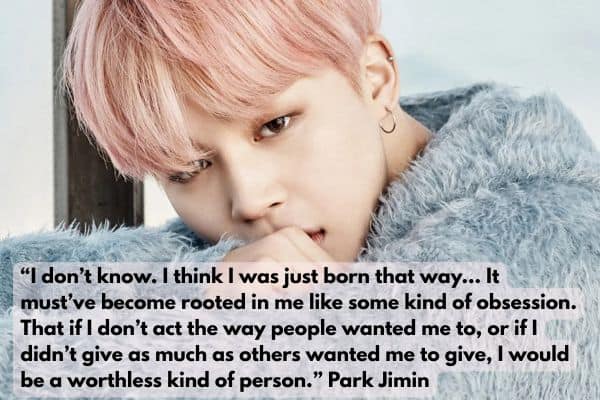
“I don’t know. I think I was just born that way… It must’ve become rooted in me like some kind of obsession. That if I don’t act the way people wanted me to, or if I didn’t give as much as others wanted me to give, I would be a worthless kind of person.”
This quote describes a mindset where worth isn’t something you have. It’s something you maintain, something that depends on staying aligned with what others expect from you. That creates a lot of pressure.
Fellow BTS member RM said, “Jimin works very hard. He always wants to do better.”
You can see how that pressure shows up in Jimin’s behavior over time. He’s taken to extreme dieting in the past; only eating one meal over a ten day period. He’s been self critical about his round face, seeing it as “chubby” rather than something to appreciate. He’s willing to push his body past healthy limits, at one point working on choreography 16 hours a day. He would sleep in the dance room so that he could force himself to practice “just one more time.” On the surface, it looks like discipline, and to be fair, there is real discipline there. But underneath that is a sense that he has to keep improving in order to remain acceptable.
He’s also said:
“I had given up a perfectly good life… I wanted desperately to find the reason why I was in this scene… Which was why I tried to make one more person like me, to show one more person how much better I was doing.”
This validation-seeking is where the Enneagram adds an important layer of understanding.
Jimin fits very strongly with Enneagram Type 3, often called “The Achiever,” likely with a 2 wing. Type 3s are driven by a need to be seen as valuable, successful, or worthy in the eyes of others. Their underlying fear is that they are worthless without success. The 2 wing adds warmth, charm, and a desire to be liked or loved, which amplifies that relational focus.
In practical terms, this means:
- He doesn’t just want to succeed. He wants his success to mean something to others.
- He doesn’t just want to be good. He wants to be recognized as good.
- And when that recognition feels shaky, the response is often to work harder, refine more, and push further.
You can hear that dynamic in his words:
“I want to grow further and faster so I can show them a really great performance… I’ll do better real soon.”
There’s a forward momentum there that never quite settles. A sense that where he is right now isn’t enough, but where he could be might be.
At the same time, there’s an emotional cost to living this way. ENFJ Threes can easily lose track of what they actually feel or want outside of that feedback loop. Jimin has described this in quieter moments:
“I used to be really unstable. I was acting like I was well-grounded when I was around other people… I worried about others by saying things like, I’m fine, but how are you?”
That’s a familiar pattern for strong Fe users, especially when paired with a Type 3 structure. You learn how to present stability. You learn how to take care of others. You learn how to keep things running smoothly. Meanwhile, your own internal state becomes something you deal with later, if you get around to it. Sometimes “later” turns into isolation. Those moments are important because they show the other side of the personality. The part that isn’t performing, isn’t adapting, isn’t trying to meet expectations. The part that’s left alone with all the pressure that’s been building.
When you look at Jimin through both lenses, Myers-Briggs® and Enneagram, the picture becomes more complete. His warmth, empathy, and responsiveness point strongly toward an ENFJ pattern, someone whose attention is naturally drawn to others and who feels a deep sense of responsibility for emotional connection. His drive, perfectionism, and sensitivity to public perception align closely with Enneagram 3w2, adding intensity and a constant push toward improvement.
Put those together, and you get someone who can create powerful emotional experiences for others while carrying a heavy internal standard for himself. Someone who can make people feel seen while still figuring out how to fully see himself.
During one performance, Jimin had a sore throat and was struggling to sing. When his voice cracked during a song, back stage he broke down and said “It’s ruined.” He later stated, when referring to that situation,“Others could say that it’s not a big deal, but that one thing makes me feel guilty, and I get so stressed out about that one thing.”
Early in his career, Jimin stated that he lacked talent, which was clearly not the case. However, he’s notoriously hard on himself. At one point he stated,“The reasons why I’ve had a hard time these days is that I can’t do well. As hard as I try I can’t do it well. Honestly, these days, the amount of effort I put in and the time that I’ve invested to show a better version of myself, is not much compared to before, and I regret that and think I should change.”
Signs of Introverted Intuition: The Quiet Vision Beneath the Performance

If you’re going to make the case for Jimin as an ENFJ, you can’t stop at Extraverted Feeling. That only explains the outward warmth, the responsiveness, the emotional connection. The second piece of the puzzle is Introverted Intuition, and this is where things get more subtle and easier to miss if you’re only watching the surface.
Because Introverted Intuition doesn’t show up externally as much as it’s felt internally.
It shows up in patterns. In the way someone thinks about time. In how they orient themselves toward a future version of who they’re trying to become.
And with Jimin, that thread is there. You just have to look for it. You can see it in how he approaches performance, especially in this line:
“I usually already have the big picture set in my mind when I sing…”
That phrase, “big picture,” gets thrown around a lot, but here it’s doing something specific. He’s holding an internal vision of what the performance should feel like as a whole, and then adjusting himself to match that vision.
He does this also in the way he sculpts his body. He’s admitted that he often has a vision of how he wants to appear aesthetically for a certain song, and he’ll work tirelessly to create that aesthetic physically.
I’ve worked with a lot of Ni users over the years, and this is one of those tells that shows up again and again. They move in alignment with something internal that’s often hard to explain in concrete terms. It’s less “I’ll try this and see what happens” and more “I already know the direction, now I need to get there.”
“Never give up on a dream that you’ve been chasing almost your whole life.”
Another subtle indicator is how he handles growth. Some people approach growth like experimentation. They try a bunch of things, pivot quickly, follow whatever feels interesting in the moment. That’s more exploratory, more open-ended.
Jimin has described himself differently:
“Trying out different things is great, but I am more of a type who works on one thing for a longer period of time.”
That kind of focus suggests narrowing rather than expanding. Instead of chasing multiple possibilities, he locks onto something and refines it until it aligns with his internal standard. Ni tends to work that way. It reduces complexity into a single direction and then commits.
In one interview I watched with Jimin he spoke of how he’d create a goal and always get it. There was no “maybe this will happen,” he would make sure it happened. Often through tireless work and commitment.
There’s also a future-oriented concern that shows up in how he talks about others, especially during uncertain times. During the pandemic he stated,
“Kids don’t have a lot of options right now to do the things they want to do. I imagine a lot of kids see this as something that’s being forced upon them by adults, so I hope the grown-ups will properly explain the situation to the kids so they can help each other too, to end the pandemic.”
There’s a projection happening, an attempt to understand how current circumstances will shape people’s experiences over time. Ni often pairs with Fe like this, creating a kind of forward-looking empathy that isn’t just about how people feel now, but how they will feel if things continue in a certain direction.
At the same time, Ni isn’t always comfortable.
“No matter how hard it is right now, think of how the result will make you feel.”
When it turns inward without grounding, it can spiral. It can fixate on possibilities that feel overwhelming or inescapable. Jimin has hinted at this kind of experience as well, describing moments where his thoughts go deeper and deeper, like being pulled into something he can’t easily step out of.
That’s the shadow side of Ni. The same function that helps you see patterns and direction can also trap you in them when things feel uncertain or unstable.
So while his outward presence is expressive and relational, there’s a quieter process underneath it all. A sense of direction he’s trying to follow. A version of himself he’s moving toward. A tendency to compress experiences into meaning rather than just letting them pass.Bottom of Form
The Tertiary Se: Where He Comes Alive (and Sometimes Escapes)
If Extraverted Feeling explains how Jimin connects with people, and Ni explains the clear vision he’s moving toward, then Extraverted Sensing is where everything suddenly becomes real. This is the part of him that steps out of his head and into his body. The part that stops analyzing, stops adjusting, stops trying to become something… and just is.
You can see it most clearly when he dances. He’s described it like this:
“It was my own space where I could go to a different world… I didn’t have to think about other things… it made me feel really free.”
For someone who spends a lot of time thinking about how they’re coming across, how they’re being received, what they should be doing next, that kind of freedom isn’t automatic. It’s something they fall into when the conditions are right. And for Jimin, those conditions are physical, immediate, and sensory.
Movement. Music. Presence.
Tertiary Se often shows up as a kind of relief valve. It’s not the main way someone navigates life, but it becomes a place they go to reset. A way to reconnect with the moment when everything else starts to feel too heavy or too abstract.
I’ve seen this with a lot of ENFJ clients. They’ll spend most of their time in their heads or in other people’s emotions, tracking, adjusting, planning, envisioning… and then they’ll find something that pulls them back into their body. For some it’s exercise. For others it’s music, cooking, even something as simple as going for a walk and noticing the environment again.
For Jimin, it’s immersive performance. It’s the version where the music takes over and the thinking quiets down.
There’s also a sensual quality to how he performs that points in this direction. The way he uses his body to express emotion isn’t stiff or overly controlled. It’s fluid, responsive, and instinctive. He adjusts to the moment, to the energy, to the feeling he’s trying to convey, and it creates something that feels alive rather than calculated. That’s Se working in tandem with everything else.
It takes the internal vision from Ni and gives it form. It takes the emotional awareness from Fe and makes it visible. It’s the bridge between what he feels and what you experience. However, at the same time, because it’s tertiary, it’s not always stable.
Sometimes it shows up as indulgence or escape. Moments where he leans into the present to get a break from the constant pressure of self-improvement and emotional awareness. That can look like enjoying the moment a little more intensely, letting go of control, even just relaxing into experiences that don’t require him to be “on” in the same way.
In “Like Crazy,” he sings:
“I’d rather be lost in the lights
Lost in the lights
I’m outta my mind
Can you help me numb the pain?”
While that reads like poetic imagery, when you pair it with the other lyrics and his own statements you can see that it’s a statement of deep overwhelm.
When someone spends most of their life:
- managing how they’re perceived
- refining themselves
- tracking others’ expectations
- pushing toward a future ideal
…it creates a kind of internal pressure that doesn’t always have an outlet, and eventually, something in them just wants it to stop.
When the Mind Won’t Shut Off: Drinking, Escape, and Tertiary Se
There’s a thread running through Jimin’s lyrics that feels very different from his public warmth. It’s a little darker and more vulnerable. You can hear it clearly in these lines:
“I’m drunk and asleep
I can’t remember when
I’ve been thinking about what I’m doing…
I’m pretending to be okay every time
I’m so pathetic.”
and
“This cold and lonely night
Without thinking
I walk in my dark room alone…
I feel like I’m losing myself slowly.”
and
“Tonight, I don’t wanna be sober (Sober)
Pour it up, it’s all f*cking over
What stands out isn’t just sadness. It’s the loop. ENFJs when they’re overburdened can loop between trying to meet others’ expectations and drifting into sensory impulsivity and indulgence when it all gets to be too much. This seems to be a pattern in Jimin’s past, although I don’t think it continues to be an ongoing pattern. In an interview with Suga he described this as something of a past experience that he’d overcome.
Tertiary Se, when it’s healthy, helps someone:
- be present
- enjoy the moment
- connect with their body and environment
When it’s overwhelmed or used as an escape, it can look like:
- chasing intensity
- numbing out
- trying to shut off the mind through sensation
Drinking fits right into that pattern.
It slows things down.
Blurs the edges.
Turns off the constant analysis, even if only temporarily.
The Loop: When Ni and Fe Turn Inward
When you look at this through a personality lens, it lines up closely with what happens when someone with strong Fe and Ni gets overwhelmed.
- Fe is tracking people, expectations, emotional dynamics
- Ni is trying to make sense of everything, building a bigger picture
When those two are healthy, you get empathy, insight, direction.
When they’re overloaded, you get rumination.
You start asking:
- Why is it only me?
- What am I doing wrong?
- Why can’t I get this right?
As friendly as Jimin is, he’s often stated that he has no friends outside of BTS and that he deeply craves regular relationships and friendships.
“I felt so overwhelmed that I went to my parents and cried before. It was a moment when I felt incredibly lonely. I said ‘mother, I don’t have any friends.’ I felt like I was in that situation where I constantly had to give something in order to have friends around me. I felt like people weren’t looking at me as myself, but as a celebrity. I thought, “Why doesn’t anyone see me as a human Park Jimin, not a celebrity?” So I wished for friends with whom I could discuss more ordinary questions. I wished for friends with whom I could have such conversations.”
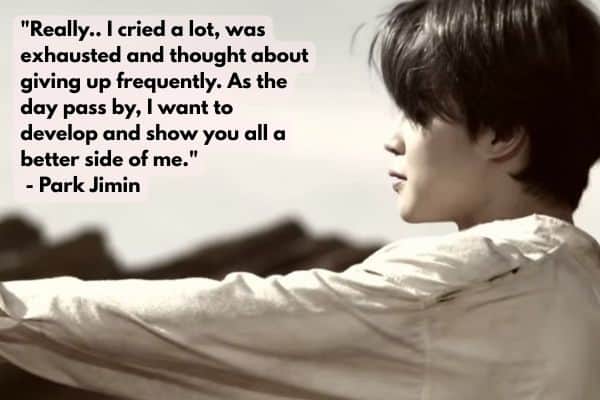
“Really.. I cried a lot, was exhausted and thought about giving up frequently. As the day pass by, I want to develop and show you all a better side of me.”
“I’m Pretending to Be Okay”: The Fe Mask
When Fe is functioning well, it creates harmony, connection, emotional clarity. When it’s strained, it can turn into emotional performance. You keep showing up. You keep smiling. You keep managing the atmosphere even when you’re falling apart internally.
You see the same pattern echoed in his earlier words:
“I only realized it recently, but I used to be really unstable. I was acting like I was well-grounded when I was around other people, like my family and friends. It meant I had to pretend a lot. I worried about others by saying things like, I’m fine, but how are you?”
Over time, this creates a split between what’s shown and what’s actually happening underneath.
“Even if I’m a little hurt, it’s okay”