The Enneagram Types of Each BTS Member
There’s something fascinating about watching BTS through the lens of the Enneagram because, unlike MBTI®, the Enneagram isn’t really about how someone thinks. It’s about why they do what they do. It tracks motivation, fear, desire, and coping mechanisms. It also focuses on the emotional survival strategies people build over time without even realizing it.
What I’ve loved while writing this article is that BTS gives us a surprising amount of material to work with when it comes to the Enneagram. I really got to dive into their creative processes, their thought processes, and even their reactions to the time they spent in the military.

Part of the reason they resonate so deeply with people worldwide is because they’ve never fully hidden the emotional reality underneath the success. They talk openly about burnout, insecurity, loneliness, pressure, identity, ambition, depression, self-worth, and the strange emotional disorientation that comes from becoming symbols to millions of people while still trying to remain human underneath it all.
That’s Enneagram gold, psychologically speaking.
All things considered, I want to clarify something upfront: this is interpretation, not certainty. The Enneagram is deeply internal. Nobody fully knows another person’s core motivations except that person themselves. Fame complicates things even more because public identity and private identity are rarely the same thing. So what I’m doing here is looking at recurring emotional patterns, defense mechanisms, fears, desires, and coping styles across interviews, lyrics, documentaries, livestreams, and public behavior. In other words: emotional detective work. But since I cannot actually interview the members individually, it is guesswork at the end of the day. These are my guesses as to their Enneagram types, but what they reveal publicly may not be the whole picture.
With that said, let’s get started!
Not sure what your personality type is? Take our personality questionnaire!
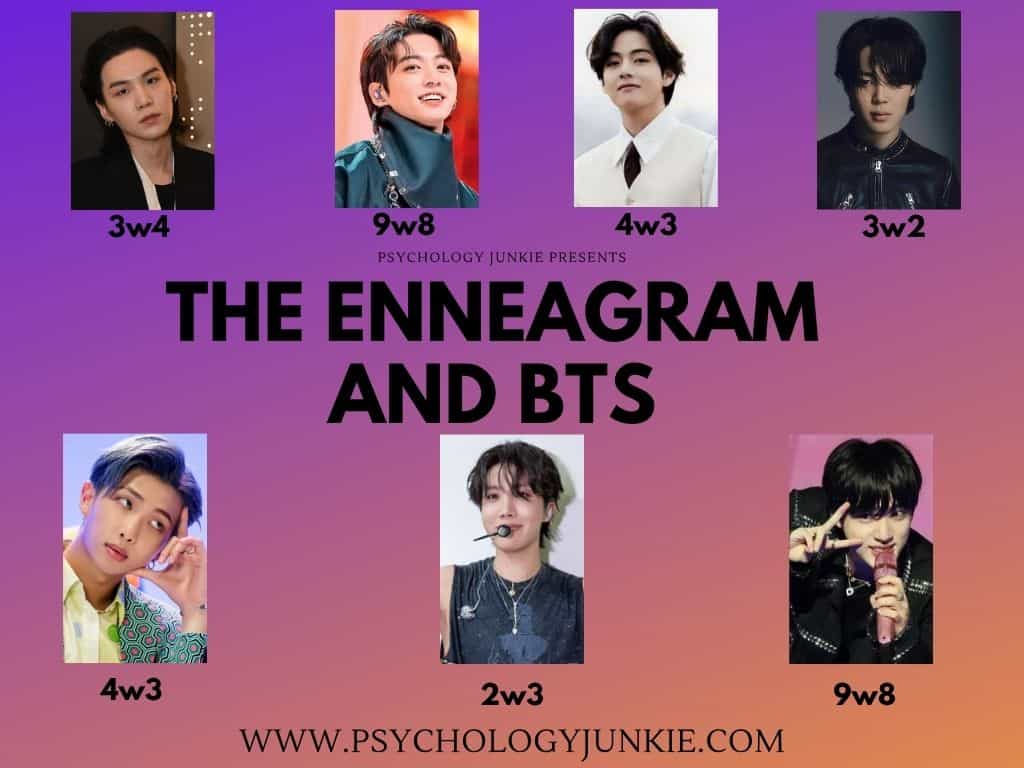
Jungkook (9w8): The Easy-Going Artist Trying to Stay Grounded

Jung Kook might seem like an odd fit for Enneagram 9 at first glance. He’s ambitious, talented, intensely hardworking, physically disciplined, and capable of commanding enormous attention on stage. People often assume 9s are passive, sleepy background characters whose greatest ambition is becoming one with a couch cushion. But healthy 9s can actually be incredibly accomplished. Especially 9w8s.
At their core, Enneagram Nines are driven by a desire for inner peace, emotional stability, and harmony. They cope with stress by simplifying life, avoiding unnecessary emotional conflict, and disconnecting from anything that feels too overwhelming or destabilizing. Rather than aggressively forcing themselves onto the world, they tend to move with life, adapt, and try to maintain connection and calm.
The 8-wing adds quiet strength, stubbornness, independence, and groundedness. So while 9w1s often come across softer or more idealistic, 9w8s tend to have a more solid and powerful energy. They’re usually calmer under pressure than people realize, but also surprisingly resistant when pushed too far.
Nines try to keep their world, both inner and outer, as peaceful as possible. They do this through maintaining an inner calm, sometimes compromising for their relationships, and focusing on things that provide a sense of “zen” whether that be a proverb, mantra, hobby, or even an artistic pursuit.
These quotes by Jungkook help to reveal some of those Nine patterns:
“When I’m not onstage, I try to keep my mind empty and avoid overthinking.”
“I pour out my inspiration when I’m working on an album or preparing for a performance. But in daily life, I prefer to keep things simple and think in a straightforward way.”
“When people are in love, the heart for compromising and understanding each other is the most important.”
“We should try to respect and understand each other.”
“I want to do the things I’m drawn to and not overthink it.”
“I can’t just tell you to cheer up no matter what, but in the midst of that difficulty, try to find that small happiness.”
That’s definitely Nine language. Moving toward connection, mutual understanding, inner simplicity, and finding something simple to focus on to dull difficulty or pain.
There’s also a humility to how Jungkook wants to exist outside the spotlight:
“I’m fairly easy-going, very honest, and nothing special.”
“When I look at myself, I’m not anyone that great. There’s a part of me that just wants to be seen as a singer.”
“There must be a reason why they love me so much, even if I don’t know what it is.”
“I don’t give things too much thought. I just, you know, keep it casual and share about what I’m up to or what’s happening.”
“I’m not someone with very high self-esteem. Why am I so popular? Is it just because they like my voice? Or maybe the way I dance? I still can’t figure it out—about why I’m loved by all these people.”
When you hear Jungkook speak, there’s very little sense that he’s trying to construct some grand identity around being exceptional. If anything, he often seems to want relief from the pressure of constantly being “The Golden Maknae.” No matter how famous he gets, he maintains his humility and seems genuinely confused by how much attention and esteem he’s getting.
Jungkook’s 8-wing shows up in his individualistic stubbornness and self-direction. People sometimes imagine 9s as endlessly accommodating, but 9w8s often have this calm internal resistance underneath them. Jungkook repeatedly emphasizes autonomy and authenticity:
“Don’t do anything you don’t like to do.”
“I always dress my way!”
“Isn’t a man someone who doesn’t care about what others think? A man does whatever he wants.”
(When a fan told him to turn off his WeVerse live) “Don’t tell me what to do.”
What fascinates me most about Jungkook psychologically is the tension between his immense external competence and his desire for internal peace. The world constantly pushes him toward intensity, performance, perfection, and visibility, while part of him seems to crave simplicity and emotional quiet.
Nines also have a tender, compassionate side, but they don’t go parading it around. Jungkook has given large sums of money to charity, including a children’s hospital in Seoul. This donation made it in the news, but he didn’t mention it or bring it up in any kind of showy way. When asked about it he said, “My thoughts have been turning to the younger kids these days, so I turned my attention to the children’s hospital thinking it would be good for some new resources and facilities to get built. I’m really happy I could do that.”
He also donated 1 billion won to the Hope Bridge Korea Disaster Relief Association to aid victims of wildfire and there is frequently news that he gives “silent donations” that have rivaled corporate donations regularly.
Another strong quality of Nines is that they tend to merge deeply with the emotional ecosystems they belong to, and Jungkook essentially grew up inside BTS. His identity feels merged with the group in a way that seems emotionally stabilizing for him rather than limiting. He frequently adjusts to their needs, goes out of his way to lighten the mood, offer a supportive shoulder, or empathize. Rather than focusing on himself in many projects or interviews, he either stays quiet or brings the attention to others.
Some of the most revealing moments come when he discusses directing “Life Goes On” or The Golden Closet Films. I noticed that he naturally he puts himself in the background emotionally.
“I kind of take a back seat. I tried to make the other members look really good when I recorded them…I wanted to show what was happening with every member and the team, not just one individual’s thoughts. Each person who watches the video might feel different, but I wanted to show that we feel what other people feel, that we’re in the same situation.”
“I never really liked having my picture taken. (laughs) And I’m usually with the others when we’re working, obviously, but it’s hard to take a camera and take selfies. So I take pictures and videos of the other members every chance I get.”
“I don’t expect myself to be able to handle everything from start to finish and tell people what to do, and I wouldn’t want to anyway. I sort of feel like … everyone does what they’re best at and then we allow it all to intersect.”
As a Nine, Jungkook is good at blending with the team, keeping the focus shared rather than focused individually on himself. He notices and praises others for their gifts, whether it’s the members or the staff, who are famously fond of him. So fond, in fact, that his hairdresser cried when cutting his hair before he joined the military. No matter how famous he gets, Jungkook stays humble and down-to-earth, never really letting it get to his head.
“I can be a shy person. When people used to ask me to sing, I couldn’t always do it—like in front of adults or teachers. And I’m still a bit like that. If I start thinking, “Oh, I can’t do this,” then I really end up not being able to do it. Even when I could have done well.”
“I feel the same way about my dancing and my singing, and I can’t compose a really amazing melody either. I feel like I’m always somewhere in the middle. But then I also think I have my own colors, so I like to quietly, slowly open up to people, and let them know what kind of person I am.”
Even though Jung Kook may grapple with self-doubt, there’s also a steadiness in him that probably helped stabilize BTS over the years. Nines often become emotional anchors for the people around them because they instinctively absorb tension and try to maintain connection even during difficult periods.
A fellow soldier who worked with Jungkook in the military expressed this when he said, “I am someone who served in the military with him. He is the kind of person who tries to maintain every connection, even the passing ones; even after being discharged, he meets up with us and buys us meals. He even spent his own personal money to replace all the cooking equipment in the unit so that the soldiers could have warm meals.”
Jungkook doesn’t seem driven by the need to stand apart from others or prove himself superior to them. He seems driven by the desire to stay emotionally whole while navigating an overwhelming world. I really grew in admiration for him as I studied him for this particular article, and I’m excited to see what comes next in his journey.
V / Taehyung (4w3): The Romantic Searching for Meaning
While some people experience life in a relatively straightforward way, V tends to absorb it, romanticize it, symbolize it, and turn it into imagery, longing, memory, beauty, and atmosphere.
“When things get hard, stop for awhile and look back and see how far you’ve come. Don’t forget how rewarding it is. You are the most beautiful flower, more than anyone else in this world.”
Enneagram Fours are driven by a deep desire to understand and express their identity authentically. They often feel emotionally different from other people, sometimes painfully so. And they tend to transform emotional intensity into creativity, symbolism, aesthetics, and self-expression.
This creative form of self-expression and symbolism can be seen in the following quotes:
“Life is perhaps not about finding shining moments among the worthless, but realizing that what had seemed worthless were really the shining moments.”
“Purple is the last of the rainbow colours, so it means I will love and trust you for a long time.”
There’s also a very Four-ish relationship with melancholy in him. He doesn’t seem to run away from painful emotions so much as metabolize them creatively.
“That unleashed all the arrows charged with various emotions pent up in my heart.”
“I was having the toughest time, but I couldn’t keep carrying that feeling around with me. Instead, I could use it as a kind of fertilizer. So I took care of that feeling by constantly writing it down in my notes. I just kept writing everything down.”
“I don’t really sleep well. I toss and turn and get caught up in a lot of thoughts. Even when I turn out all the lights, I can see everything clearly. I close my eyes, but all my thoughts spread wide open. Then I’m sleepy at work, and staring off into space when I’m alone, with bags under my eyes, but if I want to avoid that then I really have to sleep. Except, with the way I am, it doesn’t allow for it.”
Fours often process emotions by deepening into them, examining them, shaping them into art. And Taehyung repeatedly describes doing exactly that. He doesn’t run away from the depth or the sadness or darkness of life, instead, he wants to address it, write it down, and figure it out for himself.
“Rather than just some stranger telling them to cheer up, I think it’s better to say something like, “You seem depressed lately,” or, “Seems like these days it’s tough for you to perk up.” “Blue & Grey” is the same: “You’re depressed lately? Me too. We’re in the same boat. Wanna talk about how you’re feeling? You wanna feel better, right? I know, but sometimes it feels like you’re being washed away by a whirlpool of stress.” I want the listeners to hear me saying that to them.”
What made me consider the 3 wing for Taehyung was how often he compares himself to others while simultaneously valuing individuality.
“I started to compare myself to others. ‘Because my pace is slower than the members and my thoughts are a bit different… is that why I’m more burned out?’ I thought this a lot. Whenever I looked at our members when we perform, I thought, ‘The members are so perfect and they enjoy the stage. But why am I the only one like this?’”
That sense of being emotionally out of sync with others is very Four-ish. Especially stressed Fours, who can become painfully aware of perceived deficiency or emotional alienation. And yet, alongside that vulnerability, there’s also clear ambition and artistic drive.
Suga once told him, “I personally think you’re one of the most musically ambitious members.”
Taehyung’s military service also speaks to his ambitious nature. He ended up joining one of the harshest and most physically demanding units possible: the Military Police Special Duty Team. And somehow, he thrived there. Despite training with injuries, including a cracked rib, shoulder pain, and thigh injuries, he earned titles like platoon leader, exemplary shooter, and “Special Warrior,” ranking first in shooting and winter urban warfare exercises. But even inside this brutal environment, the emotional tenderness people associate with Taehyung still showed up constantly. Fellow soldiers described him working out beside them in the rain, encouraging them during physical tests, buying meals for others, donating gym equipment, and helping create meaningful memories during an exhausting period of life.
“When we ran 3km together, we tried to make it to the special class somehow, pulling each other and cheering each other on, and when we came in much earlier than the special class standard, it was really romantic, and I think it will be very memorable. And the time I went to work out with Sunghyun, rain or shine, and the time I sweated while working out in a better environment thanks to the equipment my brother donated, are all precious memories. Also, I was so grateful that he bought me a lot of delicious food when I went to the PX when I went out or stayed out overnight. In particular, I still can’t forget the eel sushi my brother bought me. It was really delicious…” – Fellow soldier of Kim Taehyung
I think Taehyung was being sincere when he famously said, “I have a big heart full of love, so please take it all.”
J-Hope (2w3): The Heart That Keeps Everyone Going
J-Hope is probably the BTS member people most immediately associate with warmth, brightness, and positivity. He’s the group’s “sunshine.” The emotional energizer. The one constantly encouraging people, lifting the atmosphere, making others laugh, checking on the members, and trying to keep morale alive even during exhausting periods.
At first glance, that can look like Enneagram 7 energy. And I completely understand why some people profile him that way. He’s playful, expressive, energetic, creative, and constantly moving forward. But the deeper I dug into his interviews and lyrics, the more it felt like something else was driving him underneath all that brightness.
J-Hope doesn’t just want to feel good, he wants to make sure other people feel okay. That’s a very different emotional motivation.
At their core, Enneagram Twos are driven by a desire to be loved, emotionally meaningful, and valuable to others. They often become highly attuned to what people need emotionally and unconsciously shape themselves into a source of support, encouragement, warmth, or comfort. Healthy Twos are generous, affectionate, emotionally intuitive people who genuinely want to help. But they can also struggle with feeling responsible for everyone else’s emotional state.
And J-Hope talks like a Two constantly.
“I just thought I have to make music that can give consolation and a sense of hope to other people.”
“It’s clear how I’m able to bring joy to people, and that’s through performing. I want to show what I can do. I want to keep performing and bring people happiness.”
That line feels like the emotional core of his personality. Even the identity of “J-Hope” itself became something he consciously tried to embody for others:
“Once I got this name, I told myself that I should take responsibility for this name I’m carrying. Once I started thinking that way, it changed something inside of me.”
Twos often internalize emotional roles very deeply. Over time, they don’t just play the role anymore. They become it. And unlike more self-focused image types, J-Hope’s attention repeatedly turns outward toward the emotional impact he has on people around him and their opinions and perspectives.
“Personally, I’m very affected by the people around me, so I have to think about whether I can handle the emotional effect my decisions will have on so many others. I struggled with that.”
“I ask people for their opinions a lot. I ask my family and the people at the label, too. What do you think? Would it be okay if I did that?”
“I read a lot of letters when I was in the army and I had some extra time. ARMY really poured their hearts into those letters saying, I hope you’ll try this or that. They really, really inspired me. They really want me to do this. They think that’d be a good idea. If there’s some overlap with my own ideas, I take it into consideration and get some feedback on it. Stepping back like that helps me figure out what people want and what I need to focus on.”
“That tenderness, deep longing, and the moments that move our hearts…Because we shared all that, it helped us stay together.”
These quotes demonstrate heart-triad thinking. His choices naturally pass through an emotional-relational filter.
You can also see this in the way he talks about BTS itself:
“I wouldn’t say it’s a burden (to be needed so much by the group), I just do what I can. I think that’s my role on the team. And, well…I don’t think of it as a requirement. I don’t think about what I need to do. It just comes naturally. This…role? Should I even call it that? It feels weird to call it a role. But all I do is take it in stride, and do what I can for the other members.”
For Twos, supporting others feels so natural to them that they often struggle to even recognize how much emotional labor they’re carrying. Apparently the people around him feel this too. Jin once said, “If it wasn’t for J-Hope, the team atmosphere would have been a lot darker.”
Twos often become emotional stabilizers inside groups because they instinctively monitor morale and try to keep emotional energy moving.
At the same time, the 3-wing is very obvious in J-Hope. Unlike a 2w1, which tends to appear more modest or purely service-oriented, 2w3s often combine warmth with ambition, professionalism, charisma, and image-awareness. They want to help people, but they also want to do it beautifully and successfully. J-Hope clearly cares about presentation, performance, aesthetics, and growth:
- carefully planning outfits
- focusing intensely on choreography details
- pushing himself professionally
- wanting to refine his artistic identity
- thinking deeply about how “j-hope” is perceived publicly
Even his military service reflected this combination of emotional support and professionalism:
“I tried my best to fulfill the role assigned to me and give it my all. It’s like how in BTS we actually show each other more respect because we’re a group. I tried to do the same in the army. Since my actions determined what kind of memories each person would have left of me, I tried to respect certain boundaries, which I think made other people like me more and feel more at ease around me.”
“Nobody enters the military lightheartedly. It’s a tough, challenging journey, and at times psychologically demanding. But I felt like integrating into that society as Jeong Hoseok would make me into more of an adult and that the personal development would act as a good steppingstone for me. There were hard times, sure, but getting through them, and getting closer with people on a more personal level by communicating with them, helped me gain some insight.”
“Since drill instructors are often thought of as scary, I tried to be more approachable. For them, it’s their first step in military life. Since all the trainees knew who I was, I tried to be more approachable.”
What’s especially interesting, though, is that J-Hope has become increasingly self-aware about the emotional cost of constantly being “hope” for other people. That’s where his recent interviews become psychologically fascinating.
“Out of habit, I would say, ‘I’m okay; I have hope,’ and keep working, but I think I was just avoiding my work-related problems rather than facing them head on.”
“Is getting all this love and attention actually a good thing? Maybe while everyone is clapping and cheering for me, I should just turn it all off. And I wondered whether I wanted this. All I had was a tiny flame inside me, and It had just spread like wildfire. I felt a lot of pressure around that.”
“Even as I went around talking about hope, I wasn’t sure if I was truly a hopeful person.”
2w3s often cope by staying useful, encouraging, and emotionally available even when they are struggling underneath. They become so identified with being the uplifting one that admitting exhaustion can feel strangely threatening.
You can also see his emotional attunement in how deeply he values fans:
“At any time of any day, the fans come first.”
“I’m so incredibly thankful that sometimes I feel overwhelmed just thinking, ‘Wow, how can I ever return this much love?’”
Twos are often deeply affected by love and emotional connection because relationships form the center of their emotional world. In a WeVerse interview he stated, “I always think if there’s a line, it shouldn’t be crossed.” When the interviewer asked why, he stated, “Because I get a lot of love. Because I’m in this position and in this place, there’s things I have to deal with, and I should do things and think things I am able to bear. I thought about that a lot and accepted it. So I thought about what I could do during these hard times, and how I could help out my friends, my team.”
Underneath all the polish, professionalism, fashion, choreography precision, and stage charisma, J-hope is someone who fundamentally wants to connect emotionally with people in a genuine way. Someone who wants to comfort, uplift, encourage, energize, and remind people that hope still exists even during difficult periods. At the same time, he needs time for himself, time to just turn off and not have to be “sunshine” for everyone.
Kim Namjoon “RM” (4w3): The Philosopher Searching for His True Self
RM feels almost impossible to separate from questions of identity.
Who am I really?
What does it mean to live authentically?
How do you remain yourself while becoming a symbol to millions of people?
What parts of you are real, and what parts were built for survival?
Those questions run through his interviews, lyrics, speeches, livestreams, and creative work constantly. And to me, that emotional fixation points very strongly toward Enneagram 4.
At their core, Fours are driven by a longing to understand and express their authentic identity. They often feel fundamentally different from other people in some way, as though there’s a missing piece they’re constantly trying to locate through introspection, creativity, relationships, beauty, meaning, or self-expression.
And RM talks like that constantly.
“Who am I? The question I had my whole life
The question which I probably won’t find an answer to my whole life”“My shadow, I wrote and called it hesitation
It has never hesitated after becoming that
It keeps appearing under the stage or the light
Keeps glaring at me scorchingly like a heat wave”
Fours examine emotions, revisit them, shape them into meaning, and try to understand what those emotions reveal about identity itself. RM does this almost compulsively. Even when discussing abstract concepts, he somehow circles back to authenticity, contradiction, emotional truth, or the search for selfhood. Fours often struggle with deep feelings of sorrow or melancholy as well. Unlike some types who try to focus on the bright side at all times, RM frequently mentions grappling with darker concerns.
“I’m just admitting it, that essential sorrow. I don’t know what it is called, but it’s always there in some part of my heart.”
“Every day is a fight, every day is a war to me, not to lose to depression and exhaustion”
At the same time, RM’s 3-wing is incredibly obvious. Unlike more withdrawn or purely introspective Fours, RM is deeply driven to create impact in the external world. He wants his ideas, music, words, and art to reach people. There’s ambition in him alongside all the introspection.
“I’m Korean, so I’m no stranger to finding joy in accomplishment. It was really satisfying and nice.”
“When I perform my role well, I feel proud.”
He spoke about how his Korean heritage influences the intense pressures faced by that culture in this interview:
“In the West, people just don’t get it. Korea is a country that has been invaded, razed to the ground, torn in two. Just 70 years ago, there was nothing. We were getting aid from the IMF and the UN. But now, the whole world is looking at Korea. How is that possible? How did that happen? Well, because people try so hard to better themselves. You are in France or the UK, countries that have been colonizing others for centuries, and you come to me with, “oh God, you put so much pressure on yourselves; life in Korea is so stressful!” Well, yes. That’s how you get things done. And it’s part of what makes K-pop so appealing, although, of course, there’s a dark side. Anything that happens too fast and too intensely has side effects.”
A 4 with a 5 wing might be more hesitant to take the creative and personal risks that RM has. But the 3 wing, and of course RM’s own personal values and cultural influences, compel him to push himself in a way that may sometimes feel scary, but ultimately feels meaningful.
Another facet of RM’s personality is that he’s full of contradictions. He repeatedly talks about duality:
- success and emptiness
- authenticity and performance
- ambition and exhaustion
- individuality and responsibility
- joy and melancholy
- public image and private self
For example:
“I’ve had to accept that everyone cannot love me. Because when there’s love, there’s hate. When there’s light, there’s dark.”
Unlike more straightforward types, Fours often hold contradictory feelings simultaneously rather than simplifying them into neat conclusions. They can’t see light without seeing darkness, or vice versa. Even his reflections on love become philosophical and layered:
“If you want to love a person, you should know that there are tears, and there can even be hatred inside of it.”
RM may genuinely be one of the most introspective public figures I’ve ever seen. An interviewer might ask him whether he likes a painting and suddenly he’s discussing mortality, artistic permanence, the burden of success, and the metaphysical loneliness of being human. Which is, respectfully, very Four. I’m also a Four so I can relate.
I’ve also noticed with RM that there is a recurring emotional movement in him toward self-acceptance, emotional honesty, and integrating all the fractured pieces of himself into something whole. He talks about “speaking yourself” and “loving yourself” while simultaneously admitting that this has been an effort for him. He’s still not sure if he loves himself, but believes it’s a journey more than a destination.
There’s also a recurring tension in RM between global success and preserving his identity as a Korean artist. It seems like it’s been a challenge for him to face the pressure of becoming more Westernized in his music. In the documentary BTS: The Return, RM and Suga shared worries that heavily relying on English lyrics, especially in rap, risks losing the group’s identity. They both expressed concerns with their producers about singing so many of their lyrics in English, but were very much pressured to do so for their global audience. You can see that pressure in this interaction from the documentary:
Suga: “We’d like to write more lyrics in Korean, there’s too much English right now. Especially for the rap verses.”
RM: “Because for this album, authenticity matters. So using too much English can…”Nicole Kim: “Of course, authenticity is important. But if we want this album to go global, we need to go ahead and try.”
RM: ”The challenge is that we are running out of time. We don’t even have time to get the pronunciations right.”
RM has indicated that the pressure to produce English content, often under very tight deadlines, made him feel as though the group’s authenticity was being compromised.
“We do not want our identity or authenticity to be compromised by singing songs with English lyrics. Even if doing so could allow us to reach the top, that is not what we desire.”
“I can’t do anything not Korean, because that’s what I am. I used to work late and then stay up all night when things weren’t working out, sometimes walking from Samseong to Sinsa station, thinking everything through. But now, like the saying, I realize that maybe I can’t do more than what I am.”
That attachment to authenticity and rooted identity feels incredibly important to him. Even while leading one of the biggest musical acts in the world, he repeatedly circles back to wanting to preserve something emotionally true beneath all the “bling-bling symbols of success,” as he called them.
“We have all these bling-bling symbols of our success, but we’re not that kind of team.”
And despite all his philosophical depth, there’s also emotional intensity underneath everything.
“I’m maybe too sensitive, more than the others… Or I think too much. Sometimes I can’t sleep.”
“My heart races when I make good music,
And I smile like a kid when I play around with the members
And, when I think of the armys bombs glow in the audience,
just like a forest at night.
I feel like I’m about to cry.
Because I believe that this energy and this feeling,
is what brought me, brought us, this far.”
“When I think about love…when I say “I love you all,” or when you say you love me or us, what matters to me is not the cover of the book called love, but the content inside. When I say “I love this person,” what does that mean I want to do for them? What do I hope for with this person?”
After his time in the military, RM wrote a letter to his fans and in it he stated:
“Over the past year, I was trapped by several things
So much appeared only to disappear,
Come and then leave
Caught amidst them, I wavered a lot, I struggled,
and went through many mistakes.
After all that,
I feel like I’m finally standing here
looking at spring.
I have too many thoughts,
And even though I believe that I’ve grown
and try to keep believing so,
I know I will fail and make mistakes again
In the process of that, I might end up hurting
someone or hurt myself too, right?
But now I know.
That saying “I tried my best” doesn’t become
the answer to everything.”
RM’s military experience almost feels like an extension of the emotional contradictions he wrestles with constantly: intellectual sensitivity inside an intensely structured environment. During his enlistment he served in the Special Task Force as a platoon leader, military band member, and assistant chaplain, eventually earning “Elite Warrior” recognition. It was an extremely difficult period for him psychologically. He admitted to dealing with severe insomnia, anxiety, emotional instability, and moments where he questioned his own strength.
“Why are you so weak? Haven’t you been through worse? Why are you struggling now — with sleep, with military life?” – Kim Namjoon
“I live a lonely life.” – Kim Namjoon on WeVerse live after his time in the military ended.
“Honestly, I’m still scared. I want to act strong, ‘I don’t care, I don’t give a sh*t, I don’t give a f*ck, I don’t care about anything. Nothing matters to me. What can you do to me?’ I’m not like this. I’m still very weak and anxious and get hurt a lot. I don’t want to deny that I just accept it. I just fight this and keep moving forward.” – Kim Namjoon on WeVerse, 2025
For the first time since he was 14, RM said he found himself unable to write music and relied on journaling to find peace and groundedness.
Fours are often notoriously hard on themselves, seeing their weaknesses and their differences from others more than their strengths. They often grapple with feelings of melancholy, feelings of being the odd one out, or the misfit. This pattern seems to show up on occasion in RM’s own words. And yet, even while struggling internally, he still moved toward leadership and emotional support roles, offering encouragement and comfort to other soldiers as an assistant chaplain. That combination feels deeply Four-ish to me: emotionally overwhelmed at times, painfully self-aware, but still trying to transform suffering into meaning.
RM has admitted that he still feels like he’s “fighting the demons” and remains in the middle of learning who he is, even now. For Fours, it’s often a lifelong journey. In a WeVerse live stream he admitted, “Honestly, I turned this on because I wanted to cry. It’s because I’m alone. Your love doesn’t lack. From the start, your love has always been more than enough. I’m the one who lacks.” He then ended the stream with acceptance and encouragement to himself and his viewers to do their best and to continue to do well.
One thing I really love about RM is that he doesn’t present himself as someone who has everything figured out. He presents himself as someone trying to live truthfully inside uncertainty, contradiction, ambition, loneliness, creativity, pressure, and emotional complexity without pretending he’s transcended any of it yet.
He doesn’t seem driven purely by achievement, admiration, or status. He seems driven by the need to understand himself, express something emotionally true, and create meaning out of the strange, painful, beautiful contradictions of being human.
Jin (9w8): The Quiet Support Hiding Behind Humor
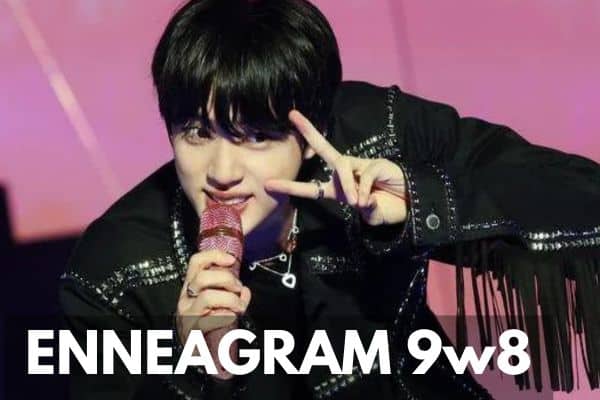
Jin is one of the easiest BTS members to misunderstand if you only focus on his surface energy.
At first glance, you see the jokes, the confidence, the “worldwide handsome” persona, the dad humor, the chaos, or the man willing to split a birthday cake in half with his bare hands.
And because of that, people often assume he must be some loud attention-seeking type.
But away from the spotlight, Jin actually seems very quiet and laid-back. He consistently comes across as someone deeply motivated by emotional steadiness, harmony, comfort, and helping the people around him feel okay.
“There seems to be little point in thinking about the future or the next beautiful moment. I might be a global star today, but even if I become a neighborhood star later, or even just a star in my own home, as long as I’m happy, that’s all that matters. Would that send me into despair? Would there never be another beautiful moment again?”
At their core, Enneagram Nines are driven by a desire for inner peace, emotional stability, and connection. They often become emotional mediators inside groups, softening tension, maintaining morale, and trying to keep everyone emotionally afloat. Rather than forcing themselves aggressively into the center of things, they tend to stabilize the emotional environment around them.
“I just want to be remembered as someone who brought good memories. Someone who, in their generation, brought happy memories to others. That’s the kind of person I’d like to be.”
The Nine’s core desire is harmony and their core fear is fragmentation of inner peace. Jin seems very aware of the emotional atmosphere he creates for other people, and he works to preserve a sense of camaraderie and peace.
But unlike image-driven types who carefully construct a polished identity for admiration, Jin’s emotional energy feels much more grounding and casual. He makes fun of himself, often stays quiet when he’s not on camera, and uses humor to de-intensify situations.
He repeatedly uses jokes, absurdity, and lightness to soften emotional pressure inside the group. When things become too heavy, Jin instinctively redirects the emotional energy sideways instead of letting everyone spiral into tension.
“I always try to be cheerful on-camera. People watch me because they want to be happy. If they feel sad from watching me, it would make my heart ache even more. I feel that I always have to show you the bright side of me. But for BTS Jin, life may be difficult on the other side.”
This statement is very relational and it shows his focus on preserving a sense of outer harmony, even if it means that he has to hide some of himself in the process.
Nines often cope with emotional pain by minimizing conflict internally and refusing to stay emotionally stuck in distress for too long.
“The past is the past. Let’s try to be a big person with a big heart”.
One thing that makes Jin especially interesting psychologically is the contrast between the bright public energy and the much quieter, more introverted side underneath it all.
He’s admitted:
- he dislikes crowded environments
- talking on the phone makes him anxious
- meeting unfamiliar people feels difficult
- he prefers staying home gaming or resting
- he often withdraws when not actively working
Nines often adapt socially more than people realize, especially when they feel responsible for maintaining emotional harmony. But when external demands disappear, they retreat inward toward comfort, familiarity, and emotional quiet. Jin has spoken about how, on his off days, he will enjoy sleeping and gaming for up to 16 hours, and it makes him feel so happy. He loves his rest and his downtime, without pressure, without having to be “on” for the public.
“I don’t think I’m built to live this life of a superstar.”
“I don’t feel the burden. I know the results are important, but I just want us to be happy.”
For a Nine, emotional well-being and relational harmony matter more than endless striving.
And unlike types who desperately need to stand apart as unique individuals, Jin often seems happiest simply sharing enjoyable experiences with people he loves.
One of the clearest real-world examples of his emotional warmth showed up during Jin’s military service. When he was discharged, entire barracks of younger soldiers reportedly cried while saying goodbye to him. And the explanation he gave for why people became so attached to him says a lot about the way he moves through relationships.
Many of the younger recruits were teenagers who had never worked before and didn’t have much money, so Jin constantly bought them food. Fried chicken. Pizza. Jokbal. Barbecue. He said he spent most of his military pay taking care of the younger soldiers around him, including people from entirely different barracks.
“You gotta eat well to stay healthy. Come on, I’ll treat you.”
Jin could have leaned on his celebrity status and felt that he was above others. But instead he fed people, teased them, made them laugh, and created an atmosphere where everyone felt emotionally safe and connected.
Even the joking dynamic itself feels very 9w8:
“Sometimes the guys would joke around and say, “Sergeant Kim, did you do anything other than sleep today?” And then I’d say, “What barracks are you from? I was gonna buy you dinner tonight, but not anymore. You’re not coming with me!” Then they’d say, “Sorry, sir!” We just goofed around like that, and I’d buy them all dinner anyways.”
Jin rarely presents care in an emotionally heavy or self-important way. Instead, it comes sideways. Through humor. Through food. Through emotional steadiness. Through creating comfort in everyday moments.
“I kept a smile on my face all throughout my service and told them, “It’s okay, everybody makes mistakes. You haven’t done anything seriously wrong. Honestly, just because I joined the military six months earlier doesn’t make me any better. I’ve been in the entertainment industry for 10 years already, and there’s still tons I don’t know. I make mistakes—everybody does.”
Jin’s military service not only shows his kindness, but also his work ethic. While serving as an assistant drill instructor at the 5th Infantry Division, he earned “Elite Soldier” recognition, was promoted early, and eventually achieved “Top Warrior” status after excelling in a grueling series of endurance, strength, and skill evaluations.
Suga (3w4): The Survivor Who Turned Pain Into Purpose
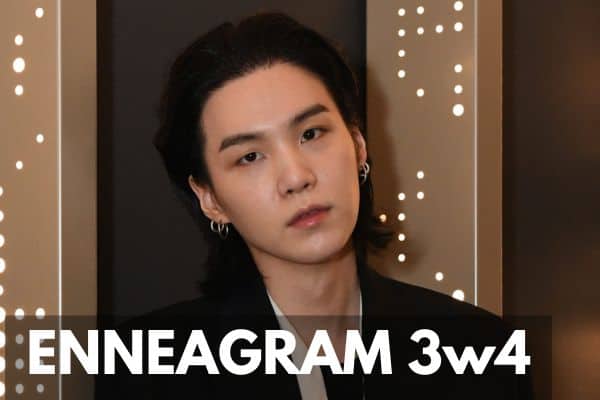
Suga may be one of the most emotionally misunderstood members of BTS. Because he’s quiet, analytical, private, and often emotionally restrained in public, many people immediately type him as a Five. I understand the argument, and spent a lot of time considering Five for him. He clearly values competency, independence, technical mastery, and solitude. He likes chess, producing, arranging, refining details people may never even consciously notice. He hates forced social interaction, dislikes eye contact, avoids unnecessary emotional performance.
But underneath all of that, Suga’s inner world revolves less around withdrawing from pressure and more around surviving it through achievement, perseverance, and relentless self-construction. Suga seems to give every bit of energy he has to his dreams, his goals, and his vision. He has pushed himself to the breaking point, both physically and psychologically, to achieve his goals. That seems more Three than Five to me.
At their core, Enneagram Threes are driven by a need to become valuable, successful, capable, and effective. They often build identity through accomplishment and become intensely hardworking, adaptive, and productivity-oriented. The self-preservation subtype looks very different from the flashy, polished stereotype people often associate with Type 3. Self-preservation 3s are quieter and more practical. They focus on endurance and gaining security, often through intense workaholism. They want competency, survival, stability, mastery, and proof that their existence has value.
And Suga talks like a 3 constantly.
“I’ve never not had a dream, and I made it all come true. In my trainee years, I wanted to make my debut. Afterwards, I wanted to land No.1. After that, winning the grand prize and performing in Japan and the U.S. I didn’t even dare to dream of Billboard and the American Music Awards but it all came true.”
Here we see a relentless forward movement in him. Goal after goal after goal. Even after achieving things most people could never imagine, his mind naturally shifts toward the next horizon.
We can also see this in his song, Interlude: Shadow
“I wanna be a rap star
I wanna be the top
I wanna be a rockstar
I want it all mine
I wanna be rich
I wanna be the king
I wanna go win.”
And the thing is, this drive wasn’t born from comfort or privilege. It came out of hardship.
Self-preservation Threes often emerge from environments where security felt unstable or conditional. Instead of expecting support from others, they learn to survive through competency, self-reliance, endurance, and relentless effort. Reading about Suga’s early life, that pattern appears everywhere.
Before BTS became successful, Suga was balancing trainee life, underground producing, delivery jobs, financial instability, and family disapproval all at once. His parents initially opposed his musical ambitions so strongly that they reportedly threw away the lyrics he had written. In response, Suga stated, “I think that motivated me or helped me work harder because there was something that I now had to prove.”
When he was 15, his family home burned down in a fire. Financial hardship and instability were constant realities in his early life, compounded by serious health struggles within his family, including his mother undergoing heart surgery and his father battling liver cancer. There seemed to be an ongoing sense that everything could collapse at any moment if he stopped pushing forward. That context makes his later choices feel much more understandable psychologically.
After severely injuring his shoulder in a delivery accident, he initially hid the injury because he was terrified of losing his position as a trainee. Giving up didn’t feel like an option to him. He had already sacrificed too much to turn back. He lived with the shoulder injury for eight years before getting medical treatment, only doing so when he realized he couldn’t hold a 500 mL can of cider in his left hand for a commercial. ““It hurt too much. I thought, ‘I can’t continue to live like this.’”
Suga himself admitted:
“I always wanted to become the best. So I was impatient and anxious. To compare myself against others became my daily life, and my greed, which used to be my weapon, became a leash that chokes me.”
“Life is hard and things don’t always go well, but we must be brave and go on with our lives.”
“No one else can take responsibility for you.”
Self-preservation 3s often survive by becoming highly competent, productive, self-sufficient people who don’t allow themselves to stop. They can appear calm and controlled externally while carrying enormous anxiety underneath.
You can hear that anxiety directly in Suga’s words:
“Ever since I was young, I had a lot of trouble getting over the fear of the future because I thought that I had to prepare for unknown circumstances.”
“At times I’m scared of myself too, thanks to self-hatred and / The depression that pays a visit / Min Yoongi is already dead (I killed him) / Comparing my dead passion with others has long been my daily life”
The more I studied Suga, the more I saw a constant underlying pressure in him to prepare, improve, work harder, keep moving, and keep achieving.
And unlike more emotionally detached achievers, Suga’s Four wing gives him tremendous emotional depth and self-awareness.
His lyrics in “The Last” are brutally honest:
“On the other side of the famous idol rapper stands my weak self, it’s a bit dangerous. Depression, OCD, they come back again from time to time. Hell no, perhaps that might be my true self.”
“Then I thought success would pay for everything. But as time goes by, I feel like I’m turning into a monster.”
Many Threes believe that achievement will finally heal the pain, only to discover that success itself becomes another source of emptiness and pressure.
We can also see some of his disillusionment with fame in “Interlude: Shadow“
“I’m scared of flying high.
No one told me
how lonely it is here
That my leap can be my fall
People say, in that bright light, it’s splendor
But my shadow rather grows even bigger,
swallows me, and becomes a monster
Going higher, higher, and only higher, higher,
it makes me dizzy”
Unlike many Threes, Suga doesn’t seem particularly intoxicated by status itself. If anything, he repeatedly minimizes success once he achieves it.
“When we got nominated for the Grammy Awards… everyone’s rejoicing, but it’s like, ‘Let’s do what we have to do.’”
“It’s incredible to be ranked first on Billboard, but there’s also this sense of, ‘Okay, and?’”
That emotional flattening around success feels very self-preservation 3. Achievement quickly becomes normalized into survival mode. The mind immediately moves toward the next thing, and there’s always another thing.
“I always wanted to become the best.”
“Every day, I was excited about how far I’d go. I was running frantically and somehow reached here”
While Suga is known for his emotional restraint publicly, there’s enormous compassion underneath him as well. I want to highlight this to show how Enneagram 3s, at their best, integrate some healthy Six qualities and try to give back to communities, seeing themselves as part of something larger and more connected to others.
One of the clearest examples of this is the Min Yoongi Center and the MIND autism program. Suga donated 5 billion KRW to build the Min Yoongi Center at Severance Hospital, and he actively helped create a music-based therapeutic program for autistic children, participated directly in sessions, refined methods alongside professionals, and helped create systems designed to continue helping children long-term.
Professor Cheon Keun-ah, a leading authority in child psychiatry at Severance Hospital, stated of Suga, “Suga’s involvement went far beyond financial support. His sincerity, consistency, and intellectual engagement throughout these past months deeply moved all of us involved.” Suga himself said, “Being part of these children’s journey has been both humbling and fulfilling, and I will continue to support their integration into society with everything I can.”
And Suga’s giving back doesn’t stop there. He has also opened up about his own mental health in an effort to bring light and encouragement to others who are struggling. This is especially meaningful in South Korea, where there is still a lot of stigma around mental health struggles.
“I really want to say that everyone in the world is lonely and everyone is sad, and if we know that everyone is suffering and lonely, I hope we can create an environment where we can ask for help and say things are hard when they’re hard and say that we miss someone when we miss them.”
“People fall into despair because they can’t see the future. They’d be able to move forward if they see any light… but if they don’t have any light, they fail and can’t progress. I want my music to become that light for those in the dark. I want them to heal from it and find the courage to step forward again.”
Part of this effort included writing the song Amygdala, where he explored past traumas, stress, and self-harm or suicidal ideation. He wanted to not only purge himself of some of the pain he’d held in, but give others who are struggling the sense that they’re not alone. That kind of practical compassion demonstrates what 3s can do at their best. So many stereotypes focus on the image-conscious nature of the Three, but when they integrate and grow, they become useful, world-changing, community building.
Underneath all the ambition, discipline, and emotional armor, Suga seems driven by a desire not just to succeed, but to turn suffering into something meaningful. He knows what it feels like to be exhausted, anxious, lonely, overworked, and uncertain about the future. He knows what it’s like to feel trapped between who you are and who you think you have to become in order to survive. And instead of hiding those experiences completely, he’s gradually transformed them into music, honesty, philanthropy, and encouragement for other people. He is someone who survived through relentless effort and self-reliance, but who also eventually learned that true success isn’t just about proving your worth. It’s about using what you’ve built to help other people carry their pain a little more easily too.
Jimin (3w2): The Performer With a Caring Heart
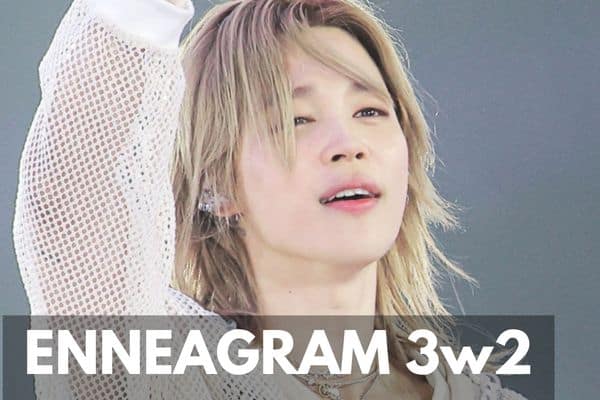
Jimin has one of the most emotionally transparent faces in BTS, which is ironic because underneath that openness is someone who has spent much of his life trying to perfect himself for other people.
At first glance, people sometimes type Jimin as a Two because he’s affectionate, emotionally expressive, sensitive, and deeply relational. But the more I looked at the emotional themes that consistently appear in his interviews, live streams, and lyrics, the more 3w2 made sense.
At their core, Enneagram Threes are driven by a need to become valuable, admired, successful, and worthy through achievement. They often adapt themselves into the version that will be loved, respected, or appreciated most by the people around them. The 2-wing adds emotional warmth, charm, generosity, and a stronger focus on relationships and emotional connection.
One of the clearest examples is how deeply tied his self-worth seems to be to improvement and performance and living up to others’ expectations.
“I want to grow further and faster so I can show them a really great performance.”
“As the days pass by, I want to develop and show you all a better side of me.”
“It must’ve become rooted in me like some kind of obsession. That if I don’t act the way people wanted me to, or if I didn’t give as much as others wanted me to give, I would be a worthless kind of person.
There’s a constant movement toward becoming better, refining himself, improving his image, improving his performances, and becoming more worthy. Threes, at their core, fear that without achievement and success they will be worthless. In Jimin’s own words this seems to be a clear fear. That said, I want to clarify that he has experienced a tremendous amount of growth and now speaks as though he’s learning to love himself as he is much more.
Unlike more detached achievers, Jimin’s motivation is all about relationships and connection.
“I’m kind of a person who likes to be loved.”
“I am really so happy when I see the thousands of fans in the crowd. It’s so beautiful. The view that I have from the stage is like a pretty sunset. I get frustrated when I can’t express just how happy I am through expression or words.”
“I am the most thankful that we are able to be in this journey together. I believe that I would not be where I am today if we weren’t able to do this together.”
Beneath all the perfectionism, discipline, and professionalism, there’s a very human emotional longing underneath it all: the desire to be cherished, valued, and emotionally meaningful to other people. Even J-Hope said, “Jimin, you’re pure romance.”
“I wanted people to be smiling and have them near me, which is why I would sometimes resort to exaggeration. I’d be acting like someone else, in other words. Then, from 2019, I would stay silent when I wanted to be silent, and tried speaking out against things when I didn’t like them. And that’s when I began to see it clearly. It’s not that I didn’t want to be alone, I just didn’t want to be left behind.”
Threes, especially 3w2s, often learn very early that they can secure love, approval, closeness, and belonging by becoming whatever version of themselves people respond positively to. They become emotionally adaptive, charming, pleasing, impressive, and entertaining. Sometimes so much so that they slowly lose touch with what they genuinely feel underneath the performance. Underneath all the striving, emotional attentiveness, charm, perfectionism, and people-pleasing, there’s often a very human fear in 3w2s that if they stop performing well enough, adapting well enough, or becoming lovable enough, they may lose connection altogether.
“I only realized it recently, but I used to be really unstable. I was acting like I was well-grounded when I was around other people, like my family and friends. It meant I had to pretend a lot. I worried about others by saying things like, I’m fine, but how are you? I spoke like I could always take care of anything that came up, but looking back, that wasn’t the case.”
“I wish I could always smile. I hope I wouldn’t laugh in sadness. I truly wish I could laugh. I wish I only had moments of genuine laughter.”
Jimin’s early trainee years were especially hard on him. He was nearly cut from BTS eight times prior to his debut. Because much of his dance background was ballet and contemporary, adapting to hip hop and idol choreography was especially challenging. He used to sleep at the studio, practicing for 16+ hours a day, working himself to exhaustion to try to preserve his place.
“I had given up a perfectly good life learning dance in high school to come up to Seoul, but no one cared. You could be eliminated after any of the tests they would put us through time to time, which was scary. I was really putting the pedal to the metal then. I wanted desperately to find the reason why I was in this scene. That I wasn’t here only because I was forcing it or out of sheer luck. Which was why I tried to make one more person like me, to show one more person how much better I was doing.”
“I would practice until about 4 AM and wake up around 6:30 to go to school.”
“I endure all these hardships and continued to practice hard in order to be a part of the team all because of the members. We are all equally lacking and we are all the same people, but we can do it if we are together.”
“When I was at the dorm, I always felt uneasy and thought, ‘Should I really be taking a break like this?’…Even on my days off, I would go to the practice room to rest. I stayed with the thought that maybe I’d practice just one more time.”
“Every month I was told ‘this time it was really dangerous.'”
“Coming up from Busan, I had no home, so I ended up staying at the dormitory. The thought of not knowing when I might have to leave that place was very uncomfortable and tough.”
Jimin is known for his relentless perfectionism in performance. While he often appears as playful, charming, and socially smooth, there’s an inner vulnerability there.
Threes often believe they are only worthy if they can perform well, and they can downplay or overlook their core value as a human if they don’t feel they’re accomplishing enough. Because of this, they put their all into showing their best selves and denying any underlying pain.
“No matter how hard it is right now, think of how the result will make you feel.”
You can see this same perfectionism and struggle to achieve in how intensely self-critical Jimin has been at various points in the past.
“The reasons why I’ve had a hard time these days is that I can’t do well. As hard as I try I can’t do it well. Honestly, these days, the amount of effort I put in and the time that I’ve invested to show a better version of myself, is not much compared to before, and I regret that and think I should change.”
“Even if I’m a little hurt, it’s okay.”
“For our team, I should live quietly. I have to live without standing out for being bad. So I have to improve quickly. Also I have to do well quickly.”
“I still don’t think I’ve grown much. When I see what I’m doing, I feel frustrated…Talent is essential, and perhaps I lack it.”
I’m sure anyone who reads this will agree with me that Jimin is extremely talented, from his singing to his dancing to his connection with ARMY, he never stops showing us new skills and abilities. Yet Threes often feel like it’s never enough. When he struggled during a 2023 performance of “Like Crazy”, the media and onlookers were quick to tear him down. But no one was harder on Jimin than himself:
“In March, after my solo activities, I learned a lot from the experience. Realistically, I thought, ‘I’m lacking in so many ways. I can’t continue like this.’ I had a lot of thoughts like that, and I felt very embarrassed. It wasn’t about nerves or other problems. It was simply that I was lacking, and instead of trying to compensate from these shortcomings, I wanted to start new from scratch. Looking back, it was just excuses I made for myself, and I had been too lazy.”
There’s a tendency in Threes to override pain and continue pushing themselves forward anyway. Any break, any pause can feel like “laziness.” Jimin repeatedly seems willing to endure enormous emotional and physical strain in order to improve. Even RM said, “Jimin works very hard. He always wants to do better.”
“According to my standards, Jimin hyung is the most strict and hard-working on himself.” – Jungkook
As much as Jimin has pushed himself and been hard on himself, he also wants to help others who feel like they’re not good enough.
“I thought the phrase ‘Love Yourself’ would mean extra special to people who are harsh on themselves.”
Another thing to notice is that Jimin’s relationship with performance also demonstrates Three tendencies. The stage doesn’t just seem like a job for him. It seems like a place where identity, love, self-worth, artistry, and emotional connection all fuse together.
“It’s like I’m at another time and space. The stage is the world that heals me.”
“It (dancing) was my own space where I could go to a different world, where I didn’t have to think about other things. It was something that I could really immerse myself into. And it made me feel really free. And it made me really happy.“
Healthy Threes often feel most alive when they’re fully embodying the version of themselves they’ve worked so hard to become. Performance becomes emotional confirmation that they matter.
Now let’s look at the Two wing. Unlike some Threes who are more focused on individual pursuits, Jimin’s 2-wing keeps him emotionally attuned to other people. He doesn’t just want admiration. He wants emotional closeness and mutual care.
“One thing I’m always curious about, about our fans, is what’s the hardest thing in their lives. What each of them is struggling with, what’s making them happy—I’m really curious to know. We face our own difficulties as well, so I always wonder if there’s someone in each of our fans’ lives to ask them if they’re doing okay.”
Jimin often speaks to fans not from a distant celebrity position, but from a place of emotional companionship.
“Remember there is a person here in Korea, in the city of Seoul, who understands you.”
Jimin seems like someone who learned to pursue love through excellence and self-improvement, but who is gradually discovering that he doesn’t have to become perfect to deserve care, connection, or belonging.
Jimin’s military service seemed to intensify both sides of his personality simultaneously: the relentless perfectionism and the deep emotional warmth. From the very beginning, he ranked first during basic training and was chosen to represent his fellow soldiers at the completion ceremony. Later, he became a squad leader and earned the “Special Grade Soldier” title through exceptional performance in leadership, physical endurance, and shooting. Asian Entertainment and Culture stated, “If it is actual war and on the battlefield, Jimin, because he specializes in jungle or weapons, would be the most lethal.”
To be specific, Jimin specialized in the 15mm Howitzer which requires a 5-man crew, pinpoint accuracy, and battlefield level coordination to operate accurately. He was the commander in charge of this weapon. He also had to master various handheld guns and was stationed in the jungle, where he had to undergo intense jungle survival training. Many soldiers have attested that jungle survival training is by far the hardest of all training mentally. During some of this training, you are totally isolated without a radio or team or clear support and have to survive in dire and dangerous circumstances. Soldiers often face hunger, thirst, loneliness, and more. You can find out more about his military role here.
What stands out just as much during Jimin’s military career is how often fellow soldiers described him as unusually kind, considerate, and emotionally supportive during difficult conditions on the front lines. Jimin himself admitted the experience felt psychologically intense, saying that a single week could feel like a month, and that he became so immersed in military life he temporarily forgot he was an entertainer at all. Even after discharge, instead of focusing on his own hardship, he encouraged civilians to offer soldiers warmth and kindness because he had personally seen how hard military life could be.
“Lastly, if I could dare ask for something to the citizens, now that I’ve served in the military and I’ve seen how it is… Many people are working so hard, so if you see the soldiers when you pass by them out there, and if you are comfortable, please give them some warm words. I would feel so honored.”
What makes Jimin especially compelling to me psychologically is that underneath all the achievement, discipline, charm, and emotional sensitivity is someone who seems to have spent much of his life trying to earn the right to belong. But over the years, there’s also been visible growth in him. More honesty. More willingness to show imperfection. More acceptance of himself as a human being rather than just a performer. And I think that’s part of why so many people connect to him so deeply. Beneath the polish, Jimin never really hides the vulnerable human heart underneath it all.
What Do You Think?
Do you agree with my perspectives or do you have a different perspective or insight to share? Let me and other readers know in the comments!
Find out more about your personality type in our eBooks, Discovering You: Unlocking the Power of Personality Type, The INFJ – Understanding the Mystic, and The INFP – Understanding the Dreamer. You can also connect with me via Facebook, Instagram, or YouTube!