
What You’re Like in a Loop, Based On Your Myers-Briggs® Personality Type
Have you ever heard the word “looping” thrown around and wondered what it meant? In the type community, looping is an instance where someone veers back and forth between the dominant and tertiary functions in their mental function stack. Not sure what functions are? Don’t worry, we’ll get into it step-by-step.
Here’s a picture to help clarify. We’re using the INTJ as an example, but we’ll be discussing all 16 personality types in the article:

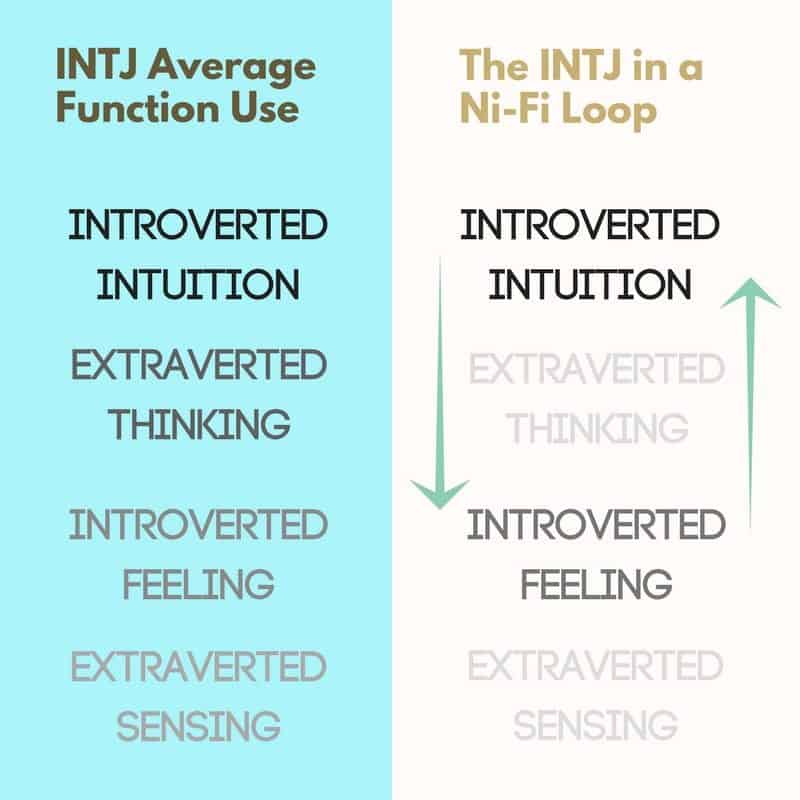
The INTJ functions best when there’s a healthy balance of introverted and extroverted input. We all need some input from our inner world and our outer world. But in a loop, the INTJ is more detached from the external world than is healthy. Instead of putting his insights and visions (Ni) into action (Te) he sits on them and analyzes them through the realm of his feeling function (Fi). How can this show up in a negative way? Well, that’s where this article comes in. We’re going to take a brief look at how “looping” shows up for each of the 16 Myers-Briggs personality types.
Why Does Looping Happen?
Looping often boils down to someone living in their preferred introverted or extroverted state at the expense of their well-being. Introverts are going to have a natural comfort with their introverted functions. For example, if you’re an ISFJ then Introverted Sensing (Si) and Introverted Thinking (Ti) will be comfortable for you because they don’t cause you to venture into an extroverted place. In the same way, an ESTP is most comfortable in the extroverted world. Therefore, they might enjoy staying in an Extraverted Sensing (Se) and Extraverted Feeling (Fe) loop.
Auxiliary-Inferior loops can happen, but dominant-tertiary loops are much more common. So today those are the loops we’re going to be looking at.
Confused?
Even if you don’t know about cognitive functions or function stacks yet, this article can help you to identify if you’re in an unhealthy pattern of type development. You can enjoy the read even without knowing all the in-depth typology jargon, I promise!
Want to find out more?
Joel Mark-Witt and Antonia Dodge from Personality Hacker have written extensively about loops in their book, Personality Hacker: Harness the power of your personality type to transform your work, relationships, and life
This article contains affiliate links to books on Amazon. If you purchase one of these books, I get a small kickback that I can use to pay for hosting and other demands of this site. I only recommend books I love.
What Each of the 16 Personality Types is Like in a Loop
Table of contents
- Why Does Looping Happen?
- Confused?
- Want to find out more?
- What Each of the 16 Personality Types is Like in a Loop
- The ENFP Ne-Te Loop
- The ENTP Ne-Fe Loop
- The INFP Fi-Si Loop
- The INTP Ti-Si Loop
- The ENFJ Fe-Se Loop
- The ENTJ Te-Se Loop
- The INFJ Ni-Ti Loop
- The INTJ Ni-Fi Loop
- The ESFP Se-Te Loop
- The ESTP Se-Fe Loop
- The ISFP Fi-Ni Loop
- The ISTP Ti-Ni Loop
- The ESFJ Fe-Ne Loop
- The ESTJ Te-Ne Loop
- The ISFJ Si-Ti Loop
- The ISTJ Si-Fi Loop
Estimated reading time: 14 minutes
The ENFP Ne-Te Loop
ENFPs normally balance their excitement for possibilities (Ne) with a strong internal sense of meaning and personal conviction (Fi). Healthy ENFPs aren’t focused on excitement for its own sake (at least, most of the time). They chase ideas that feel alive to them. Ideas that connect to their identity, values, emotions, creativity, or sense of purpose.
That Fi side acts like an internal compass. It helps the ENFP ask:
“Does this actually matter to me?”
“Is this authentic?”
“Is this who I want to become?”
But in a Ne-Te loop, the ENFP starts bypassing that inner compass entirely. Instead of slowing down to process their feelings or values, they stay in constant motion. They brainstorm, plan, optimize, achieve, produce, network, hustle, fix, organize, and chase the next possibility without ever really checking whether any of it feels meaningful anymore.
From the outside, they may even look productive or successful for a while. Internally, though, they often feel strangely disconnected from themselves.
A looping ENFP tends to become externally driven instead of internally guided. Their life turns into a constant search for momentum, validation, stimulation, or achievement. The problem is that without Fi grounding them, they can end up climbing ladders they never actually wanted to be on in the first place.
How this can show up:
- Chasing after ideas without checking in to make sure the ideas coincide with their values or ethics
- Chasing “success” through a series of superficial, short-lived goals
- Spending an inordinate amount of time on “busywork” only to regret it later because it doesn’t provide true meaning or fulfillment
- Over-reacting to perceived offenses without taking time to internally process what’s happening
- Doing what’s easy rather than what they feel is right
- Burying negative feelings by chasing after achievement
- Struggling to put themselves in other people’s shoes without projecting
- Trying to solve every problem with hard facts or fruitless brainstorming
- Comparing themselves to the successes of others
- Becoming impatient and negative when having to introspect or analyze their values
A lot of ENFPs in this state feel emotionally numb and weirdly restless at the same time.
How ENFPs Break Out of the Loop
The way out usually involves reconnecting with Introverted Feeling (Fi), the part of the ENFP personality that processes emotions, clarifies values, and asks what genuinely matters on a personal level. This often means slowing down long enough to hear themselves again. Which sounds simple until you realize many looping ENFPs are treating silence like it’s a federally banned substance.
Breaking the loop can involve:
- Journaling without trying to “perform” or optimize the outcome
- Asking “Do I actually want this?” instead of “Could I succeed at this?”
- Spending time alone without distractions
- Letting themselves feel emotions instead of immediately escaping them
- Reconnecting with art, music, creativity, or causes that feel personally meaningful
- Making decisions based on conviction instead of urgency or external validation
- Reflecting on what kind of life feels authentic, not just impressive
Healthy Fi helps ENFPs stop scattering their energy across a thousand disconnected pursuits. It reminds them that meaning matters more than momentum.
ENFPs are happiest and most fulfilled when their enthusiasm is connected to something real. Otherwise they can accidentally become the human equivalent of twenty browser tabs, three unfinished screenplays, a productivity app they forgot to open, and a motivational speech happening during a mild existential crisis.
The ENTP Ne-Fe Loop
ENTPs normally balance exploration and innovation (Ne) with internal logical clarity (Ti). Healthy ENTPs are curious, inventive, and mentally flexible, but there’s usually a strong analytical core underneath all the chaos. Their Ti helps them slow down and ask:
“Does this actually make sense?”
“Is this true?”
“Am I being intellectually honest here?”
That inner framework keeps the ENTP grounded. It gives structure to all the brainstorming, debating, experimenting, and idea-hopping. However, in a Ne-Fe loop, the ENTP starts bypassing that internal analysis. Instead of filtering ideas through logic and personal reasoning, they become increasingly reactive to external energy, approval, emotional reactions, and social feedback. Their attention shifts outward. They stop asking whether something is true and start unconsciously focusing on whether it gets a response.
At first, this can look charismatic or socially energetic. The ENTP becomes funny, engaging, provocative, adaptable, maybe even wildly charming. But underneath it, there’s often a growing disconnect from their own intellectual center. A looping ENTP can start shaping themselves around reactions instead of principles. They chase stimulation, novelty, debate, validation, momentum, attention, emotional intensity. The problem is that without Ti grounding them, they can lose track of what they actually believe.
How this can show up:
- Jumping from project to project and quitting when things get tedious
- Trolling other people for a “reaction”
- Putting other people’s needs ahead of the most logical course
- Using emotion to defend against criticism (cracking jokes, appealing to emotions)
- Distrusting their own logic
- Seeking praise rather than determining their own sense of self-worth
- Using people as “tools” for self-centered gains
- Struggling to admit when they’re wrong
A lot of ENTPs in this state feel internally untethered. Their personality starts becoming reactive instead of intentional.
How ENTPs Break Out of the Loop
The way out usually involves reconnecting with Introverted Thinking (Ti), the part of the ENTP personality that analyzes independently, clarifies principles, and looks for truth over reaction. For many ENTPs, this means learning to tolerate quiet long enough to actually hear their own thoughts without immediately turning them into entertainment for other people.
Breaking the loop can involve:
- Spending time alone thinking without outside input
- Writing ideas down and logically examining them
- Asking “Do I actually believe this?” instead of “Does this get a reaction?”
- Following through on projects even after the excitement fades
- Letting criticism become information instead of a threat to identity
- Building internal standards instead of relying on praise or attention
- Practicing intellectual honesty, especially when it’s uncomfortable
Healthy Ti helps ENTPs regain their center of gravity. It reminds them that being clever is not the same thing as being grounded, and that endless stimulation is not the same thing as genuine growth.
The INFP Fi-Si Loop
INFPs normally balance their deeply personal values (Fi) with a sense of curiosity and possibility (Ne). Even when life is hard, healthy INFPs usually have some part of them asking:
“What else could this mean?”
“What else is possible?”
“Maybe there’s another path.”
But in a Fi-Si loop, that openness starts to collapse inward.
Instead of exploring new ideas or possibilities, the INFP begins recycling old feelings, old memories, old hurts, and old interpretations of reality. They retreat into what feels emotionally familiar and safe. Over time, their world can get smaller and smaller without them fully realizing it.
A looping INFP may start feeling emotionally trapped, hypersensitive, defensive, nostalgic, or strangely stuck. They can become so focused on protecting their inner world that they stop growing it.
How this can show up:
- Replaying old emotional wounds over and over
- Retreating into fantasy, nostalgia, routines, or comfort habits
- Avoiding new experiences because they feel draining or risky
- Becoming unusually pessimistic or closed-minded
- Feeling secretly resentful when people challenge their beliefs or identity
- Staying isolated for too long and becoming disconnected from reality
- Over-identifying with past pain or past versions of themselves
- Romanticizing “what could have been”
- Refusing opportunities because they feel unfamiliar or uncomfortable
- Hiding their authentic self while also feeling misunderstood
- Getting stuck in analysis and emotion without taking meaningful action
A lot of INFPs in this state feel like they’ve lost their spark. Life starts feeling repetitive, emotionally heavy, and strangely airless. Instead of imagining new possibilities, they keep circling the same emotional territory like a raccoon trapped in a garage at 2am.
How INFPs Break Out of the Loop
The way out usually involves reconnecting with Extraverted Intuition (Ne), the part of the INFP personality that explores, experiments, and opens doors mentally and emotionally.
That doesn’t necessarily mean doing something huge or dramatic. Usually it starts small.
- Talk to new people
- Read something outside your usual interests
- Go somewhere unfamiliar
- Start creating again, even badly
- Explore ideas without immediately deciding whether they’re “right”
- Let yourself be curious instead of certain
Healthy Ne reminds INFPs that life is still unfolding. There are still possibilities they haven’t seen yet. They are more than their past experiences, more than their current feelings, and more than the story their mind has been replaying on a loop for the last three weeks while staring at the ceiling fan.
The INTP Ti-Si Loop
INTPs normally balance deep analysis (Ti) with curiosity and exploration (Ne). Healthy INTPs analyze and expand ideas. They chase connections, possibilities, contradictions, weird theories at 1am, and questions that accidentally destroy their sleep schedule. Even when they’re highly logical, there’s usually a playful, exploratory side to their thinking.
But in a Ti-Si loop, that curiosity starts collapsing inward.
Instead of exploring new possibilities, the INTP becomes trapped recycling the same thoughts, same conclusions, same routines, and same internal frameworks over and over again. Their thinking becomes less exploratory and more defensive. Less “What if?” and more “I already know why this won’t work.” The result is often a strange mix of intellectual overactivity and real-world paralysis.
A looping INTP may spend enormous amounts of time thinking, researching, categorizing, optimizing, theorizing, or mentally preparing…while becoming increasingly disconnected from actual lived experience. Their world slowly narrows without them realizing it.
How this can show up:
- Retreating from the world and thus failing to ground their theories in real-world experiences
- Becoming anxious or hesitant to try new things.
- Extreme aversion to risk.
- Relying on bad habits or creature comforts at the expense of their relationships or responsibilities.
- Developing tunnel vision and having difficulty generating positive alternatives or possibilities.
- Becoming an “armchair expert” on many things without testing their validity in the real world
- Avoiding human connection, even when they desire it
A lot of INTPs in this state feel mentally claustrophobic. Their mind becomes like a browser with 74 tabs open, except every tab is somehow the same argument wearing a fake mustache.
How INTPs Break Out of the Loop
The way out usually involves reconnecting with Extraverted Intuition (Ne), the part of the INTP personality that explores possibilities, experiments freely, and engages with the unknown.
INTPs often don’t escape loops by “thinking harder.” Usually they escape by interrupting the closed system.
That means:
- Trying something before fully understanding it
- Talking ideas out loud with other people
- Exploring unfamiliar perspectives
- Letting curiosity matter more than certainty
- Engaging with the real world instead of endlessly preparing for it
- Allowing room for spontaneity, experimentation, and even mistakes
Healthy Ne reminds INTPs that life is not a math proof you solve before participating in it. Sometimes clarity comes after movement, not before.
The ENFJ Fe-Se Loop
ENFJs normally balance emotional connection and outward engagement (Fe) with deep insight and long-range vision (Ni). Healthy ENFJs aren’t reactive or emotionally volatile. Instead, they pause and look beneath the surface. They notice patterns in people, underlying motives, future consequences, and emotional dynamics that other people completely miss.
That quiet intuitive side gives the ENFJ depth and direction. It helps them ask:
“Where is this heading?”
“What’s really going on here?”
“What actually matters in the long run?”
But in a Fe-Se loop, the ENFJ starts bypassing that deeper reflection. Instead of slowing down to process insightfully, they become increasingly reactive to external stimulation, social feedback, emotional intensity, and immediate experiences. Their attention gets pulled outward so constantly that they lose touch with their inner clarity.
At first, this can look energetic, charismatic, productive, or socially magnetic. The ENFJ may become more outgoing, spontaneous, emotionally expressive, or action-oriented than usual. But underneath that energy is often a growing sense of restlessness and disconnection.
A looping ENFJ can become trapped chasing external momentum while ignoring their deeper intuition. They keep moving, helping, socializing, reacting, performing, fixing, planning, or emotionally managing everyone around them without stopping long enough to ask whether any of it still feels aligned or wise.
How this can show up:
- Inability to tolerate being alone
- Reacting to other people without taking the time to analyze their perspectives thoroughly
- Chasing after emotional “highs” and thrills without looking at the long-term implications
- Selectively choosing “facts” to support their judgments
- Jumping to conclusions
- Chasing superficial markers of success and obsessing over “image”
- Feeling restless and indecisive and making poor choices as a result
- Becoming self-indulgent at the expense of their health
- Being out of touch with their own feelings
- Developing an impatient “hurry-it-up” attitude towards people, particularly introverts
A lot of ENFJs in this state feel emotionally overstimulated but internally untethered. Like their whole nervous system is standing in the middle of Times Square holding twelve conversations at once while their intuition sits quietly in the corner trying to make meaningful eye contact that nobody notices.
How ENFJs Break Out of the Loop
The way out usually involves reconnecting with Introverted Intuition (Ni), the part of the ENFJ personality that slows down, reflects deeply, and looks for underlying meaning and direction. For many ENFJs, this means stepping away from constant external input long enough to actually hear themselves think again. Which can feel surprisingly uncomfortable at first because looping ENFJs often develop a reflexive fear or restlessness around stillness.
Breaking the loop can involve:
- Spending intentional time alone without distractions
- Journaling or reflecting before reacting emotionally
- Looking for long-term patterns instead of immediate emotional fixes
- Asking “What is this really about?”
- Meditating, walking, praying, or engaging in quiet reflective practices
- Limiting overstimulation and unnecessary social obligations
- Letting themselves pause before making decisions or judgments
- Reconnecting with personal vision and purpose instead of external momentum
Healthy Ni helps ENFJs regain perspective. It reminds them that not every emotion requires immediate action, not every opportunity needs to be chased, and not every social fire needs them personally sprinting toward it carrying emotional buckets and motivational speeches.
The ENTJ Te-Se Loop
ENTJs normally balance decisive action and external efficiency (Te) with long-range vision and strategic insight (Ni). Healthy ENTJs are rarely just charging forward randomly. Even when they move quickly, there’s usually an underlying vision and strategy guiding them. Their intuition helps them see patterns, anticipate consequences, and think several moves ahead.
That Ni side is what gives the ENTJ depth instead of just drive. It helps them ask:
“Where is this leading?”
“What’s the larger strategy here?”
“What actually matters long-term?”
But in a Te-Se loop, the ENTJ starts bypassing that reflective, intuitive process. Instead of slowing down to think strategically, they become increasingly focused on immediate action, measurable results, stimulation, achievement, and external momentum. They start operating in constant “go mode.” Productivity becomes compulsive and action starts replacing reflection.
At first, this can even look impressive. In this state, ENTJs tend to seem highly motivated, energetic, bold, competitive, or unstoppable. They may throw themselves into work, leadership, fitness, networking, goals, status, or external success with enormous intensity. But underneath it, there’s often a growing sense of inner disconnection.
A looping ENTJ can become so focused on conquering the next challenge that they stop questioning whether the challenge is even worth conquering anymore. They keep moving because slowing down would force them to confront emotions, uncertainty, exhaustion, or deeper existential questions they’ve been outrunning for six straight months.
How this can show up:
- Putting their objectives into action too quickly, without thinking them through or looking at the long-term implications of their decisions
- Becoming fixated on short-term successes and achievements at the expense of their long-term goals
- Being impatient and high-tempered
- Escaping difficult situations without looking at the underlying patterns for the problems
- Becoming image-focused and superior because they fear inadequacy
- Avoiding introspection because they fear they will not like what they see
- Acting out recklessly and indulgently when stressed
A lot of ENTJs in this state feel strangely hollow beneath all their momentum. They may accomplish more and more while feeling less and less connected to themselves. The external machine keeps running, but internally there’s this growing sense of, “Wait… why am I even doing all this?”
Which is not a question looping ENTJs enjoy sitting with for very long.
How ENTJs Break Out of the Loop
The way out usually involves reconnecting with Introverted Intuition (Ni), the part of the ENTJ personality that reflects deeply, recognizes patterns, and reconnects with long-term meaning and direction. For many ENTJs, this means intentionally stepping away from constant output long enough to think without immediately trying to optimize, fix, dominate, or solve something. This can feel extremely unnatural at first. Looping ENTJs often treat stillness the way medieval villagers treated suspicious forest witches. With fear, hostility, and a strong urge to set something on fire.
Breaking the loop can involve:
- Taking quiet time to reflect before making major decisions
- Journaling or thinking through long-term implications
- Asking “Why am I pursuing this?” instead of only “Can I achieve this?”
- Slowing down enough to notice emotional exhaustion or burnout
- Spending time alone without constant productivity
- Reconnecting with larger purpose and vision
- Looking for patterns instead of reacting to immediate pressures
- Allowing uncertainty to exist without instantly forcing control over it
Healthy Ni helps ENTJs regain perspective. It reminds them that effectiveness without meaning eventually becomes empty, and that wisdom matters just as much as execution.
The INFJ Ni-Ti Loop
INFJs normally balance deep insight and pattern recognition (Ni) with emotional attunement and human connection (Fe). For healthy INFJs, life is about understanding the big picture while connecting in a meaningful way with individuals. They care about emotional truth, human needs, and creating genuine understanding between people. Their intuition helps them see beneath the surface, while Extraverted Feeling helps them stay connected to real human experience instead of disappearing entirely into abstraction.
But in a Ni-Ti loop, the INFJ starts withdrawing from that emotional connection. Instead of using Fe to reality-check their insights and stay relationally grounded, they retreat deeper and deeper into private analysis. Their mind becomes increasingly internal, theoretical, and self-contained. They start over-relying on intuition and internal logic while slowly disconnecting from the emotional world around them.
At first, this can feel strangely safe or even empowering. The INFJ may feel more independent, analytical, intellectually sharp, or “above” messy emotional dynamics. But over time, the loop often becomes isolating and emotionally sterile. A looping INFJ can become trapped inside their own interpretations of reality. They analyze endlessly, searching for hidden meanings, patterns, motives, implications, and explanations while becoming increasingly disconnected from actual human interaction and emotional vulnerability. The result is often a person who looks calm externally but feels mentally exhausted and emotionally cut off internally.
How this can show up:
- Retreating from the outside world excessively
- Becoming detached and critical of other people’s perspectives without understanding their underlying feelings
- Reacting impatiently when people intrude on them or request their help
- Becoming cold and distant towards loved ones
- Nitpicking other people’s arguments and pointing out minor technicalities to dismiss them
- Becoming self-protective and withdrawn in order to protect from vulnerability
- Becoming detached from their own feelings
- Stubbornly insisting on one “right” way to do things
- Trusting intuition and theories without testing their ideas in the real world for validity
- Getting stuck in overthinking and only trusting their own logic
A lot of INFJs in this state feel deeply lonely while also feeling exhausted by the idea of social interaction. They crave understanding and connection, but vulnerability starts feeling dangerous or draining. So they retreat further into their minds, where everything feels more controllable and significantly less likely to text them “hey can we talk?” at 11:48pm.
How INFJs Break Out of the Loop
The way out usually involves reconnecting with Extraverted Feeling (Fe), the part of the INFJ personality that connects emotionally with the outside world and remembers that insight is supposed to serve human connection, not replace it. For many INFJs, this means gently re-entering life instead of endlessly analyzing it from a distance.
Breaking the loop can involve:
- Reaching out to trusted people instead of isolating
- Talking through thoughts and feelings out loud
- Participating in meaningful conversations or shared experiences
- Volunteering, mentoring, helping, or supporting others in practical ways
- Letting themselves experience emotions instead of immediately dissecting them
- Allowing human connection to be imperfect instead of hyper-analyzed
- Engaging with the real world instead of living entirely in interpretation mode
Healthy Fe helps INFJs reconnect to warmth, empathy, and shared humanity. It gives their life more warmth, meaning, and a sense of connection.
The INTJ Ni-Fi Loop
INTJs normally balance deep strategic insight (Ni) with focused execution and logical structure (Te). They’re not simply focused on theories and abstractions for their own sake. They test those theories against reality. Their intuition helps them see patterns and long-term implications, while Te helps them organize those insights into effective plans and measurable results.
But in a Ni-Fi loop, that external grounding starts collapsing inward. Instead of testing their insights objectively, the INTJ retreats deeper into personal interpretations, emotional reactions, and internal stories. Their intuition and personal feelings begin feeding each other in a closed system. Over time, they can become increasingly isolated, defensive, rigid, or disconnected from reality-testing.
Looping INTJs tend to spend enormous amounts of time analyzing motives, interpreting patterns, refining theories, or mentally replaying perceived betrayals and disappointments…while becoming increasingly detached from outside feedback and practical action. Their inner world slowly becomes more airtight and emotionally charged without them fully realizing it.
How this can show up:
- Retreating from the outside world excessively
- Developing theories but failing to test them in the outside world
- Becoming defensive and over-reactive towards any perceived personal slight
- Feeling that they are misunderstood misfits even though they refuse to invite other people into their lives
- Believing that they are morally superior to others
- Trusting poor insights because they’re not logically analyzing them
- Being irresponsible and careless in personal relationships
- Reacting harshly to any interruption or demand from others
- Feeling like they shouldn’t have to do anything they don’t feel like doing
Which means the INTJ slowly becomes trapped inside a mental echo chamber wearing the aesthetic of intellectual independence.
How INTJs Break Out of the Loop
The way out usually involves reconnecting with Extraverted Thinking (Te), the part of the INTJ personality that connects with external reality, tests ideas objectively, and focuses on effectiveness rather than internal emotional certainty. For many INTJs, this means shifting from endless interpretation into measurable action.
Breaking the loop can involve:
- Testing ideas in the real world instead of only theorizing about them
- Seeking objective feedback from trusted sources
- Creating structure, plans, timelines, or measurable goals
- Re-engaging with work, systems, projects, or practical problem-solving
- Allowing trusted people to challenge their conclusions
- Taking action before feeling emotionally certain
- Separating intuition from emotional woundedness
Healthy Te helps INTJs regain perspective. It reminds them that insight becomes distorted when it exists entirely in isolation, and that even brilliant intuitions still need contact with reality. At their best, INTJs are not just visionaries hidden away in their introverted bubbles. They are builders, strategists, innovators, and architects of real change. The loop traps them inside subjective interpretation and Te helps them reconnect their inner vision to the external world where it can actually do something useful.
The ESFP Se-Te Loop
ESFPs normally balance spontaneity and connection with the outside world (Se) with a strong personal value system (Fi). Healthy ESFPs balance their hunger for excitement with their deeply-held personal values. Their feeling side helps them ask:
“Does this actually matter to me?”
“Is this authentic?”
“Am I proud of who I’m becoming?”
That Fi side gives the ESFP emotional depth beneath all the energy and charisma. It’s why healthy ESFPs are usually more thoughtful, loyal, and emotionally perceptive than people expect.
But in a Se-Te loop, that inner emotional direction starts getting ignored or hazy. Instead of slowing down to reflect on what feels meaningful or morally right, they becomes increasingly focused on action, momentum, productivity, achievement, stimulation, and external results. They keep moving, reacting, fixing, doing, competing, organizing, or chasing the next thing without stopping long enough to process what they actually feel.
A looping ESFP can become so focused on staying active and effective that they slowly lose touch with their deeper values and emotional needs. Their life becomes driven by external momentum instead of internal conviction. The result is often a person who looks confident and engaged externally while internally feeling restless, irritable, emotionally numb, or strangely empty.
How this can show up:
- Impulsively chasing excitement without checking into their moral compass
- Taking the easy path instead of the path that would provide long-term meaning
- Becoming stubborn and demanding
- Believing that their criticisms and judgments are objective, but not looking inward to analyze them properly
- Becoming forceful and aggressive to protect their ego
- Becoming obsessed with accomplishing a lot of “busy-work” tasks without slowing down to figure out which projects are the most important
- Losing touch with what matters to them personally
- Micro-managing others and believing that everyone else is “lazy” or too slow
- Basing their self-worth on external achievements
A lot of ESFPs in this state feel emotionally disconnected from themselves without fully realizing it. They just know they can’t seem to slow down anymore, and stillness feels more uncomfortable than it should.
How ESFPs Break Out of the Loop
The way out usually involves reconnecting with Introverted Feeling (Fi), the part of the ESFP personality that looks inside, processes emotions, and reconnects with personal meaning and authenticity. For many ESFPs, this means intentionally slowing down long enough to ask themselves what they actually want beneath all the activity and momentum.
Breaking the loop can involve:
- Spending time alone without constant distractions
- Journaling or reflecting on emotional reactions
- Asking “Does this feel meaningful to me?” instead of only “Does this work?”
- Reconnecting with personal values and emotional truth
- Making decisions based on conviction rather than impulse
- Letting themselves process difficult emotions instead of escaping them
- Engaging in creative or emotionally expressive activities
Healthy Fi helps ESFPs regain their center of gravity. It reminds them that success without emotional authenticity eventually feels hollow, no matter how exciting or impressive it looks from the outside.
The ESTP Se-Fe Loop
ESTPs normally balance action, adaptability, and real-world responsiveness (Se) with internal logical analysis (Ti). Healthy ESTPs assess situations, troubleshoot problems, and figure out what actually makes sense instead of living purely on impulse. Their thinking side helps them stay sharp, grounded, and strategically aware even in high-pressure situations.
That Ti side is part of why healthy ESTPs are often much more analytical than people assume. Underneath the charisma and spontaneity, there’s usually a strong instinct for accuracy, efficiency, and realistic problem-solving.
But in a Se-Fe loop, that internal analysis starts getting bypassed.
Instead of slowing down to think independently, the ESTP becomes increasingly reactive to external stimulation, emotional reactions, social dynamics, and approval. They start chasing momentum, excitement, image, attention, or validation without stopping to examine whether their choices actually make sense long-term. At first, this can look fun, confident, charming, or socially magnetic. They tend to become more outgoing, entertaining, impulsive, or emotionally expressive than usual. But underneath it, there’s often a growing disconnect from their own judgment and self-awareness.
How this can show up:
- Recklessly chasing fun and excitement at the expense of the most logical path
- One-upping or exaggerating in order to appear more impressive
- Becoming obsessed with image and external perceptions of success
- Difficulty admitting that their poor judgments caused long-term problems
- Using humor or emotions to deflect criticism
- Manipulating situations so that they deflect responsibility away from themselves
- Reacting impulsively without reflecting
- Relying too much on close relationships to set the course for their lives
- Not analyzing their own thinking critically
- Feeling the need to be the center of attention
A lot of ESTPs in this state feel restless underneath all the activity. They keep chasing the next experience, conversation, thrill, relationship, or distraction because slowing down would force them to confront things they haven’t fully processed yet.
How ESTPs Break Out of the Loop
The way out usually involves reconnecting with Introverted Thinking (Ti), the part of the ESTP function stack that questions assumptions and looks for logical consistency beneath surface reactions.
For many ESTPs, this means learning to pause before reacting and asking themselves what actually makes sense beyond the emotional or social momentum of the moment.
Breaking the loop can involve:
- Spending time alone reflecting without distractions
- Examining patterns behind impulsive choices
- Asking “Is this actually true?” instead of “Does this feel exciting?”
- Taking responsibility honestly when mistakes happen
- Following through on long-term goals instead of only chasing immediate rewards
- Building internal standards instead of relying on approval
- Slowing down enough to think before reacting
- Letting boredom exist long enough for deeper clarity to emerge
Healthy Ti helps ESTPs regain their center of gravity. It reminds them that confidence without reflection can become recklessness, and that being impressive is not the same thing as being grounded.
The ISFP Fi-Ni Loop
ISFPs normally balance their individual values and emotional authenticity (Fi) with real-world experience and adaptability (Se). Healthy ISFPs interact with life directly while extracting meaning from every experience they encounter. They create, explore, experiment, observe, build, move, experience, and respond to what’s actually happening around them.
Their sensing side keeps them grounded in reality and connected to the present moment. It helps them act on their values instead of getting trapped inside them.
But in a Fi-Ni loop, that grounding starts disappearing. Instead of relating and connecting to the outside world, the ISFP retreats deeper into private feelings, interpretations, fears, and symbolic meanings. Their emotions and intuition begin feeding each other in a closed system. Over time, they can become increasingly withdrawn, pessimistic, suspicious, or emotionally overwhelmed.
A looping ISFP may spend enormous amounts of time reflecting on painful possibilities, hidden meanings, future fears, regrets, disappointments, or imagined outcomes. Their normally realistic nature starts drifting into overinterpretation and emotional forecasting.
How this can show up:
- Complaining about difficult situations, but failing to act to change them
- Becoming fatalistic and only imagining negative possibilities
- Being non-conformist against rules without reason or cause
- Becoming disengaged from the outside world
- Losing touch with their normally realistic, pragmatic outlook
- Retreating from the outside world excessively
- Bending facts to fit a pattern, even if it doesn’t make sense
- Developing feelings of anxiety about their ability to cope with the future
- Becoming paranoid and frightened of the future
A lot of ISFPs in this state feel disconnected from life itself. Their world becomes smaller, quieter, and heavier. Instead of interacting with reality directly, they start living inside interpretations of reality. The result can feel like being emotionally trapped inside a fog machine your own brain assembled at 3am while sad music plays in another room.
How ISFPs Break Out of the Loop
The way out usually involves reconnecting with Extraverted Sensing (Se), the part of the ISFP personality that gets out and really lives life instead of endlessly interpreting it from a distance.
For many ISFPs, this means physically re-entering the world again. Not necessarily in some huge dramatic way. Usually through small, immediate experiences that reconnect them to reality, movement, creativity, and action.
Breaking the loop can involve:
- Spending time outside or in nature
- Creating something real and tangible with their hands
- Trying new experiences instead of overthinking them
- Moving their body through exercise, dance, hiking, sports, or physical activity
- Taking small practical actions instead of waiting for emotional certainty
- Sharing creative work with trusted people
- Interrupting catastrophic thinking with real-world experiences
- Focusing on what is actually happening now instead of imagined future disasters
Healthy Se helps ISFPs reconnect with reality, spontaneity, and aliveness. It reminds them that intuition is useful, but it becomes distorted when it loses contact with actual lived experience.
The ISTP Ti-Ni Loop
ISTPs normally balance internal logical analysis (Ti) with direct experience with the real world (Se). Healthy ISTPs troubleshoot, experiment, adapt, observe, and respond to what’s actually happening in front of them. Their sensing side keeps them grounded, flexible, and action-oriented. Even highly intellectual ISTPs usually prefer reality over abstraction. They want to test things for themselves instead of endlessly theorizing from a distance.
But in a Ti-Ni loop, things look different. Their real-world engagement starts disappearing. Instead of interacting directly with life, they retreat deeper into analysis, predictions, interpretations, and future projections. Their thinking and intuition begin feeding each other in a closed system. As time goes on, they get increasingly withdrawn, pessimistic, suspicious, or mentally trapped.
A looping ISTP may spend enormous amounts of time overanalyzing situations, predicting negative outcomes, replaying mistakes, or constructing theories about why things will fail before they’ve even fully tried. Their normally pragmatic nature starts turning inward and becoming detached from actual experience.
How this can show up:
- Retreating from the outside world excessively
- Having a fatalistic, gloomy perspective of the future
- Developing self-defeating attitudes as an excuse for not trying or persisting
- Becoming paranoid and reclusive
- Feeling like nobody can understand them
- Using scapegoats to blame their misfortune on
- Having a general lack of interest in new activities or opportunities
A lot of ISTPs in this state feel mentally boxed in. They can’t seem to stop focusing on problems, limitations, and worst-case outcomes while their connection to actual lived experience keeps shrinking.
How ISTPs Break Out of the Loop
The way out usually involves reconnecting with Extraverted Sensing (Se), the part of the ISTP personality that gets out there and experiences the real world instead of endlessly theorizing about it.
For many ISTPs, this means physically re-connecting with life again. Action, movement, and real experience take up more space. ISTPs usually don’t think their way out of this loop. They experience their way out of it.
Breaking the loop can involve:
- Getting physically active through sports, hiking, exercise, or hands-on activities
- Trying something new without over-preparing for it
- Working on practical projects that produce tangible results
- Spending time outdoors or in stimulating environments
- Reconnecting with hobbies that involve movement, mechanics, creativity, or skill-building
- Focusing on immediate reality instead of imagined future failures
Healthy Se helps ISTPs reconnect with adaptability, confidence, and momentum. It reminds them that intuition can become distorted when it loses contact with reality, and that not every future prediction deserves to be treated like an unavoidable prophecy.
The ESFJ Fe-Ne Loop
ESFJs normally balance emotional connection and social awareness (Fe) with grounded realism and stability (Si). Healthy ESFJs are warm and supportive, but they’re also practical. Their sensing side helps them stay rooted in reality, consistency, and lessons from past experience.
But in a Fe-Ne loop, that grounding starts slipping away. Instead of slowing down and reflecting carefully, they get increasingly reactive to emotional impulses, social drama, possibilities, and external stimulation. They tend to jump to conclusions, chase excitement impulsively, or create unnecessary chaos because stillness feels uncomfortable.
A looping ESFJ often becomes emotionally restless and scattered. Instead of learning from experience, they keep repeating the same patterns while searching for relief, validation, or excitement outside themselves.
How this can show up:
- Jumping to conclusions too quickly
- Pursuing new experiences and pleasures to cover up their feelings of insecurity or discontentment
- Creating drama just to get a buzz of excitement
- Projecting blame and discomfort onto others
- Manipulating information to justify their conclusions
- Pursuing indulgent, risk-taking behavior
- Developing a plethora of random, shallow relationships
- Repeating the same mistakes over and over again without learning from them
How ESFJs Break Out of the Loop
The way out usually involves reconnecting with Introverted Sensing (Si), the part of the personality that slows down, reflects, and learns from experience.
This can involve:
- Taking time alone to reflect before reacting
- Looking at facts instead of assumptions
- Re-establishing routines and stability
- Learning from past mistakes instead of repeating them
- Slowing down before chasing excitement or new opportunities
Healthy Si helps ESFJs regain emotional balance and perspective and reminds them that stability is not the enemy of happiness.
The ESTJ Te-Ne Loop
ESTJs normally balance efficiency and decisive action (Te) with grounded realism and practical experience (Si). Healthy ESTJs are productive, organized, and focused, but they’re also usually careful about what they’ve learned in their personal history or through the tests of time.
But in a Te-Ne loop, that grounded perspective starts falling away. Instead of relying on practical experience and careful judgment, they become reactive, impulsive, and overly convinced by untested possibilities or suspicions. They may rush decisions, force conclusions, or double down on bad ideas because slowing down feels like weakness.
How this can show up:
- Jumping to conclusions and refusing to back down
- Throwing caution to the wind and taking poorly thought-out risks
- Becoming hypocritical and making excuses to distract from mistakes
- Casting blame at others, projecting their own irresponsibility outwardly
- Manipulating data to blame others for their own negative feelings
- Forming premature judgments
- Being unable to learn from past mistakes
- Becoming overly-suspicious about other people’s motivations or intents
- Becoming ungrounded and less practical than usual
A lot of ESTJs in this state feel internally chaotic while trying to appear completely in control.
How ESTJs Break Out of the Loop
The way out usually involves reconnecting with Introverted Sensing (Si), the part of the personality that focuses on patience, reflection, and practical reality-testing.
This can involve:
- Slowing down before making judgments
- Looking at facts and past experiences carefully
- Rebuilding healthy routines and structure
- Thinking through long-term consequences
- Admitting mistakes and adjusting course
The ISFJ Si-Ti Loop
ISFJs normally balance stability and careful reflection (Si) with emotional warmth and connection (Fe). They like a stable life, but one where they feel connected to others emotionally and able to make a real impact. They tend to be compassionate, emotionally attentive, and highly considerate of others.
But in a Si-Ti loop, that emotional connection starts shutting down. Instead of reaching outward relationally, they retreat inward into overthinking, self-protection, and internal analysis. They may become unusually withdrawn, critical, emotionally detached, or hyper-focused on technicalities and flaws.
A looping ISFJ often feels emotionally cut off without realizing it. They retreat into their head because it feels safer there, but over time the isolation only makes them more defensive and disconnected.
How this can show up:
- Retreating excessively from the outside world
- Behaving with less empathy and consideration than usual
- Becoming critical and cold in reaction to the perceived logical shortcomings of others
- Becoming out of touch with their own feelings and values
- Struggling to explain life choices or thoughts with clarity
- “Showing off” intelligence in order to prove their worthiness
- Nitpicking technicalities of things that others say; becoming pedantic
- Overthinking without taking action
- Perfectionistic behavior
- Becoming self-protective and overly-defensive
A lot of ISFJs in this state feel lonely but emotionally guarded at the same time. Like they desperately want connection while simultaneously building an emotional moat around themselves.
How ISFJs Break Out of the Loop
The way out usually involves reconnecting with Extraverted Feeling (Fe), the part of the personality that connects emotionally with others.
This can involve:
- Reaching out to trusted people
- Talking openly about feelings
- Helping others in meaningful ways
- Volunteering or engaging in community
- Letting themselves receive support instead of only giving it
The ISTJ Si-Fi Loop
ISTJs at their best balance stability and practical reflection (Si) with logical structure and objective decision-making (Te). Healthy ISTJs are dependable, steady, and grounded because they combine personal responsibility with practical logic.
But in a Si-Fi loop, that logical grounding starts collapsing inward. They retreat deeper into personal feelings, private judgments, and internal frustrations. This often shows up outwardly in them becoming unusually rigid, emotionally reactive, defensive, or disconnected from external accountability.
A looping ISTJ often starts operating from emotional certainty instead of practical logic. Their world slowly becomes narrower, more personal, and more emotionally charged without them fully realizing it.
How this can show up:
- Retreating excessively from the outside world
- Having difficulty explaining their perspectives and plans in a logical way
- Forming warped judgments about others without confronting them directly to find out the truth
- Avoiding responsibilities; they won’t do things unless they feel like it
- Forming rigid judgments and perspectives without a willingness to see other perspectives
- Becoming quickly frustrated by challenges
- Believing that they are morally superior and their morals shouldn’t be questioned
- Using moral justifications to “cover up” their wrongdoings
A lot of ISTJs in this state feel inwardly resentful and emotionally cornered. Instead of solving problems directly, they retreat inward and become trapped in increasingly rigid personal narratives.
How ISTJs Break Out of the Loop
The way out usually involves reconnecting with Extraverted Thinking (Te), the part of the personality that focuses on objective reasoning, structure, and effective action.
This can involve:
- Testing assumptions against reality
- Creating clear goals and action steps
- Seeking objective feedback
- Re-engaging with responsibilities directly
- Focusing on measurable solutions instead of emotional certainty
Healthy Te helps ISTJs regain clarity and perspective. It reminds them that feelings are important, but they are not automatically objective truth.
What Are Your Thoughts?
Do you have any suggestions or insights from your own experiences? Let us know in the comments!
Find out more about your personality type in our eBooks, Discovering You: Unlocking the Power of Personality Type, The INFJ – Understanding the Mystic, The INFP – Understanding the Dreamer, and The INTJ – Understanding the Strategist. You can also connect with me via Facebook, Instagram, or Twitter!








Great article, thanks for sharing! I’ve always found loops very interesting, as they can be so easy to fall into and they suppress a major part of our personalities. I’ve never heard of an auxiliary-inferior loop, but I’ve always wondered if there was such a thing. Does it work similarly to a person’s extraverted or introverted countertype’s dominant-tertiary loop? For example, an ESTJ’s auxiliary-inferior loop would be like an ISTJ’s dominant-tertiary loop?
As an INFJ, I can’t say that I agree with your summary here. Eventually my goal is always to go back to connecting with the outer world. However, many times we end up shutting down and entering this loop because we’re overwhelmed by the demand for our empathy. In my personal experience, it’s been easier to step out of the loop if I first focus on my Se which allows me to enjoy the external world without being needed. After I gain back some of my energy and feel more comfortable in the world I’m able to once again connect with others. Again, this is just a personal analysis of the advice given and I know it’s difficult to pinpoint exacts for each type.
Well, politely disagreeing with another comment here, loops don’t happen to all types exactly. It is just an example of an unhealthy version of a type, and if you don’t experience this much, then perhaps you’re just either more of an average type, or if you experience it very rarely, then you’re a healthier type. Reminder here that types are not explicitly healthy or unhealthy. It just depends on the individual. Though for some healthy types, if you remind yourself of your younger less experienced years, you might end up finding examples of that in your own life.
Hmm, well, I’ve never heard that auxiliary-inferior loops before, but I’ve theorized the concept for a long time already by watching people over time. It often seems to be the case either when introverts are pressured to act like extroverts all the time, or the extroverts shut down from intense depression to become isolated, both perhaps from not being accepted to be themselves. While introverts are more likely to be pressured to be extroverts, extroverts tend to experience greater struggles when rejected by peers, due to factors such as socioeconomic status, race, gender, sexuality or even small things like your fashion sense, your hobbies, or your taste in music.
Still, it seems worse in introverts after all. People just don’t seem to value introversion’s strengths, and just see being quiet all the time as a flaw. It’s rather unfortunate.
Is it possible to accurately assess one’s type while in a loop? I’ve taken different versions of the test (across 3 websites) multiple times, and either the questions seem vague (i.e., there’s too much overlap between possible responses) or the description of the type that results doesn’t seem to fit me. I wonder if I’ve been in a loop for so long (most of my life?) that I don’t know what my “typical” responses or strengths are.
I can see the truths in some of the loop examples given. That said, I do not identify with my own. After thorough analysis over time and testing it out, my stress looping is definitely not this. I way more identify with auxillary-inferior looping, that ends up twisting the dominant perspective; I need to lean into my tertiary to get out of it. I would be curious to read more of your take on auxillary-inferior looping, but can’t seem to find it. Please advise.