The Most Optimistic and Pessimistic Enneagram Types, Ranked
Does having a certain Enneagram type mean you’re more likely to be positive or negative in outlook? That’s a question I’ve wondered about for a while. Yes, Sevens are always described in a more optimistic way while Fours are seen as being more aware of the darker side of life. But how do the types REALLY feel?
Over a year ago I created a survey (you can take it here) about the Enneagram types and their emotional experiences. In the survey one of the questions I asked was, “Would you describe yourself as a positive person?” It took over a year for me to get enough responses, but I’m now ready to get into the results!

So let’s look at those results first, and then we’ll unpack what’s really going on underneath them.
The Results: Who Sees Themselves as Positive?
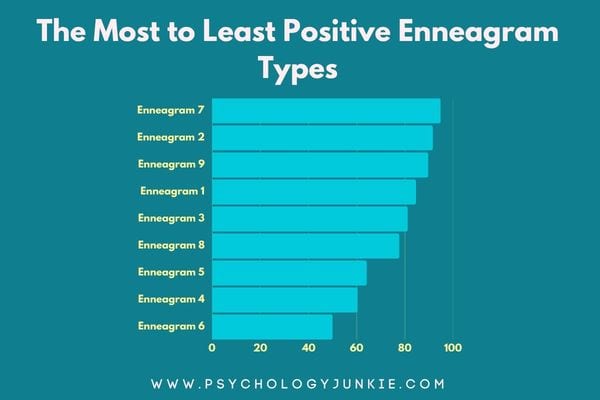
If we combine the people who answered “Yes” and “Often,” here’s how the types ranked:
- Type 7 – 94.8%
- Type 2 – 91.6%
- Type 9 – 89.7%
- Type 1 – 84.6%
- Type 3 – 81.2%
- Type 8 – 77.7%
- Type 5 – 64.2%
- Type 4 – 60.4%
- Type 6 – 50.0%
At first glance, this looks exactly like what you’d expect.
7s at the top, looking for opportunities and fun wherever they go.
6s at the bottom, carefully scanning for what could go wrong.
4s and 5s hanging out in the lower half, looking vaguely skeptical of the whole concept.
But let’s get some clarity here, because this isn’t actually measuring who is positive. It’s measuring who identifies as positive, and those are not always the same thing.
What Does “Positive” Even Mean?
Here’s the problem with the question. “Positive” is one of those words that feels obvious until you try to define it.
Ask a Type 7 what it means, and you’ll get something like:
“Seeing the bright side. Staying upbeat. Not getting stuck.”
Ask a Type 1:
“Having a good attitude. Being constructive. Not being negative or cynical.”
Ask a Type 5:
“…Not being irrationally pessimistic?”
Already we’re in three different worlds.
I’ve worked with clients who would all describe themselves as positive, and yet one of them is reframing everything into opportunity, one is trying to maintain emotional balance and self-control, and one is simply not spiraling into worst-case scenarios that day.
So when we look at these results, we have to remember that.
We’re not looking at one universal standard.
We’re looking at nine different internal definitions trying to answer the same question.
The High Positivity Types: 7, 2, and 9
Let’s start at the top.
Type 7: “Why would I not be positive?”
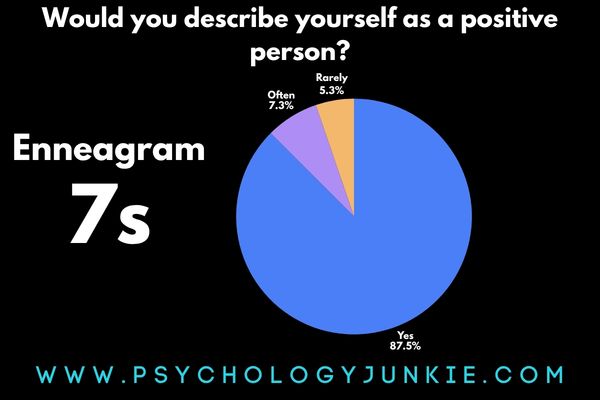
If Type 7 didn’t rank first, I would have assumed the survey broke. Of the 72 Sevens who took the survey, 94.8% answered “Yes” or “Often” to the question of whether they’d describe themselves as positive people.
Their entire psychological strategy revolves around staying in the realm of possibility, excitement, and forward momentum. Positivity isn’t just a preference. It’s a survival strategy – a way to escape the anxiety just brimming under the surface.
As Don Richard Riso and Russ Hudson state in The Wisdom of the Enneagram, “They approach life with curiosity, optimism, and a sense of adventure, like kids in a candy store who look at the world in wide-eyed, rapt anticipation of all the good things they are about to experience.”
I once worked with a 7 who told me, “If I slow down too much, I start thinking about things I don’t want to think about. So I just… don’t.”
Riso and Hudson also bring attention here when they say, “As long as they can keep their minds occupied, especially with projects and positive ideas for the future, they can, to some extent, keep anxiety and negative feelings out of their conscious awareness.”
7s aren’t lying when they say they’re positive. They are. But it’s an active process. A constant redirect. A refusal to dwell.
So 94.8% makes sense. Of course they see themselves that way. The real question is what happens when they can’t.
Type 2: “I want to be someone who lifts people up”
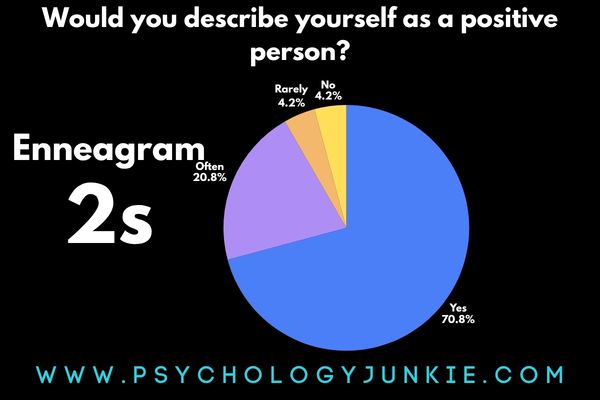
2s come in right behind 7s, and this is a different flavor entirely.
For 2s, positivity is all about being relational and having good connection with another person or group of people. It’s not just about how they feel. It’s about how they affect others.
They want to be warm, encouraging, and supportive. They want to be the person who makes you feel better after a hard day.
I’ve had 2 clients say things like, “Even if I’m struggling, I don’t want to bring the mood down.”
So when they answer “Yes,” they’re not necessarily describing how they always feel. They’re describing who they are trying to be in the world. Which also means something important.
Some of that positivity is genuine and some of it may be…effort.
Type 9: “I try to keep things calm and okay”
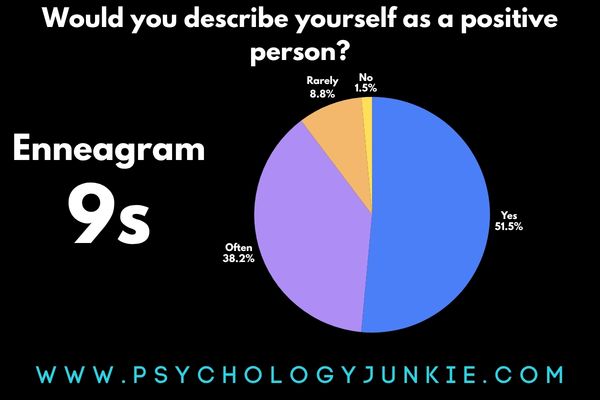
9s ranking this high might surprise people who associate them with numbing out or avoiding conflict. Yet 89.7% answered “Yes” or “Often” to the question, “Would you describe yourself as a positive person?”
And if you’ve worked with 9s, it makes perfect sense.
9s define positivity as peace, emotional steadiness, and not escalating things unnecessarily. They are often the ones saying, “It’s okay. We’ll figure it out. Let’s not make this bigger than it needs to be.”
That reads as positive, and in many ways it is. But we need to add more nuance here, because sometimes that positivity comes at the cost of fully acknowledging what’s wrong.
As Riso and Hudson state in The Wisdom of the Enneagram, “They (Nines) work to maintain their peace of mind just as they work to establish peace and harmony in their world. The issues encountered in the Nine are fundamental to all inner work- being awake versus falling asleep to our true nature; presence versus entrancement, tension versus relaxation, peace versus pain, union versus separation….Nines demonstrate the universal temptation to ignore the disturbing aspects of life and to seek some degree of peace and comfort by numbing out.”
The healthy Nine will be truly positive; able to see both the light and darkness of life and choose joy even in the midst of this awareness. The average to unhealthy Nine will numb themselves to the pain they experience or the pain in the world around them, trying to manufacture peace through numbness rather than awareness.
The Middle: 1, 3, and 8
Now we get into more complicated territory.
Type 1: “I should be positive”
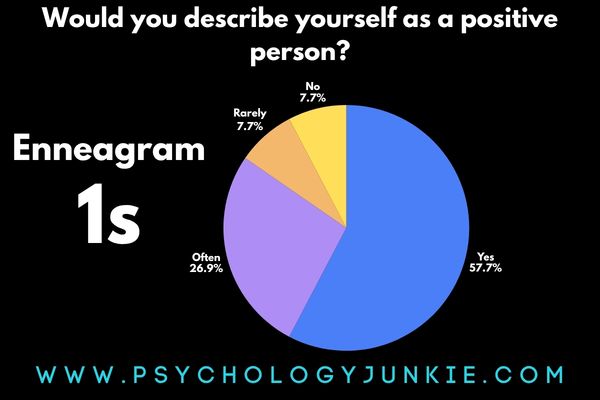
1s score high, but their positivity often comes with a sense of responsibility. They feel like being grumpy, melancholy, or sad could prevent them from being competent, reasonable, or responsible. It can feel indulgent, unhelpful, or even wrong.
They don’t necessarily wake up feeling cheerful, but they believe they ought to have a constructive, grounded outlook. After all, how are they going to get through their to-do list when their heart is breaking?
So their “Yes” often sounds like: “I choose to be positive because it’s the right way to approach things.”
While I’m sure there are exceptions to this, based on the comments of some of the Ones who took the survey, it seems their optimism is less about natural cheerfulness and more about intentional mindset.
As Julie, one of the Enneagram 1s said, “I try to stay positive so I can do my best job for my family and work. My feelings can cloud my judgment and make me ineffective, so as an ESTJ (and a One) I know how to focus on what’s right rather than what’s wrong.”
Type 3: “Of course I’m positive”
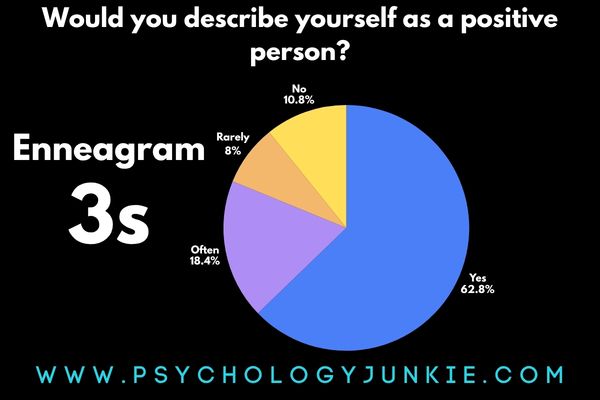
3s are interesting here. 81.2% described themselves as generally positive people.
On one hand, they are genuinely forward-moving, goal-oriented, and resilient. They work hard to stay in a productive headspace so they can keep going out and achieving their goals. Being sad or pessimistic is a real productivity killer. It stops you in your tracks and demands you grapple with your demons.
But it doesn’t mean that all Threes are genuinely optimistic and joyful. I’ve worked with way too many 3s who maintain a polished, optimistic front while privately feeling exhausted or disconnected. And sure, this can sound fake, but that’s not exactly what’s going on here. Their positivity is real, but it often comes at a cost. They truly do try to focus on forward momentum rather than their darker emotions, but that can also take quite a bit of effort.
As Riso and Hudson state in The Wisdom of the Enneagram, “Threes want success not so much for the things that success will buy (as Sevens do), or for the power and feeling of independence that it will bring (as Eights do). They want success because they are afraid of disappearing into a chasm of emptiness and worthlessness; without the increased attention and feeling of accomplishment that success usually brings, Threes fear that they are nobody and have no value.” The healthier the Three is, the more they learn that their value is inherent and they don’t have to always be “the best” in order to be worthy.
Type 8: “I’m not negative, I’m just realistic”
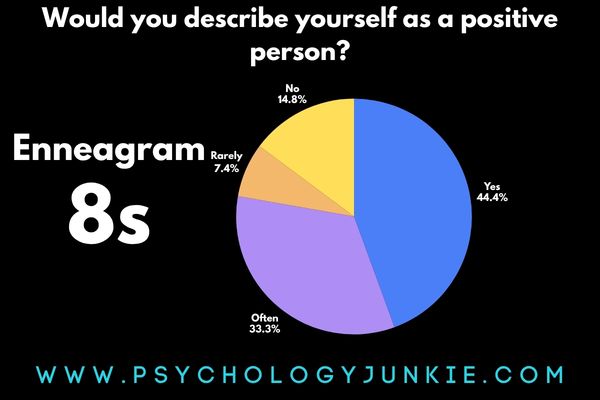
8s don’t usually think of themselves as “positive” in the bubbly, happy-go-lucky sense.
But they do see themselves as strong, direct, and grounded. They pride themselves on facing life head-on, not getting wrapped up in vulnerable feelings or useless pessimism.
They’ll say things like, “I focus on solutions” or “I don’t dwell on problems.”
One Eight in the survey said, “I like to say I’m an ambitious realist. I see the potholes in the road, but I also know how to fix them or get around them. No point in letting them get you down.”
The Lower Scores: 5, 4, and 6
Let’s now explore the three types that had the lowest scores of all. Let’s find out not just what they scored, but the why behind it.
Type 5: “I don’t feel the need to label myself that way”
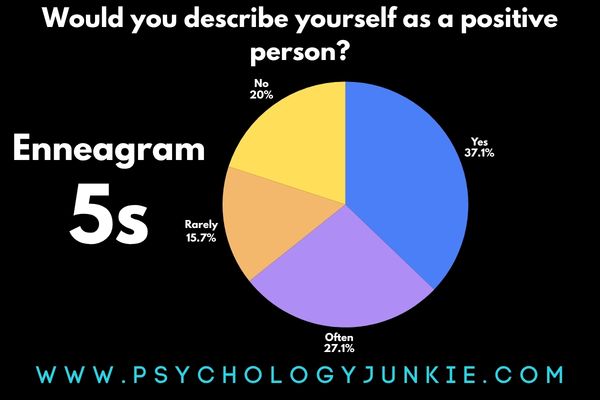
5s are allergic to vague, feel-good labels. “Positive” is one of those words that can feel imprecise or even a little… suspicious.
So instead of asking, “Am I positive?” they’re more likely to ask, “Compared to what? In what context? Based on what criteria?”
Which means fewer automatic “Yes” answers.
Not because they’re pessimistic, but because they’re exacting.
On top of that, Fives tend to face the darker side of life, examining and analyzing the very things they fear in order to overcome that same fear. So their inner world can feel a little too complex to organize into “optimist” or “pessimist” labels.
As Riso and Hudson state in The Wisdom of the Enneagram, “As strange as it might sound, Fives think a lot about the things that they find the most frightening. They may even make a career out of studying or creating works of art out of things that scare them. A Five afraid of diseases might become a pathologist; another Five who suffered from “monsters under the bed” in childhood may grow up to be a science fiction or horror writer or film director….Fives try to control fear by focusing their thoughts on the frightening thing itself, not on their feelings about it.”
Type 4: “The question requires more nuance”
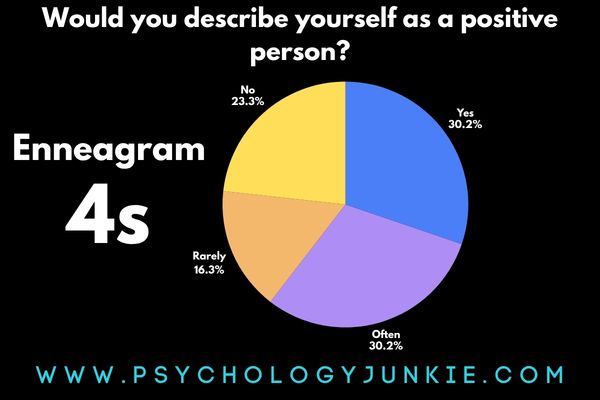
4s split evenly between Yes and Often, with a significant chunk saying Rarely or No.
4s are emotionally honest to a fault. They are not interested in maintaining a positive identity if it doesn’t match their internal reality.
If they feel heavy, they’ll own that. If they feel hopeful, they’ll embody that too, but they’re not going to smooth it over with a blanket “Yes” just to feel better about themselves.
Of all the types, Fours are often the ones most likely to face their own inner demons and shame. They need to understand their whole self; the good, the bad, and the ugly. To not do so would to be dishonest and shallow. So naturally they have a more complex answer to a question like this. As a Four myself, I can say that there are parts of me that are deeply joyful and positive, and other parts that are more pessimistic, moody, and melancholy.
Type 6: “Define positive”
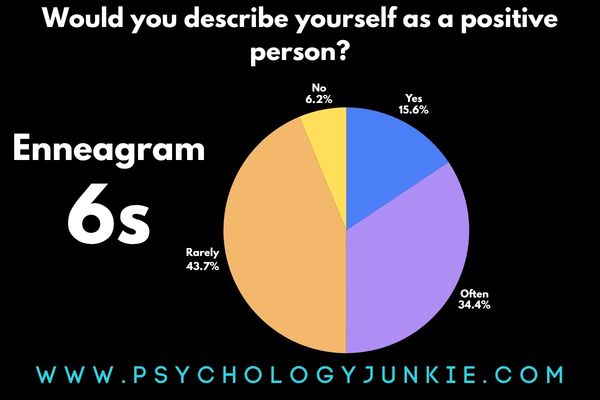
6s came in lowest, and again, this fits. Not because they’re inherently negative, but because their attention is trained on something different. Sixes are concerned with spotting threats, being attentive to danger, and being prepared for when the you-know-what inevitably hits the fan. They’re often in a state of scanning, questioning, and anticipating.
So positivity, to a 6, can feel like skipping steps. Like saying “It’s probably fine” without actually checking.
I’ve had 6 clients say things like, “I don’t want to assume everything will be fine if it might not be.”
Riso and Hudson put it this way in The Wisdom of the Enneagram: Sixes “tend to think and worry a lot,” while also fearing both making the wrong decision and giving up control. So they try to build what the authors call “bulwarks” against anxiety, ways to feel secure in an uncertain world.
Sixes are all about prioritizing safety, and they give up a bit of optimism in the process. But keep in mind, the same mind that looks for danger also looks for certainty, and certainty is hard to find. So they can get stuck in a loop of second-guessing, wanting to be prepared without ever feeling fully secure.
Which means when you ask, “Are you a positive person?” many of them hesitate, because they’re unwilling to ignore variables.
And that has its own value. Sixes are the ones who catch what others miss. The ones who ask the question that prevents a bigger problem later. The growth edge for them isn’t becoming blindly positive. It’s learning that awareness and trust can coexist.
That you can prepare for what might go wrong and still recognize when things are actually okay.
A Few Things to Keep in Mind
Before anyone starts using this to rank types as “better” or “worse,” let’s slow down for a second. This self-reported data reflects how people see themselves, not necessarily how they behave or what they feel underneath.
Some types are more comfortable claiming positivity while others are more cautious with that label. Some define positivity as joy, while others define it as stability and still others define it as not lying to themselves.
Also, the sample sizes vary. Some types had more responses than others, which means a few percentages could shift with more data. I’m going to keep this survey running for a while in case the patterns change.
But even with that, the overall pattern is clear enough to be meaningful.
The Deeper Question
The part I keep coming back to is this: What if the goal isn’t to be a “positive person”? What if the goal is to be a real one?
Because I’ve seen “positive” people who were disconnected, avoidant, and unraveling underneath the surface.
And I’ve seen “not positive” people who were grounded, thoughtful, and resilient.
Of course, I’ve seen pessimists who really should take a lesson from the optimists, and vice versa in some contexts.
Positivity, by itself, is not the prize. Awareness is. Flexibility is. The ability to face reality without collapsing or pretending.
Every type has its own version of growing into genuine, authentic positivity:
- 7s learn to stay present with discomfort.
- 2s learn to include themselves in the care they give others.
- 9s learn to engage instead of smoothing over.
- 1s learn to allow imperfection.
- 3s learn to be honest without performing.
- 8s learn to soften without losing strength.
- 5s learn to step into life instead of observing it from a distance.
- 4s learn to hold hope alongside depth.
- 6s learn to trust without abandoning their discernment.
None of those require you to answer “Yes” to a survey question. They just require you to show up a little more honestly than you did yesterday. And that, in my experience, is a far more reliable form of positivity than anything you can label.