
How Each Enneagram Type Tries to Help and Comfort Others
Have you ever had a bad day, decided to vent to someone, and then later regretted it? You opened yourself up, made yourself vulnerable, and now you just feel awkward, frustrated, and a little mad at yourself.
Just me?

I don’t think so.
We’ve all had those moments where we needed to get our feelings out and then we later wished we’d never said a thing. That’s where today’s topic comes in.
How does each Enneagram type help someone when that person comes to them in a state of distress? That was a question I asked my subscribers and readers in a survey I’ve been running for over a year now (you can take it here, if you’re interested). After looking at the results, there are some clear connections between Enneatype and responsiveness. Some types look for logical solutions while others are all about affirmation and listening.
Knowing how each type is inclined to respond when you come to them for a listening ear can help you to understand what you’re likely to get in that situation and why. So let’s get started!
Not sure what your Enneagram type is? Take our free Enneagram questionnaire here.
How Each Enneagram Type Tries to Help and Comfort Others
Enneagram 1 – “Let me fix this properly”
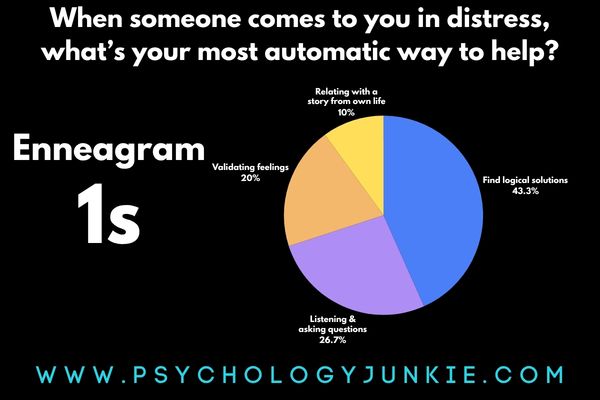
Top response: Finding logical solutions (43.33%)
Ones want to help by making things right.
If you come to them in distress, they’re already scanning for what went wrong, what should have happened, and what can be corrected. Their brain turns into a quiet, efficient troubleshooting system.
They care a lot, but if you’re just looking for validation and a listening ear, you might be surprised by the way they tend to lean into advice and practicality.
I’ve worked with several Ones who said some version of, “If I can help them solve it, they won’t have to feel this way again.” That’s the heart of it. They’re trying to eliminate future suffering.
The tension is this: emotions aren’t problems you can permanently fix.
So when someone just wants to vent, the One can feel a little… trapped. Like being handed a puzzle with no solution. And in their efforts to help, they may inadvertently make other people feel like a problem to be solved rather than a human with feelings that just need to be heard.
They do listen and validate, of course. You can see that in the data. But their instinct is still to improve the situation.
Growth for Ones looks like learning that sometimes the most “right” thing to do is sit in the mess with someone and not clean it up.
Enneagram 2 – “I feel this with you”
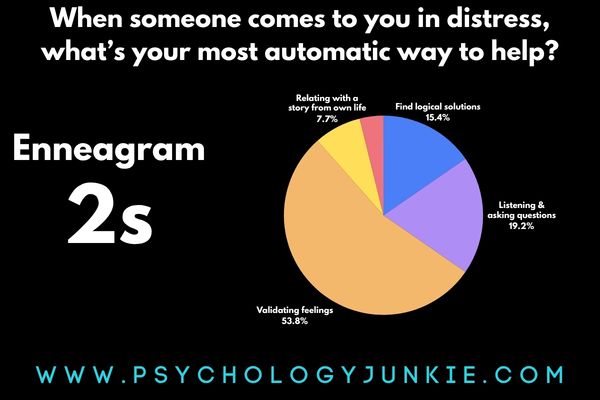
Top response: Validating feelings (53.8%)
Twos move toward people in pain like it’s magnetic.
You say you’re struggling and they’re already getting closer, emotionally syncing, offering warmth, reassurance, presence. Half of them default straight to validation, which is the highest percentage of any type in any category here.
This is their superpower, but there can also be a catch to this. Twos don’t just respond to your pain, they often absorb it. It becomes personal. Sometimes more personal than you intended.
I’ve seen Twos walk away from conversations completely drained, wondering why they feel like they were the one who went through something traumatic. Because in a way, they did. They stepped inside it with you.
They also have a tendency to try to fix any problems you’re dealing with, taking it on themselves to check in, offer guidance, and be the helper. Which can be beautiful. Or a little overbearing if you’re someone who just wanted space.
Growth for Twos is learning that they don’t have to merge to care. They can support without disappearing into someone else’s emotional world.
Still, if you want someone to sit with you and say, “That makes sense. You’re not crazy,” a Two is your person.
Enneagram 3 – “Okay, what do we do next?”
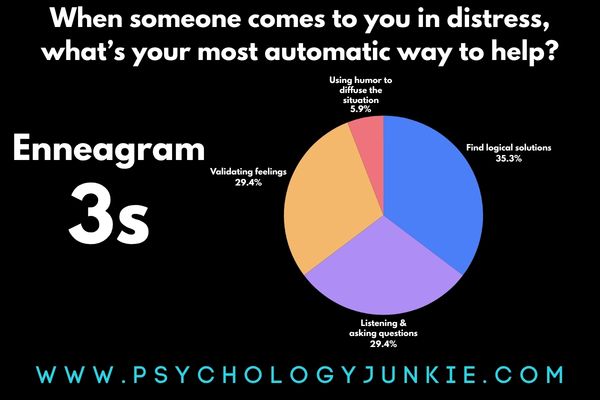
Top responses: Solutions (35.3%), Listening (29.41%), Validation (29.41%)
Threes are more balanced here than people expect. They show up in multiple ways. Listening, validating, problem-solving. It’s almost evenly split.
But there’s still a forward momentum to how they help. They want metamorphosis and solutions. When someone is in distress, the Three’s brain is likely to ask, “How do we get you back to functional?”
This doesn’t mean they don’t care about feelings, but because they associate being okay with being able to move again. Getting back up and going towards another goal tends to be their focus. They hate seeing anyone stuck in an emotional quagmire.
I worked with a Three client who said, “If I stay in the emotion too long, I feel like I’m losing control.” So helping someone often becomes a gentle nudge toward action. Even if it’s small.
The blind spot is rushing the process too quickly. Sometimes people don’t need to “get back on track.” They need to fall apart for a minute.
Growth for Threes is learning that sitting still with someone in pain doesn’t mean you’re being unhelpful. It means you’re honoring where they are, not where you want them to be.
Enneagram 4 – “Tell me everything”
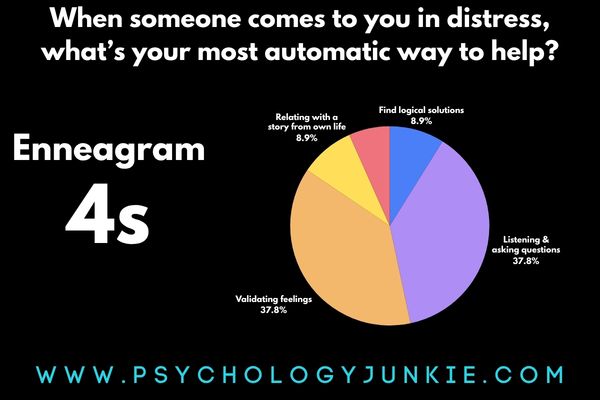
Top responses: Listening (37.8%), Validating (37.8%)
Fours don’t flinch at emotional intensity. In fact, this is the world they were born to inhabit.
When someone comes to them in distress, their instinct is to create space. Ask questions. Validate the emotional experience. Let the person fully be where they are. They don’t try to rush people or force them to accept some form of logic.
I’ve heard Fours say things like, “I want people to feel understood, not fixed.” And you can see that clearly in the data.
They’re not as interested in solutions because solutions can feel like bypassing the depth of what’s happening.
The upside is deep emotional attunement. They’ll walk with you into the dark side of your psyche, anxiety, and shame. This can make people feel seen in a way that’s rare.
The downside is they can sometimes linger in the pain with someone. Or even amplify it unintentionally by exploring it in great detail.
Growth for Fours is learning when to gently shift the conversation toward grounding or next steps, without feeling like they’re betraying the emotional truth.
But if you’ve ever had a Four really listen to you, you know. It’s like being given permission to exist exactly as you are.
Enneagram 5 – “Let’s understand this”
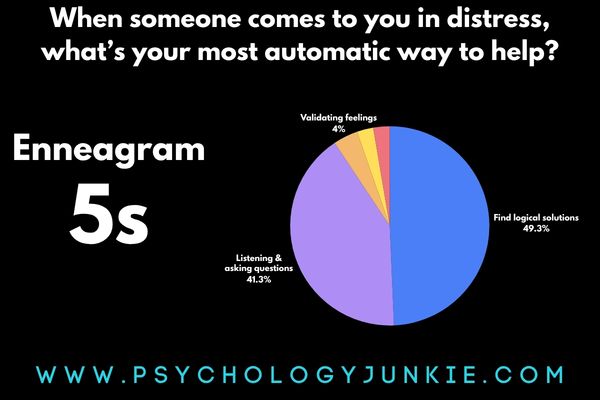
Top response: Logical solutions (49.3%), followed by listening (41.3%)
Fives approach emotional distress like researchers. They listen carefully, ask questions, gather data, and then they try to make sense of what’s happening.
Almost half default to solutions, but notice how high listening is too. They’re not dismissive, jumping in with quick advice and easy solutions. They like to investigate first.
For a Five, the thought is, “If I can understand it, it feels less overwhelming.” That applies to their own emotions and yours.
Validation is very low here. Not because they don’t care, but because emotional language isn’t their first language. They might show care by helping you think through the situation, spotting patterns, or offering insight that reframes everything.
Which, to be fair, can be incredibly helpful or incredibly frustrating if you just wanted someone to say, “Yeah, that sucks.”
Growth for Fives is learning to occasionally skip the analysis and meet someone in the emotional space first.
Even if it feels inefficient. Even if it doesn’t “solve” anything.
Enneagram 6 – “Let’s figure this out together”
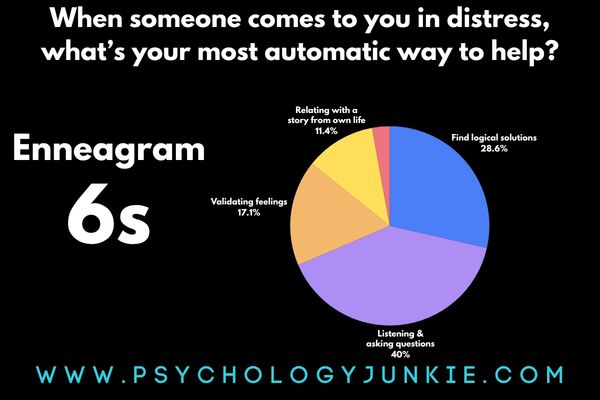
Top response: Listening and asking questions (40%)
Sixes are the steady, grounded responders. They don’t rush in with answers. They don’t disappear into your feelings. They stay engaged, curious, and focused.
They ask questions because they’re trying to understand the full picture. What happened? What could happen next? What are the risks? There’s a collaborative energy to how they help.
Not “I’ll fix this for you.” More like, “We’re going to figure this out together.”
They do offer solutions, but not as aggressively as Ones or Fives. It’s more cautious and thoughtful.
The underlying drive is safety.
I’ve had Six clients say things like, “I want people to feel prepared, not blindsided.” So their help often includes helping you think through possible outcomes and how to handle them.
The challenge is that their focus on potential problems can sometimes increase anxiety, both for them and for you.
Growth for Sixes is trusting that not every situation needs to be fully mapped out to be survivable. Sometimes reassurance matters more than preparedness.
Enneagram 7 – “Hey, you’re not alone in this”
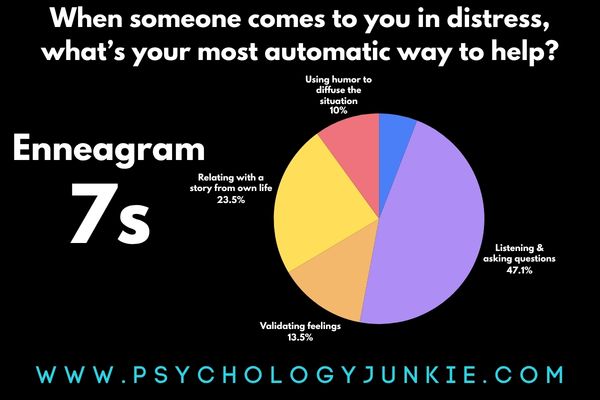
Top response: Listening (47.1%), then relating (23.53%) and validating (13.5%)
Sevens are more emotionally present than their stereotype suggests. I completely expected them to rank highest for using humor to diffuse the situation, but I was definitely wrong.
Nearly half say they listen first, while many others said relating was important. It’s always nice to hear, “Oh yeah, something similar happened to me…”
They’re trying to connect and show you that you’re not alone and that things can turn out okay.
There’s also validation, which is higher than people expect.
But notice how low solutions are.
Sevens aren’t trying to fix the problem. They’re trying to shift your emotional experience. Lighten it. Expand it. Give it air.
The risk is moving too quickly toward positivity or distraction.
I’ve worked with Sevens who admitted, “When things get too heavy, I want to get out.” So helping can become a subtle attempt to steer the conversation somewhere less painful.
Growth for Sevens is learning to stay in the discomfort a little longer. To resist the urge to brighten everything immediately.
Still, their ability to bring hope into a dark moment is something a lot of people deeply need.
Enneagram 8 – “Here’s what we’re going to do”
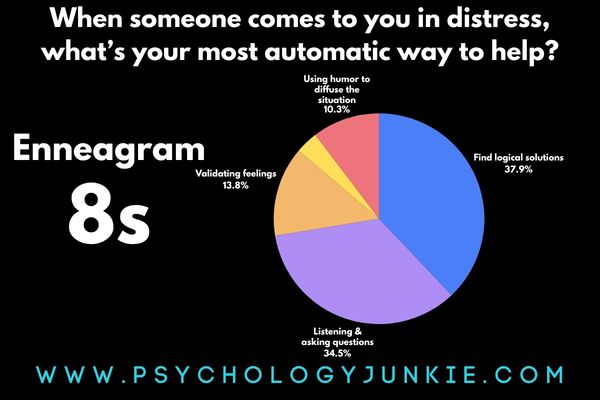
Top response: Logical solutions (37.9%), close second: listening (34.5%)
Eights help by taking charge.
You come to them in distress and they’re already thinking, “Who do we need to call? What needs to change? How do we stop this from happening again?”
It’s protective, direct, and action-oriented.
That said, I was surprised at the listening percentage. It’s almost as high as solutions which was a nice surprise. Eights are paying attention, they want to know the facts of what you’re dealing with. The key is that they just don’t linger in vulnerability for long. Staying in place of “wallowing” will quickly tire them. They need to feel like action and solutions are on the horizon.
Most of the Eights I know say things like, “I hate seeing people I care about hurting. I want to do something about it.”
Validation is lower, which makes sense. Eights hate to beat around the bush. This can make them come across as blunt or dismissive, even when they care deeply.
They might say, “Okay, but what are you going to do?” when you were hoping for, “That sounds really hard.”
Growth for Eights is slowing down enough to acknowledge the emotional reality before jumping into action. Because the tough truth is that sometimes the most powerful thing they can do is not fix it right away.
Enneagram 9 – “I’m here. Take your time”
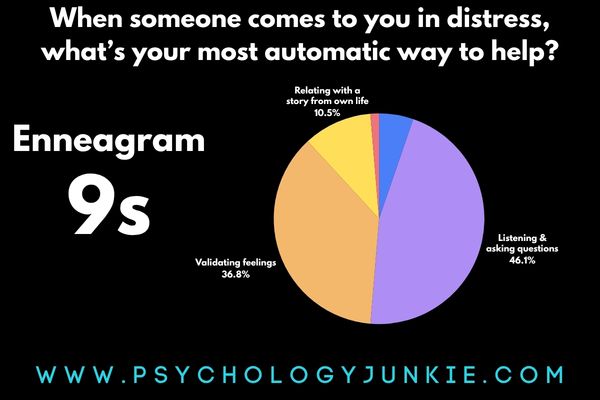
Top response: Listening (46.1%), followed by validation (36.8%)
I like to think of Nines as the calm in the storm. When someone is in distress, they create a soft landing. For them, being a good friend is about listening and validating and presence. They’re not likely to push or rush you to find a conclusion or solution.
There’s a gentle, accepting presence to how they help.
I’ve had clients describe Nines as “safe” which makes sense. They’re not trying to control the situation or impose a solution. They’re just there and by being present and fully with you they hope to help you realize your own inner solutions.
The challenge is that they can sometimes avoid conflict or hard truths in the process.
They might agree with you even if they don’t fully see things the same way. Or avoid bringing up something that could actually help, because it might create tension.
Solutions are very low here. Not because they can’t think of them necessarily, but because they prioritize peace and emotional comfort.
Growth for Nines is realizing that true support sometimes involves a little discomfort, honesty, and disruption. Loving someone and helping them isn’t always about staying peaceful, sometimes it means shaking things up.
But if you need someone to sit with you without judgment, a Nine will do that better than almost anyone.
What Do You Think?
Do you relate to the section I wrote up for your type? Do you have a different opinion or perspective? Let us know in the comments! We’d love your insight!
Find out more about your personality type in our eBooks, Discovering You: Unlocking the Power of Personality Type, The INFJ – Understanding the Mystic, and The INFP – Understanding the Dreamer. You can also connect with me via Facebook, Instagram, or YouTube!













was Typed as a 6 but my way of responding to that is closer to 8, I like to suggest possible solutions and options probably makes sense being counterphobic.