
40 Fictional ISFJ Characters
ISFJs get described as dependable and caring so often that you’d think they never get angry, make questionable choices, or have a decent comeback. Fiction gives us a much more interesting picture. From Samwise packing food for an impossible journey to Yor worrying about dinner after an assassination assignment, these characters show how differently the same preferences can play out. I’m looking at how they notice things, make decisions, and respond to the people around them. Let’s get started!
Estimated reading time: 1 minute


#1 -Sally (The Nightmare Before Christmas)
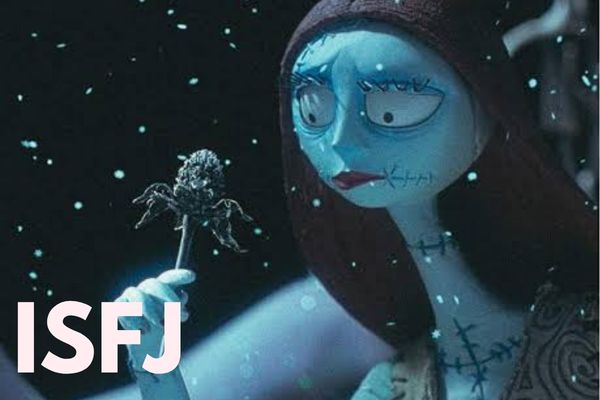
Let’s start with the sweetest love interest of all time. If you’ve seen The Nightmare Before Christmas you probably know a thing or two about this ragdoll. In the film, we witness Sally try to convince Jack ‘The Pumpkin King’ (I would argue that Jack is an ENTP) that he’s good enough as he is. Sally thinks that Jack doesn’t have to get involved in figuring out what Christmas means because his nature lends itself towards understanding Halloween. But Jack is Jack. He’s curious and as soon as his brain latches onto an idea, he must pursue it. Sally knows this and knows that Jack has been experiencing general boredom with his life. Thus, she makes subtle moves to show her support of him. Despite knowing Jack belongs in and to Halloween, Sally still encourages his wish to pursue Christmas, to “play” Santa Claus.
Just marry this girl already, Jack.
Goodness.
Sally continually depicts the sort of concrete help many ISFJs flourish by. She, for example, makes Jack a basket of food when he’s up in his tower, lost in thought. At a time when Jack’s refusing to see anyone, he accepts her gift with a smile. She also helps sew together what would become his Santa costume. Sally’s gentle nudges provide a good example of how ISFJs might go about showing their care, especially when they remain uncertain as to whether their love interest shares a mutual desire towards them. Her compassion and devotion are quite visible, as well as her brilliant mind—something ISFJs aren’t given enough credit for.
She outsmarted the “brainy” doctor, didn’t she?
Of special note is Sally’s clear connection with Introverted Sensing (Si), which forms impressions and meaning based off of objects. Before Jack “becomes” Santa, Sally has a “vision” that is physically manifested. She picks off a dead flower from a bush, which quickly transforms into a fully decorated Christmas tree with cute ornaments hanging off of it. Sally is wowed by the shift. However, suddenly the tree catches fire and she knows that Jack’s Christmas will end badly. Sally knows that she must tell Jack of the symbolism the object gave her. However, when Sally approaches Jack on the matter, he doesn’t listen to her pleas and moves forward with his plot (for all the dads out there) anyway. And his attempt at being Santa fails as he is shot out of the sky. Although the pair ultimately winds up together, Jack might have saved himself some grief had he trusted the meaning Sally had found in the object.
Trust your SJs sometimes, people!
#2 – Meg March (Little Women)

Meg March is the oldest of four girls that make up Little Women. We actively see her trying to keep the peace between her sisters, helping her mother whenever possible, and trying to keep with the social customs of the time. Meg’s help is very practical in upkeeping family bonds. Her irritation flares when her siblings refuse to get along or conduct irrevocable acts such as when Amy burns much of Jo’s (handwritten!!!) book.
The turd!
Meg is quite smart and a bit playful. She wants to enjoy herself at balls and the like but never goes too far as to make a scene. While her sister Jo March basically tries to prove her independence and strength, Meg’s sense of calm derives from the hope that one day she will get married and start her own family. Meg remarks, “I don’t want a fashionable wedding, but only those about me whom I love, and to them I wish to look and be my familiar self. Tomorrow I shall put away my ‘fuss and feathers’ and be desperately good again.” Meg’s wishes are just as strong as Jo’s, although they have much different goals. Meg’s general disposition provides a good example of how an ISFJ might act within a family dynamic and care so strongly for those around her.
#3 – Mr. Rogers (Mr. Rogers’ Neighborhood)
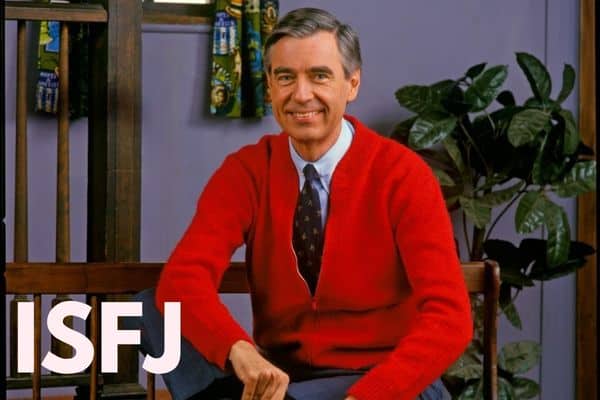
It’s Mr. Rogers. Need I say more? Mr. Rogers is the teacher, friend, and face of Mr. Rogers’ Neighborhood. Much of the show explores how to approach emotions, how to treat others, and how to be open to the range of people in one finds in life. The show is considered children’s programming, but I would venture to guess that most adults would gain something from it as well. Mr. Rogers is generally kind, welcoming, practical, and very interested in cardigans.
So interested in cardigans.
Hello, perfect ISFJ.
Mr. Rogers’s Extroverted Feeling (Fe) preference is quite visible. Nearly everything he “preaches” has to do with how our actions, our decisions, and our approach to problems affects others. We may all experience strong emotions at some point in life, but it’s what we do with it that matters. In the words of Mr. Rogers, “what do you do with the mad that you feel?” He goes on to say there are healthy ways to manage anger, sadness and so on. Like striking the lowest note on a piano. Managing your emotions without negatively affecting others or yourself was of pivotal concern, something most ISFJs could get behind. The goal is to have positive relations with people now to avoid negative Introverted Sensing (Si) impressions later. Mr. Rogers wanted a better world for everyone on a daily basis.
Gotta love an ISFJ king.
#4 – Pam (The Office)

Pam Beesly is our favorite ISFJ from The Office. She’s quiet, calm, and has a playful side. She doesn’t mind getting lost in shenanigans with her love interest Jim. She also tends to drift along with whatever madness her boss Michael forces on the entire office, but will “check” him if he goes too far. Pam is near-constantly trying to assess her social role so that she can meet the needs of the people around her. It’s a big moment when Pam finally says, “I’m gonna start telling people what I want directly.” Something most ISFJs struggle to learn, but learn in time they do.
And some of us are still learning this lesson, dang it!
Like many ISFJs before her, it takes Pam several seasons to see her own inherent value (given our Introverted Feeling lies in the shadows, it’s not hard to see why this can be such a problem for ISFJs). There are a range of choices Pam makes that reflects her general underassessment of herself. She stays in a loveless engagement with Roy out of comfort for several years. She has to nearly will herself out of her “stable” role as a receptionist in order to try art school, and when that doesn’t go as planned, she reels in worry over what she will (or will not) become. Her fear at the changes she must make for her growth showcase inferior Extroverted Intuition (Ne) quite well. Pam spends much of the series making subtle shifts until she stands beside Jim, on equal footing.
#5 – Marta Cabrera (Knives Out)

Marta Cabrera from Knives Out immediately struck me as the quintessential ISFJ. Ever polite and always agreeable, she moves through her environment bordering on timid. Marta spends the majority of the movie accommodating the people around her and trying to put her learned skills (nursing) to work for the wealthy Harlan Thrombey. She also makes herself present at every beck and call of the family, taking her duty to the group seriously.
Somehow.
These people are nuts.
When Harlan is murdered, Marta becomes a suspect in his case given her proximity to him as his caretaker. Detective Blanc keeps Marta close as she holds an interesting habit of not being able to lie without puking: seemingly helpful and convenient in a murder investigation. Marta does what she can to not become the prime suspect. Yet, when it matters most, Marta saves the life of another who could raise her stakes as a suspect in the crime. However, it didn’t matter that the other person could ultimately hurt her reputation through their survival. Marta simply saw it as her duty to save the life before her and she did.
Don’t cry. It’s beautiful. Okay, fine. Cry.
#6 Retsuko (Aggretsuko)

Aggretsuko’s Retsuko is a red panda who works in an accounting office. She’s dutiful in her work but can never seem to make her explosively aggressive boss happy. Retsuko lives a semi typical life with semi typical problems. She frets over letting down her friends, has some anxiety over managing her relationship with her mom, and some reservations training incoming staff. Much tends to weigh on her furry shoulders.
But when Retsuko finds karaoke, she finds a place that can hold the weight of her drear. She expels all of her anger by singing screamo music.
Retsuko: “Underneath that smile, I’m metal till I die.”
Dang gurl.
Same.
One wouldn’t guess by looking at her that she would carry so much raw energy inside her—as she, like many other ISFJs keep that in check—but her own disappointments and stressors pile up. Making herself feel “heard” gives her a release. Ever dutiful, once her scream sessions are complete, she heads back into the world where she accommodates at all costs.
#7 – Jacob Kowalski (Fantastic Beasts Series)

All Jacob Kowalski from Fantastic Beasts wants to do is own and run a bakery. Hello, strong ISFJ vibes. Nuff said? Jacob is generally lowkey, wanting only to convince the bank of the potential of his startup. He wants not for fame or fortune. He’d settle for a cupcake or two. That is, before getting thrust into the wizarding world.
As Jacob tags along with Newt Scamander, what he knows of life shifts drastically. He’s constantly (and somewhat unwillingly) put into situations he doesn’t understand with objects and creatures set in his path that he’s never heard of. At one point Jacob asks himself, “What did you do today, Jacob? I was inside a suitcase.”
Sane.
Real sane, Jacob.
Don’t worry.
Or do.
Still, despite the oddities, Jacob remains by Newt’s side, doing what he can with what he learns. Jacob’s dedication to Newt forms quickly and they become fast friends. Newt is more than sorry when he’s told Jacob’s mind must be erased.
Everyone needs an ISFJ bff.
#8 – Esme & Carlisle Cullen (Twilight)

Carlisle and Esme Cullen from The Twilight Series share a similar gentle touch. They are both compassionate, understanding, and would put their family above all else. The vampires share their home to a human (Bella) simply because their son Edward likes her (causing some discomfort on their part, I’m sure…who’s hungry?). Esme even reveals how her son’s unhappiness prior to Bella directly correlated to her own: “He’s been the odd man out for far too long; it’s hurt me to see him alone” (Twilight).
We witness Carlisle’s immense care when he puts aside his own desires (blood) in order to treat his patients (humanity at large). Becoming a doctor was one way he could still help others progress in time: “What I enjoy the very most is when my… enhanced abilities let me save someone who would otherwise have been lost. It’s pleasant knowing that, thanks to what I can do, some people’s lives are better because I exist” (New Moon). Carlisle’s general concern for humanity appears in every move he makes. He is one of the few vampires who chooses to live a life aware of how his diet affect others and he gently entices others onto a softer path, if they are willing. Yet he doesn’t harshly judge the vampires who reject his “vegetarian” cause either. He’s generally open and giving to all who come into his path.
It’s no secret that Carlisle does not view his vampirism positively. Despite disliking his natural state, he does his best to help everyone he can. “I’m sure all this sounds a little bizarre, coming from a vampire. But I’m hoping that there is still a point to this life, even for us. It’s a long shot, I’ll admit. By all accounts, we’re damned regardless. But I hope, maybe foolishly, we’ll get some measure of credit for trying” (New Moon).
As if Carlisle would ever be damned.
Ever.
Carlisle is my favorite fictional ISFJ. Don’t tell the others I said that.
Esme shares her husband’s vision and openness. It’s no wonder Carlisle saw something in her and changed her at near death. Esme moves to assist him and the family in little ways, supporting her children by lending an ear. Her kindness is readily felt by even Bella, who is instantly put to ease upon their first meeting. Esme at one point notes to Bella, “You’re what he wants. It will work out, somehow” (Twilight).
#9 – Cinderella (Cinderella)
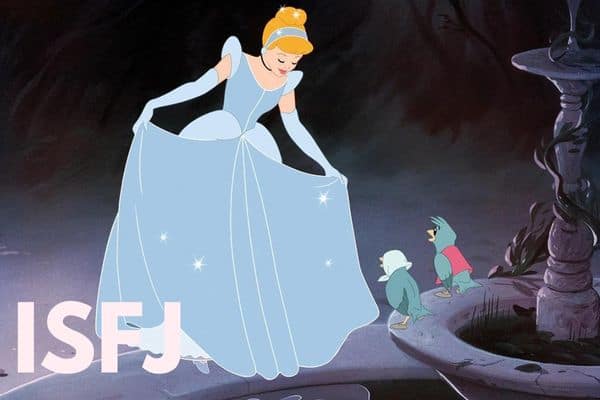
Cinderella lives under the thumb of her stepmother, cooking and cleaning nearly 24/7. She doesn’t have much freedom and tends to relive her days over and over. Her kindness and care never falters, even when no compassion from others can be found. Although locked inside a rough situation, Cinderella makes the best of it.
As is the ISFJ samurai code.
Cinderella’s fantasies of a better life and family keep her going, despite the daily struggles she encounters. “Well, there’s one thing: they can’t order me to stop dreaming” (Disney’s Cinderella). Amidst her daydreams, Cinderella makes the most of her days. She befriends the animals around her and hums while she cleans. When she has the opportunity to attend the ball, she does with no expectations. Yet she wins the heart of the prince. When the castle scours to find the princess who enticed the prince, she is reluctant to come forward and claim the glass slipper as her own. Yet when she does, the world falls into alignment. Her undying hope and kindness ultimately guides her towards a better life.
#10 – Narcissa Malfoy (Harry Potter)

Narcissa Malfoy is Draco’s mother in the Harry Potter series. Her role might be small, but it carries weight. We witness her seal an unbreakable curse with Snape so that her son might be protected if her son’s mission fails. Although Narcissa may be associated with the Death Eaters, her role with them does not rise above her family. We see Narcissa’s will focused on the preservation of those she cares about. She proves herself to be a caring mother who would lie to the devil himself if it meant protecting her own. Very much the Slytherin way.
Later, with everything at stake, Narcissa asks a breathing Harry, “Is Draco still alive?” (Harry Potter and the Deathly Hallows). Harry confirms that he is. It’s all she needs to hear. Narcissa then lies to Voldemort, claiming that his spell had killed Harry, when in fact, the boy had lived.
Again.
Why does he keep doing that.
We can question whether Narcissa lied about Harry because she learned that Draco was safe or that she had a moment of compassion for Harry due to her position as a mother. Either way, it would set the course for the fate of those at Hogwarts.
#11 – Fluttershy (My Little Pony: Friendship Is Magic)

Fluttershy is shy until someone smaller than her needs help. Then you may find yourself being firmly corrected by a pony who was struggling to introduce herself five minutes ago. In “Dragonshy,” she’s terrified of the dragon threatening Equestria, but when it hurts her friends, she confronts it. Her care for animals works the same way: she pays attention to what each creature needs, rather than assuming one approach will work for all of them.
Fluttershy pays close attention to what makes others feel safe. She’s observant, protective, and much tougher than her soft voice suggests. She doesn’t stop feeling afraid. She decides that her friends matter more than the fear.
#12 – Hinata Hyuga (Naruto)

It would be easy to describe Hinata as the girl who admires Naruto from a distance and leave it there. It would also sell her short. She grows up being judged against her clan’s expectations, trains despite her lack of confidence, and keeps watching how Naruto gets back up after people dismiss him. His persistence gives her an example to return to when she doubts herself.
When Pain has Naruto pinned down, Hinata steps in even though she has little chance of winning. She’s frightened, and she understands the danger. Her choice still feels consistent with everything we’ve seen of her: years of loyalty have turned into the courage to act. She watches closely, remembers encouragement, and gradually learns to act on it.
#13 – Yor Forger (Spy x Family)

Yor can handle an assassination assignment with terrifying detachment. Preparing a meal for her family presents more of a challenge. Watching her worry about being a good mother after demonstrating enough strength to rearrange someone’s skeleton is one of the great pleasures of Spy x Family.
Although her marriage to Loid begins as a practical arrangement, Yor takes her place in the family seriously. She wants Anya to feel protected and Loid to feel supported. When her cooking falls short, she seeks lessons from Camilla, hoping to contribute something her family will enjoy. She puts real effort into learning, even when the results are initially alarming.
That attention to her family’s needs is a big part of why I lean toward ISFJ for Yor. Her Extraverted Feeling comes through in her concern about how she affects the people around her and whether she is fulfilling her role well. She can be painfully hard on herself, measuring her worth against her idea of what a good wife and mother should be. Meanwhile, Anya has a mother who would move heaven, earth, and several unfortunate criminals to keep her safe. That deserves some credit.
#14 – Rory Gilmore (Gilmore Girls)

Rory Gilmore has a book for the occasion. Probably several. She’s studious, observant, and most comfortable when she understands what’s expected of her. Between school, Stars Hollow, and her relationship with Lorelai, she grows up with people and routines she knows well.
I lean toward ISFJ because Rory often approaches the future by carefully building on what she already knows. She studies, prepares, and works toward an established goal. Her relationships matter enormously, too. Being the capable, promising daughter and granddaughter carries emotional weight, even when those expectations begin pulling her in different directions.
Then Mitchum Huntzberger tells her she lacks what it takes to become a journalist, and the plan falls apart. Rory leaves Yale for a time, shaken by a judgment that threatens the future she has spent years preparing for.
Her mistakes can be frustrating to watch. Still, they make her more interesting than a permanently sensible girl with good grades. Rory shows how destabilizing it can be when competence and approval become tangled up with your identity. Learning what she wants, independently of everyone else’s expectations, is much messier than acing an exam.
#15 – Nezuko Kamado (Demon Slayer)

Nezuko loses her family, becomes a demon, and has to fight instincts she never asked for. Through all of that, her bond with Tanjiro endures. She protects him and other humans, drawing on both Urokodaki’s conditioning and her own willpower to resist the urge to harm them.
What draws me to an ISFJ interpretation is the persistence of those attachments. So much of Nezuko’s life changes, yet caring for the people close to her remains central. Her affection is often expressed physically: staying close, offering comfort, and putting herself between someone vulnerable and danger.
And those actions can be fierce. Anyone expecting a harmless little sister has badly misunderstood the situation. Nezuko’s tenderness survives alongside her strength, which makes her a welcome addition to a list so often associated with mild manners and accommodating smiles. Her protective nature has teeth. Literally.
#16 – Sophie Hatter (Howl’s Moving Castle)

Sophie moves into a magical castle and promptly decides it needs a good cleaning. Which, to be fair, it does. Howl may be a gifted wizard, but someone needs to address the situation in that bathroom.
At the beginning of the film, Sophie seems resigned to a small life working in her family’s hat shop. She underestimates herself and puts duty ahead of whatever she might want. Being cursed into an elderly body changes things. Suddenly, she’s willing to speak her mind, leave home, and appoint herself housekeeper to a wizard who never actually hired her.
Her practical approach fits an ISFJ reading. Faced with a bewildering new world, she starts with something she understands: making a home livable and caring for its inhabitants. Her Extraverted Feeling also comes through when she takes in the weakened Witch of the Waste, despite having every reason to resent her.
I love how much personality emerges once Sophie starts speaking her mind. She’s affectionate, stubborn, resourceful, and entirely capable of telling Howl to get over himself. Caring for people apparently includes refusing to indulge all their nonsense.
#17 – Lottie Bell (Wonka)

Lottie Bell is one of the people trapped working in Mrs. Scrubbit’s laundry, where the employment benefits include debt, exhaustion, and more debt. A former telephone operator, she initially keeps to herself, but gradually becomes part of the group helping Wonka escape Scrubbit’s control and establish his business.
Her contribution is practical. When the group needs to find Noodle’s mother, Lottie puts her experience with telephone calls to work, helping make their eventual reunion possible. It’s a small part of the film, but a meaningful one: she has a skill, sees where it could help, and uses it for someone else.
That combination of remembered experience and personal concern makes ISFJ a plausible fit for Lottie. Her limited screen time makes this a tentative typing, but her soft-spoken nature, practicality, and warmth seem very ISFJ to me. Wonka provides the spectacular ideas. Lottie helps with the details that turn a hopeful possibility into something real.
#18 – Alma Beers Del Mar (Brokeback Mountain)

Alma is a painful character to watch because she knows far more than Ennis realizes. After seeing him kiss Jack, she carries that knowledge through years of marriage, raising their children while his trips with Jack continue. Everyday family life goes on around something that has fundamentally changed her understanding of it.
Her attention to detail becomes especially clear when she questions those supposed fishing trips. She notices that Ennis’s fishing basket still has its price tag attached and leaves a note on the line. When the note remains untouched, she has another piece of evidence that his explanation doesn’t hold up.
I see a possible Introverted Sensing pattern in how she retains particular observations and compares them with what she’s being told. Her investment in their family also makes an ISFJ reading understandable, although betrayal would hurt someone of any type.
Alma’s resentment builds as Ennis continues leaving her with unanswered questions. Overall, I like her because she’s an ISFJ character with resentment, anger, and limits. She’s messy and imperfect, but she’s trying.
#19 – Morwenna Chynoweth (Poldark)

Morwenna’s affection for Geoffrey Charles is one of the sweetest parts of Poldark. As his governess, she takes her responsibilities seriously, but their relationship also has warmth and companionship. He’s a child she knows and cares about, rather than another obligation to get through.
Morwenna is gentle, conscientious, and deeply affected by the people close to her. Her relationship with Drake offers the possibility of a life built around affection, but family pressure pushes her into marriage with Osborne Whitworth instead.
Her story becomes devastating because the people with power over her treat her sense of duty as something they can exploit. Her withdrawal and fear develop under coercion and abuse.
What makes Morwenna compelling is how much feeling and determination exist beneath her restrained manner. She has wishes of her own, even when expressing them feels impossible. Watching her gradually reclaim a say in her life was so satisfying to me. Gentleness needs room to survive, and Morwenna has to fight for that room.
#20 – Todd Brotzman (Dirk Gently’s Holistic Detective Agency)

Todd would like an explanation. Preferably one involving recognizable facts and a sequence of events that makes sense. Instead, he gets Dirk Gently, who treats the universe like an enormous group project whose instructions will become apparent eventually. I believe Dirk Gently is an ENFP, which creates a lot of the hilarity with Todd Brotzman’s ISFJ character.
Todd’s skepticism makes him a useful counterweight to Dirk. He questions, objects, and tries to establish what is actually happening before accepting another extraordinary claim. I lean toward ISFJ because he often looks for familiar reference points while Dirk keeps dragging him into possibilities he never wanted to consider.
But Todd’s past complicates any comfortable picture of him as the responsible one. His efforts to care for Amanda are tangled up with guilt, which makes him more interesting than a permanently dutiful brother. Todd has to become dependable through difficult choices, honesty, and repair. Somewhere amid all the supernatural chaos, he starts learning how to show up for people without hiding behind the version of himself he wants them to believe.
#21 – Fishlegs Ingerman (How to Train Your Dragon)
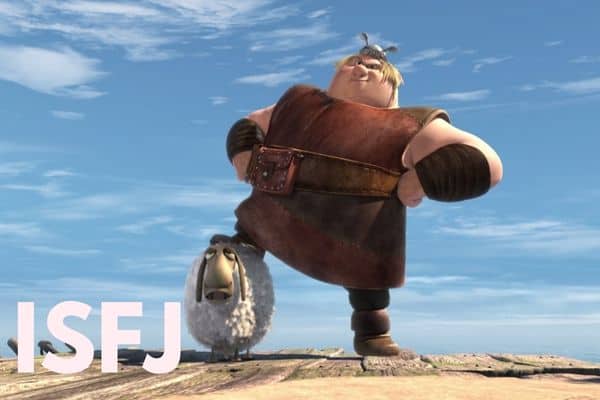
Fishlegs has probably already read the relevant chapter in the Book of Dragons. And memorized it. While his friends are charging toward something with teeth, he’s recalling its species, abilities, and the reasons charging toward it might be a terrible idea. I think it’s a great example of Introverted Sensing with Introverted Thinking, two of the ISFJ’s primary functions.
His detailed knowledge makes him valuable to the group. He collects information because he loves the subject, then puts it to use when his friends need help. Like most ISFJs, he’s good at retaining specific facts and experiences, comparing what he encounters with what he knows, and building expertise over time. His affectionate bond with Meatlug gives that knowledge a personal dimension. Dragons become creatures he knows and cares about individually.
I like Fishlegs because he gives ISFJ intelligence some overdue attention. He’s a thorough, enthusiastic nerd who can contribute something the loudest person in the room hasn’t considered. He may worry about the danger, but he still accompanies his friends into it. Ideally with some useful information and a dragon he adores.
#22 – Otis Milburn (Sex Education)

Otis can help you understand your relationship problems. Please don’t ask how his own are going.
Growing up with a sex therapist for a mother gives him years of detailed information, much of which he would probably have preferred to acquire under less embarrassing circumstances. When he and Maeve start advising their classmates, though, that background becomes useful. He knows how to listen, ask questions, and make an uncomfortable problem feel manageable.
That combination is what draws me toward ISFJ for Otis. He applies information absorbed over years to particular people’s situations, which fits an Si reading. His Extraverted Feeling comes through in his desire to be understood, connect, and help people with their personal problems. There’s also an analytical side to him: he wants to work out what is actually causing the difficulty for people, and he does so by piecing together all that information and finding practical solutions and down-to-earth insight.
Of course, insight gets harder when his own feelings are involved. He can become defensive, self-absorbed, and painfully clumsy. I appreciate that about his character. Being good at helping people doesn’t automatically make you good at apologizing to your best friend or telling someone you love them. Those require practice, too.
#23 – Thomas Hutter (Nosferatu, 2024)

Thomas Hutter wants to gain a better life for himself and Ellen. Unfortunately, his career advancement involves visiting Count Orlok, which turns out to be a really poor onboarding experience.
Thomas approaches the assignment as a professional responsibility and an opportunity to improve their circumstances. Ellen’s fears conflict with the ordinary explanation he has available: he needs to travel, complete a property transaction, and come home. By the time he understands what he has walked into, that familiar picture of the world has become impossible to maintain.
I lean toward ISFJ because of his investment in their shared life, his sense of obligation, and the concrete way he tries to secure their future. His intentions are caring, but he initially struggles to give Ellen’s experience the weight it deserves. He fails to value her more abstract, otherworldly perceptions, instead believing what’s most easy and concrete.
#24 – Tobias Durand (We Live in Time)

Tobias wants a life with Almut: a home, a child, and time to enjoy the family they built together. Everyday hopes matter to him and quality time spent together means more than achievement in his eyes. He’s tender and earnest, but his concern can also become anxious and insistent. When Almut’s cancer returns, he wants to preserve their time together. She also wants to pursue the cooking competition that means so much to her, and the two wishes don’t meld well. He has to understand that the woman he loves has ambitions beyond the life they share. Eventually, he and Ella are there to support her as she competes.
ISFJ for Tobias makes sense to me in his attachment to their shared experiences and his desire to care for his family through tangible acts. At the end, cooking with Ella becomes a way of carrying something of Almut forward. He infuses love and affection into simple, routine acts that remind him of the people he loves.
#25 – Rex (Toy Story)

Rex is a dinosaur who worries that he isn’t intimidating enough. He would like to be taken seriously, but preferably without upsetting anybody. A tricky situation for a Tyrannosaurus rex.
He’s affectionate, eager to contribute, and prone to imagining everything that could go wrong. Familiar people and a clear role help him feel secure. When the toys face another upheaval, Rex tends to need reassurance before he can trust that things will work out. ISFJs everywhere will relate. Stress tends to wake up the catastrophizer in the ISFJ, whereas stability and community bring a sense of comfort.
I can see an ISFJ pattern in Rex’s loyalty, reliance on familiar reference points, and anxious anticipation of uncertain outcomes. But what I enjoy most is that Rex keeps participating even through the fear. He worries aloud, asks for help, and goes with his friends anyway. Someone has to voice the concerns everybody else is sprinting past.
#26 – Dr. Dennis Whitaker (The Pitt)

Whitaker shows up as a student at the emergency department eager to learn and visibly out of his depth. He asks questions, makes mistakes, and tries again. In a workplace where everyone seems to be moving three steps ahead of him, his earnestness is endearing but also a little painful to watch.
What stands out is how personally he takes his patients’ experiences. After connecting with Bennet Milton, he struggles with the man’s death, wondering whether he could have done more. Later, when he finds Robby overwhelmed after the mass shooting, he offers comfort and calm emotional support. He’s still learning medicine, but he already understands something about staying with a person who is hurting. It’s easy for him to connect, care, and gently support.
#27 – Lilly Bainbridge (IT: Welcome to Derry)

Lilly wants someone to believe her. Unfortunately, she lives in Derry, where asking adults for help is something of a gamble.
She begins the story carrying grief and guilt over her father’s death. Her thoughts have become memories she keeps returning to, and the fear of being dismissed or institutionalized makes it difficult to speak openly about what she’s experiencing. Still, she shows up for her friends and repeatedly risks her safety to help them.
I lean toward ISFJ because Lilly often looks to what she has experienced, what she can observe, and the people she trusts to understand what is happening. Her Extraverted Feeling shows in how much her friends’ feelings and safety matter to her. When uncertainty overwhelms her, possibilities can become frightening rather than inviting, which fits an inferior Ne interpretation. Although, to be fair, an imagination full of terrible possibilities is fairly reasonable when you live near Pennywise.
Lilly’s sensitivity makes her vulnerable, but it also keeps her responsive to others. Even while frightened and doubting herself, she cares enough to keep reaching for people. That gives her courage a particularly human quality.
#28 – Seo Jun-tae (Weak Hero)

Jun-tae is the friend who remembers that someone will need ointment after all the punching is over. In Weak Hero, this is an essential public service.
He pays attention to the practical things his friends need, bringing medicine and offering help without turning it into a big deal. He’s also frightened by the violence around him, which makes his willingness to intervene matter. It’s one thing to show up when you’re already a big risk taker, it’s another when you’re naturally cautious and timid. Jun-tae watches for an opening, helps where he can, and stays involved even when he would have good reason to retreat.
That combination of observation and personal concern makes ISFJ a strong fit in my view. He notices an injury, remembers a need, and does something useful about it. His Extraverted Feeling also comes through in the value he places on his friendships and his desire to help the group hold together.
I appreciate that Jun-tae doesn’t need to become the most intimidating fighter to earn his place. His contribution grows out of who he already is.
#29 – Willow Park (The Owl House)

Willow spends far too long being judged by something she isn’t good at. Her parents place her in the abomination track at school, even though her talent lies in plant magic. Other students mistake that mismatch for a lack of ability, and Willow has to live with the label. An excellent argument for letting children have some say in their education.
As she finds opportunities to use her actual strengths, she becomes more confident, assertive, and willing to lead. But she retains her attentiveness to friends and her history with Amity still matters to her. ISFJ makes sense to me in that combination of lasting personal impressions and deep desire for belonging.
What I enjoy about Willow is how much she changes once people stop treating her as a disappointment. She just needed room to discover what she could do, and friends who helped her see herself more accurately. By then, anyone still expecting an easy target has quite a surprise waiting.
#30 – Eiji Okumura (Banana Fish)
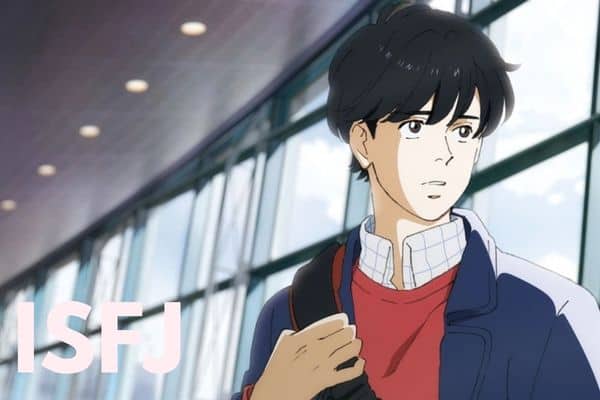
Eiji enters Ash’s world as a photographer’s assistant, with very little preparation for the danger surrounding him. Yet he becomes someone Ash can trust, offering affection without demanding that Ash prove himself worthy of it.
His kindness also comes with initiative. When he is held captive with Ash and Skip, Eiji uses his pole-vaulting experience to escape over a wall and seek help. It’s a moment where a skill from his earlier life becomes useful in an entirely unfamiliar situation.
I lean toward ISFJ because Eiji combines that practical resourcefulness with sustained attention to someone he loves. He’s gentle and warm-hearted, but also cautious and detail-oriented. He sees Ash’s vulnerability alongside his competence, and their relationship gives Ash space to experience something beyond survival.
Eiji’s final letter carries that same loyalty. Before returning to Japan, he writes to assure Ash that distance will not erase their bond. His presence matters because he keeps treating Ash as a person with a future, ordinary needs, and a right to tenderness. I think in a story as gritty as Banana Fish, that speaks volumes.
#31 – John Watson (Sherlock)

John Watson moves in with Sherlock Holmes and discovers that sharing a flat involves rather more crime scenes than he anticipated. Fortunately, he has a medical background, military experience, and a tolerance for difficult people that deserves its own award.
He brings practical judgment to Sherlock’s extraordinary deductions. While Sherlock is absorbed in solving the puzzle, John often notices the people caught inside it: their fear, grief, injuries, and need for a somewhat sensitive explanation. In “A Study in Pink,” that concern becomes decisive action when he shoots the cabbie threatening Sherlock’s life.
I lean toward ISFJ because John draws heavily on experience, recalling past examples, and taking his time to cross-reference. He also feels a strong responsibility toward the people he has committed to. His medical and military training give him reliable skills to use when a situation becomes dangerous. His Extraverted Feeling shows in his attention to how Sherlock’s behavior affects others, although he occasionally expresses that concern through exasperated shouting.
John also enjoys danger more than he initially admits. That makes him an interesting ISFJ candidate: dependable and relationship-focused, but restless when life gives him too little to do. Sherlock offers him purpose, companionship, and approximately no peace.
#32 – Aziraphale (Good Omens)

Aziraphale owns a bookshop where purchasing a book can feel like asking him to surrender a beloved relative. He appreciates familiar pleasures: good food, treasured books, and the company of one particular demon. After thousands of years on Earth, he has become rather attached to the place.
His care is evident from the beginning. When Adam and Eve leave Eden, he gives them his flaming sword because they might need warmth and protection. Then he worries about whether he was supposed to do that. It’s a wonderfully revealing sequence: notice someone’s needs, help them, and fret afterward about the rules.
I see an ISFJ pattern in his attachment to accumulated experience and the personal meaning he gives familiar things. His concern for others suggests Extraverted Feeling, while his loyalty to Heaven creates a painful conflict when the institution’s demands clash with the lives he cares about.
Aziraphale wants to believe the system he serves can be good. Crowley makes that increasingly difficult. Watching him wrestle with the difference between being obedient and being helpful gives his character much of its depth. Also, anyone threatening his earthly comforts should remember that an affectionate angel can become extremely stubborn.
#33 – Samwise Gamgee (The Lord of the Rings)

Sam leaves the Shire with cooking equipment. There may be ancient evil to defeat, but Frodo will still need something to eat.
That attention to everyday needs makes his loyalty tangible. He watches their supplies, notices Frodo’s exhaustion, and keeps doing the next useful thing when the journey becomes unbearable. On the slopes of Mount Doom, when Frodo can no longer walk, Sam carries him. The enormous task has narrowed to one immediate responsibility: help his friend keep going.
Sam is one of my strongest ISFJ picks because his care is grounded in familiarity, experience, and personal commitment. Memories of the Shire matter to him throughout the journey. He knows what a good life feels like, and that gives him something worth protecting when everything around him becomes frightening and strange.
His loyalty also comes with judgment. He’s suspicious, outspoken, and entirely capable of arguing when he thinks Frodo is making a dangerous mistake. Sam has affection, opinions, and a formidable will. Middle-earth is fortunate that all three are directed toward getting Frodo home.
#34 – Neville Longbottom (Harry Potter)

Neville begins his time at Hogwarts looking as though he would appreciate being excused from the entire experience. He forgets things, struggles in class, and lives under the weight of other people’s expectations. Having Snape as a teacher does very little for the situation.
But Neville’s courage appears early. In his first year, he tries to stop Harry, Ron, and Hermione from sneaking out because he believes they will get Gryffindor into trouble. Standing up to friends is difficult when their acceptance matters to you, yet he does it anyway. Years later, he defies Voldemort and destroys Nagini with Gryffindor’s sword.
I lean toward ISFJ because of his conscientiousness, lasting attachments, and gradual development through practice. Herbology gives him an area where his careful attention becomes real competence. Encouragement and experience help him trust abilities that criticism had made difficult to recognize.
#35 – Hershel Greene (The Walking Dead)

Hershel begins with a farm, a family to protect, and beliefs that the apocalypse is doing its best to dismantle. He wants to preserve something recognizable in a world that has become horrifying. Sometimes that steadiness helps people and sometimes it makes accepting the truth much harder.
His ISFJ qualities are clearest in how he puts experience and care to work. A veterinarian before the outbreak, he uses the skills available to him to treat people. During the prison’s flu outbreak, he stays with the sick, tending patients even as the danger to his own life grows.
I see Introverted Sensing in his reliance on established knowledge and the importance he places on the life he remembers. He doesn’t want change; he wants everything to be as consistent as possible, even when the world is falling apart around him. His Extraverted Feeling comes through in his efforts to preserve dignity, offer reassurance, and keep the group connected to its humanity.
Hershel’s growth involves him being able to revise beliefs he once held firmly, while finding ways to retain the values underneath them. Eventually, he becomes someone others turn to for perspective. Experience gives him authority, but his willingness to keep caring is what makes people trust it.
#36 – Souya “Angry” Kawata (Tokyo Revengers)

Souya looks perpetually furious. His nickname is Angry. Naturally, he turns out to be one of the gentlest people in the gang.
Excellent branding, everyone.
Unlike his smiling twin brother, Souya isn’t especially eager to hurt people. He’s sensitive to others’ suffering, and that becomes painfully clear during the fight with the Haitani brothers. Even with his own arm and leg broken, what finally brings him to tears is watching them brutally beat Hakkai. He begs them to stop because he’s afraid his friend will die.
Then the “Crying Blue Ogre” appears, and the fight takes a considerable turn.
Probably should have listened to the crying boy.
His response to Hakkai’s pain is one reason I lean toward ISFJ for Souya. His attention goes to the person beside him: He’s being hurt. I need to help him. That personal concern fits an Extraverted Feeling interpretation, although we get less evidence of his dominant perceiving function than we do of his protective instincts.
What makes Souya such a fun addition to this list is the mismatch between his expression and his actual disposition. He looks ready to pick a fight while wishing people would stop being cruel. But once someone he cares about is in danger, that tenderness can become formidable. Underestimate him at your own risk.
#37 – Kim Geon-woo (Bloodhounds)

Geon-woo is a boxer with excellent manners. He can knock someone down, then seem sincerely concerned about how the rest of their day is going.
His priorities are straightforward: work hard, help his mother, and take care of the people who matter to him. With his mother’s café struggling, he puts his earnings toward supporting her. His boxing match against Woo-jin also becomes the beginning of a friendship, rather than an excuse to maintain an impressive grudge.
I lean toward ISFJ because Geon-woo is all about personal warmth and responsibility. He’s down to earth and reliable, with an eye for detail and a consistency that makes him an expert in his field. He trains, works, and makes himself useful. There’s an earnestness to him that pairs wonderfully with Woo-jin’s more talkative personality.
He’s also a welcome reminder that an ISFJ can be physically formidable. His reserved manner and tenderness toward his mother coexist comfortably with discipline and strength.
#38 – Chilli Heeler (Bluey)

Chilli can join an elaborate children’s game, offer thoughtful advice, and deliver a dry comment about the household chaos without missing a beat. She loves her family, but she would also occasionally like twenty uninterrupted minutes.
A reasonable request. Somehow, still a whole episode.
In “Baby Race,” Chilli remembers worrying that Bluey was falling behind other babies. Each milestone becomes a judgment on her parenting until another mother reassures her that she’s doing well. Later, she uses that experience to help her daughters understand comparison. That’s a lovely example of an Si-style approach: a personal memory becomes a useful lesson for someone facing a similar feeling.
Her Extraverted Feeling comes through in how carefully she responds to the girls’ emotional needs. But Chilli has needs of her own, and in “Sheepdog,” she makes that clear by asking for time alone after a long day with the children.
I like Chilli as an ISFJ because she feels like a person you might actually know. Affectionate, observant, funny, occasionally exhausted. She offers reassurance while still learning how to give herself some. And sometimes the best thing she can do for everyone is close the bedroom door.
#39 – Choi Ji-seon (Teach You a Lesson)

Ji-seon becomes a teacher because she cares about children. You can see that care in her classroom: she wants her first graders to feel welcome, comfortable, and safe. She takes the little details seriously because those details shape a child’s day.
Then a parent begins harassing her, and Ji-seon keeps trying to smooth things over. She worries, second-guesses herself, and hopes that if she can endure a little longer, the situation will settle down. Watching this, you desperately want someone to step in and help her. Preferably several episodes ago.
Her attention to everyday needs fits an Introverted Sensing interpretation, while her concern for relationships points toward Extraverted Feeling. She feels responsible for creating harmony, even when the person confronting her has no interest in cooperating.
#40 – Kathy Selden (Singin’ in the Rain)

Kathy Selden meets a movie star and immediately questions his acting abilities. Don Lockwood is accustomed to women swooning over him, so this is a refreshing change. For us, anyway. Don needs a minute.
Kathy takes her craft seriously. When Don and Lina’s first talking picture becomes a disaster, she lends her voice to rescue it, dubbing Lina’s dialogue and songs. She puts in the work while someone else receives the applause. Then Lina decides Kathy should keep doing this indefinitely, without credit.
How generous of Lina. With Kathy’s entire career.
Kathy combines conscientious work with personal loyalty. She’s attentive to what the production needs and willing to help Don through a difficult situation. But she also wants recognition for her abilities. She can care about Don while questioning him, and she can contribute behind the scenes while wanting her own chance in front of the camera. Please put this woman’s name on the billboard already.
What Are Your Thoughts?
Do you agree with this list? Disagree? Have any other characters you think might be ISFJs? Let us know in the comments!
Find out more about your personality type in our eBooks, The ISFJ – Understanding the Protector, Discovering You: Unlocking the Power of Personality Type, The INFP – Understanding the Dreamer, or The INFJ – Understanding the Mystic.
Other Articles You Might Enjoy:
The Flirting Style of the ISFJ Personality Type
Here’s What it Means to be an ISFJ Personality Type
About the Author:

Jami Cannon is an MBTI® enthusiast who hopes to shed more light on the SJ experience. She holds a very stereotypical degree in History (MA) and loves to learn all she can about the people around her.







This is so much fun! Are you planning to make a series out of this concept? I have a hard time finding ENFj’s in fictional characters, and would be interested to know who you could find!
Absolutely! I’m trying to get articles like this for each of the 16 types, so stay tuned! 🙂
I can’t relate to Meg March or Cinderella at all. I’m rather a Jo March. I can also relate to Mr, Rogers because people say so. Therefore I’m still confused as in who I am. I havent watched other movies from the above .
One character that people associate me with is Katherine Watson from ” Mona Lisa Smiles” all the time.