12 Things That Hurt FJ Personality Types More Than They Let On
Someone’s tone changes at dinner, and you notice. Someone gets interrupted three times, and you start looking for a way to bring them back into the conversation. Someone says, “I’m fine,” with the warmth of an icicle, and suddenly you’re reviewing the last forty minutes for evidence of your involvement.
Meanwhile, your food is cold, your shoulders are somewhere near your ears, and you have absolutely no idea whether you were enjoying yourself.

Welcome to one possible evening in the life of an FJ personality type.
ENFJs, ESFJs, INFJs, and ISFJs all use Extraverted Feeling, or Fe, as their primary decision-making function. In type theory, this process focuses on interpersonal dynamics, shared values, and how decisions affect people. That doesn’t make FJs universally agreeable, selfless, or blessed with supernatural access to your emotional state. Some will bring up an uncomfortable issue because leaving it alone feels dishonest or harmful.
But paying attention to people can get expensive when you start believing every discomfort you notice comes with your name on the repair ticket.
My sister is an ENFJ and she often struggles with taking on more than she can handle just because she naturally feels responsible for the feelings of others. I admire her selflessness, but it comes at a cost. Sometimes it means burnout, feeling taken for granted, or dealing with people who take far more than they ever think to give.
The struggles below won’t fit every FJ. Your history, relationships, and circumstances matter, too. Still, if you’ve ever said “It’s okay” while something inside you withered and died, you may recognize a few.
1. You Feel Responsible for Moods You Didn’t Create
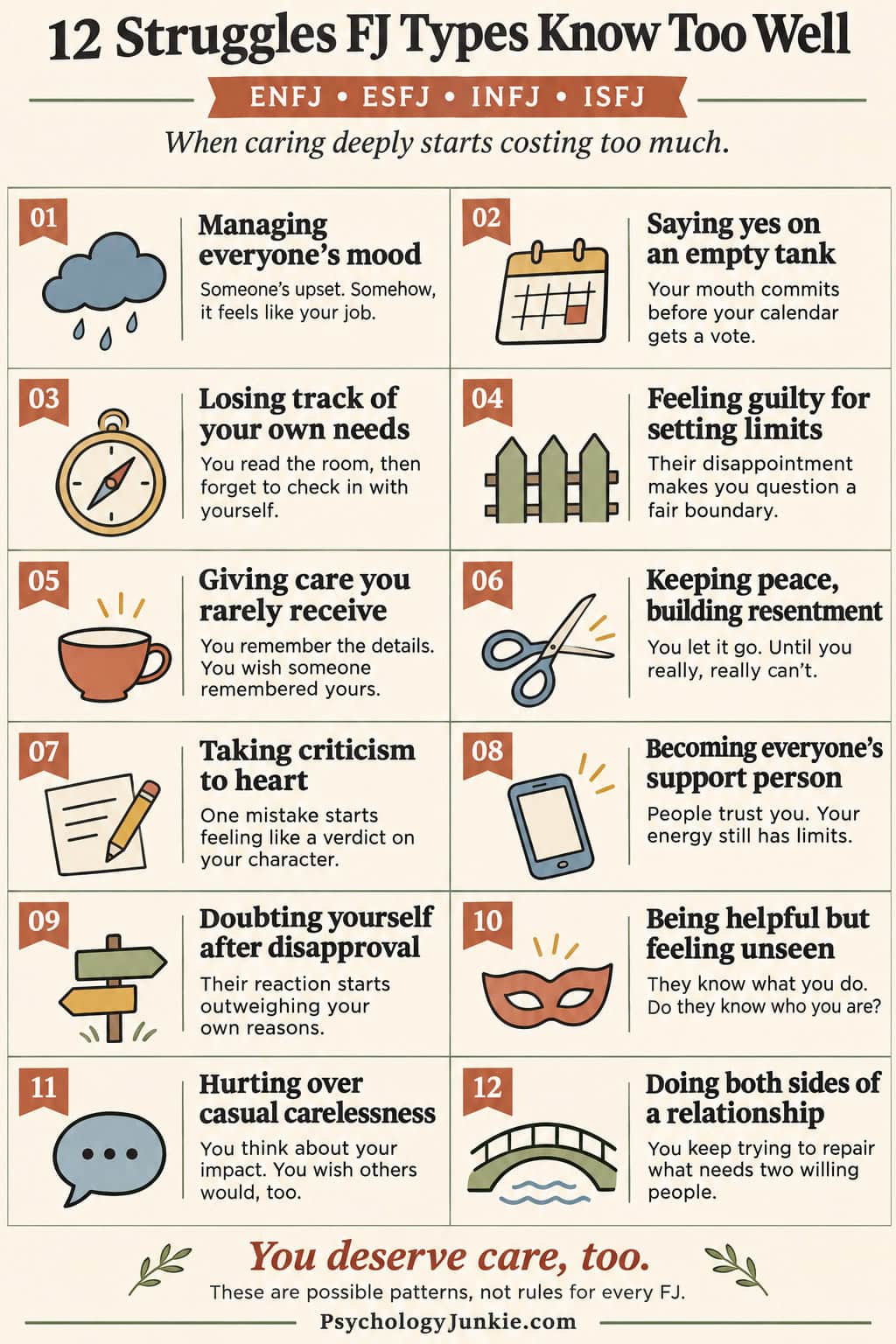
Someone you love is irritable, and your brain opens an investigation. Are they tired? Hurt? Angry with you? Should you ask, give them space, make coffee, become a fundamentally different person before lunch? While you might know perfectly well that people have moods for reasons unrelated to you, shaking off the concern can be a huge challenge.
Over time, someone else’s bad day can become the atmosphere you have to breathe, and you keep trying to change the weather with a considerate text.
A question worth practicing is: “Have they asked for help, or am I trying to relieve my own discomfort with their discomfort?” Sometimes there’s a real need you can meet. Sometimes someone needs to be grumpy while you finish your sandwich.
2. You Say Yes, Then Meet the Consequences Later
Someone requests some help from you. The request arrives attached to a human face, which is extremely inconvenient. You can picture their relief if you agree and their disappointment if you refuse, while your own exhaustion feels vague and negotiable.
So you say yes. Future You will figure it out. Future You apparently has unlimited energy, no laundry, and a suspiciously open calendar. Even as a TJ personality type, I can relate to this struggle.
Then the day comes, and Future You turns out to be you, only angrier.
Try giving yourself a sentence that creates some space: “Let me check what I can realistically manage before I commit.” You can care about someone’s situation while taking a few hours to decide whether you can help with it.
3. You Can Read the Room and Lose Track of Yourself
You know who feels excluded, who needs encouragement, and who is one poorly phrased comment away from making Thanksgiving a historical event. Then someone asks what you want to do, and your mind goes blank.
Your first instinct may be to work out what everyone else would enjoy. After enough practice, that answer starts passing for your own preference. Eventually, even a free afternoon can feel confusing. What do you actually enjoy when nobody needs anything from you? What would you choose if nobody had to approve, participate, or understand?
Start somewhere small enough to feel almost stupid: pick the restaurant, choose the music, admit you dislike the activity everyone assumes you love. Your preferences deserve practice before they’re needed for a life-altering decision.
4. Someone Else’s Disappointment Feels Like Proof You’ve Done Something Wrong
You set a reasonable limit, and the other person looks hurt. Immediately, your carefully considered decision starts wobbling. I’ve been there, so I relate. You start thinking, “Perhaps I was selfish. Perhaps I explained it badly. Perhaps I should offer three other alternatives, a heartfelt apology, and one of your major organs.
When maintaining connection matters deeply to you, another person’s disappointment can feel like an emergency. But people can be disappointed by a perfectly fair decision. You can love someone and decline a request they really hoped you would accept.
Try letting your first explanation stand. “I can’t do that this week” doesn’t become more legitimate after a twelve-minute defense presentation.
5. You Give Care in Details That Nobody Seems to Return
You remember the appointment they were worried about. You check in after the difficult conversation. You notice when their jokes get a little too convincing about how badly things are going.
Then you have a rough week, and nobody asks how you are doing.
It can feel embarrassing to admit how much this hurts, especially when you don’t think of your care as a transaction. You wanted to be thoughtful. You also wanted to matter enough for someone to remember.
People show care differently, and they may need you to say what helps. Still, repeated indifference deserves your attention. “Could you check in with me tomorrow?” is a reasonable request. If even direct requests receive very little response, that tells you something about the relationship.
6. You Keep the Peace Until You Can Barely Stand Anyone
You let the comment go because they’re stressed. You take on the extra task because it’s easier than dealing with the swallowed tension. You hold onto the small irritation because bringing it up would turn an ordinary weekday into a whole thing.
Eventually, someone asks where the scissors are, and you experience an emotion so big it overtakes everything inside you.
The scissors are innocent. Mostly.
You’ve been making private accommodations that other people may know nothing about, while hoping they’ll recognize the cost and adjust. That leaves you exhausted and them confused when your patience finally gives out.
An earlier, smaller conversation usually gives everyone a better chance: “I’ve handled this the last few times, and I need you to take the next one.” It may feel awkward. So does silently despising someone over kitchen supplies.
7. Criticism Lands Somewhere Much Deeper Than Intended
Someone says your message sounded abrupt, and suddenly you’re remembering every person you may have disappointed since adolescence.
When you’ve put real effort into being considerate, criticism can hit the part of you that wants to be good to people. A complaint about something you did starts feeling like a revelation about who you are. There may be useful feedback in what they said, but you can look for it without accepting every conclusion your shame produces.
Ask what specifically went wrong and what would help next time. “I interrupted them twice” gives you something you can change. “I’m a terrible person who ruins conversations” mostly gives you a miserable evening.
8. You Become Everyone’s Emotional Support Person
People open up to you because you listen, follow up, and connect. Soon you’re holding a remarkable amount of information about other people’s marriages. Being trusted can feel meaningful. It can also become a role you don’t know how to step out of, especially when someone begins with, “You’re the only person I can talk to.”
That sentence can make declining feel impossible. You have your own problems, but apparently they’ll have to wait in the hallway.
You’re allowed to say, “I care about you, but I don’t have the energy for a heavy conversation tonight.” Sustainable support needs room for the person providing it to have an actual life.
9. Disapproval Makes You Distrust Your Own Judgment
You make a decision that feels right. Then someone important to you reacts badly, and suddenly you’re reconsidering everything.
Their opinion may deserve consideration. The trouble starts when their discomfort automatically carries more weight than your reasons.
An ENFJ might keep trying to win someone over to a meaningful plan. An ESFJ might feel torn between a personal choice and family expectations. An INFJ or ISFJ might keep a decision private because explaining it feels like inviting a committee into an already crowded head.
Before changing course, write down why you chose what you chose. Then consider whether the other person offered information you were missing or simply expressed a preference. Those deserve different amounts of influence.
10. People Appreciate Your Helpfulness Without Really Knowing You
They call you kind, dependable, thoughtful. Lovely words. You may also be ambitious, skeptical, ridiculous, impatient, creatively restless, or interested in something that has nothing to do with improving anyone’s day.
Sometimes you wonder whether people know that person at all.
This can be especially painful when you’ve helped create the pattern by showing everyone the accommodating version of yourself. You’ve made yourself easy to be around, then discovered how lonely it feels when nobody looks much further.
Let someone meet a less polished piece of you: an unpopular opinion, an odd fascination, a dream you can’t justify in practical terms. Give the relationship a chance to include more than what you provide.
11. Other People’s Carelessness Leaves You Baffled
You spend ten minutes rewriting a text so it won’t sound dismissive. Someone else casually humiliates a friend at dinner and goes back to eating bread. You wonder whether you’re both operating under the same basic understanding of civilization.
Some people overlook social cues you notice immediately. Others recognize the impact and don’t give it much thought. Figuring out which you’re dealing with matters more than producing an increasingly elaborate private explanation for their behavior.
Be concrete: “When you joked about that in front of everyone, it put me in an uncomfortable position. Please keep that private.” Their response gives you better information than another week of wondering how they could possibly have missed it.
12. You Keep Trying to Do Both People’s Work in a Relationship
You explain yourself more carefully, choose a better moment, and acknowledge their perspective. You wonder whether a gentler opening would have helped, or a different example, or perhaps an accompanying slideshow.
There’s always another adjustment you could make, which is part of what makes this so exhausting. Your ability to imagine a better approach keeps you invested long after the other person has stopped participating.
Eventually, you need to look at what happens after you make yourself clear. Do they get curious? Take responsibility? Change anything? Or do you end up apologizing for having brought it up?
A relationship needs more than your ability to understand both sides. It needs another person willing to understand yours.
You Get to Be Someone Who Needs Care, Too
There’s something painful about realizing you can be surrounded by people who appreciate you and still feel desperately alone. They may love your warmth, your insight, your reliability, while knowing very little about what it costs you to keep showing up that way.
Sometimes they need clearer information. Sometimes you need to stop reassuring them before they’ve even had a chance to respond. Sometimes a relationship has become comfortable for everyone except you, and changing that will involve a conversation nobody is particularly excited to have.
Start with one honest sentence. “I need you to listen for a while.” “I don’t want to organize it this time.” “I know I said I was fine, but I’m actually having a hard week.”
You may feel exposed. You may even feel inconvenient. Give the people who care about you a chance to know what’s happening before you decide you have to manage it alone.
And if you’re an FJ, I’d love to hear from you in the comments: which of these hits closest to home, and what do you wish people understood about you?
Find out more about your personality type in our eBooks, Discovering You: Unlocking the Power of Personality Type, The INFJ – Understanding the Mystic, The ISFJ – Understanding the Protector, and The INFP – Understanding the Dreamer. You can also connect with me via Facebook, Instagram, or YouTube!