When Someone You Love Wants More Connection Than You Can Give (Or Vice Versa)
I’m an INTJ married to a connection-seeking ESTP, which means that sometimes we can both want a perfectly reasonable evening and have very different ideas about what that evening should involve.
My version might include reading, researching something nobody asked me to research, or going for a walk with music. His includes more connection with me, things like laughter, flirting, swapping massages, etc.. Considering that he married me, I suppose this is fair.

And this struggle can extend to any type of relationship. Sometimes my extroverted 10-year-old needs more talking, expression, and interaction than feels natural to me. Does this mean I don’t care? Absolutely not. It just means I sometimes need space to hear myself think (I’m sure any parent can relate).
The difficulty is that I can love them, enjoy them, and still reach the end of the day feeling as though one more question might finish me off. Meanwhile, wanting time with your loved one is hardly an unreasonable request. Neither is needing space to recharge.
Maybe you’re the person who needs some time without anyone asking you a question. Or maybe you’re the person who has been waiting all day to talk, only to discover that someone you love has reached their daily limit on human interaction. Unfortunately, you are a human. You may also find yourself on different sides of this depending on the relationship. You might need a break from a talkative family member, then feel hurt when a close friend rarely makes time for you. Even two introverts can disagree about how much togetherness feels good.
Either position can feel lonely. One person wonders, “Can I have a little room to breathe?” The other wonders, “Do you actually enjoy spending time with me?”
This can happen between spouses, friends, siblings, or parents and children. You can care about each other and still want very different amounts of contact. There are a few different things worth untangling here: introversion, extroversion, Thinking and Feeling preferences, overstimulation, and attachment. They can overlap, but each tells us something different.
Not sure what your personality type is? Take our new personality questionnaire!
Table of contents
- When You’re an Introvert, Conversation Can Interrupt the Very Thing That Helps You Recover
- When You’re the One Waiting for Connection
- Thinking Types: Your Partner May Need Something Other Than an Assessment
- Attachment Changes What Space Means
- The More One Person Pushes, the More the Other Retreats
- Ask for the Thing You Actually Need
- Come Back Without Making Them Chase You
- Find a Way of Being Together That Both of You Enjoy
- You Can Love Your Partner and Still Need to Be Alone
- Other Articles You Might Enjoy:
When You’re an Introvert, Conversation Can Interrupt the Very Thing That Helps You Recover
For introverts, attention naturally turns toward the inner world. Whether you’re an ISTP, an INFP, an ISFJ, or any other introverted type, you need opportunities to check in with your own thoughts, impressions, feelings, or experiences. That inward attention gives you room to process what’s happening and hear yourself think.
I think of it as mental oxygen. I can enjoy being with people, but eventually I need to come up for air.
Your battery for interacting with the outer world may run out sooner than the people around you expect. You can be having a good time and still reach your limit. Conversation requires you to keep listening, responding, shifting your attention, and taking in new information. Meanwhile, you may still be trying to sort through something someone said forty minutes ago.
Without a chance to turn inward, you can start to feel like you’re driving a car that’s sputtering. You’re pressing the gas because people still need things from you, but getting a coherent sentence out is becoming a mechanical concern.
You may notice that:
- You need longer to answer even simple questions.
- Interruptions make it difficult to finish a thought.
- You become less talkative or struggle to stay engaged.
- Small requests feel unusually demanding.
- You get irritable because you can’t find a moment to think.
- You want to read, walk, work on something alone, or simply stop responding for a while.
For me, with five children, there are plenty of opportunities to discover how many questions I can answer before my brain starts buffering. I can want everyone I love to be happy while also wanting absolutely nobody to request anything for ten minutes.
From the other person’s side, this can be confusing. Your friend is telling you a story. Your child wants to show you something. Someone you love asks how your day went, and you respond with the enthusiasm of a printer jam. They may wonder whether they’ve annoyed you or whether you’re interested in them at all. They can’t necessarily tell how much energy you’ve already spent staying available.
That’s where a specific explanation helps:
“I want to hear about this, but I’m having trouble taking anything else in. Could I have twenty minutes to myself, then come find you?”
Or, with a child:
“I need ten minutes of quiet to get some energy. Then I’d love to see what you made.”
The time alone needs to give you some room to follow your own attention. Reading, thinking, making something, or taking a walk may help. Sitting alone while answering twelve messages may leave you feeling just as depleted.
For every individual the time that your battery runs down will vary. Introversion doesn’t automatically mean sensitivity to noise or touch, and extroverts also need rest and privacy. Stress, sleep, and the demands of the day affect everyone’s capacity.
But if turning inward helps you recover, it makes sense to build opportunities for that into your day. And when you explain what you need and follow through on reconnecting, the people you love have less reason to interpret your tiredness in a negative way.
When You’re the One Waiting for Connection
Maybe you’ve been giving someone space. You’ve found other things to do, held off on sending another message, and told yourself they’re tired. But eventually you start wondering when they’ll want to spend time with you without being asked.
That can hurt, especially if you’re usually the one who calls, suggests plans, or notices that you haven’t had a proper conversation in a while.
Sometimes what you want is fairly small. A friend who asks a follow-up question. A parent who puts down their phone. A sibling who occasionally calls first. Some sign that the relationship matters to them when you aren’t standing directly in front of them hoping for some voluntary evidence.
It helps to name what you’re missing: “I’d love it if you initiated plans sometimes,” or “When we talk, I want a few minutes of your full attention.” It also helps to hear the answer. Someone may care about you and have less time or energy available than you’d like. Then you have something concrete to discuss, including whether the amount of contact they can offer works for you.
Thinking Types: Your Partner May Need Something Other Than an Assessment
Thinking and Feeling preferences influence how we make decisions. Thinking preferences give more weight to logical analysis and consistent principles; Feeling preferences give more weight to values, personal circumstances, and the people involved. Both types can reason, feel deeply, and want intimacy, but these preferences can influence how we try to help.
If your partner says, “I feel like you don’t want to spend time with me,” you might immediately search your memory for evidence. You watched a movie together. You went somewhere on Saturday. You were both in the kitchen for forty-five minutes yesterday, although admittedly most of that involved a missing permission slip.
Your defense is coming together beautifully. Why is your partner is getting more upset?
They may be trying to describe a lack of attention or affection while you’re establishing that the two of you have, in fact, occupied the same premises.
Before presenting your case, try asking:
“What have you been missing when we’re together?”
A Feeling partner may want you to understand the personal meaning of the situation before discussing solutions. A Thinking partner may want exactly the same thing. My husband’s type is a useful reminder that emotional needs do not check the third letter of your MBTI code before appearing.
You can take someone’s feelings seriously without agreeing with every conclusion they draw. “I can see why that hurt” leaves room for a later conversation about what you intended or remember differently.
And if your instinct is to fix the problem, ask whether that would help. Sometimes your partner wants advice. Sometimes they want company while they feel disappointed. Discovering which one it is can save you both a very unnecessary argument.
Attachment Changes What Space Means
Personality preferences describe part of how we naturally approach life. But I think that attachment style is also important to consider. Attachment concerns our expectations and responses around closeness, support, and a partner’s availability.
Psychologist and attachment researcher R. Chris Fraley describes two important dimensions: attachment anxiety and attachment avoidance. Higher anxiety involves more worry about a partner’s availability and responsiveness; higher avoidance involves more discomfort relying on others and opening up.
If you have an anxious attachment style, your partner’s need for space can feel like rejection. If you have an avoidant attachment style, their need for closeness can feel like pressure, making you want to pull away.
Now to clarify, wanting solitude doesn’t mean that you’re avoidant. Wanting reassurance doesn’t mean that you’re anxiously attached. Sometimes you’re exhausted; sometimes your partner really has been unavailable.
Clinical psychologist Sue Johnson, who developed Emotionally Focused Therapy, captured a central relationship concern in these questions:
“Are you there for me – Can I count on you?”
That helps explain why the same half-hour break can feel very different depending on what usually happens afterward.
If you reliably return, show interest, and make time together, your partner has evidence that space is temporary. If “later” regularly becomes tomorrow, then next week, their concern has something concrete behind it.
On the other side, if every request for solitude produces accusations, repeated checking, or pressure to continue talking, a person may start to brace themselves whenever their partner approaches. So both the need itself and the history around it deserve attention.
My friend Heidi Priebe has made a lot of helpful videos about attachment style if you want to find out more about it.
The More One Person Pushes, the More the Other Retreats
Psychologist Harriet Lerner describes pursuing and distancing as common responses to relationship stress. Trouble develops when they become entrenched and each person’s behavior keeps provoking the other’s.
One partner feels disconnected and asks for more contact. The other feels pressured and withdraws. The withdrawal increases the first partner’s worry, so they ask more urgently. Now the second person is even more determined to get away.
Lerner puts it plainly:
“Pursuing and distancing are normal ways that humans navigate relationships under stress, and one is not better or worse than the other.”
It’s easy to understand your own side. You know how many times you’ve tried to connect, or how many times you’ve tried to explain that you need a break. Your partner’s behavior can start to look like the entire problem.
You don’t have to decide who started it before changing what you do next.
If you usually retreat, try offering a specific return time and taking responsibility for restarting the conversation. If you usually pursue, try making a direct request and allowing the agreed interval of space.
Neither person should have to do all the adjusting. A relationship where one person gets unlimited solitude and the other waits indefinitely is going to hurt. So is a relationship where being alone requires an elaborate defense.
Ask for the Thing You Actually Need
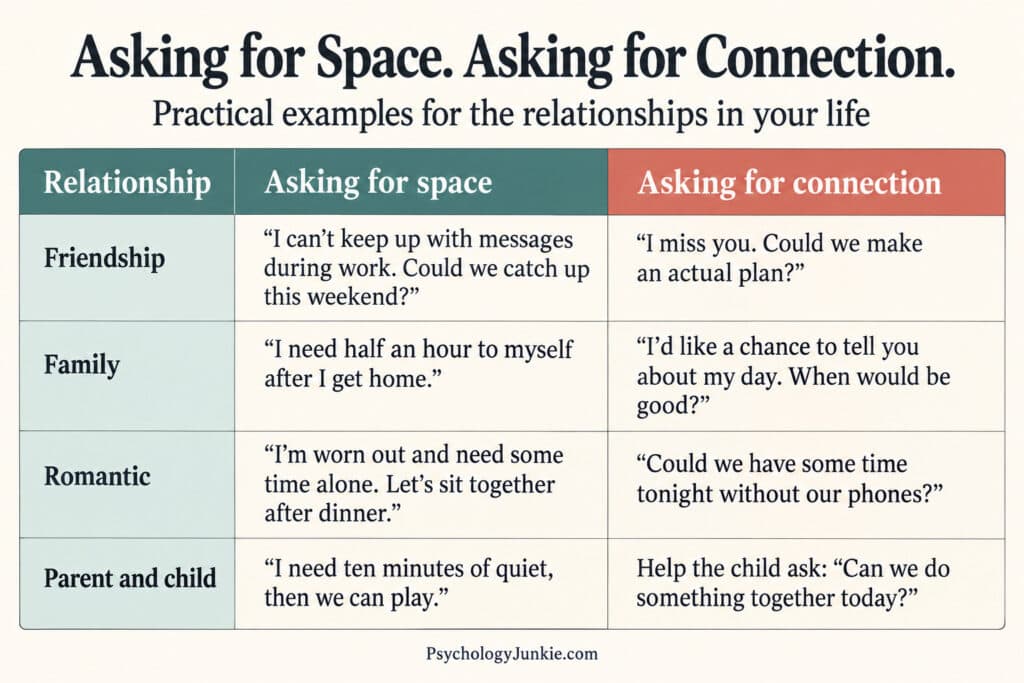
“I need space” can mean anything from “Please don’t speak to me for twenty minutes” to “I’m reconsidering this relationship.” You may mean the first while your partner hears the second. A little detail makes a huge difference.
“I’m tired and need thirty minutes without conversation. I’d like to sit with you after that.”
Or, “I need more connection” is easier to respond to when it becomes:
“I’d like some time tonight when we’re both off our phones and can talk.”
You might discover that your partner wants something fairly small: a warm greeting, a hug, a question about their day, or for you to occasionally be the person who suggests spending time together.
And you might discover that what you need is less complicated than an evening alone: no television during the conversation, a chance to finish work first, or a little time without answering questions.
Ask rather than assuming. Your partner is available for consultation, even if their preferred consultation hours differ from yours.
Come Back Without Making Them Chase You
Something important for fellow introverts like me: when you ask for a break, take responsibility for returning. The person wanting connection shouldn’t always have to wonder whether enough time has passed, whether you’re annoyed, or whether bringing it up again will make everything worse.
If you said you’d find them after dinner, find them after dinner. If you need more time, tell them and make another realistic plan.
During an escalating argument, a break can also help you settle enough to listen. The Gottman Institute recommends allowing at least twenty minutes when you’re overwhelmed, while also emphasizing the importance of returning to the conversation. You may need longer, but the break needs a plan.
Use it to recover rather than rehearse everything your partner has done wrong since 2014. Going for a walk is generally more useful than preparing closing arguments against someone you’d like to remain married to.
When you return, give the conversation your attention. Your partner will probably notice if your body has arrived but the rest of you is still reading something on your phone.
Find a Way of Being Together That Both of You Enjoy
Connection doesn’t always have to involve sitting face-to-face and discussing your feelings until somebody develops a headache. Thank God.
It might be walking, cooking, playing a game, sharing music, or going somewhere together. For a couple with different preferences, a shared activity may make interaction easier and more enjoyable.
As an INTJ, I need to be able to follow my interests and spend time in my own head. My husband’s desire for connection matters, too. The useful question for us is what kind of time together leaves room for both.
A few years ago we had a lot of disagreements and friction because of our different needs for space. He would feel rejected and I would feel suffocated. Over and over again we’d have rifts related to this. As we studied our different attachment styles and worked on more open communication and personal growth, we’ve grown together more. Now I can ask for time alone to do my own thing without fear of hurting him, and he can be more direct about his needs and we can make space without a lot of unnecessarily hurt feelings. We’ve also found together activities that don’t wear me down as quickly as others; mutual activities that feel mutually refreshing and connecting.
It’s also worth looking at practical fairness. If one partner’s break means the other handles the children and housework for another hour, that cost belongs in the conversation. Both people need opportunities to recover.
And sometimes you may have to stretch a little. The person who needs space can initiate affection or stay involved in a difficult conversation. The person who wants more interaction can tolerate a pause and pursue interests beyond the relationship.
Those efforts go further when both people can see them.
You Can Love Your Partner and Still Need to Be Alone
Kahlil Gibran wrote:
“But let there be spaces in your togetherness.”
I appreciate this sentiment, although I would also appreciate a footnote explaining how to achieve it with children in the house.
For me, being an INTJ married to an ESTP makes these differences personal. I can understand my need for solitude much faster than I can understand why someone wants more interaction when I’m already worn out. From his side, having a wife who wants to retreat into her own interests may be equally baffling at times.
Knowing our types gives us a place to begin. Attachment, stress, and the ordinary demands of family life add more to the picture.
What helps is being specific, taking each other seriously, and following through. You can say, “I need some time alone,” while making it clear that your partner still matters. You can say, “I miss you,” without demanding that every other need disappear.
And if you repeatedly struggle to make room for either person, a qualified couples therapist can help you look at the pattern together.
You’re allowed to want closeness, and you’re allowed to want room to think. The work is figuring out how both fit into the life you actually have.