
Here’s the Animal You’d Be, Based on Your Myers-Briggs® Personality Type
Have you ever wondered what kind of animal would sum up your Myers-Briggs® personality type? Today we’re going to explore (in a rather lighthearted way) which animal best fits your unique personality type. Keep in mind, we can only understand a small amount of what really goes on in an animal’s mind, so this is post is mainly theorizing based on the limited information we have. Let us know what you think when you’re done reading!
Not familiar with the Myers-Briggs® personality types? Check out this quick and easy guide to get started!
Not sure what your personality type is? Take our new personality questionnaire!
Table of contents
- Here’s the Kind of Animal You’d Be, Based on Your Myers-Briggs® Personality Type
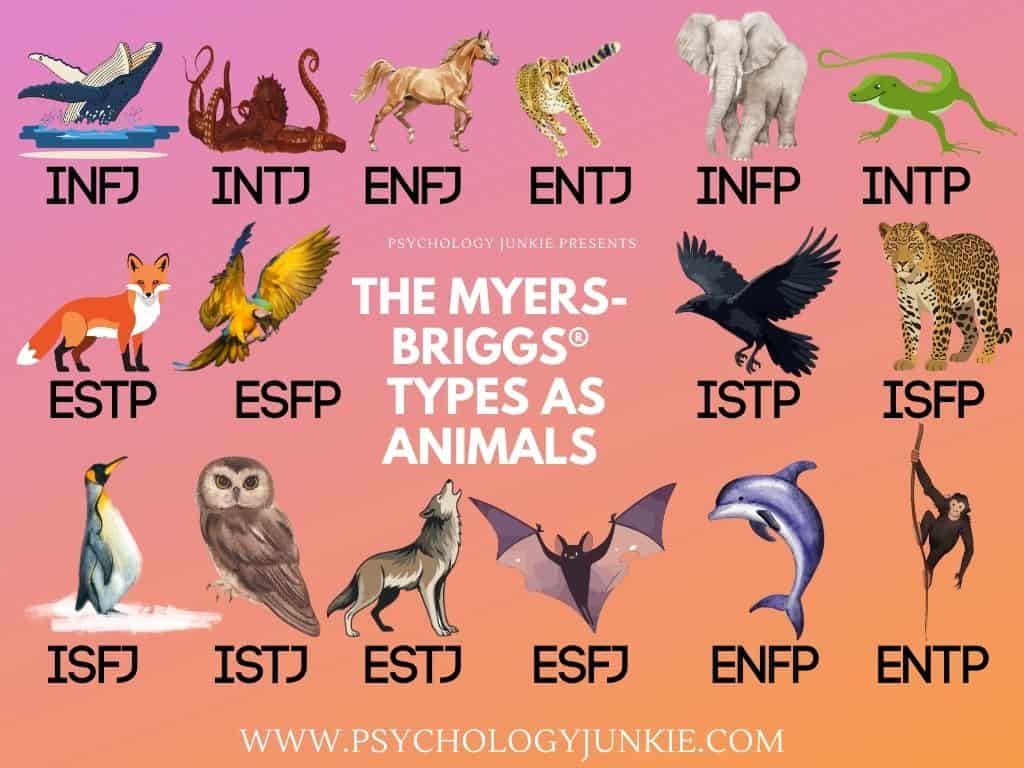
- ENFP – The Dolphin
- ENTP – The Chimpanzee
- INFP – The Asian Elephant
- INTP – The Green Anole Lizard
- ENFJ – The Arabian Horse
- ENTJ – The Cheetah
- INFJ – The Humpback Whale
- INTJ – The Octopus
- ESFP – The Blue and Gold Macaw
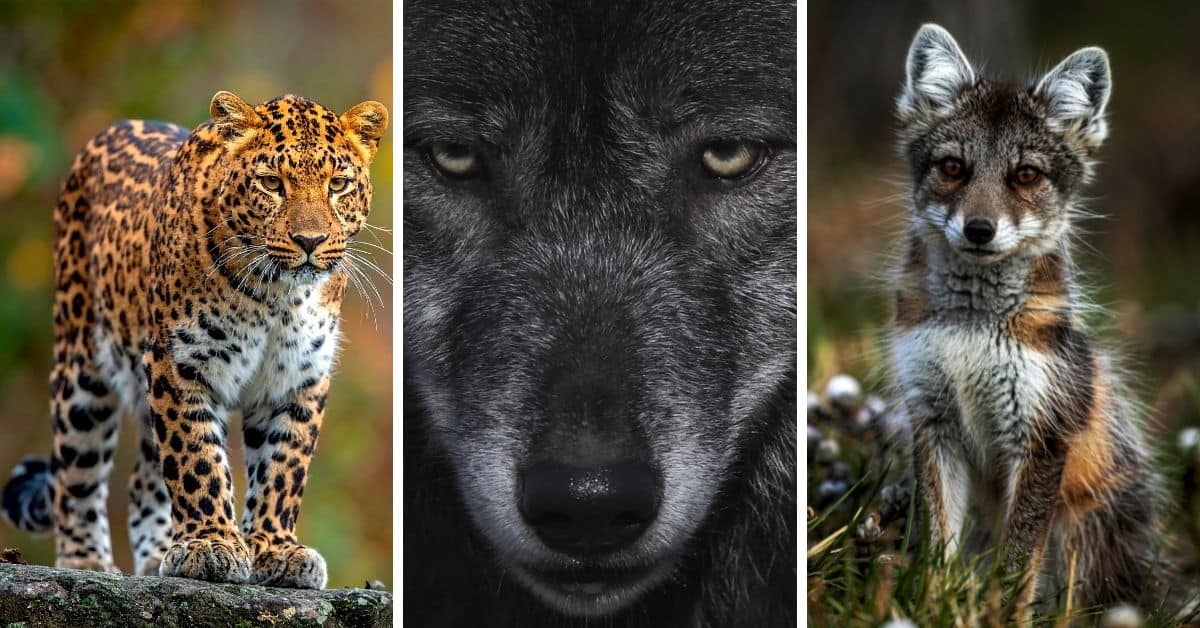
- ESTP – The Fox
- ISFP – The Leopard
- ISTP – The Crow
- ESFJ – The Vampire Bat
- ESTJ – The Wolf
- ISFJ – The Penguin
- ISTJ – The Great Horned Owl
- What Are Your Thoughts?
Estimated reading time: 18 minutes
Here’s the Kind of Animal You’d Be, Based on Your Myers-Briggs® Personality Type
ENFP – The Dolphin

Dolphins are basically ENFPs with better PR and fewer student loans. Smart, friendly, curious in that chaotic way that feels delightful until you realize someone has to clean up afterward, they glide through the ocean like they own it, which they kind of do, and somehow still act surprised every time they discover a new trick. These creatures literally wear sea sponges on their noses to protect themselves while rummaging around sharp rocks for fish, which feels aggressively on-brand for the ENFP approach to life: wildly inventive, slightly unhinged, and somehow effective. Of course I will fashion a soft helmet out of marine debris so I can chase an idea into dangerous territory, thank you for asking.
They play constantly. They leap. They tumble. They invent games out of currents and chaos. You get the sense they would get bored in a perfectly structured aquarium and start a small revolution just to feel something. Dolphins socialize for fun, for connection, for stimulation, for the thrill of shared experience, and if that isn’t the ENFP experience in a nutshell then I don’t know what is.
And yet beneath all that sparkle and improvisation is a startling intelligence, a sharp awareness of patterns and cooperation and survival. They look playful, but they are calculating in the most creative way possible, solving problems sideways, finding loopholes in the ocean itself. Their creativity does not politely color inside the lines. It rewrites the lines, then forgets where they were, then laughs and invites you to chase them anyway.
You Also Might Like: 3 Weird and Wonderful Secrets About the ENFP
ENTP – The Chimpanzee

Chimpanzees are what happens when intelligence gets bored and decides to start experimenting with the furniture. They are clever, inventive, and just chaotic enough to make you slightly nervous about what they’re planning behind your back, which feels deeply lined up with the ENTP experience. These creatures build tools, invent games, form alliances, break alliances, then circle back around like it was all part of a larger social experiment. They sharpen sticks into spears to hunt, use branches to fish for termites, and generally look at their environment as if it’s a draft version that could use some improvements. You can almost hear the internal monologue: What if we tried this differently? What if the rules are optional? What if the termites never saw it coming?
Their social world is layered and strategic (for animals), full of signaling, negotiation, playful provocation, and the occasional power move that feels suspiciously like a debate club gone feral. There’s a restless brilliance there, the kind that pokes at systems just to see where they bend, the kind that treats adaptation as a creative sport. Like ENTPs, chimpanzees don’t simply survive inside their environment; they interrogate it, remix it, and sometimes set it on metaphorical fire just to watch the reaction. It’s adventurous, yes, but also deeply analytical under the surface, a mind constantly testing angles and outcomes while pretending it’s all just for fun. The playfulness is real. So is the strategy. And if something collapses along the way, well, at least the experiment yielded data.
INFP – The Asian Elephant

Elephants feel like what would happen if tenderness grew legs and weighed several tons. Compassionate, intuitive, gentle, they move through the world with this slow, deliberate presence that makes you want to lower your voice out of respect. They help their babies out of mud pits, nudge the struggling back onto their feet, pull darts from each other’s skin, and gently dust wounds of their friends. They grieve their dead. They linger around bones. They comfort the ones who are keening. It’s hard to watch footage of that and not feel something. If you don’t, are you even alive?
And then, just when you assume they’re all solemn wisdom and emotional depth, they turn around and solve puzzles together or pick up a paintbrush and create abstract art like it’s the most natural thing in the world. Of course they do. Of course the animal with the near-mythic memory and the heartbreakingly visible empathy also has a creative streak. It feels very INFP, this mix of softness and quiet intelligence, this refusal to rush, this sense that life is meant to be felt fully even when it hurts.
You Also Might Like: Here’s Why INFPs and INTPs Get Misunderstood
INTP – The Green Anole Lizard

Clever, adaptable, and quietly intense, green anole lizards look harmless until you realize they can count, solve problems, and adjust their strategy depending on the situation, which is frankly more than I can say for most group projects I’ve witnessed. They live in complicated environments where catching insects requires actual thought, which means their brains have had to stay sharp. No lounging around waiting for the universe to hand you a neatly labeled fly. You calculate, observe, and recalibrate.
The way they assess their surroundings, tweak their methods, and treat survival like an ongoing experiment rather than a dramatic performance seems very INTP to me. Anoles are all about analyzing, adapting, and innovating while everyone else is flailing. You almost get the sense that if they had opposable thumbs they’d be building tiny whiteboards to diagram optimal insect trajectories. They stay on top of their game not through brute force but through thoughtful adjustment, the kind of strategic flexibility that says, I have updated my model of reality and will proceed accordingly.
You Also Might Like: 3 Weird and Wonderful Secrets About the INTP
ENFJ – The Arabian Horse

Arabian horses have a combination of grace and intensity that makes you feel inspired, like life is full of potential and hope. Gentle, intelligent, emotionally attuned, they respond to human cues with this almost uncanny sensitivity. They’re famously good with families and children, steady without being dull, warm without losing their edge. There’s something very ENFJ about that blend of empathy and presence, the way they seem to lock onto your emotional state and say, I see you, now let’s move.
And then there’s the fire. Arabian horses are known for extraordinary endurance, outlasting other racing breeds with a kind of passionate persistence that borders on dramatic. Once they’re pointed toward a goal, they don’t half-heartedly trot in that direction. They commit fully, surging towards their goal with persistence. It feels like the ENFJ experience in motion: deeply relational, but fueled by vision and determination. When they believe in something, whether it’s a person or a purpose, they pour their strength into it with startling stamina.
ENTJ – The Cheetah

Cheetahs are basically the ENTJs of the savannah: efficient, self-sufficient, and visibly annoyed when things move too slowly. They don’t wander around hoping dinner will emotionally connect with them. They assess, calculate, and launch with zero dithering. Also, they go from 0 to 112 km/h in about three seconds, which feels like the physical embodiment of “I already decided five minutes ago, why are we still talking?”
There’s a no-nonsense autonomy to them that ENTJs would deeply respect. Cheetahs don’t wait for permission, motivational speeches, or a five-step vision board. They stay lean, stay ready, and when the moment comes, they act with terrifying efficiency. They value freedom, open terrain, and the ability to respond instantly to opportunity. If something needs to be done, they do it fast. Preferably very fast. And if the rest of the animal kingdom can’t keep up, well… that sounds like a them problem.
INFJ – The Humpback Whale

Humpback whales feel very INFJ to me. Empathetic, quiet but intense, and somehow both gentle and formidable at the same time. These are the whales that will literally interrupt a killer whale attack to defend animals that aren’t even their own species. Gray whale calves, seals, whoever’s getting a rough deal that day. They just show up like, “I don’t like the energy here,” and proceed to body-block an apex predator. It’s protective and also dramatic in a way INFJs will understand.
They’re known for their complex, haunting songs that travel for miles underwater, layered and patterned and strangely beautiful. Like INFJs they are peace-loving but not passive. Solitary but deeply relational. Capable of immense force when something vulnerable needs defending. They spend a lot of time beneath the surface, moving through vast oceans most people never see, and then when it matters, they rise up and make a very clear statement. They’re quiet most days, but powerful when it counts.
You Might Also Like: What it Means to be an INFJ Personality Type
INTJ – The Octopus
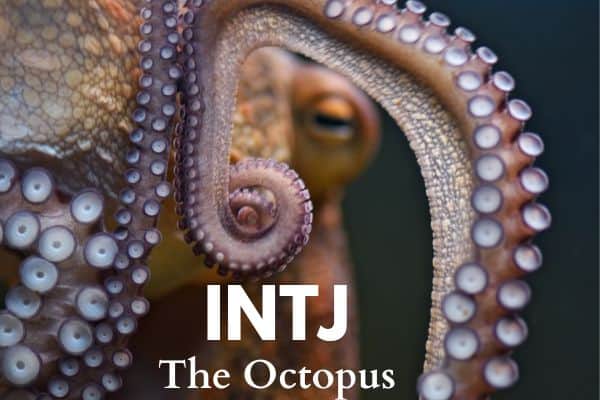
Octopuses are what you’d get if an INTJ decided evolution was taking too long and handled it personally. Creative, strategic, slightly unsettling in their competence, they solve mazes, escape enclosures, and generally treat obstacles like mildly interesting puzzles rather than actual problems. They don’t thrash around dramatically when threatened. They assess, reposition, and release a perfectly timed cloud of ink and disappear while everyone else is still processing what just happened. It’s efficient with minimal theatrics and maximum outcome.
Octopi are powerful hunters, but it’s the method that stands out. Quick thinking. Precise movements. A calm dismantling of whatever’s in front of them. They can even play, which says a lot about their intelligence, because play usually means the brain has bandwidth to experiment. Very INTJ. Master the environment first, then test its edges for fun. There’s something competent about an octopus. You get the sense that if it had a whiteboard and a long-term plan, the ocean would be reorganized within the week.
You Might Also Like: 3 Weird and Wonderful Secrets of the INTJ Personality Type
ESFP – The Blue and Gold Macaw

Bright, affectionate, impossible to ignore, ESFPs (or Macaws) are not quiet and meek. They’re loud, playful, and wildly expressive. If there’s a group, they want in. If there’s an audience, they’re ready. If there’s a new environment, they’re already exploring it before everyone else finishes reading the brochure.
They’re highly observant too, which people sometimes miss because the charisma steals the spotlight. Macaws pay attention. They read reactions and adjust, bonding bond deeply with their people and thriving on interaction, movement, and color. You don’t put a bird like that in a dull, isolated corner and expect it to thrive. Same with ESFPs. They want life textured and shared. New landscapes. New faces. Laughter echoing off the walls. If something sparkly is happening somewhere, they will find it. And probably improve it.
ESTP – The Fox
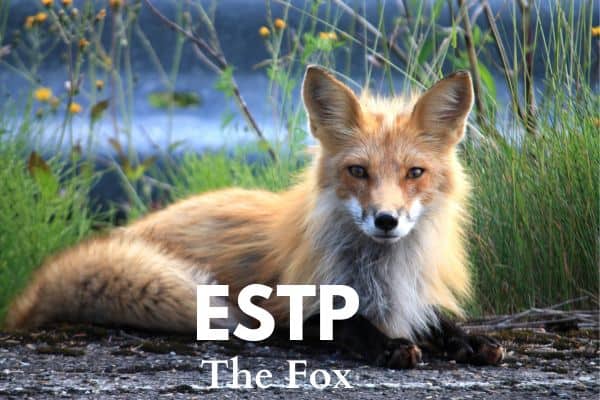
Foxes feel very ESTP to me. Adaptable, sharp, a little too confident for their own good in a way that usually works out anyway. They trust their instincts. They move fast. They read the terrain and adjust without overthinking it. There’s no five-year plan pinned to a tree somewhere. It’s more like, “What’s happening right now, and how do I win?” Quick thinking keeps them alive. Quick reflexes keep them fed. Overanalyzing would just slow things down.
They’re endlessly curious and surprisingly playful, especially when raised around humans. They’ll investigate, test boundaries, poke at whatever looks interesting just to see what happens. It’s exploratory, hands-on intelligence. Of course, there’s also that slightly chaotic edge. Foxes are charming, but you still give them space because they’re wild animals and occasionally carry rabies. ESTPs, thankfully, do not. The point is simply this: there’s a spark there. They’re alert, responsive, and ready to pivot. And if the situation gets messy, they’ll figure it out on the fly and probably have a good story afterward.
ISFP – The Leopard
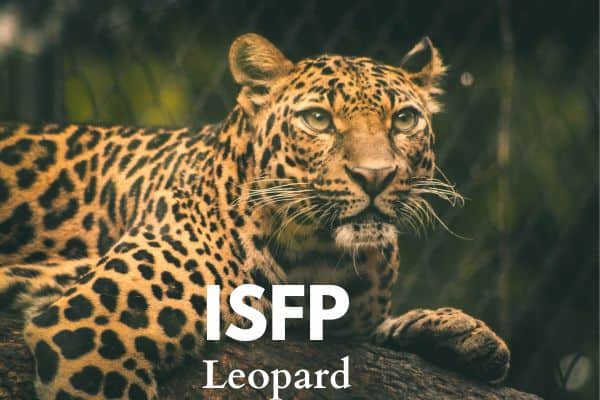
Like ISFPs, leopards are quiet, self-contained, and beautiful in a way that isn’t attention-seeking. They move alone most of the time, slipping through tall grass with an air of mystery. There’s independence there. A preference for handling life on their own terms without a committee meeting about it. They’re resourceful hunters, strategic without being showy, perfectly capable of taking care of themselves.
During a National Geographic program called ‘Eye of the Leopard’, a wild leopard killed a baboon in order to feed herself. But then she noticed the infant clinging to its mother and instead of finishing the job, she carried the baby up into a tree, groomed it, sheltered it, and kept it safe through the night like it’s her own. That mix of instinct and tenderness feels very ISFP. Capable of decisive action. Also capable of sudden, fierce empathy. They like their solitude and value their space, but underneath the calm exterior is a depth of feeling that can surface in unexpected, almost startling ways. Quiet on the outside, but not shallow for a second.
ISTP – The Crow
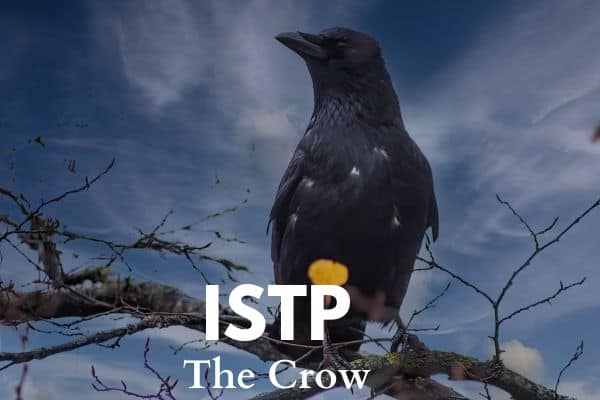
Crows are basically ISTPs with feathers and a mild superiority complex. Resourceful, independent, quietly brilliant, they look at a stick and see a tool prototype. They’ll bend leaf stems into hooks to extract food, drop nuts into traffic so cars can crack them open, then wait for the light to change like tiny, patient engineers running an urban experiment. Like ISTPs, they have practical intelligence applied in real time. If something works, they keep it. If it doesn’t, they adjust.
And then there’s the part where, if a crow dies, the others gather around to study the scene like a black-feathered detective squad. They assess what happened, identify the threat, and then coordinate and chase predators off in a behavior called mobbing. It’s tactically proficient, collective problem-solving without a lot of emotional theatrics. Handle the issue. Neutralize the risk. Move on. Crows are curious, observant, mechanically clever, and quietly formidable. Which feels extremely ISTP. Low noise. High competence. Don’t underestimate them.
You Might Also Like: The Rare ISTP Female
ESFJ – The Vampire Bat
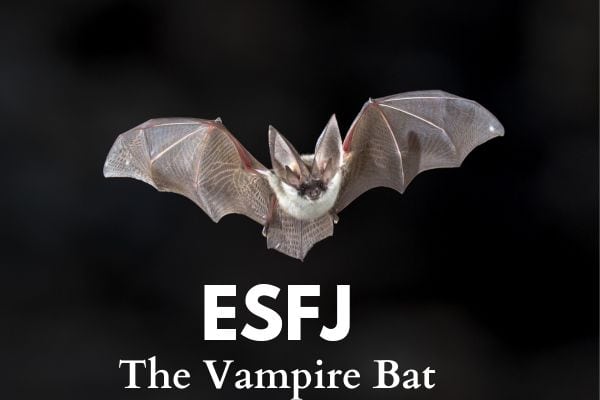
Vampire bats sound like villains, but socially they’re basically ESFJs with wings and a slightly unfortunate diet. Beneath the horror-movie branding is a highly relational creature with a large neocortex and an impressive capacity for long-term bonds. They remember who helped them. They share food with bats who came up short on a hunt. They groom each other and babysit each other’s young. If one member of the group is struggling, others will literally regurgitate dinner to keep them alive. That is commitment to community. It might be slightly gross, but hey, it’s loyal.
They operate on a simple but powerful principle: survival improves when everyone looks out for everyone else. There’s tracking, reciprocity, and relational maintenance involved. You don’t freeload forever in a vampire bat colony, but if you’ve shown up for others, others show up for you. There’s an instinctive understanding that safety comes from strong bonds and consistent support. They may not look warm and fuzzy at first glance, but underneath the fangs is a surprisingly organized, community-first heart.
ESTJ – The Wolf
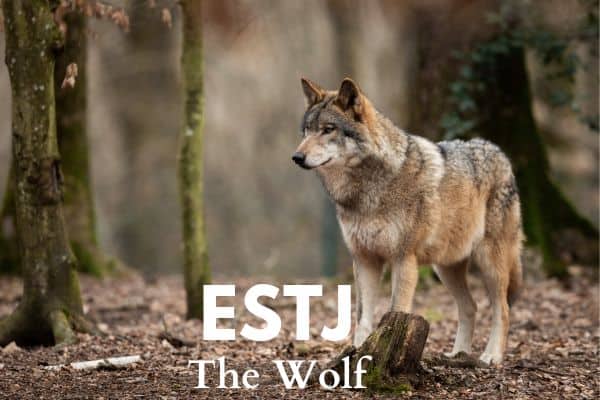
Wolves are the ESTJs of the wilderness. They’re structured, focused, and deeply invested in the stability of the pack. Hunting is coordinated. Roles are understood. Effort is expected. A strong wolf pack depends on leadership, discipline, and clear communication, and that is exactly where an ESTJ thrives. If there is a more efficient way to track prey or protect territory, you can assume someone in the pack has already implemented it.
Beyond the structure, though, there is loyalty that runs surprisingly deep. Wolves form close bonds, often mate for life, and work tirelessly to protect their young and support the group. They are not loyal in a sentimental, abstract way; they are loyal in a practical, show-up-every-day kind of way. They endure harsh conditions without losing focus on the survival of the whole. That steady determination, that willingness to shoulder responsibility for the sake of the unit, feels very ESTJ.
ISFJ – The Penguin

Loyal, protective, and intelligent, penguins have a lot of qualities in common with ISFJs! These arctic birds have complex social abilities and will go to great lengths to take care of each other. They also have a remarkable memory for detail, returning to the same spot year after year and being able to find it, even if the landscape has changed or it’s surrounded by other colonies. Like ISFJs, penguins are also fiercely loyal, staying monogamous and recognizing their partners’ song, even in noisy colonies where hundreds of penguins are searching for each other. This ability to hone in on one individual is a trait that penguins share with humans!
You Might Also Like: The ISFJ Personality Profile
ISTJ – The Great Horned Owl

Great horned owls have strong ISTJ energy, and I mean that as a compliment with a hint of fear. They sit there in total silence, looking mildly judgmental, as if they have already audited your life choices and found several inconsistencies. They prefer solitude, stick close to their mate or family, and don’t feel the need to network aggressively with the rest of the forest. While other animals are out there improvising, the owl is running a quiet, efficient night shift.
They hunt with extreme focus, gliding low and slow, calculating distance, before dropping in like a well-executed plan. They return to the same nesting areas year after year, protect their territory, and provide for their young with steady persistence. It may not look flashy like the macaw, but it’s durable leadership. The kind that keeps things running while everyone else is experimenting with chaos. If forests had operations managers, the owl would already have the spreadsheet finished and the quarterly prey numbers optimized.
What Are Your Thoughts?
Do you agree or disagree with this article? Do you have a better animal in mind for your type? Let us know!
Find out more about your personality type in our eBooks, Discovering You: Unlocking the Power of Personality Type, The INFJ – Understanding the Mystic, The INTJ – Understanding the Strategist, and The INFP – Understanding the Dreamer. You can also connect with me via Facebook, Instagram, or Twitter!

You might also like:
Here’s Which Cat Breed You’d Be, Based on Your Personality Type
Here’s Which Dog Breed You’d Be, Based on Your Personality Type
The Extraordinary Strengths of Every Myers-Briggs® Personality Type
Sources:
Penguins don’t just look smart, they’re highly intelligent, says study
Is An Anole Smarter Than a Fifth Grader?
6 Reasons You Should be Totally Into Vampire Bats
What Humpback Whales Teach Us About Compassion
Asian Elephants Reassure Others in Distress





As an entp I see where you coming from with the chimp comment only problem is that I don’t like monkeys at ever! That said it is a very cute article. I always enjoy reading your posts even when I don’t agree
As an ENTP who also extremely dislikes chimps I have to agree. Super bummed to see that my animal happened to be my least favorite animal.
As an INFJ, I am out of words of this article. The thing is, whales (I guess all of them) are my favourite animal(s) and somehow before I reach the INFJ animal, I kept on praying: Please let it be a whale and them boooooom, it’s a humpback whale, you can just imagine my reaction, OUT OF THIS WORLD.
So I guess this article has showed me which whale compliments me, Humpback Whale.
NTJ are the eagle : Overview, long distance view, strategy of action to pass unnoticed between the mountains. And decisive strike (that’s so obivous). Haha, the INFJ is the narwhal, what else, >< it's the real unicorn who navigates in the depths of the unconsc… Of the sea . I have seen a lot of ESFPs behaving like monkeys. Loud laugh, scream, doing acrobatics in addition to being sociable. If the ESTP is powerful, sociable, sensual, domineering and down to earth, then I only see the lion for him. So the ISTP can only be his solitary cousin, the jaguar. If the ENTP is sociable and intelligent and not really down to earth, then the raven is considered particularly intelligent. He lives in the sky, with the Odin god. His friend, all in color is the ENFP, sorry, the parrot. And alone in his corner, live at night and see what others do not see … The INTP? No the owl.
Dolphins gang rape and are recreational killers of their own and other animals’ babies. Can we use otters instead for ENFP?
Uter nonsense! MB has been widely criticised. Yet here we embroider on it the most stupid of pop psych games. FYI I have Doctoral qualifications in psych.
hello doctor, I’ve always liked mbti a lot but I’m getting tired of this system and really recognize its flaws. That said, do you really think Big Five is the best tool for measuring an individual’s personality?
I’m a humpback whale! I would never have come up with the comparison myself, thinking I was always more elephant. However, the drawing out of the different traits in this fun way leaves me with no doubt…. I’m a humpback whale! Haha!
Awesome I haven’t been reading your blogs in a while cause I’m busy with coursework…you know how college gets. 🙂 Somehow I don’t know but I just decided to read this and it’s so inspiring. I’m so glad I get to be the elephant. In fact I even have a sketch of an elephant in my sketch pad I plan to watercolor one day when I get some good watercolor paints. Ooooh and did you know Ive been very attracted to the elephant because some things I read about them and the fact that they look so perfect in photos. I mean Omg maaan! This is like your best article ever. Elephant for the right pick for me for real….
????????♀️????????????????????????????#happyINFP
About the elephant painting, the only reason why that elephant was able to paint is because he was captured and forced to learn it for the entertainment of tourists.
Aff always the Octopus for INTJ, I understand the connection but I think the Raven and the Tiger are the best examples.
Sue is also part of the Fantastic Four as Invisible Woman! j/k I guess that response is a dead giveaway that I am an ENFP. True blue, through and through!
I’m an Asian elephant. I don’t mind that comparison (as long as it’s not a comment on weight.) Lol. I love baby elephants, and I have seen clips of those painting elephants. 🙂
I’m and Asian Elephant and I feel this suits me because I have always related to an elephant’s sense of empathy and intelligence.
I am an ENFP, and my INFJ daughter once said (after I had read her Kipling’s ‘Rikki-tikki-tavi’), that if I were an animal, I would be a mongoose. I’d rather be a dolphin, but there are too many deadly cobras around. 🙂
Thanks for your work and your fascination for human beings!
elsa
Wow i am ESTJ-The Wolf because i am Dedicated and focused.
I am an ENFP and love dolphins however for sheer playfulness and exuberance for me it’s otters that win the prize.