How INFPs Can Find Beauty in an Uncertain World
It is a strange time to be a sensitive person.
You can wake up, reach for your phone, and within ten minutes learn about a war, a political crisis, another frightening prediction about AI, somebody losing their job, another species disappearing, another economic warning, another person explaining why everything is probably going to get much worse.

Then you’re supposed to make coffee, maybe find somebody’s missing shoe, answer an email, pay the electric bill, or worse…figure out what to make for dinner.
I don’t think human beings were designed to carry this much awareness of suffering at once. For most of human history, you knew what was happening in your village and perhaps heard stories about what was happening farther away. Now you can watch terrible things unfold thousands of miles away while you’re standing in your kitchen.
And if you’re an INFP, it’s not necessarily easy to shrug that off. I’m an INTJ and I had a full-blown existential crisis just last week. Nightmares, a racing heart, feelings of intense anxiety and despair filled my night. None of us are immune to this pain, but I’ve spoken to many INFPs recently who are especially struggling.
INFPs can care about things they cannot personally fix. An injustice involving people they’ll never meet can genuinely hurt. So can cruelty toward an animal, the destruction of a beautiful place, or the thought of children inheriting a world that feels increasingly unstable.
And lately I’ve talked to INFPs who are struggling.
They’re worried about the future. They’re overwhelmed by the news. They’re thinking about climate change, war, politics, artificial intelligence, money, their kids, and what the world is going to look like ten or twenty years from now.
I understand that more than I’d like to. I’ve had plenty of moments when I’ve looked at my own children and wondered what kind of world they’re going to inherit. I’ve gone too far down the rabbit hole of trying to figure out what is going to happen, as if reading enough predictions could finally make the future hold still. It doesn’t work, and nobody gets that kind of certainty. So I started wondering about a different question.
Not sure what your personality type is? Take our in-depth personality questionnaire here. Or you can take the official MBTI® here.
How do you love being alive when you can’t be sure what happens next?
One of the things I love most about Introverted Feeling, the INFP’s dominant mental process, is that it gives them a surprisingly independent relationship with meaning. That doesn’t mean INFPs don’t care what other people think. Obviously they do. They’re human. It doesn’t mean they’re walking around completely immune to cultural pressure either, but underneath all of that is a tendency to ask this question:
What does this mean to me?
Not what should it mean to me or what everyone on the internet has agreed it means. Not what is currently popular, impressive, profitable, embarrassing, sophisticated, or socially approved.
What do I actually think about this?
What matters to me?
What do I want to stand for?
Who do I want to be?
This is part of what Carl Jung was getting at when he originally described introverted feeling. He wrote that it is “continually seeking an image which has no existence in reality, but which it has seen in a kind of vision.”
The INFP can look at the world as it currently exists and think, No. That’s not the only way it could be. And this matters enormously when the external world is frightening. Because if all of your meaning comes from outside you, then you’re completely at the mercy of outside conditions. When the economy is good, you can feel hopeful. When your political candidate wins, you can feel hopeful. When scientists publish encouraging findings, you can feel hopeful. When your career is going well and everybody you love is healthy and the news isn’t terrifying, life feels safe.
But what happens when those things aren’t true? The INFP has another place to go which is inside themselves. To clarify, I’m not saying reality doesn’t matter, and I’m not saying retreating into your imagination solves the world’s problems. I’m saying there are some things the world doesn’t get to vote on.
You can still believe kindness matters when people are cruel.
You can still believe human beings deserve dignity when somebody powerful behaves as though they don’t.
You can still care about beauty when beauty isn’t profitable.
You can still write poems when nobody is buying poetry.
You can still love somebody who isn’t impressive.
You can still protect something small.
You can still decide what kind of person you want to be.
Viktor Frankl, the psychiatrist and Holocaust survivor who wrote Man’s Search for Meaning, argued that one of the last human freedoms is our ability to choose our attitude toward circumstances we cannot control. I wouldn’t take that to mean that we can simply choose ourselves out of grief, terror, depression, or trauma. Human psychology is much messier than that.
But there is a part of you that the headlines cannot completely occupy unless you give them the keys.
The INFP’s Refusal to Call Something Meaningless
INFPs have an unusual ability to care about things that don’t come with an obvious reason to care about them.
An abandoned building. An obscure book nobody else has read. A character everyone else dislikes. A patch of woods behind an ugly shopping center. A person sitting alone at a party. A weird little song with 900 listens on Spotify.
Other people might ask, “What’s so special about that?” And sometimes the INFP can’t even explain it. It just means something.
This is one of those qualities that can look impractical until you realize how much of what makes life worth living depends upon it.
We live in a culture that is very good at assigning measurable value to things. How much does it cost? How productive is it? How many followers does it have? How many people clicked it? How useful is it? How prestigious is it? Those measurements aren’t useless. I run a business and have bills. Believe me, there are days when numbers matter very much to me, but they are terrible at measuring some of the most important things in a human life.
There is no useful metric for how it feels when your child falls asleep against you. There is no market value for the smell of the woods after rain. Nobody can calculate exactly what an old song means to you.
Mary Oliver asked one of my favorite questions in her poem “The Summer Day”: “Tell me, what is it you plan to do with your one wild and precious life?”
She doesn’t ask what you plan to accomplish with it but what you’re going to do with it. And one of the INFP’s gifts, when they trust it, is the ability to say: This matters to me even if I cannot prove that it should.
Find the Magic in Small Things
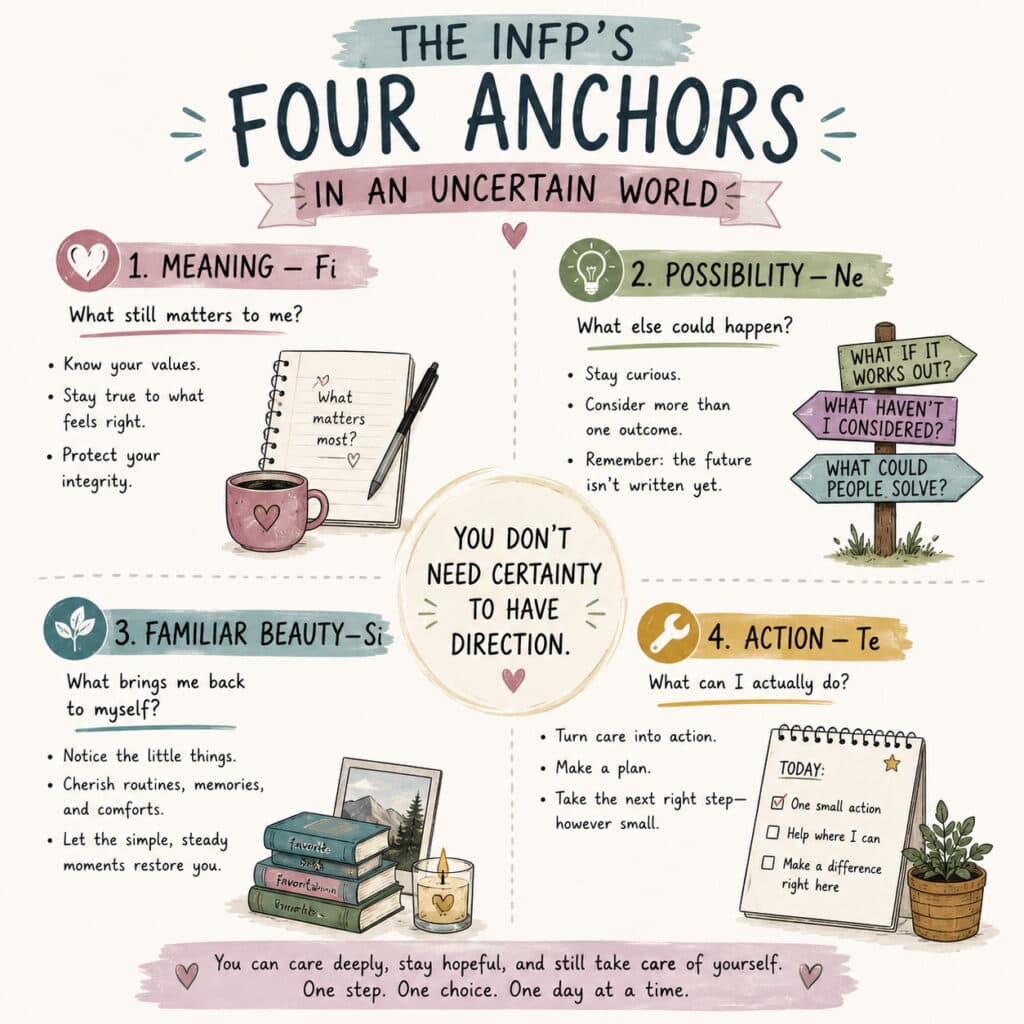
INFPs are intuitive types, so we often talk about their imagination, their ideas, their fascination with possibilities. But they also have Introverted Sensing, or Si, in their function stack. It’s their tertiary function, and as INFPs mature, it can become a surprisingly comforting place to rest.
Some typologists only reference the tertiary function in a negative way and I’ve always believed that’s a mistake. When I got certified as an MBTI practitioner I was taught that the third function is a “relief” function. A place to go when you’re worn out, exhausted, and need to rest, play, and refresh yourself.
One of the things that tertiary Si does is notice the personal history attached to things. That’s why an old mug can be more valuable than a beautiful new one because your grandmother drank coffee out of this mug.
That’s why you keep the stupid ticket stub or why a particular smell can suddenly put you back in a house you haven’t seen in twenty years.
It’s why you might reread the same book when you’re going through a difficult period, return to the same trail, make the soup your mother used to make, listen to an album you loved when you were seventeen, or feel strangely comforted by the first cold morning of fall.
None of this is very impressive and that’s exactly the point.
When we’re frightened about the future, our minds tend to become enormous. We’re thinking about civilization. Artificial intelligence. Democracy. Climate. War. The economy. Humanity. Sometimes it helps to become very small again.
Go outside and look at moss.
I’m serious.
Notice the ridiculous little ecosystem growing on the side of a rock. Find the moon. Watch a spider rebuild its web after somebody walked through it. Smell your coffee before you drink it. Sit outside when it’s raining. Go somewhere you went when you were a child. Pet your dog. Make the recipe you’ve made a hundred times
There is a tendency to dismiss these things as escapism because somewhere, right now, something terrible is happening, and that’s true. Something terrible is happening right now. But something beautiful is happening right now too.
A baby is laughing so hard they can’t catch their breath. Somebody is falling in love. Somebody who thought they’d never walk again is taking a step. A scientist is staring at a result they didn’t expect. Somebody is rescuing an animal. Someone is sitting beside a hospital bed holding another person’s hand. Somewhere, a teenager is reading the book that will change the direction of their life.
And somewhere a person is standing outside looking at a tree that has survived fifty winters without ever knowing what Twitter thinks about anything.
You don’t have to pretend suffering isn’t real in order to notice any of this, that’s one of the things I think we’ve lost in the age of constant information. We confuse paying attention to suffering with refusing to pay attention to anything else.
But here’s what I want you to know…and, really, what I want to absorb into my own brain as well: You are allowed to notice what is still beautiful. In fact, sometimes noticing it is how you remember why the world is worth caring about in the first place.
Your Life Is Bigger Than the News Cycle
There is another problem with consuming too much news that I don’t think we talk about enough: eventually the world in your head starts looking nothing like the world immediately around you.
This doesn’t mean the news is lying. It means news has a job, and that job is mostly to tell us what has gone wrong, what might go wrong, what is unusual, and what requires our attention.
“Millions of people had fairly normal Tuesdays” is not a headline.
Neither is:
LOCAL MAN HELPS NEIGHBOR CARRY COUCH UPSTAIRS
or
WOMAN MAKES PRETTY GOOD LASAGNA; FAMILY EATS IT
or
CHILD SPENDS 45 MINUTES LOOKING AT BUG
Yet these ordinary, unreported moments make up an enormous percentage of human existence.
If you consume enough frightening information, though, your nervous system doesn’t necessarily understand that distinction. Eventually “things are happening in the world” becomes “something terrible is happening to me right now.” And sometimes something terrible is happening to you, but sometimes you’re sitting on your couch. That’s worth checking, so look around. What is actually happening in this room?
Maybe the dishwasher is running. Maybe your kid left socks on the floor again. Maybe sunlight is coming through the blinds. Maybe your cat is doing something anatomically impossible on the back of the couch. This is your life too.
The terrible headline is real but so is this.
And I think INFPs have a particular capacity to take an ordinary moment and feel the enormousness hiding inside it. Their Extraverted Intuition sees connections and possibilities; their Introverted Feeling supplies personal meaning; their Introverted Sensing holds onto the sensory details that make a moment belong specifically to their life.
And here’s what I think: The opposite of despair isn’t certainty. Maybe sometimes it’s attention. Paying attention to what is still here, what you still love, what hasn’t been destroyed, and remembering that the worst thing happening in the world today is not the entirety of the world.
There Is Always Another “What If?”
One of the cruel things about anxiety is that it can take something you’re genuinely good at and turn it against you. INFPs use Extraverted Intuition, or Ne, as their auxiliary function. In everyday life, this is the part of the INFP that sees possibilities everywhere. One idea leads to six others. A conversation reminds you of a book, which reminds you of something that happened twelve years ago, which suddenly gives you an idea for a story you want to write. Ne naturally asks, What else could this mean? Where else could this go? What haven’t we thought of yet?
Give that same imagination enough frightening information, though, and it can become an extremely efficient disaster generator. What if AI eliminates millions of jobs? What if another war starts? What if the economy collapses? What if something terrible happens to my children? The frustrating thing is that I can’t honestly tell you those things are impossible. Nobody can. But that’s where I think INFPs sometimes need to notice what anxiety has done to their intuition. Ne is supposed to generate possibilities. Anxiety changes the assignment and tells it to generate bad possibilities, then presents those possibilities as predictions.
If you’re going to ask “What if?” then you might as well finish the exercise. What if somebody solves a problem we currently think is unsolvable? What if the technology you’re afraid of is also used to cure a disease? What if your children grow up to be thoughtful, interesting people who contribute something good to a difficult world? What if a movement that currently seems tiny changes millions of minds? What if somebody is sitting in a university laboratory right now working on something that will save lives twenty years from now? What if people surprise you?
History is full of things that once looked permanent and weren’t. That doesn’t mean progress is inevitable. History can move backward too, sometimes terribly. But when your brain tells you that the worst possible future is the future, it has crossed the line from reasonable concern into fortune-telling. You don’t know what happens next. Neither do I. Strangely enough, there can be some freedom in admitting that.
Borrow Some Hope From People Who Refused to Accept the World They Were Given
When the present starts making me despair about humanity, one of the things I find helpful is looking backward. Not because history is particularly comforting. Most of it isn’t. What comforts me is realizing that human beings have lived through periods when cruelty, oppression, disease, violence, and injustice were completely normal parts of life, and there were always people who looked at what everyone else had accepted and thought, No. This doesn’t have to stay this way.
Think about the abolitionists who fought slavery when slavery was legal, the people who hid Jewish families during the Holocaust, the women who demanded political rights they had been told they didn’t need, or the doctors and scientists who spent their lives fighting diseases that had killed people for centuries. Think about workers who organized against dangerous conditions, writers who wrote books governments wanted burned, and ordinary people who sheltered strangers, smuggled food, exposed corruption, protected forests, cared for the sick, adopted unwanted children, rescued animals, or stood beside someone everyone else had abandoned.
None of these people had proof that they would win. I think we sometimes clean history up afterward and accidentally remove the most useful part. We know how the story ends, so courage starts looking obvious, almost inevitable. It wasn’t obvious to the people living through it. They were standing in the middle of the story just like we are, without the benefit of knowing what the next chapter would say. Some of them never lived to see the thing they fought for become reality, and yet they acted anyway.
That’s one reason I think reading biographies can be particularly good medicine for an INFP who is losing faith in humanity. Find people whose values you admire and learn what their lives actually looked like. Find out what they were afraid of, what they got wrong, what discouraged them, how long change took, and what kept them going anyway. You may discover that hope has rarely meant believing everything will be fine. Sometimes hope has meant deciding something is worth doing even when you don’t know how the story ends.
Beauty Is Not an Excuse to Look Away
There’s an obvious objection to everything I’ve been saying that I want to address, because otherwise an article about looking at moss and noticing sunsets can start sounding pretty ridiculous. If people are suffering, isn’t it incredibly privileged to turn away from that and focus on the beautiful things in your own life?
Sometimes, yes. If somebody needs help and you have both the ability and responsibility to help them, admiring the sunset instead isn’t profound. It’s avoidance. There are things happening in the world that should make us angry. There are things we should refuse to normalize. People are suffering through war, poverty, abuse, displacement, exploitation, disease, and countless other things that don’t disappear because we decide to practice gratitude.
I don’t want this article to convince you to become better at ignoring any of that. I want you to become harder to paralyze, because there is an enormous difference between caring about suffering and continually consuming information about suffering. One can lead to action. The other can leave you sitting on your couch at 1 a.m., reading your fourteenth terrible story of the night, feeling as though humanity is doomed while helping absolutely nobody.
Psychologists have studied some of the effects of this kind of news consumption. Heavy exposure to negative news can increase stress, intrusive thoughts, anger, and anxiety, and the American Psychological Association has recommended putting limits around news consumption while channeling some of that distress into concrete action. You don’t owe the world unlimited access to your nervous system. You can care deeply and still turn off the news. You can know what is happening without watching every horrible video, and you can grieve for people without reading five hundred comments about their suffering.
Eventually, though, it helps to replace What else can I read about this? with a much more useful question: What can I do?
Turn “This Matters to Me” Into “Here’s What I’m Going to Do”
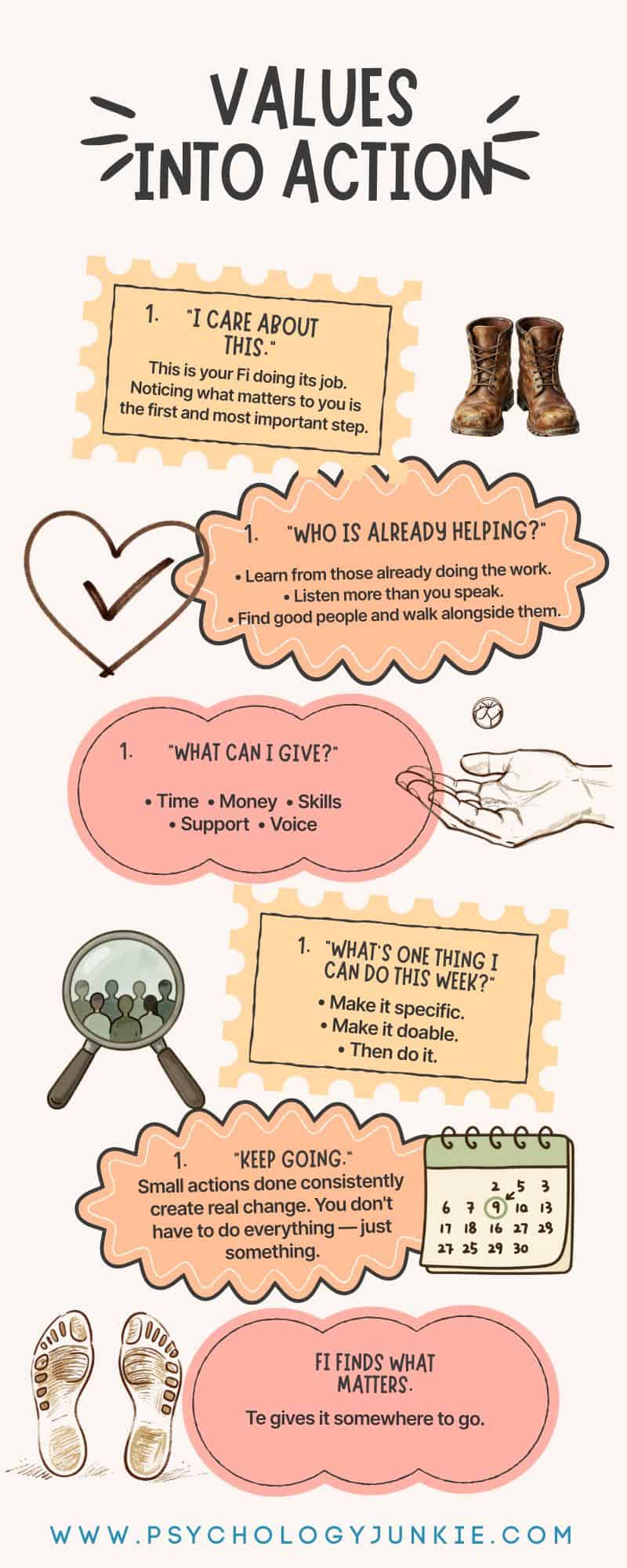
This is where INFPs can sometimes underestimate themselves. Introverted Feeling is very good at recognizing what matters, and Extraverted Intuition can imagine how things might be different. Eventually, though, those convictions need somewhere to go. This is where the INFP’s less-preferred Extraverted Thinking, or Te, can become an ally by asking some annoying but useful questions: What’s the plan? Who is already working on this? Where would my money do the most good? Who do I contact? What could I realistically accomplish in an hour? What is the next actual step?
You don’t need to become a different personality type to do this. You just need to give your values a pair of work boots. If you’re frightened about climate change, perhaps you join a local conservation group, plant native species, donate to people doing work you believe in, or show up at a community meeting. If you’re devastated by war, perhaps you support a reputable humanitarian organization helping people directly. If you’re worried about children, tutor one. If you’re horrified by loneliness among older people, visit someone. If animal suffering keeps you awake, volunteer at a shelter. If you’re worried about political decisions, learn what is actually being proposed, contact your representatives, vote in the boring local elections nobody talks about, or volunteer for a cause you believe in.
And if you’re worried about what technology is doing to childhood, maybe your contribution begins much closer to home. You can make your own home a place where children still read books, go outside, make things, get bored, argue, imagine, build forts, talk to adults, and learn how to be human around other humans. That isn’t going to solve every problem associated with technology, but it is something real that exists because you chose to do it.
You also don’t need large amounts of money or free time to matter. Send an email. Bring someone dinner. Write something. Give an hour. Sign up for one shift. Check on your neighbor. Pick up trash at the park. Teach somebody something you know. Encourage the person doing work you admire. Raise children who understand that other people’s suffering matters. None of these things will fix the entire world, but that’s not the assignment. The world is made out of an incomprehensible number of small human decisions, and you get some of them. Use yours.
Research on prosocial behavior gives us another reason to take this seriously. Acts of kindness and volunteering have been associated with greater connection and well-being, and some experimental research has found reductions in anxiety and loneliness when people intentionally do kind things for others. What I especially like about this for INFPs is that the benefits seem to be stronger when people have some choice in how they help and can see that their contribution actually made a difference.
So don’t choose a cause because you think a good person is supposed to care about it. Pay attention to the thing you can’t stop caring about, and then give that feeling somewhere to go.
Keep Evidence That People Are More Than Their Worst Behavior
There’s another practice I’d suggest, particularly if you spend much time online: start collecting evidence. Not evidence that humanity is wonderful, because I don’t think we’re going to win that case. Collect evidence that humanity is complicated.
Save the story about the stranger who ran toward danger to help somebody. Keep the photograph of people rebuilding after a storm. Bookmark the article about the medical breakthrough. Write down what your friend did for you when you were having a terrible week. Notice the teacher who buys supplies with her own money, the teenager who stops traffic because there’s a turtle in the road, the person who returns the wallet, or the neighbor who keeps mowing the elderly man’s lawn and never mentions it.
There are millions of people doing fairly decent things every day who will never become newsworthy because “Person Behaves With Basic Human Decency” isn’t particularly clickable. You could literally make a folder for these stories and call it Evidence Against Despair. Put photographs, historical examples, memories, poems, scientific breakthroughs, acts of courage, and tiny examples of human goodness inside it.
This isn’t about building a case that people are inherently good. Human beings have given us far too much contradictory evidence for me to make that argument. It’s about correcting a sampling problem. If you spend two hours looking at the worst things human beings did today and zero minutes looking at anything else, of course humanity will start looking monstrous. Your sample is monstrous.
There is even research suggesting that deliberately putting hopeful material back into that sample can affect how we feel. Studies of inspiring media have found that brief exposure to stories of moral courage, kindness, and human possibility can increase hope and, in some cases, reduce stress.
When Your Inner World Stops Feeling Like a Refuge
I’ve spent a lot of this article talking about the INFP’s inner world as a source of strength, but I don’t want to romanticize it. Sometimes the place you go for comfort becomes the place where you’re making yourself miserable.
Your imagination produces a frightening possibility, your feelings respond as though it has already happened, and then your mind starts gathering evidence. You read another article, watch another video, remember another prediction, and eventually a possibility starts feeling like something you’re simply waiting to happen.
That’s when it can help to get out of your head and back into the physical world. Eat something. Go outside. Walk around the block. Call someone who grounds you. Then ask yourself some boring but useful questions: What do I actually know? What am I assuming? Is this happening right now? Is there anything useful I can do about it today?
Sometimes there will be something you can do. Figure out the next step and do it. Sometimes the answer will be, There is absolutely nothing I can do about this tonight.
That’s useful information too. You’re allowed to put it down.
You Don’t Need to Believe Everything Will Be Okay
I think this is where a lot of advice about hope loses me. “Everything happens for a reason.” “It will all work out.” “Everything is going to be okay.”
Maybe. I hope so. But none of us knows.
Hope doesn’t have to mean convincing yourself that nothing terrible will happen. You can grieve what is being lost and protect what remains. You can be frightened about the future and curious about it. You can know that human beings are capable of horrifying things and still be moved by what they create, discover, repair, sacrifice, and love.
The world can be frightening and beautiful at the same time.
Find Something You Can Still Love
If I could leave an overwhelmed INFP with one thought, I wouldn’t tell them to stay positive. I’d tell them to find something they can still love.
Human beings have always made beautiful things during terrible times. They’ve written poetry during wars, planted gardens during depressions, fallen in love during epidemics, told jokes, raised children, studied stars, rescued animals, and made plans for spring when they had very good reasons to be afraid.
Maybe they didn’t do those things because they failed to understand how bad things were.
Maybe they did them because they understood exactly how precious the alternatives were.
The World Doesn’t Get to Decide What It Means to You
There is something stubborn at the heart of Introverted Feeling that I think is desperately useful right now. The world can tell you what’s happening, but it doesn’t get complete control over what you love, what you value, or what kind of person you become in response.
Cruelty doesn’t require you to become cruel. A frightening future doesn’t require you to spend the present rehearsing your grief for it. You can notice beauty while still getting angry, donating, voting, volunteering, writing, protecting, teaching, and refusing to accept things you believe are wrong.
Your sensitivity to beauty and your sensitivity to suffering may come from the same place. You don’t need to destroy one to survive the other.
I can’t tell you what the world will look like ten years from now. But uncertainty works both ways. The future contains things to fear because they haven’t happened yet. It also contains people you haven’t met, discoveries nobody has made, problems somebody hasn’t solved yet, places you haven’t stood, and ordinary Tuesday mornings that will someday become memories.
So don’t let fear pretend that it knows what’s coming.
Pay attention to what is still good. Protect what is worth protecting. Help where you actually can. Make your little corner of the world more humane.
And when the world feels unbearably ugly, don’t force yourself to believe that everything is beautiful.
Just keep looking until you find something that is.
What Do You Think?
How are you coping with stress and uncertainty these days? Do you have any suggestions for me or other readers? Let us know in the comments!
Find out more about your personality type in our eBooks, Discovering You: Unlocking the Power of Personality Type, The INFJ – Understanding the Mystic, The ISFJ – Understanding the Protector, and The INFP – Understanding the Dreamer. You can also connect with me via Facebook, Instagram, or YouTube!










I’m an INFP enneagram 8, the challenger-so I spend my extra time looking up all of the information, statistics, scandals that the news never talks about because corporate media is nothing but billionaires trying to stay billionaires by any means necessary and they know exactly who gives them their cushy corporate welfare tax breaks. They need us voting for republicans. There are credibly linked Epstein associates that have paid a Subtotal of all donations:
$1,570,153,099
84% of all donations went to republicans while only 7% of total donations went to democrats of a total of $1.7 TRILLION DOLLARS.
84% of $1.7 trillion dollars was paid to republicans by the EPSTEIN CLASS. Let that sink in awhile. It doesn’t get more corrupt than THAT. Elon and Peter Thiel paid for a hefty portion of placing the current administration, and if you don’t know about Peter Thiel then you most certainly need to look him up on YouTube and FIND OUT. Be afraid. We’re in a surveillance state now, and it’s everywhere. Data is the new gold mine. Forget gold, it’s not as valuable as our data. For where this is all headed and what the plan is-go read the book AI and Our Human Future, read the books One Nation Under Blackmail, The Technocracy: PRISM, Big Tech, and the Rise of the Corporate Digital Surveillance State (AI and the Technocratic State), Dark Money: The Hidden History of the Billionaires Behind the Rise of the Radical Right, The Nerd Reich: Silicon Valley Fascism and the War on Democracy, and to a lesser extent the book Without Precedent: How Chief Justice Roberts and His Accomplices Rewrote the Constitution and Dismantled constitutional Rights.
I go around dropping information and a complete list of GOP predators all over the internet, explain things to unwilling Trump supporters, certainly have quite a few arguments they never fail to lose and stop talking, and signing petitions against this regime. I’m not very nice when I leave comments on them, I’ll tell you that. I know the risks and accept them. If you can’t stand for something then you’ll fall for anything. Especially with no research on trustworthy sites.
This made me feel warm inside.
♥