
18 Ways Tertiary Se Shows Up for ENTJs
Welcome to the tertiary function. The middle child of the personality stack. It is not in charge, but it has enough influence to rearrange the furniture, spend too much money on a new hobby, and convince everyone this was part of the plan.
For ENTJs, that function is Extraverted Sensing, or Se. Personality Hacker calls the tertiary function the “10-year-old,” while psychologist John Beebe connected it with the archetype of the Eternal Child. Other typologists call it the relief function because it often appears when we loosen our tie, stop being responsible for five minutes, and do whatever feels interesting right now.

If an ENTJ’s personality were a company, dominant Extraverted Thinking (Te) would be the CEO, setting goals and asking why this process still requires three forms. Auxiliary Introverted Intuition (Ni) would be the strategist predicting where the market will be in ten years. Inferior Introverted Feeling (Fi) would be in a locked office trying to determine whether any of this means something. Tertiary Se would kick open the door and announce that it bought concert tickets, hired a personal trainer, and found a restaurant where dinner arrives on fire.
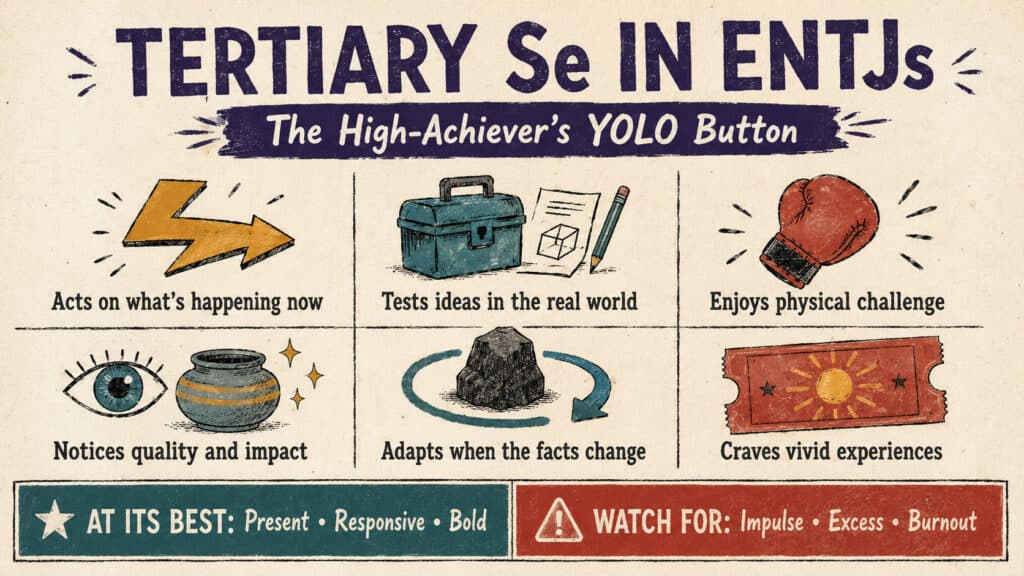
That is the basic flavor of tertiary Se. It brings the ENTJ out of long-range strategy and into direct contact with life as it is happening. It notices the opening, tests the limits, moves fast, and wants the experience to be real rather than theoretical. This is the high-achiever’s secret YOLO button, although most ENTJs would prefer to call it “rapid experiential research.”
As an MBTI® practitioner, I think tertiary Se is often reduced to expensive watches, extreme sports, and yelling “Let’s go!” at people who did not realize they were competing. Those things may occur, but Se is a perceptive process before it is a lifestyle. It takes in present, concrete reality: what can be seen, heard, handled, used, enjoyed, or acted upon now.
Jung described the extraverted sensation type as having an unusually developed awareness of objective facts and concrete experience. [His original description concerned dominant Se], so it should not be pasted wholesale onto ENTJs. In an ENTJ, Se is less mature and more recreational. It can provide realism, adaptability, pleasure, and impressive nerve. It can also become impulsive, excessive, or strangely determined to solve an existential problem by ordering something with overnight shipping.
Here are 18 ways you might recognize tertiary Se in real life.
1. You Trust What Produces a Visible Result
ENTJs can think far into the future, but they usually do not want a strategy to remain an elegant idea. Tertiary Se wants proof that something works in the actual world. Show the prototype. Run the test. Make the call. Put the offer in front of a real customer and see whether anyone buys it.
This gives ENTJs a useful combination of foresight and practicality. Ni forms a prediction, Te builds the system, and Se watches what happens when the system meets reality. You may revise quickly because the evidence matters more than preserving a beautiful theory.
The less healthy version becomes impatient with anything that cannot produce an immediate, visible payoff. Some forms of learning, healing, and relationship-building do not provide a useful dashboard by Friday. That does not make them imaginary.
2. You Come Alive When There Is Something to Act On
An ENTJ can spend hours discussing a complex problem, but the energy often changes when an opening appears. Once there is a decision to make, a person to contact, or a concrete obstacle to remove, you become more alert. The situation is no longer a fog of possibilities. It has handles.
Se enjoys direct engagement, and Te likes execution, so action can be genuinely refreshing. This is why an ENTJ who seems drained during a vague meeting may become almost cheerful when the server crashes. At last, a problem with evidence, urgency, and a place to begin.
Action becomes less helpful when it is used to escape a question that needs thought. Doing *something* feels better than uncertainty, but movement and progress are not always the same thing.
3. You Notice Leverage in the Immediate Environment
ENTJs are often associated with high-level strategy, yet many are also quick to spot what can be used right now. You notice the person with the needed skill, the empty space that could serve another purpose, the overlooked feature, or the moment when resistance has dropped enough to make the proposal.
This is Se giving Te live information. You are not only following a predetermined plan; you are reading the room for openings and acting before they close. To other people, this can look like confidence or luck. Often it is attention combined with a low tolerance for hesitation.
The risk is treating every person, object, or moment as a resource to deploy. The environment contains opportunities, but it also contains human beings who do not want to feel like movable pieces in your larger design.
4. You May Be Surprisingly Playful Off the Clock
The serious, controlled ENTJ can become a different person when responsibility loosens its grip. You may start a competitive cooking challenge, rent something unnecessarily fast, invent a drinking game with disputed rules, or turn a family hike into an expedition with performance metrics.
Tertiary functions often carry a younger energy. Se lets the ENTJ stop optimizing the future and play with what is available now. There is an appealing lack of dignity to it. You can be louder, sillier, more physical, and more willing to follow an impulse just because it might make a good story.
This side may surprise coworkers who thought you slept in a suit and reviewed quarterly projections for fun. Your close friends know there is a secret button, and some of them should not be trusted near it.
5. Competition Makes Physical Activities More Interesting
Some ENTJs enjoy exercise for the health benefits. Many enjoy it more once there is a clock, a score, an opponent, a ranking, or an instructor who has made the terrible mistake of saying, “Most beginners cannot do this.”
Se likes physical engagement while Te enjoys measurable improvement. Boxing, weightlifting, tennis, climbing, racing, and martial arts can all satisfy this combination. The body becomes another system to understand, train, and push.
Used well, physical challenge pulls the ENTJ out of mental overwork and restores contact with the present. Used poorly, rest day becomes a moral failure and an injured shoulder becomes “a minor variable.” Your body is not an underperforming employee. It is allowed to send feedback before something tears.
6. You Appreciate Quality You Can See and Feel
ENTJs may spend freely on items that combine usefulness, performance, and sensory quality. A well-cut jacket, excellent sound system, sharp kitchen knife, powerful vehicle, or chair that does not punish the spine can feel worth the cost because the difference is tangible.
This is not always about displaying status, although it can be. Often the attraction is direct: the item works well, looks right, feels satisfying, and improves the experience of using it. Te approves the function; Se approves the finish.
Trouble begins when quality becomes a convenient name for impulse. “I believe in buying once and buying well” sounds responsible, but it becomes less convincing when applied to the fourth premium espresso machine. Sometimes the ordinary version would have done the job.
7. Your Environment Affects You More Than You Admit
An ENTJ may insist that ambience is irrelevant, then become noticeably more focused in a clean, bright room with a solid desk and good coffee. You might dismiss decorative details until a cluttered, shabby, or physically uncomfortable space begins lowering your patience with everyone in it.
Tertiary Se responds to the immediate setting even when Te would rather regard the body and environment as support equipment. Beauty, order, lighting, sound, temperature, and physical ease can influence your energy more than you consciously register.
Paying attention to these factors is not frivolous. A well-designed environment can support sustained effort. The goal is not to turn the workspace into a luxury showroom; it is to stop pretending you are a disembodied strategy engine who can function equally well under fluorescent lights beside a broken air conditioner.
8. You Can Be Excellent in a Crisis
When circumstances change fast, ENTJs often become more focused rather than less. Te organizes priorities, Ni anticipates the next danger, and Se tracks what is happening in front of you. You may take command, assign roles, improvise with available resources, and make a hard decision while everyone else is still processing the problem.
This can make ENTJs effective in emergencies, negotiations, competitive fields, and any setting where hesitation carries a cost. You are willing to engage reality before it becomes comfortable.
The downside is that crises can feel strangely energizing. If ordinary life seems dull by comparison, you may overcommit, provoke unnecessary confrontations, or wait until a situation becomes urgent before giving it your full attention. Competence under pressure is a strength. Requiring pressure in order to feel awake is exhausting.
9. You Like Experiences That Feel Earned
ENTJs often enjoy pleasure more when it follows an accomplishment. Finish the launch, then order the excellent meal. Hit the target, then book the trip. Survive the week, then buy the thing that has been sitting in your cart while you pretended not to want it.
Se supplies the sensory reward, while Te turns it into a contract. This can be a useful motivational system, especially for long projects that otherwise exist entirely in calendars and future projections. A good life needs something enjoyable before retirement.
But pleasure does not always need to justify its existence through productivity. If every meal, afternoon outside, or hour of rest must be earned, you may turn ordinary human needs into performance bonuses. Sometimes the reward is not compensation for working. It is part of being alive.
10. You Can Make a Bold Pivot When Reality Changes
ENTJs are strategic, but healthy tertiary Se keeps the strategy from becoming sacred. When new evidence arrives, you may abandon a failing approach with surprising speed. The original plan mattered because it served the objective; if it no longer does, sentimentality will not save it.
This responsiveness can look abrupt to people who need more time to adjust. From your perspective, continuing a known failure would be the stranger choice. Se registers the present facts, and Te reallocates resources.
The skill is knowing whether you are making a clear-eyed pivot or chasing the stimulation of a new direction. Not every difficult middle is evidence that the plan has failed. Sometimes the exciting alternative is attractive because it has not yet had time to become work.
11. You May Use Appearance as Strategic Communication
ENTJs often understand that presentation affects how information is received. Clothing, posture, grooming, visual branding, and the physical setting of a meeting can all communicate competence before anyone examines the argument.
Se notices visible impact, and Te wants that impact to serve a purpose. You may develop a strong personal style or know exactly what an occasion calls for, even if you claim not to care about fashion. The issue is not vanity so much as congruence: the outside should support the message.
Under insecurity, however, image can become an attempt to manufacture certainty. More money goes into the wardrobe, car, body, office, or online presence because the internal question feels harder to address. A polished exterior can reinforce confidence, but it cannot settle whether you respect the life underneath it.
12. You Are Tempted to Solve Emptiness With Intensity
When ENTJs achieve what they planned and still feel dissatisfied, inferior Fi may begin asking uncomfortable questions about purpose, identity, and what they actually value. Tertiary Se has a faster proposal: do something exciting enough that the question cannot be heard.
This can look like spontaneous travel, expensive purchases, sexual impulsivity, punishing workouts, overeating, drinking, or throwing yourself into another high-stakes goal. None of those experiences is automatically unhealthy. The clue is desperation. Are you choosing the experience, or are you trying to outrun the silence after it ends?
Stimulation changes your state. It does not necessarily answer your life. If every thrill requires a larger one next time, Se is no longer providing relief; it is helping you avoid the meeting Fi keeps trying to schedule.
13. You Can Overestimate What Your Body Will Tolerate
The ENTJ mind may have a ten-year vision, a six-month plan, and no interest in the headache developing behind the left eye. Hunger, fatigue, pain, and overstimulation are treated as minor interruptions until the body files a formal complaint by shutting down.
This is an odd relationship with Se (and Si in your shadow). You may enjoy using the body, testing it, styling it, and pushing it, yet fail to listen to its less dramatic information. A hard workout is engaging. Going to bed on time is apparently an insult to human ambition.
Developed Se notices physical reality before it becomes an emergency. It respects the plain facts: you are tired, you have not eaten, and caffeine is not legally classified as sleep. The body is part of the plan, not the vehicle you abandon on the roadside after reaching the goal.
14. You Prefer Directness to Endless Interpretation
ENTJs can appreciate complex ideas, but they often lose patience when a conversation keeps circling without touching observable reality. What happened? What was said? What does the person want? What are we going to do next?
Se draws attention back to concrete facts, which can be helpful when Ni has generated too many implications or other people are discussing possibilities without testing any of them. A direct question can cut through hours of projection.
Yet not every human problem can be reduced to visible behavior alone. Motives, fears, loyalties, and emotional meanings matter even when they cannot be photographed or entered into a spreadsheet. Directness becomes bluntness when it demands that another person produce a neat answer before they understand their own experience.
15. You May Have Sudden, All-Consuming Hobbies
An ENTJ rarely needs to “dabble” when it is possible to acquire professional equipment, watch thirty tutorials, join a competitive league, and develop opinions about brands by Thursday. Tertiary Se enjoys the novelty of direct experience, while Te immediately starts building competence.
This can be great fun. Cooking, photography, woodworking, wine tasting, gardening, motorcycling, or some sport with expensive gear can restore energy precisely because the activity is physical, immediate, and separate from your usual responsibilities.
The problem appears when every interest becomes a second career. If enjoyment requires mastery, optimization, and public proof, the hobby has been recruited into the productivity department. You are allowed to be average at pottery. The bowl can be ugly and still hold soup.
16. You Can Be More Charismatic in Person Than on Paper
ENTJs are sometimes described as intimidating because their written communication is concise and their decisions can sound final. In person, tertiary Se may add playfulness, humor, timing, animation, and an ability to adjust to the energy in the room.
You can make an idea feel immediate. You read reactions, change pace, use the space, and give people the sense that something is happening now. This presence is one reason many ENTJs do well in leadership, sales, teaching, debate, and public speaking.
Charisma becomes manipulative when reading the room is used only to overpower it. The strongest presence does not merely create momentum; it stays aware of whether other people are choosing to come along or being swept into agreement before they can think.
17. You May Confuse Impulse With Intuition
ENTJs trust their instincts, often for good reason. Ni has been gathering patterns beneath conscious awareness, and Se can recognize a live opportunity before there is time for a committee review. The resulting decision may be fast and excellent.
However, not every strong urge is a strategic insight. Sometimes Se wants novelty, challenge, pleasure, or escape, and Ni gets hired afterward to produce an impressive explanation. You did not buy the motorcycle because transportation trends point toward increased urban mobility. You wanted the motorcycle.
There is nothing shameful about desire. It becomes safer once it is named correctly. Ask whether the impulse fits the larger pattern you have observed, whether the facts support it, and whether you will still endorse the decision when the adrenaline drops.
18. You Need to Experience Your Life, Not Only Direct It
ENTJs can become managers of their own existence. The trip becomes an itinerary, dinner becomes networking, exercise becomes a metric, and family time becomes a protected calendar block with an efficiency problem. Everything important is included, yet you may not be fully present for any of it.
Healthy Se interrupts this habit. It notices the weather, the food, the person’s face, the texture of the day, and the fact that this particular moment will not recur. Henry David Thoreau wrote that he went to the woods because he wished “to live deliberately.” That did not mean planning life from a greater distance. He wanted to meet its essential facts and know it by experience. [The full passage appears in *Walden*](https://www.gutenberg.org/files/205/205-h/205-h.htm).
Your life is not only the enterprise you are building. It is also the thing happening while you build it.
How to Let Your Se Out to Play Without Wrecking Your Schedule
Most ENTJs have access to impulse already, particularly when stressed, bored, or fresh from a major accomplishment that somehow failed to provide permanent fulfillment. The goal is to give Se regular, sane contact with reality so it does not have to stage a coup.
Start by getting physical on purpose. Choose something that brings attention into the body: climbing, dancing, boxing, swimming, gardening, hiking, axe throwing, or a long walk without a business podcast. If there is gear involved, you will probably find a way to cope.
Try sensory mindfulness without making it a grand spiritual project. For five minutes, notice what you can see, hear, smell, taste, and physically feel. Psychologist William James wrote that voluntary attention is guided by the interests it serves. [His discussion of attention is more than a century old], but the practical point holds: attention changes what becomes available to consciousness. You may discover that the present contains useful information your plans have been screening out.
Give yourself experiences that have no advancement potential. Eat somewhere new. Attend a concert. Learn one recipe without turning it into a meal-prep system. Take a day trip that will not become content, networking, or a tax deduction. Se needs contact with life, not another deliverable.
You can also attach sensory rewards to long-term goals. Finish the proposal, then wear the absurdly comfortable hoodie. Complete the launch, then order pizza. Just remember that food, rest, beauty, and pleasure are not wages paid to the body for acceptable performance. Include some because you are a person and Tuesday happened.
Finally, when the urge for a dramatic experience hits, ask what job you are hiring it to do. Is this play, exploration, restoration, avoidance, or an attempt to feel successful from the outside? Any answer is useful if it is honest.
You do not have to choose between the ten-year plan and the day you are living now. Se helps you see the ground beneath the vision, respond to what is actually happening, and enjoy some of what all that work was meant to create. Let it choose the restaurant once in a while. Just do not give it unrestricted access to the company card.
What Do You Think?
Do you see yourself in this article? Do you have any unique perspectives or experiences to share? Let us and other readers know in the comments!
Find out more about your personality type in our eBooks, Discovering You: Unlocking the Power of Personality Type, The INFJ – Understanding the Mystic, The ISFJ – Understanding the Protector, and The INFP – Understanding the Dreamer. You can also connect with me via Facebook, Instagram, or YouTube!