The Myers-Briggs® Personality Types of the IT: Welcome to Derry Characters
IT: Welcome to Derry is a story about fear, manipulation, and control. We’re not just talking monsters in sewers. The show explores what fear does to memory, to morality, and to people who are forced to grow up inside a town that rewards cruelty and punishes vulnerability.
Honestly, I tend to despise horror movies. I have an overactive imagination and an anxious personality in general. For example, I still just have to check behind the shower curtain whenever I use the bathroom. You never know, someone could be waiting there with a dagger! So it has surprised me how much I’ve enjoyed IT: Welcome to Derry. I love the aesthetics, the characters, and the complexity of the whole storyling.

Set in 1962, the series expands Stephen King’s IT universe by focusing on how dread seeps into everyday life. Children are pressured, silenced, manipulated, and made to doubt their own perceptions. Adults are not merely absent. Many of them participate, whether through denial, authority, or violence disguised as order. As a parent myself, I kept grimacing at the precarious situations the parents had NO IDEA their children were trapped in.
But as an MBTI® practitioner, I can’t just watch a show and be done with it. I have to analyze. In horror stories, character is revealed under pressure. When safety collapses, people fall back on their deepest psychological wiring. Some cling to what they know. Some ponder their inner values. Some fight, some freeze, some rationalize, and some protect others at great cost to themselves.
This article looks at the major characters in IT: Welcome to Derry through the Myers-Briggs® personality system. The goal is not to flatten them into labels, but to understand how their inner decision-making systems shape their choices when fear is no longer hypothetical.
There will be spoilers, so if you haven’t watched the show yet, you may want to wait to read.
Not sure what your personality type is? Take our new personality questionnaire!
The Myers-Briggs® Personality Types of the IT: Welcome to Derry Characters
Lilly Bainbridge — ISFJ
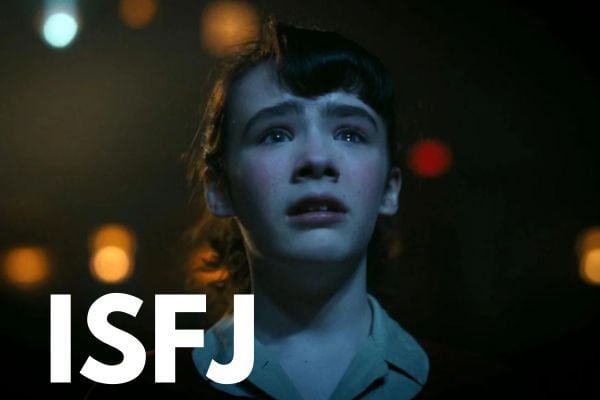
“If I do tell them, they’re going to think I’m crazy and take me away.”
Lilly Bainbridge is the vulnerable, anxious, tormented heart of Welcome to Derry. When the series begins, Lilly is already living inside unresolved grief. Her father’s death at the pickle factory was sudden, violent, and felt like her personal responsibility.
Living in self-blame and overwhelming guilt, she turns inward, looking out at the world with anxiety and a strong sense of inevitable betrayal. Of course, her mother isn’t much help in this regard. Nobody really seems to “get” what she’s going through or the fear and torment that pervades every moment of her life.
I think ISFJ is the best-fit type for Lilly, although I really strongly considered INFP or even INFJ. But I didn’t see her theorizing, predicting, or extrapolating possibilities. At the end of last night’s episode, Ronnie posed a theory, and Lilly fairly quickly shut it down with some version of, “Well, we’ll just have to wait and see” rather than exploring the possibility further or branching off into other alternatives. This, along with other missed opportunities to explore concepts, possibilities, or insights, makes me think she’s less of an intuitive and more of a sensing type. Like most ISFJs, Lilly has a strong sense of duty, loyalty, and a need for community and stability. She wants Derry to go back to the way it was before her entire reality turned upside down.
Another reason I veered away from INFP for Lilly is that I didn’t see her auxiliary Intuition coming out to protect and nurture her the way it would for an INFP. When life is closing in, INFPs explore possibilities, imagination, and find connections between things that others find disparate or random. Their imagination broadens as a way to protect them; yet for Lilly, her imagination tends to broaden as a way to box her in, trap her, and torment her. This to me seems more like an expression of inferior Extraverted Intuition (Ne) that feels more uncertain, overwhelming, or filled with negative, catastrophic possibilities.
That said, Lilly is also living in a horror movie town so, chances are, anyone is going to be pretty overwhelmed with dark possibilities in that situation.
When life hits Lilly hard, she tends to look to her past (Si), her relationships (Fe), and her inner analysis of the problem (Ti) while also being overwhelmed by negative possibilities (inferior Ne). She’s perceptive of others’ feelings, prioritizes those feelings, and will do anything, even risk her own life repeatedly, to help her friends. She’s quiet and gentle, but observant of the ones she cares about. She’s cautious and detail-oriented more than she is brazen and impulsive. Overall, I think ISFJ fits her best, but I’d love to hear your opinions in the comments!
Veronica “Ronnie” Grogan — ESFP
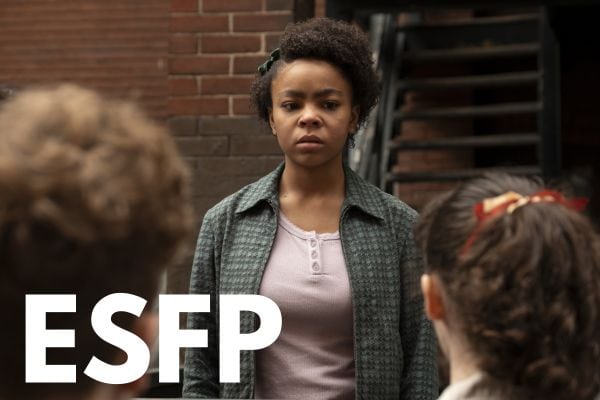
“This is my dad’s life we’re talking about.”
Ronnie Grogan enters Welcome to Derry with a very different relationship to fear than Lilly’s. Where Lilly internalizes dread and guilt, Ronnie externalizes it. She reacts. She confronts. She takes action.
Ronnie’s primary motivation throughout the series is all about protecting her father. Once the theater massacre occurs and the town begins circling Hank Grogan as a convenient scapegoat, Ronnie’s fear sharpens into action. She does not wait quietly for adults to sort things out, and she has no reason to trust that they will. She pressures Lilly to go to the police. She demands accountability. When things get out of control, she shows up in person, pounding on doors, raising her voice, and calling out what she perceives as injustice.
This pattern strongly suggests dominant Extraverted Sensing paired with auxiliary Introverted Feeling. Ronnie is grounded in the immediate reality of what is happening now. She responds to what she sees in front of her with speed and intensity. She’s fiery, passionate, and impatient. When Pennywise manifests her worst fears, she does not freeze or dissociate. She fights back with her body. The womb nightmare scene is one of the clearest Se moments in the series. Ronnie tears, bites, claws, and forces her way out through sheer physical will. Fear registers, but it doesn’t freeze her up. It was pretty impressive, to be honest.
Her decision-making appears to be driven by auxiliary Introverted Feeling. Ronnie’s anger is personal and values-based. She has a strong sense of what she believes is right, and she doesn’t care how uncomfortable she has to make other people to get them to do the right thing or see her point of view. Her emotions are intense, but they are also directional. She knows who she is fighting for. She’s passionate about her values, but less concerned with framing her feelings in a way that will be palatable to others.
Ronnie’s struggles with strategy point away from intuitive dominance. She acts quickly, sometimes without considering long-term consequences. Pushing Lilly to testify is emotionally understandable and morally motivated, but it leads to devastating outcomes. Ronnie does not naturally pause to map contingencies or anticipate how systems of power will respond. Her energy is spent confronting the present moment rather than predicting future fallout.
Like I mentioned before, Ronnie is not motivated by harmony or approval. She is willing to alienate others, challenge adults, and be seen as difficult if it means defending what she loves. Her anger toward Derry’s racism is direct and unfiltered (and earned). She names what is happening without softening it for comfort.
I feel like Ronnie captures the passion, impulsivity, and relentlessness that ESFPs have when their values or the people they care about are threatened. She’s not going down without a fight, and she’s not going to look the other way while injustice runs her town.
Leroy Hanlon — ESTJ

“You do the job in front of you. Everything else comes later.”
Leroy Hanlon is an amazing representation of a healthy ESTJ. Which, of course, means a lot of people online are typing him as a Feeling type. I feel like nobody ever wants the good guy to be an ESTJ. But, as we can see through Hanlon, even dominant thinking types have feelings and values they’ll go down swinging for.
Hanlon is organized, decisive, and quick to take action. From the moment he arrives in Derry as a U.S. Air Force Major, he works hard and takes no BS. He assesses threats quickly, issues commands without hesitation, and expects others to do their jobs competently. When they do not, his patience thins fast.
Leroy’s thinking is externally oriented and results-driven. When he is attacked by masked men demanding bomber schematics, he does not spiral into panic or suspicion. He evaluates the weapon used, recalls its rarity, and concludes that the confessed suspect could not have been responsible. He brings this conclusion directly to General Shaw. Facts matter to Leroy, but only insofar as they lead to decisive action.
His past injury, which has impaired his ability to experience fear, amplifies this tendency. Fear is often what slows people down, forces them inward, or clouds judgment. Leroy lacks that internal brake. As a result, he moves through terrifying situations with unsettling calm. Even Dick Hallorann notices this when he reads Leroy’s mind and finds no fear, only problem-solving. This absence helps to make him intensely functional.
Leroy’s auxiliary Introverted Sensing shows up in his respect for structure, tradition, and duty. He believes in chain of command, procedure, and earned authority, until of course his family’s lives are threatened. His loyalty to the military and his country runs deep, even as he experiences racism within the system. Rather than emotional withdrawal or ideological rebellion, he responds by doubling down on competence. He proves himself indispensable.
At home, this same structure governs his family life. He is not emotionally expressive, but he is present, protective, and consistent. Hanlon believes that survival requires decisiveness and follow-through. He prepares the people he loves for a dangerous world by making them strong enough to face it. He also warns his wife of meddling too much in town affairs, trying his best to operate within the authority system, trying to keep things stable and safe.
Leroy’s tertiary Extraverted Intuition appears in brief flashes when patterns begin to surface. He recognizes that Derry harbors something cyclical and malevolent. He remembers. He connects timelines. He accepts that some threats cannot be dismissed as coincidence. Still, these insights are always subordinate to action. Once he identifies a problem, his focus returns to what must be done.
Emotionally, Leroy keeps a tight perimeter. He doesn’t talk about his feelings, doesn’t see them as relevant, but, when pushed to a breaking point, they can make him lash out in unpredictable ways. He cares deeply about his family, but he expresses it through protection, provision, and expectation rather than verbal affirmation. Feelings are something to manage internally, not something to share freely.
Leroy Hanlon’s presence grounds the story in realism. He is a reminder that courage does not always look like tenderness or introspection. Sometimes it looks like discipline, steadiness, and a refusal to be paralyzed when others fall apart. In a town ruled by fear, Leroy remains functional. That may be his greatest strength. It may also be his blind spot.
Charlotte Hanlon — ENFJ

“My name’s not lady. My name’s Charlotte Hanlon.”
Charlotte Hanlon is one of the few adults in Welcome to Derry who seems fully awake to what is happening around her. She notices cruelty as it unfolds, recognizes fear as a social force rather than an isolated emotion, and responds with purposeful action. I loved her and her boldness and caring nature. That said, I couldn’t get over why she left Will alone at the house in episode 7. Did that bother anyone else?
Anyway…moving on.
From the moment she arrives in Derry, Charlotte is attuned to the emotional climate of the town. She registers hostility in passing glances, recognizes patterns of intimidation, and immediately understands who is being targeted and why. This sensitivity drives her to intervene. She’s not just going to stand by and let people be persecuted. She’s an ENFJ, after all. An In-Charge™ interaction style and an Idealist, who wants to change the world for the better. She’s not content to leave things as they are and to let discrimination continue. She wants to talk about it, do something about it, and really actively help people.
When she sees boys bullying another child, she does not hesitate. She steps in, publicly corrects their behavior, and reframes the situation in moral terms. Her instinct is to regulate the social environment when it becomes unsafe.
This pattern strongly suggests dominant Extraverted Feeling. Charlotte experiences responsibility for the emotional and ethical tone of the spaces she inhabits. When something is wrong, she treats it as a collective failure that requires correction. She speaks up when it’s hard and when the odds are not in her favor. She doesn’t love confrontation, but she also knows that doing hard things is exactly what will change the world.
Her leadership is reinforced by auxiliary Introverted Intuition. Charlotte spots patterns, reads between the lines, and sees how fear is being weaponized across the town. She recognizes that racism, secrecy, and violence are interconnected rather than random. Long before the threat is fully visible, she senses that something is fundamentally off in Derry. This intuitive pattern recognition gives her direction and steadiness. Once she identifies a danger, she moves with clarity and determination, never really second-guessing herself.
Charlotte’s activism reflects this Fe–Ni combination. She understands how systems work and how pressure travels through them. When confronting authority, she leverages networks, visibility, and consequence. Like in this conversation:
Charlotte: “My name’s not lady, my name’s Charlotte, Hanlon, and that may not mean much to you right now, but it will once you see all the scary shit I can do with a telephone.”
Officer: “Excuse me?”
Charlotte: “No, I don’t think I will. In fact, if you don’t let me see Hank Grogan right now, by tomorrow morning I’ll have MLK, JFK, RFK and a whole bunch of other FK’s breathing down your neck, along with a whole bus load of freedom riders after another from here to the turnpike singing ‘We shall overcome’ in the streets. Now are you going to let me see the man? Or do I need to make a call.”
Her threat to involve civil rights leaders and freedom riders is strategic. She knows which levers matter and how to pull them. She knows how to interact with people politely, but also when to strategically pivot to make them do the right thing when they definitely do not want to.
Within her family, Charlotte creates emotional safety without surrendering authority. She encourages her son’s individuality, pushes back against narrow definitions of masculinity, and makes space for honest conversation at the dinner table. She listens carefully, but she also directs, protects, and prepares.
Charlotte’s tension comes from the cost of awareness. She is dutiful on the surface, fulfilling the roles expected of her, while internally struggling with the knowledge that the system she is navigating is not designed to protect her family. This internal pressure builds across the season. She is polite in public, composed in conversation, and relentless in private resolve. That duality reflects an ENFJ managing constant threat while refusing to relinquish moral agency.
Dick Hallorann — INTJ

“I took all them dead things, threw them in that box in my mind, and I shoved that g*ddamn lid on tight. I was nine. I ain’t seen ‘em since. Till yesterday, when that g*ddamn thing, it forced itself into my head, ripped that lid off, and laughed as it all came spilling out.”
Dick Hallorann has a long familiarity with patterns that most people never see and would not survive seeing. From childhood, Dick has perceived reality differently. He understands what is happening before he has language for it, and once he understands, his priority becomes control. He knows the only way he can survive is to contain and control what is allowed into his mind.
Dick experiences insight as something heavy and consequential. Knowledge carries weight, danger, and responsibility. When he describes the Overlook in The Shining (because we can’t only look at his character in Welcome to Derry, as he appears in many other Stephen King books and movies), he does not speak in emotional terms. He speaks in metaphors that explain structure and residue. Events leave traces, kind of like the traces on burnt toast. Places accumulate meaning. Some forces persist long after the people involved are gone. As an Introverted Intuitive type, Hallorann can use symbols, metaphors, and insights to explain things to people. He’s guided by all the things most ordinary people can’t see or acknowledge.
Dick survives by organizing his world so it can remain functional. The lockbox technique his grandmother teaches him is about containment so that he can do what needs to be done and survive with at least some of his mental health intact. As a child, he learns how to isolate overwhelming information so it does not destroy his ability to live. That strategy stays with him into adulthood and becomes the framework he later passes on to Danny.
When Dick understands something, he asks what must be done next. He teaches methods. He issues warnings. He intervenes when necessary and withdraws when the cost becomes too high. He uses his insight to guide himself and others, but not so much for emotional or connective reasons, as an INFJ would. He uses his insights strategically, to problem solve, gain information, and prove competent in his career.
In Welcome to Derry, Dick is young, less integrated, and more desperate to stay uninvolved. He is blunt, dismissive, and at times morally compromised. When forced to access Taniel’s memories, he violates boundaries his thinking function overrides ethical reflection under threat. His internal calculation prioritizes escape and survival. The moral cost registers later.
Dick’s emotional life is deeply guarded. As an INTJ he’s not interested in sharing his emotions with anybody. That’d be too vulnerable, too personal. He’s private, analytical, always noticing and perceiving patterns, but sharing very little. He forms attachments sparingly and protects them fiercely. He knows how to do the job he’s been asked to do, and he prioritizes that because he feels that, overall, it’s what’s best for the country.
Fear for Dick is about informational overload. He is afraid of opening himself to voices that do not stop and stimulation that is too intense for his more quiet, probing mind. Silence and restraint become survival strategies. As long as he does not engage, the dead do not notice him. Attention is dangerous. And, of course, this is a horror TV show with extreme scenarios, but INTJs with inferior Extraverted Sensing are also overwhelmed by noise and sensory stimulation. They often feel the most uncertain and overwhelmed when the noise, visual or audio, becomes too much. When they can’t calm their inner world enough to get the insight they need.
Dick’s strength lies in understanding reality before others are ready to see it. His burden lies in carrying that understanding without being allowed to forget it.
Phil Malkin — ENTP

Phil Malkin doesn’t have much time on screen, but his personality is immediately recognizable. He is curious, talkative, idea-driven, and slightly irreverent. His obsession with aliens, theories, and strange possibilities marks him as someone who enjoys exploring ideas simply for the joy of thinking about them.
Phil approaches the world with playful skepticism and logical questioning rather than fear. He jokes, speculates, and pushes conversations into imaginative territory, which gives him a light, energetic presence similar to Richie Tozier from the original IT story.
This aligns well with an ENTP profile. Phil leads with curiosity and possibility, followed by analytical detachment. He is the kind of kid who notices that reality is strange and finds that strangeness entertaining and stimulating rather than something to be scared about.
Unfortunately, in Derry, curiosity tends to attract attention.
Marge Truman — ESFJ

“I am a freak!”
I went from hating Marge to loving her within the course of two episodes. She’s anxious, socially aware to the point of self-consciousness, and constantly scanning the room for cues about where she belongs. From the start, Marge is torn between two worlds. On one side is Lilly, her childhood friend, history, safety, and loyalty. On the other is the Patty Cakes, a ready-made social structure offering protection, status, and a sense of normalcy in a town that seems to punish anyone who stands out.
ESFJ fits Marge best because her decisions are guided by the emotional climate around her. She feels the pull of group expectations intensely and struggles when harmony fractures. Her near-participation in the plan to humiliate Lilly comes from fear and pressure more than from genuine cruelty. The guilt hits almost immediately, and it overwhelms her. When she tries to confess, it’s clear she can’t live comfortably inside moral dissonance for long. She needs relational connection and alignment with her values to breathe.
When Marge finally breaks from the Patty Cakes, she levels up as being a more authentic, genuine person. And she honestly seems happier with all the terrifying Pennywise ordeals than she ever seemed with the Patty Cakes. And that’s because instead of living a lie, she’s actually living in alignment with the kinds of people who she genuinely likes. She’s doing what she actually believes is right and she’s part of something bigger than herself. With Rich, we see the softer side of her Fe. She nurtures, encourages, jokes, and lights up when someone sees her as interesting rather than embarrassing.
Marge wants to belong. She wants to be kind. She wants to be good. Her arc shows the cost of outsourcing belonging to the wrong people and the bravery it takes to choose loyalty when it would be easier to disappear into the crowd.
Will Hanlon — INTP

“Dad, I know what it can do. It’s come after us a bunch of times, and it’s not gonna stop. You always told me that a man should never hide from trouble, that what makes life count are the friends you make and the risks you take. Well, I’ve got friends now dad. I’ve got friends and they need me and I’m gonna be there for them just like you would.”
Will Hanlon is probably the most lovable character in Welcome to Derry (at least in my opinion). He’s sweet, quiet, adorably nerdy, and noticeably less reactive than the people around him. While others lead with emotion or action, Will tends to pause, process, and try to understand what he’s seeing before responding. That internal distance gives him a calm presence, even when the situation itself is anything but calm.
Like most INTPs, Will gravitates toward science, systems, and patterns. He wants things to make sense. When the supernatural intrudes, he studies it, questioning, analyzing, trying to piece it all together while remaining detached enough not to get swept up in nonsense. You can see his mind working in the background, filing away details, contradictions, and unanswered questions. Even fear seems to pass through a layer of analysis before it reaches his emotions.
Will also shows the classic INTP tension between insight and action. He notices things others miss, but he doesn’t always know what to do with that information in the moment. His response to trauma is internal. But at the same time, he cares deeply about his friends and his family. He’s not going to sit back and let them get hurt, even if his dad is pressuring him to follow the rules and stay out of trouble. INTPs aren’t emotionless robots, even if the stereotypes might like to paint them as such. They care about people, but their way of showing it is generally going to be through exploring patterns, options, possibilities, and providing logical solutions and calm guidance.
Will’s significance stretches beyond the present timeline, and Pennywise knows it. He is attacked not because of who he is now, but because of what he will set in motion later through his son. He may not be the loudest or boldest member of the group, but his quiet persistence, intelligence, and ability to hold complexity make him essential.
Pennywise — ENTP*

“They all float down here.”
Pennywise is evil incarnate, which means any attempt to type him will break down if taken too literally. He is not a human psyche. He has no developmental arc, no capacity for growth, and no internal checks. That said, when Pennywise wears a human mask, the cognitive style he performs most closely resembles an unrestrained, predatory ENTP.
He is playful in the most disturbing sense. He experiments, improvises, and constantly shifts form based on what will provoke the strongest reaction. Fear is not just sustenance for him. It’s a playground. He delights in possibilities, chaos, and psychological misdirection. No single scare will do when ten variations might be more fun.
Pennywise is also keenly attuned to emotional undercurrents. He reads people quickly and accurately, zeroing in on insecurities, guilt, shame, and unresolved grief. That sensitivity looks like tertiary Fe stripped of empathy and restraint. He understands emotions well enough to weaponize them without feeling any obligation to protect them.
His downfall fits this pattern too. He toys too much. He escalates. He underestimates collective resistance because he’s intoxicated by his own cleverness. Pennywise doesn’t lose because he lacks intelligence. He loses because he can’t stop playing with the board.
So yes, ENTP energy is there, but without conscience, grounding, or humanity. What’s left is pure curiosity turned into something malignant and cruel.
Ingrid “Gray” Kersh — ISFJ

“No one who dies here ever really dies.”
Ingrid Kersh is what happens when loyalty, memory, and grief calcify into something dangerous. She seems really nice at first, although I kept telling my husband that I got a feeling she was actually evil. At her core, Ingrid is oriented toward caretaking and preservation. Like most ISFJs she remembers her past in vivid detail, feeling responsible for the people she loves and struggling to let go even when she should.
Her identity never moves far from her father. His disappearance becomes the organizing event of her life. Ingrid does not reinterpret it or release it or move on. Instead, she tends to this idea of her father and reuniting with him. She builds meaning around it. When It appears in her father’s form, she accepts the explanation that allows her to keep believing he is still reachable. That willingness to protect a familiar story, even when it grows monstrous, reflects Si at its most rigid and grief-soaked.
Ingrid’s Fe shows up in how she relates to others. She presents as gentle, encouraging, and emotionally attentive. With Lilly, she brings comfort, validation, and reassurance. She speaks in the language of connection and shared journey. That softness makes her trustworthy, which makes her betrayal more devastating. Her care is real, but it is also conditional. It bends toward whatever preserves that inner story of who her father is and how they will someday be together again.
What ultimately breaks Ingrid is fear of abandonment. The moment It reveals the truth, her composure collapses. The attachment she built her life around was never mutual. The thing she served never loved her back.
Ricardo “Rich” Santos — ENFP
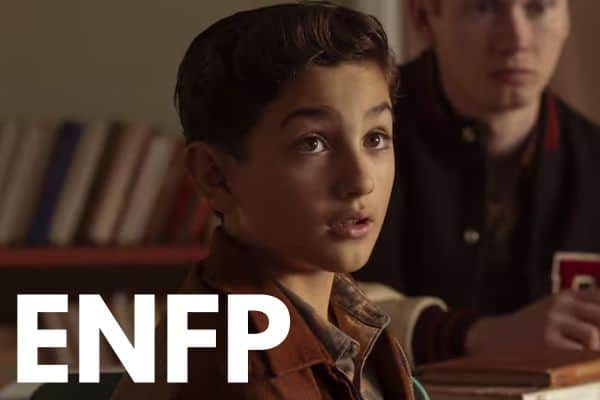
“Love can make you do some crazy things.”
I know I just said Will is probably the most lovable character in Welcome to Derry. But Rich could be a contender also. He’s curious, talkative, playful, and hopelessly devoted to Marge. He bonds fast, jokes easily, and moves through the world with a restless openness that makes people feel lighter. Complimenting Will’s pencils, riffing on science questions, inventing half-baked folklore rituals just to keep people together, Rich leads with possibility, imagination, and warmth.
ENFP fits Rich because of the way he can improvise and come up with imaginative options or quips on the spot. He tells stories to create belonging. He lies about the Orisha ritual less out of deception and more out of hope that shared meaning might bring everyone together. When that backfires, he admits the truth. He wants to be understood. He wants to be wanted.
Rich also shows the ENFP habit of softening fear with humor. Even when he’s terrified, the jokes keep coming. He talks, plays music, asks questions, and keeps energy moving. His feelings run deep, but he expresses them sideways, through poetry scribbled inside a shoe or grand romantic gestures that feel earnest and authentic.
His relationship with Marge brings his values into focus. He sees her insecurity and responds with genuine admiration. He treats her wounded eye as something interesting, even beautiful. He encourages her to stand in her difference. And that’s what ENFPs do so well. They take care of others by encouraging authenticity, sincerity, and fearlessness when it comes to personal quirks.
At The Black Spot, Rich’s heart becomes even more clear. Faced with an impossible choice, he acts without hesitation. He protects Marge and reassures her, rather than looking out for himself. He fills the final moments with memory and connection. There’s no panic, no bargaining, no resentment. I personally sobbed through this scene, even though I knew it was overtly playing on my emotions in a way that I tend to find manipulative and frustrating in most shows.
Rose — INFJ

“You were never supposed to come here.”
Rose feels different from almost everyone else in Welcome to Derry, and that’s intentional. She isn’t discovering the evil in this town. She has been living alongside it, watching it, guarding it, and carrying its memory long before the current cycle begins. Rose operates from a long view of time, one shaped by land, ancestry, and pattern. She notices past patterns, present realities, and then extrapolates how the patterns will unfold over time.
INFJ fits Rose because her insight is quiet and visionary. She understands how Pennywise works, how fear moves through communities, and how history repeats itself when it isn’t faced. She doesn’t chase evidence or argue theory. She already knows. She has a wise insight that seems certain, comforting, and sure of itself. That’s how Ni-dominant types work. They have a certainty about future realities and how to prevent or realize them. Her guidance comes in fragments, warnings, and carefully chosen moments. She speaks when it matters and stays silent when it doesn’t.
Rose’s leadership is protective and nurturing, but still commanding when it needs to be. She creates containers of safety. Her shop, her land, and her role as a watcher all function as anchors. When she invites the Hanlons to stay, she’s strategically seeing how they could impact the community and keep the world safe. She’s strategic, ethical, and communal. She understands that survival depends on shared vigilance. She’s probably one of the hardest-working and most underrated characters in the show. Her grief runs deep and mostly unseen. The loss of her childhood love, of Taniel, and the life she never got to live sit beneath her composure. Yet she does not allow that grief to derail her responsibility. When the moment comes, she becomes a soldier without theatrics. Every shot she fires is purposeful. Fear doesn’t rule her. Duty does.
Rose represents conscience in a town that prefers amnesia. She remembers so others don’t have to face the darkness alone. She stands between cycles, holding the line, knowing that protection is rarely loud and almost never thanked.
Clint Bowers — ESTJ

“You kids keep your noses out of police business.”
Clint Bowers represents authority stripped of conscience. As an ESTJ, his focus is on control, order, and preserving the existing power structure of Derry at all costs. He believes deeply in hierarchy and enforcement, but only when those systems serve him and the people he considers legitimate.
Clint’s thinking is rigid and outcome-driven. When facts stop supporting his goals, he simply replaces them. Coercing Lilly into false testimony, framing Frank Grogan, and orchestrating violence at The Black Spot all follow the same logic. Stability must be maintained, even if it has to be manufactured through fear. From his perspective, moral nuance is an inconvenience.
What makes Clint particularly dangerous is how ordinary he believes himself to be. He doesn’t see his actions as evil. He sees them as necessary. He is decisive, commanding, and confident in his right to act. That certainty allows him to commit atrocities without hesitation or reflection.
Clint doesn’t serve Pennywise directly, but he feeds the same ecosystem. Fear, silence, and compliance are his tools. Derry doesn’t just rot because of monsters in the sewers. It rots because of men like Clint Bowers, who enforce cruelty with a badge and call it order.
What Do You Think?
Do you agree with my thoughts on the characters, or do you have a different take? I’d love to hear it! Let’s keep the conversation going in the comments.
Find out more about your personality type in my eBook: Discovering You: Unlocking the Power of Personality Type . You can also connect with me via Facebook, Instagram, or YouTube!