
The INFJ and ENTJ Relationship: Compatibility, Pros & Cons
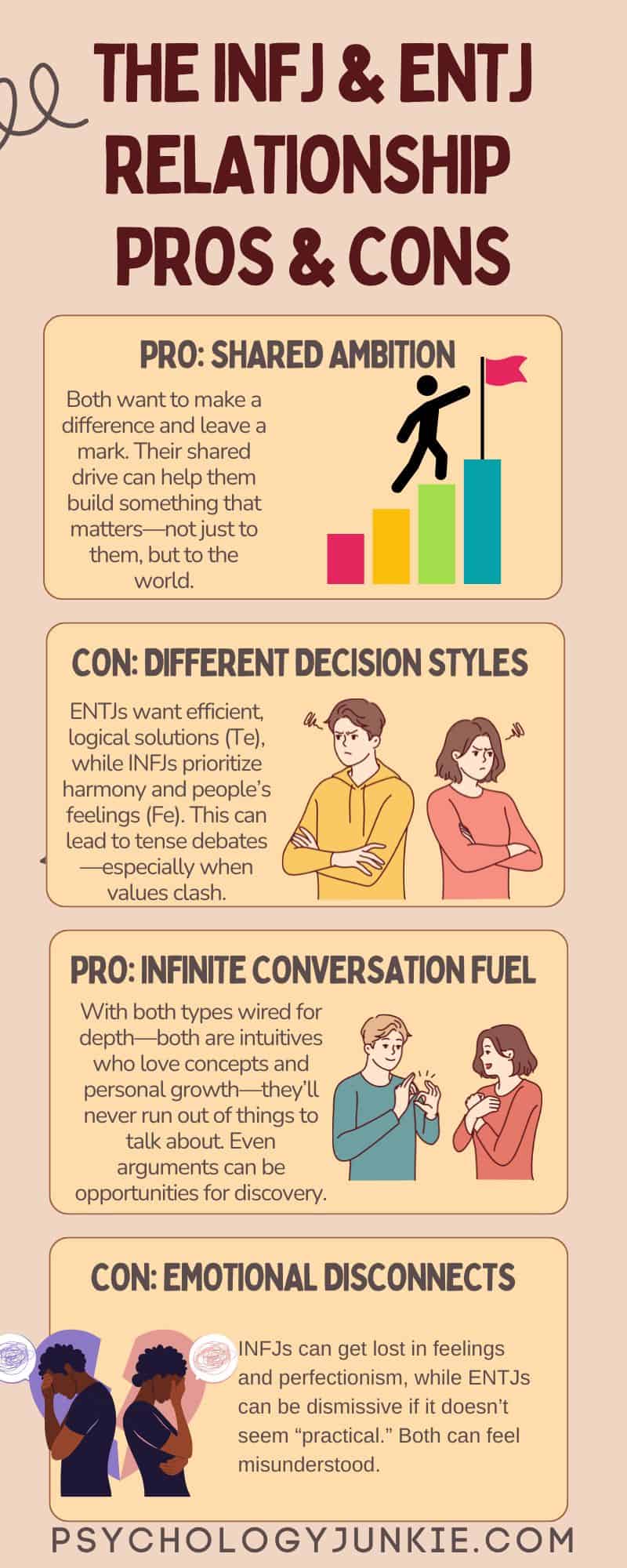
Can INFJs and ENTJs have a happy relationship? While there may be some clashes in decision-making, the two often find each other intriguing, inspiring, and a little…maddening (in both good and bad ways).
I’ve worked with couples in this pairing in the past and I can tell you that they love deep conversations, thought-provoking ideas, and philosophical enlightenment. What they don’t always like is the ways they respectively clash when it comes to emotional output or productivity. But don’t worry, we’ll get into that soon.

The magic? These two can be a powerhouse together. The INFJ brings depth and empathy while the ENTJ brings energy and direction. When they respect each other’s gifts, they can move mountains.
Of course, it’s not always that simple. The INFJ’s sensitivity and big-picture focus can clash with the ENTJ’s blunt style and need for efficiency. One might feel like the other is steamrolling their feelings; the other might feel like they’re stuck in an endless debate. But if they can find a shared purpose—if they can lean in and learn from each other—it can be a relationship that grows stronger with every challenge.
Not sure what your personality type is? Take our personality questionnaire here. Or you can take the official MBTI® here.
Overview of the Two Types
The INFJ: The Visionary Idealist
INFJs are always looking for the why behind the what. Their dominant function, Introverted Intuition (Ni), makes them future-focused and full of ideas about how everything connects. They easily see ripple-effects, likely outcomes, and the stuff going on behind the scenes. They’re that quiet person in the room who sees patterns no one else notices.
Then there’s Extraverted Feeling (Fe)—how they tune in to other people’s needs and feelings. INFJs care deeply about harmony. They’re the kind of people who just seem to know how other people feel, how to say the right thing at the right time, and empathize with sincerity and insight.
Underneath, there’s Introverted Thinking (Ti), their private logic filter. It’s how they check that their big visions actually make sense. It’s the part of them that likes taking apart theories and ideas to understand them from the fundamentals up.
Finally, there’s Extraverted Sensing (Se)—their last function. It’s their link to the present, but also the thing that can feel overwhelming when life gets loud and chaotic.
INFJs need meaning—a reason for it all. They’re dreamers, but they want those dreams to be real and to make a difference.
The ENTJ: The Driven Strategist
ENTJs are here to get things done. Their dominant function, Extraverted Thinking (Te), is all about creating order and making decisions quickly. They focus on empirical logic, evidence, and metrics. They’re the people who take charge, organize chaos, and make things happen.
Supporting that is Introverted Intuition (Ni)—a quiet engine of insight that gives them long-term vision. They share this function with the INFJ, and it makes them both interested in the big picture and patterns more than day-to-day details.
Extraverted Sensing (Se) comes next, giving them an eye for what’s happening in the here-and-now—what’s real, what’s changing, what needs to be addressed. And last is Introverted Feeling (Fi), their most private function. It’s their quiet inner conscience that focuses on what feels right or wrong to them and what ultimately matters personally.
ENTJs crave competence and progress. They want to keep moving, keep growing, and see real results—ideally yesterday.
5 Pros of the INFJ and ENTJ Relationship
- Vision Meets Action
INFJs often dream up a future so vivid it could be mistaken for a Netflix series. ENTJs? They’ve got the executive director’s chair ready. In my coaching sessions, I’ve seen how this pairing can feel like destiny: INFJs bring the insight and “big why,” while ENTJs bring the strategy and “big how.” Together, they’re a powerhouse—INFJ’s clarity of purpose fuels ENTJ’s plans, and ENTJ’s drive keeps INFJ’s visions from drifting into the clouds.
- Mutual Respect for Competence
Both INFJs and ENTJs respect intelligence and determination. When they see it in each other, it’s incredibly attractive. I’ve worked with INFJs who felt like they had to tiptoe around other types’ egos, but with ENTJs, they can lean into that heady, intense discussion. ENTJs, meanwhile, find INFJs refreshingly intuitive and deep—someone who sees beyond the day-to-day and can dive right into the depths of great conversation. It’s a relief for both of them to finally meet someone who can keep up and isn’t put off by big, audacious goals.
- Growth Catalysts
INFJs and ENTJs can draw out the best in each other—sometimes in ways that feel more like bootcamp than a spa day. ENTJs push INFJs to take real-world action, to stop hesitating and do. In my coaching sessions, I’ve seen ENTJs help INFJs stop second-guessing and finally launch that blog, podcast, or passion project. On the flip side, INFJs teach ENTJs the power of nuance—why people matter more than checklists, why empathy makes everything more sustainable in the long run.
- Balancing Strengths
Let’s be honest—ENTJs can sometimes steamroll over feelings like they’re irrelevant, and INFJs can get so caught up in what people might feel that they never say what needs to be said. Here’s the magic: ENTJs’ frankness helps INFJs trust their own voice, while INFJs’ gentleness can soften ENTJs’ edges.
- Dynamic Energy
Both types have an underlying hunger for growth—intellectually, emotionally, spiritually. I’ve seen INFJ-ENTJ pairs light up when they talk about changing the world or turning a crisis into an opportunity. They don’t just sit around whining about how things should be—they’re scheming how to actually make it happen. If you’ve ever seen two people plot out a world-changing idea over coffee, you’ve probably seen this combo at work.
5 Cons of the INFJ and ENTJ Relationship
- Te Bulldozer vs. Fe Diplomat
ENTJs lead with Te (Extraverted Thinking), so they often talk like they’re giving orders—even when they’re not. INFJs are all about Fe (Extraverted Feeling), so they’re tuned in to whether people feel appreciated and understood. In coaching, I’ve seen INFJs describe ENTJs as “insensitive without meaning to be,” while ENTJs can see INFJs as frustratingly indirect or overly cautious.
- Ni Clash: Competing Visions
Both INFJs and ENTJs use Ni (Introverted Intuition), so they’re both looking for the big picture. Problem is, sometimes they’re not seeing the same picture. ENTJs want the vision to fit into an actionable plan, while INFJs want it to feel soul-deep and meaningful. I’ve had sessions where an INFJ client said, “I feel like he just wants to conquer the world for the sake of it,” while the ENTJ was thinking, “I’m trying to conquer the world for us!” Different angles, same goal—misunderstandings happen.
- Emotional Disconnect
ENTJs have inferior Fi (Introverted Feeling), which can make them wary of “mushy” emotions or dismissive of INFJs’ sensitivity. Meanwhile, INFJs have tertiary Ti (Introverted Thinking), which makes them second-guess their feelings when they’re already stressed. In coaching, I’ve seen INFJs say they feel shut out when ENTJs don’t “get” why something hurt. I’ve also talked to ENTJs who felt overwhelmed by the INFJ’s emotions, feeling like they can “never get it right.” Tact and diplomacy can be a challenge for ENTJs to tap into, and they may think they’re being perfectly kind when they’re being too blunt or frank for the INFJ’s more sensitive soul.
- Speed vs. Depth
ENTJs want to act now—get it done, move on. INFJs want to understand everything—turn it over, see how it all fits together, and then decide. This can be a huge sticking point. INFJs often feel that ENTJs are too impatient and rushed and ENTJs often feel like INFJs are stalling too long, getting too perfectionistic.
- Stress Spiral
When both are under stress, it’s like watching a Shakespearean tragedy in fast forward. ENTJs get more controlling and bossy at first (Te), while INFJs get more suspicious and closed off. In one couple I coached, the INFJ would retreat into cryptic statements like, “I just know this isn’t going to work,” and the ENTJ would start barking orders like, “Stop sulking and tell me what’s wrong.” It wasn’t pretty.
Te vs. Fe – The Tug-of-War Between Head and Heart
ENTJs lead with Te (Extraverted Thinking). It’s all about results, logic, and action—it quickly wraps up the facts into a plan and a strategy. INFJs, on the other hand, make decisions with Fe (Extraverted Feeling). They’re scanning the emotional atmosphere, making sure everyone’s getting along and feeling good about what’s happening.
In relationships, this clash can feel like a sitcom that forgot it was supposed to be a romance.
I’ve seen this firsthand in coaching sessions: the INFJ is looking for a decision that “feels right” to everyone involved, while the ENTJ is laser-focused on what’s going to work—like, “Who cares how it feels, as long as it gets done?”
Here’s the thing: INFJs can see Te as cold, bossy, and dismissive—like it’s all about efficiency and people are just cogs in the machine. ENTJs can see Fe as wishy-washy or manipulative—like it’s bending the truth to keep everyone happy. They’re not wrong—just… not entirely right, either.
But here’s the secret: these two decision-making styles can actually balance each other out. INFJs can help ENTJs remember that people are the point—not just the plan. ENTJs can help INFJs remember that harmony is only as good as the progress it creates. That it’s okay not to make everyone happy and to prioritize yourself now and then. Together, they can make decisions that are both effective and considerate—if they’re willing to slow down and listen.
Surviving (Happily) When it Comes to Decision-Making Differences:
- INFJs: Before dismissing the ENTJ’s plan as too cold, ask yourself: “Does this actually hurt anyone, or am I just uncomfortable with the speed?” You can value harmony and still trust that directness isn’t cruelty—it’s just efficiency.
- ENTJs: Before bulldozing ahead, take a breath and ask, “Who does this affect, and have I checked in with them?” Your gut might say “goals first,” but if you have a lot of relationship fallout as a result, that could be extremely frustrating later on.
- For both:
- Recognize that your partner’s decision-making lens is as real to them as yours is to you.
- Practice explaining your “why” instead of just your “what”—it gives the other person a chance to understand where you’re coming from.
- When stuck, ask: “What’s the trade-off here, and what matters more in the long run—harmony or progress?”
- Remember: You’re not trying to win the decision; you’re trying to make it together.
When Things Go Wrong – Common Pitfalls
Even with all this relationship’s potential, there are landmines scattered across the INFJ and ENTJ landscape. Here’s what I’ve seen trip up couples the most:
- Feeling vs. Fixing: The ENTJ’s Te can turn into a runaway train of “solutions,” while the INFJ just wants to be heard. It’s like one is patching the boat while the other is just trying to say, “Hey, I’m drowning!”
- Overthinking vs. Overpowering: INFJs can spiral into “What ifs” and “Is this even the right path?” Meanwhile, ENTJs are like, “We’ll make it the right path. Let’s go.”
- Intensity overload: Both types have an intensity—INFJs with their quiet but deep convictions, ENTJs with their blunt and laser-sharp plans. When these intensities clash instead of align, it can get messy.
One couple I worked with had the same fight on repeat: she’d open up about her fears, and he’d shut them down with logic. She’d feel dismissed, he’d feel like she was refusing to solve the problem. Once they realized they were speaking different languages—her language of emotional nuance, his of external efficiency—they could finally hear each other.
The Fix? A Little Patience, a Little Curiosity
- Pause the rescue mission: ENTJs, try to just listen to your INFJ’s worries before you fix them. Let them feel safe sharing.
- Question your gut reaction: INFJs, remember that just because something feels emotionally jarring doesn’t mean it’s an attack. ENTJs are often trying to help—clumsily, but sincerely.
- Stay humble: Neither of you has the whole map. Let your partner’s strengths enrich your own instead of threatening them.
Because here’s the truth: when you lean into what feels different instead of pushing it away, you both end up growing. And that’s probably the most INFJ-ENTJ thing you can do.
Let’s Keep the Conversation Going
If there’s one thing I’ve learned after working with INFJs and ENTJs for so long, it’s that no two relationships are exactly alike. Each pair has their own brand of magic—and their own brand of mayhem. So I’d love to hear from you:
- Are you an INFJ or ENTJ who’s been in a relationship like this?
- What have you noticed about your strengths—and those hair-pulling frustrations?
- Do you have a tip or story that could help someone else see things more clearly?
Drop your thoughts in the comments! Your experiences might be just the thing another INFJ or ENTJ needs to hear today.