
18 Ways Tertiary Fi Shows Up for INTJs
Ever wonder why you can be surprisingly sensitive but try to hide it under a practical, stoic exterior? Today let’s find out by digging into the middle child of your personality stack. For INTJs, that function is Introverted Feeling, or Fi. Personality Hacker calls the tertiary function the “10-year-old,” while psychologist John Beebe associated it with the archetype of the Eternal Child. You may also hear it called the relief function because we often turn to it when we want a break from our more responsible, outward-facing way of operating.
If your personality were a car, dominant Introverted Intuition (Ni) would be the driver, scanning the horizon and deciding where the road is going. Extraverted Thinking (Te) would be in the passenger seat with the map, the fuel estimate, and a growing concern about your refusal to stop for lunch. Inferior Extraverted Sensation (Se) would be in the back wondering why nobody is enjoying the scenery. Tertiary Fi is the person who takes over the music and plays the one song that means everything to you, although you would rather not explain why.

That is the basic flavor of tertiary Fi. It brings the INTJ back to questions of personal meaning: *What matters to me? What kind of person am I? What can I live with? What feels true, even if nobody else understands it?*
As an MBTI® practitioner, I think Fi is one of the easiest INTJ functions to misunderstand. It does not necessarily make INTJs emotionally expressive, conventionally tender, or eager to discuss their feelings in a circle. Often it does the opposite. Their feelings become private territory, heavily guarded because they are personal and sometimes difficult to explain. Jung wrote that the depth of introverted feeling “can only be guessed,” which is useful here. An INTJ may look composed while having an entire moral trial, grief ritual, or doomed romance taking place behind the forehead. [Jung’s original description was about dominant Fi]), so an INTJ will not show it in exactly the same way. Still, the inwardness is familiar.
Tertiary Fi can become warmer, wiser, and more discerning with age. It can also become self-righteous, touchy, or self-absorbed when the INTJ is exhausted or insecure. Usually it is some untidy mixture of both. Here are 18 ways you might recognize it in real life.
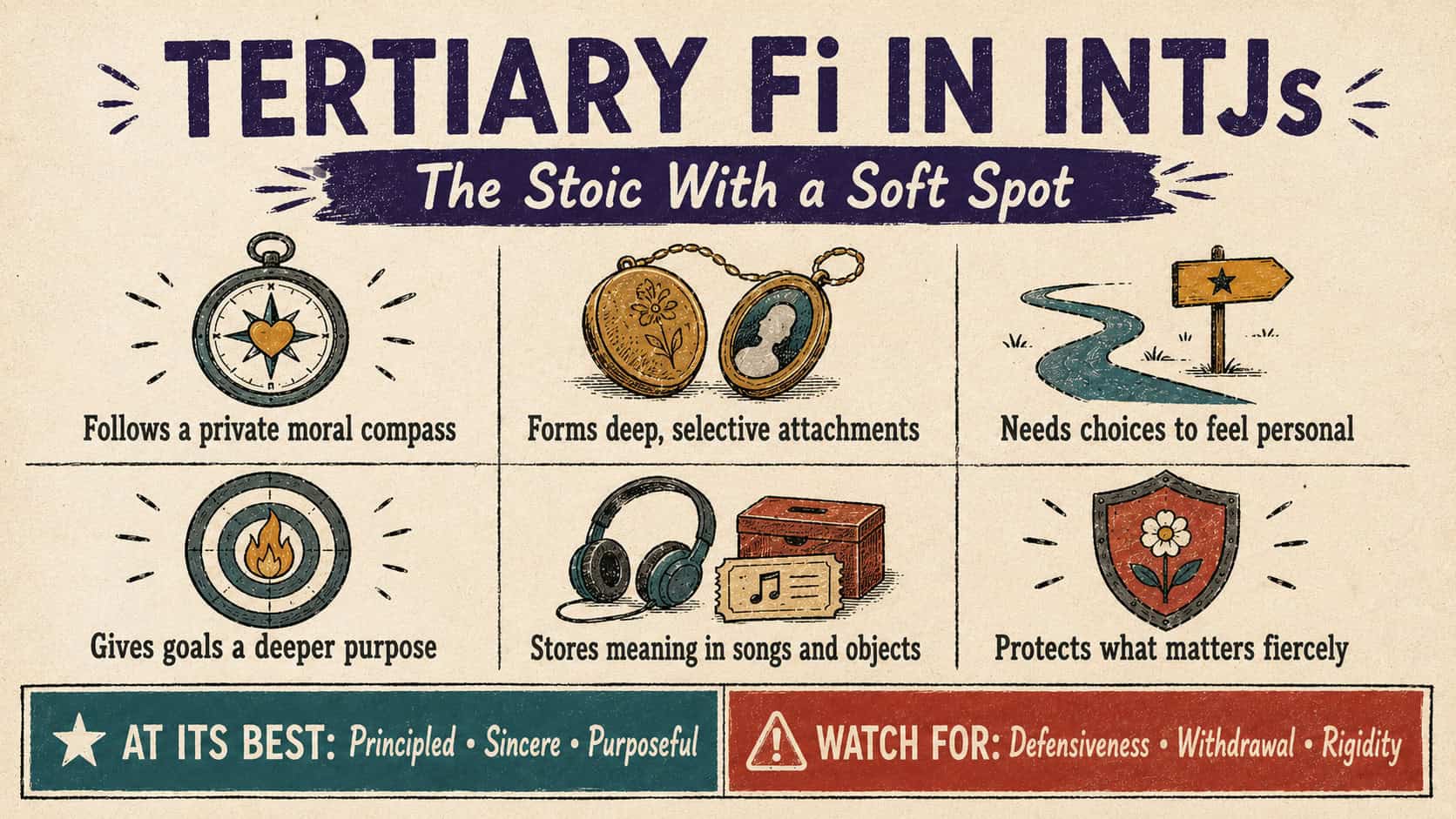
1. You Have Strong Feelings About a Very Select Number of Things
INTJs are selective about what gets their emotional energy. You may let fifty minor annoyances pass without comment, then react with startling intensity when someone touches the one issue connected to your values. Other people can be confused by this. They thought you did not care about anything; it turns out you care about three things with the force of a small religion.
This is Fi sorting experience according to personal importance. Because it is tertiary, your system may not be fully mapped or easy to articulate. You know a line has been crossed before you can explain where the line came from. Healthy Fi prompts you to slow down, name the value, and decide what response fits it. Less mature Fi assumes the intensity of your reaction proves you are right.
2. Your Emotions Often Arrive After the Meeting Has Ended
When something difficult happens, Te may take the first shift. You solve the problem, send the email, make the appointment, reorganize the budget, and tell everyone what needs to happen next. Six hours later, while washing a cup, Fi clears its throat: *By the way, that hurt.*
This delayed awareness is common for INTJs. It does not mean the emotion was absent. Your attention was directed toward managing the external problem, and the personal impact had to wait. The trouble is that postponed feelings do not disappear; they tend to emerge later as fatigue, irritability, a bleak playlist, or a sudden conviction that your entire life has been a terrible administrative error.
3. You Want Your Life to Mean Something, Not Merely Work
Te can build an efficient life. Fi eventually asks whether you even want to live in it. This question often becomes more pressing as INTJs get older, especially after years of doing what was sensible, responsible, or strategically necessary.
You may reach a goal and feel almost nothing because the goal solved a practical problem without serving a personal value. On the other hand, a project that matters deeply can pull extraordinary stamina out of you. The plan and the purpose begin reinforcing each other. This is one of the best contributions tertiary Fi makes to an INTJ: it gives the strategy a soul.
The danger is waiting until burnout to ask what any of it was for. Fi works better as part of the planning committee than as the furious auditor called in after twenty years.
4. You Are More Sentimental Than Your Filing System Suggests
An INTJ may delete useless documents, throw away clutter, and question why anyone needs seven decorative pillows, while keeping a battered ticket stub from 2009 because it carries an entire chapter of their life inside it. No, the object is not objectively valuable. That is not the point.
Fi invests certain objects, songs, books, and places with personal meaning. Inferior Se may add sensory force to the memory: a scent, a color, the exact sound of the rain that day. The result is a small private museum that looks irrational to everyone else and perfectly coherent to you.
You may not revisit these items often. You just need to know they still exist, holding a version of you that the rest of the world never met.
5. Music Can Get Past Defenses That Conversation Cannot
Someone can ask, “How are you feeling?” and receive a careful report on workload, sleep, and current obstacles. Then one song comes on and suddenly you are staring out a window as if you have been widowed in a nineteenth-century novel.
Music gives Fi a language that does not require a formal explanation. It can hold several feelings at once without forcing you to label, justify, or solve them. For an INTJ who is used to making experience intelligible, that can be an enormous relief.
This is also why the oddly specific playlist matters. It can act as an emotional filing system, a time machine, and a controlled way to feel something you have not been able to approach directly.
6. You Need Your Choices to Feel Like Yours
INTJs usually want good reasons for a decision, but good reasons are not always enough. If you feel pushed, managed, guilted, or drafted into someone else’s vision, resistance rises fast. You may reject an objectively reasonable suggestion because the method of delivery made it feel like a violation of autonomy.
Fi needs inner consent. It wants to know that your life reflects a choice you can personally stand behind, not just a set of expectations you performed well. At its healthiest, this protects integrity and makes your commitments sincere. When immature, it can turn every request into a sovereignty dispute. Nobody asked you to surrender the kingdom; they asked whether you could move your shoes.
The useful question is not only, *Do I want this?* It is also, *Am I defending a real value, or reacting to the sensation of being influenced?*
7. You Can Be Fiercely Protective of the Underdog
INTJs are often portrayed as detached strategists, but many have a strong response to unfairness, exploitation, or maybe a political cause of some sort. You may not comfort the injured person in the most socially expected way. You might research their options, confront the system, document the pattern, or build an escape route.
That combination of Fi and Te is powerful. Fi says, *This is wrong.* Te asks, *What can actually be done about it strategically?* The result is compassion with tools.
Because the value is internal, you may act without seeking recognition. You are not trying to look benevolent or win group approval. In fact, you may become irritated if someone turns the issue into a performance. What matters is whether the vulnerable person is safer when the work is done.
8. Your Affection Is Specific Rather Than General
INTJs can seem reserved in broad social settings and intensely attentive with the people they love. You remember the obscure book someone wanted, research the problem they mentioned three months ago, or make a plan that removes a recurring burden from their life. The warmth is there, but it often comes through action more than words or emotional expression.
Fi does not necessarily want to distribute affection evenly. It forms personal attachments, and those attachments can be deep. You may have little desire to charm a room while caring enormously about the welfare of three particular people in it.
This can feel wonderful to those inside the circle and chilly to those outside it. Mature Fi does not require fake intimacy, but it does learn that basic consideration is not emotional fraud. You can value a few people intensely without treating everyone else like badly designed furniture.
9. You May Hide Tenderness Behind Useful Advice
Someone tells you they are struggling. You immediately offer a framework, a resource, a diagnosis of the underlying pattern, and perhaps a five-step exit strategy. Part of this is Te, but Fi may be providing the motive. You care, and usefulness feels safer than exposure.
Advice lets you participate in another person’s pain without saying how much their pain affects you. Sometimes that is exactly what they need. Other times they need one sentence before the plan: “That sounds awful, and I’m sorry you’re dealing with it.”
Developing Fi means letting care become visible enough that the other person does not have to reverse-engineer it from the advice list you made for them.
10. Criticism Hurts Most When the Work Is Personal
INTJs can handle blunt feedback rather well when it concerns a detached problem. Point out a structural flaw, and they may be grateful. Criticize something tied to identity, purpose, or a long-protected dream, and the reaction can be much stronger.
The work may look like a report, business, painting, theory, or plan. Internally, however, it carries a piece of you. Because tertiary Fi does not always announce that attachment beforehand, even you may be surprised by how exposed you feel.
Less mature Fi turns the critic into an enemy or dismisses the feedback wholesale. Healthier Fi separates two questions: *Does this person understand what I am trying to do?* and *Is any part of their criticism useful anyway?* Protecting the meaning of the work does not require protecting every sentence in it.
11. You Have a Private Ideal Self
Many INTJs carry an inner picture of the person they are supposed to become. This is not always based on society’s definition of success. It may involve courage, independence, intellectual honesty, devotion, creative integrity, or refusing to become like someone who harmed them.
Ni supplies the image of a future self; Fi gives that image moral and personal weight. When this works well, it acts like a guide. You can tolerate slow progress because you know what direction you are moving.
When it becomes rigid, the ideal self turns into a prosecutor. Every tired day becomes evidence of hypocrisy, weakness, or wasted potential. Rainer Maria Rilke’s advice to “live the questions now” is helpful here. Identity is not a final exam you should already have passed. Some answers only become available through living. Rilke’s larger passage makes this point beautifully.
12. You Can Feel Deep Shame About Needing Help
INTJs often like being capable, and Te takes pride in handling what needs to be handled. When you can no longer manage alone, the problem may not feel only practical. Fi can translate it into a statement about who you are: *I should be stronger than this. I should not need anyone. I have failed my own standard.*
I recognize this one in myself. When I am overwhelmed, I can become ridiculously aware of all the things I wanted but kept postponing because work had to come first. Yet I do not necessarily accept help or listen to anyone. I go inward, put on sad music, write something angsty in my journal, and continue doing the work that helped create the problem. It is a very efficient way to remain miserable.
13. You Can Become a Righteous Hermit Under Stress
When hurt or disappointed, an INTJ may retreat into a Ni-Fi loop. In type language, this means intuition and personal feeling start feeding each other while Te’s reality-testing and practical engagement get pushed aside. You interpret the pattern, decide what it means, feel wounded by that meaning, and then use the feeling as proof that your interpretation was correct.
From inside the loop, withdrawal can feel principled: *Nobody understands. Everyone is shallow. I will preserve what matters by removing myself.* Sometimes distance is necessary. Sometimes you have built a moral bunker around an assumption that one honest conversation could correct.
The way out is usually not to argue yourself out of having feelings. It is to bring Te back online. What are the observable facts? What explanation have you not tested? What small action could give you new information?
14. You Are Sensitive to Hypocrisy, Including Your Own
Contradictions between stated values and actual behavior tend to bother INTJs. If an institution advertises compassion while the leaders drive fancy cars, or a leader speaks about honesty while manipulating the facts, Fi notices the violation and Te starts assembling the case.
You may be equally hard on yourself. When your behavior falls below your personal standard, the guilt can be sharp even if nobody else knows. This has a healthy side: integrity matters when nobody is watching. It also has a distorted side, especially when you demand perfect consistency from a changing, tired human being.
Values should guide repair, not eliminate mercy. If your moral code has no process for apology, learning, or trying again, it is not making you more ethical. It is just making you afraid to examine yourself honestly.
15. You Have Little Patience for Manufactured Emotion
Forced enthusiasm, corporate inspiration, public displays that seem designed for applause, and demands that everyone share the approved feeling can make an INTJ recoil. Fi wants emotion to arise from the inside and correspond to something real. If the expression feels rehearsed, inflated, or socially compulsory, you may distrust it. For me personally I hate any movie or TV show that feels like it’s manipulating me into having emotions. Over-acting in particular will immediately make me lose interest.
Often that perception is accurate. Sometimes, however, you confuse visible emotion with false emotion because your own sincerity tends to be less demonstrative. Another person’s exuberance may be completely genuine; it is merely genuine in a form you would never choose.
Mature Fi gets better at asking, *Is this actually inauthentic, or does it just embarrass me?* That distinction can save you from dismissing warm, expressive people who mean every word.
16. Your Moral Decisions Are More Personal Than Impersonal
INTJs may present an ethical conclusion as if it emerged from pure logic, complete with premises, consequences, and supporting data. Often there is also a personal judgment underneath it: *I could not respect myself if I did that.*
Feeling, in Jungian type theory, is a judging process. It evaluates worth. Te can tell you what produces the most efficient result; Fi asks whether the result is acceptable to you and whether the method violates something important.
Trouble begins when the personal judgment disguises itself as universal logic. Your conviction may be sincere without being the only moral conclusion an intelligent person could reach. Fi grows when it can say, “This is a line for me,” without adding, “and anyone whose line differs is corrupt or stupid.”
17. You Need Solitude to Know What You Actually Feel
In a demanding environment, INTJs can become highly task-responsive. You notice what must be fixed and what problem is coming next. Your own preferences fade into the background until you finally get time alone and discover that you have opinions about all of it.
Solitude lets Fi separate personal desire from obligation, social pressure, and immediate logistics. This is important maintenance. Without it, you may agree to things you do not want, function competently for weeks, and then resent everyone for a choice you never told them was costing you.
The goal is to get enough private space to return to other people with a real answer. “Let me think about that” may be one of the healthiest sentences an INTJ can learn.
18. The Things You Never Did Can Haunt You
INTJs are future-oriented, but Fi keeps an account of unlived possibilities that mattered personally. The book you never wrote, the field you wanted to study, the place you meant to see, the part of yourself that kept losing to practical necessity: these can gather emotional force over time.
This is especially painful when Te has spent years being responsible. You did what had to be done, so why does your inner life still feel deprived? Because competence cannot substitute forever for meaning. A postponed desire may be impractical, but that does not make it trivial.
Fi does not require you to burn down your life and pursue every abandoned dream. It asks for an honest hearing. Perhaps the original dream is no longer possible, but some living part of it may be. Ten minutes, one class, a revised plan, a smaller version: these count. Your values do not need a dramatic rescue. They need a place in the calendar.
How to Befriend Your Tertiary Fi Without Becoming a Righteous Hermit
I’m not trying to say in this article that Fi needs to run your life. My goal is to encourage you to let it become a trusted adviser, one that helps Ni and Te build a life you can respect from the inside.
Start by naming the value beneath the reaction. When something makes you disproportionately angry, hurt, or defensive, ask what it seems to threaten. Freedom? Loyalty? Competence? Fairness? Creative ownership? The first answer may be dramatic, so give it a minute.
You can also write a private manifesto. What do you believe? What kind of person are you trying to be? Which compromises are acceptable, and which ones cost too much? Treat it as a working document rather than sacred law. Future-you is allowed to edit it.
Support something you care about in a concrete way. Donate, volunteer, teach, advocate, make the useful spreadsheet, or send someone the book that helped you. Fi becomes healthier when values move into action instead of remaining a private measure of how disappointing the world is.
Finally, schedule one thing because it matters to you, not because it is urgent or impressive. This can feel embarrassingly indulgent to an overworked INTJ. Do it anyway. A life cannot run entirely on duties and contingency plans.
Psychiatrist Viktor Frankl built an entire school of thought around the human need for meaning. He repeatedly returned to Nietzsche’s line that a person with a why can bear almost any how. That idea fits the best of tertiary Fi. It reminds the INTJ that purpose is not a sentimental extra added after the serious work is finished. Purpose helps determine which work is worth doing in the first place.
Your Fi may not be as smooth as that of an INFP. It might show up late, clutching an old photograph, furious about injustice, and insisting that a song from fifteen years ago contains the meaning of life. Let it speak. Then give Te a pen and ask the two of them to make a plan.
What Do You Think?
Did this article create some clarity for you? Do you have any experiences or insights to share with other readers? Let us know in the comments!
Find out more about your personality type in our eBooks, Discovering You: Unlocking the Power of Personality Type, The INFJ – Understanding the Mystic, The ISFJ – Understanding the Protector, and The INFP – Understanding the Dreamer. You can also connect with me via Facebook, Instagram, or YouTube!












I love this article.
(This is a strong emotional expression for an INTJ, however, they come from deep within!)
Reading the words from a fellow INTJ resonates at a level far deeper than words from another authority. The ideas expressed may be parallel in thought, but I ‘feel’ a connection to someone who walks this walk.
Thank you for this article.
Each point felt comfortably close to my core. You get it. And you have perfected vocalizing it. Well done. One sentence struck an immediate chord with me:
“It is a very efficient way to remain miserable.”
I’m not sure why, but I felt like this is the first time I’ve seen one of my reactions documented so precisely. It really resonated with me today, in the situation I’m in.
All 18 points were on the mark. Thank you for disassembling my core parts, examining them, and reassembling them.
It’s comforting to know that they’re still functional. It’s good to know why certain outcomes occur. And it’s good to know what to look for when things don’t seem as they should…
(Why do I have this playlist on repeat?
Answer: It is a very efficient way to remain miserable.)
The Why and the How.
(Or is it the How and the Why?)
Ty
TonyW
DownUnder INTJ
18 Ways Tertiary Fi Shows Up for INTJs was a great read, thanks
#18 is so true, and I think it sometimes combines with #1, #2, and #3. It’s challenging when you make decisions based on logic and reasoning, but then the Fi shows up 20 years later and says, “Is this really who you wanted to be?”