
Fi vs. Ti: How to Tell Which One You Actually Use
If you’re here, you’re probably stuck in that particular mental purgatory where you’ve read seventeen articles, watched six videos, taken four tests, and somehow feel less certain than when you started. You relate to logic, but you also have feelings. You care about values, but you’re not floating around making decisions based on vibes and candlelight. You’ve been told “Fi users care about authenticity” and thought, well yes, I am not a sociopath, and then you’ve been told “Ti users care about internal logic” and thought, also yes, I do in fact have a functioning brain. Great. Helpful. Love that for us.
Part of the problem is that people talk about Fi and Ti like they’re personality costumes instead of decision-making engines. Fi gets turned into “emotional,” Ti gets turned into “robotic,” and anyone who doesn’t cry on cue or solve math equations for fun gets shoved into the wrong box. So people mistype themselves constantly. Especially intuitive types. Especially thoughtful people. Especially anyone who has ever reflected on their inner life for more than five minutes.

This isn’t about whether you have emotions or can think logically. Everyone does both. This is about which process your mind trusts when it has to decide what matters, what’s true, and what to do next. The thing you fall back on when you’re tired, stressed, uncertain, or quietly panicking at 2am while brushing your teeth and replaying a conversation from 2014.
By the end of this, you should not feel “well, maybe I’m both.” You should feel mildly exposed, slightly attacked, and also relieved because something finally clicked.
Let’s start simple.
Table of contents
- The Core Difference Between Fi and Ti (Strip Everything Else Away)
- Signs You Use Introverted Thinking (Ti)
- The Ti Blind Spot: Being Weirdly Bad at Knowing What You Feel
- Why Thinking-Perceivers Have Feelings (But Don’t Use Fi)
- Signs You Use Introverted Feeling (Fi)
- Why NFPs Can Be Logical and Still Lead With Fi
- Which One Actually Runs the Show?
- Other Articles You Might Enjoy:
- What Do You Think?
The Core Difference Between Fi and Ti (Strip Everything Else Away)
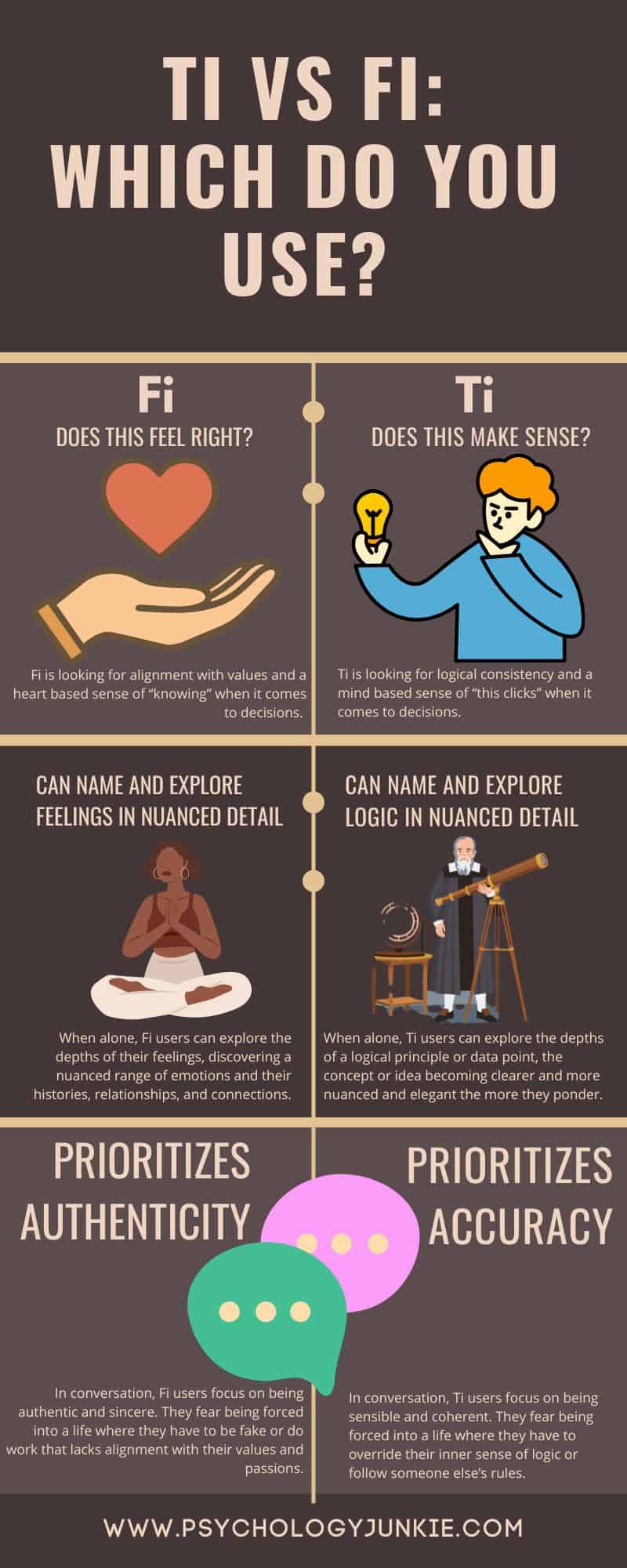
Here is the difference:
Introverted Thinking asks: Does this make sense to me?
Introverted Feeling asks: Does this feel right to me?
That’s it. That’s the axis. Everything else is commentary.
Ti is concerned with internal logical coherence. It wants systems that hold together without contradictions. It is allergic to sloppy reasoning, fuzzy definitions, and conclusions that collapse under scrutiny. A Ti user can be emotionally invested in something, but if it doesn’t make sense internally, they will feel compelled to take it apart, even if it ruins the vibe, the relationship, or Thanksgiving.
Fi is concerned with internal moral and emotional alignment. It wants decisions that preserve integrity, authenticity, and personal truth. A Fi user can understand the logic of an argument perfectly and still reject it if it violates something core inside them. They are not confused or irrational. Instead, they are prioritizing congruence with their values over correctness.
Both functions are private. Both are deeply personal. Both can look stubborn from the outside. And both are often misunderstood because they operate internally and don’t feel the need to justify themselves constantly.
A Ti user feels unsettled when something doesn’t add up. A Fi user feels unsettled when something feels like a subtle betrayal of self. One experiences dissonance as intellectual tension. The other experiences it as emotional or ethical nausea.
Neither is better. Neither is more mature. They are solving different problems.
And if you’re trying to figure out which one you use, the answer is not found in what you admire, what you wish you were better at, or what sounds more flattering. It’s found in what you default to when no one is watching and you’re just trying to get your internal world to stop buzzing long enough to sleep.
Signs You Use Introverted Thinking (Ti)
If Ti is one of your main tools, you naturally organize information into internal frameworks. Loose facts floating around without structure feel vaguely threatening. You’re constantly refining these mental models, adjusting them when new data shows up, sometimes tearing the whole thing down and rebuilding it just to see if it still holds. This doesn’t feel like hard work, it can feel calm and satisfying, like reorganizing a room inside your brain.
Precision matters to you. A lot. And I’m not talking about emotional precision. Conceptual precision. Definitions. Categories. The exact meaning of a word. When someone uses a term that’s close enough, but not quite right, something in you twitches. You might let it go outwardly, but internally you’re already rewriting their sentence and quietly judging the intellectual integrity of the conversation.
You tend to have a technical or mechanical way of thinking, even if you’re not “technical” by profession. You like understanding how things work. Systems. Processes. Mechanisms. You enjoy troubleshooting, isolating variables, and figuring out why something broke. To you, it’s satisfying when the pieces finally click.
You’re skeptical of so-called facts, popular wisdom, and things that are accepted because “everyone knows that.” Consensus does not impress you. Internal consistency does. You would rather trust your own reasoning than outsource your judgment to authority, tradition, statistics, or vibes.
Clarifying Questions for Introverted Thinking (Ti)
- Do you feel internally unsettled when something doesn’t make logical sense, even if everyone else seems fine with it?
- When learning something new, do you immediately start building a mental framework for how it works?
- Do you care deeply about using the right word, not just a close-enough one?
- Do you often catch logical inconsistencies that others miss or dismiss as unimportant?
- When something feels emotionally confusing, do you try to think your way through it rather than sit with the feeling?
- Are you more comfortable dissecting a problem than sitting inside it?
- Do you sometimes realize what you feel only after you’ve already acted on it?
- Does it irritate you when people conflate moral disagreement with logical error?
The Ti Blind Spot: Being Weirdly Bad at Knowing What You Feel
If you’re an Introverted Thinking type, you don’t have strong Fi (Introverted Feeling). You have shadow Fi. Which means your relationship to your own feelings is… murky. Not nonexistent. Just poorly labeled, badly mapped, and often confusing.
You experience emotions, but naming them can feel like trying to identify colors in the dark. You might know you’re upset, but not whether you’re sad, angry, disappointed, ashamed, or some cursed emotional smoothie made of all four. When asked how you feel, your brain might offer something like, “I don’t know. Weird. Off. Bad but not bad-bad.”
This often leads people to think they must not be thinkers after all, because look, there are feelings everywhere. But the issue isn’t whether feelings exist. It’s whether you can easily access, articulate, and orient your life around them internally. For Ti users, that’s hard. Especially when younger.
In teens and twenties, this can look like emotional obliviousness. It feels like genuine confusion. Feelings show up as background noise, physical sensations, or sudden overwhelm with no clear cause. So what do you do? You lean harder into logic, analysis, and problem-solving, because at least those make sense.
This usually improves with age. Not because Fi suddenly becomes strong, but because experience builds a rough emotional map over time. Patterns emerge. You learn, intellectually, what certain feelings tend to signal. But it rarely becomes effortless or instinctual.
If reading this makes you think, wow, I feel called out but also relieved because this explains a lot, that’s a pretty strong Ti tell.
Why Thinking-Perceivers Have Feelings (But Don’t Use Fi)
This is where a lot of smart, self-aware people get tripped up. Especially TPs who have been told, repeatedly, that thinkers don’t have feelings, which is absurd on its face and has probably caused at least one minor existential crisis.
Let’s clear this up.
TPs absolutely have feelings. Having emotions does not make you a Fi user. What matters is how you relate to those emotions and what role they play in decision-making.
If you’re a TP, your connection to feeling is Extraverted Feeling, not Introverted Feeling. That means your emotional awareness is relational and external rather than internal and value-based.
Here’s what that tends to look like in real life.
- You may sense emotional tension in a room before you can name your own internal state.
- You process emotions by talking, explaining, debating, or thinking out loud.
- You may borrow language from others to understand your own emotional experience.
- You may find you can “read” others’ emotions, but you may also lack confidence in your emotional assessment
- You sometimes feel oddly detached from your own inner emotional world.
When a TP says, “I don’t know how I feel,” they usually mean, “I don’t yet have enough external processing to make sense of this.” Once they talk it through, things start to clarify. That’s Fe at work.
Signs You Use Introverted Feeling (Fi)
If Fi is one of your main tools, your inner life isn’t vague or foggy. It’s alive; in fact, if you’re introverted feeling dominant, it feels more alive than anything in the real world. Your feelings don’t just happen to you, they inform you. They tell you when something is off, when something matters, when something is wrong even if no one else sees it yet.
You care deeply about honoring your internal values. Not in a performative “look how good I am” way. In a private, non-negotiable way. When your actions don’t line up with what you believe, it feels like a kind of internal betrayal. And once that feeling sets in, productivity drops to zero. You can’t muscle your way through misalignment.
You often need time alone to process emotions. Your feelings become clearer in solitude. Being around others can actually blur them. Alone, they sharpen, deepen, and settle into something you can name and understand.
You may express your emotions creatively. Writing, art, music, storytelling, symbolism. That’s how your inner world organizes itself. Feelings want a container, a mode of expression, a release. Logic is not that container for you.
Maintaining internal harmony matters more than keeping the peace or staying efficient. You will tolerate tension in the outer world if it means staying true to yourself. You will disappoint people if the alternative is abandoning something you believe in. This isn’t defiance for its own sake. Instead, it’s fidelity.
Some clarifying questions.
- Do you feel a strong need to be emotionally and morally aligned before acting?
- When something feels wrong, do you trust that feeling even if you can’t fully explain it yet?
- Do you process emotions best on your own rather than out loud?
- Is it usually easy for you to name what you’re feeling?
- Do your feelings feel richer, clearer, and more textured in solitude?
- Do you feel compelled to stand up for what you believe is right, even when it costs you relationally?
- Do you feel a strong respect for the integrity of people, animals, or living things, wanting them to be allowed to be themselves?
Why NFPs Can Be Logical and Still Lead With Fi
This is where a lot of people start second-guessing themselves.
NFPs are not allergic to logic. They are not floating through life making decisions based on mood and poetry, especially as they reach mid-life and beyond and have some maturity and life wisdom under their belt. They use Extraverted Thinking alongside their Introverted Feeling. This means they can absolutely evaluate evidence, follow systems, respect data, and change their minds when presented with new information. But they don’t sit around organizing a bunch of data into mental categories, then compare those categories, looking for logical inconsistencies for fun (at least, rarely).
If you’re an FP personality type, you can and do update your worldview when reality contradicts it. You are capable of saying, “I was wrong,” without your entire identity collapsing. You can be pragmatic and organized when something matters to you.
But there are certain values you will not budge on, because violating those values would feel like losing yourself, and losing yourself is anathema to the Introverted Feeling type. Logic may inform how you pursue a value, but it does not get to override it.
A few clarifying distinctions.
- You use logic as a tool, not as your compass.
- Evidence matters, but it does not automatically outrank conscience.
- When forced to choose between being “right” and being true to yourself, you choose the latter.
- Compromising a core value creates emotional distress that doesn’t resolve with rational justification.
If you’ve ever thought, I understand the argument, I just can’t live with it, that’s Fi doing exactly what it’s meant to do.
Which One Actually Runs the Show?
By now, you shouldn’t be thinking, well, sometimes I do this and sometimes I do that. Of course you do. Everyone does. That’s not the question.
The question is what your mind reaches for when you’re tired, uncertain, emotionally activated, or quietly unraveling while doing something mundane like washing dishes or lying awake at night replaying conversations you can’t fix.
So let’s make this uncomfortably simple.
When something important is on the line, what unsettles you more?
- Something not making logical sense, even if it feels emotionally acceptable
or - Something feeling internally wrong, even if you can logically justify it
When you’re stuck, what helps you regain equilibrium?
- Taking something apart, analyzing it, explaining it, refining it
or - Sitting with your feelings until they clarify and settle into something you can trust
When you make a decision you later regret, what was usually violated?
- Internal consistency and sound reasoning
or - Personal values, emotional truth, or self-integrity
Ti users feel relief when things finally make sense.
Fi users feel relief when things finally feel right.
If you’re a Ti user, you don’t feel grounded until the logic holds together. If you’re a Fi user, you don’t feel grounded until your actions line up with your values. One is not colder. The other is not kinder. They are just oriented toward different forms of internal stability.
If you’re still tempted to say, but I use both, here’s the thing: You don’t lead with both. Instead, you compensate with the other.
You lean on the one that feels like home. The one that doesn’t require effort or permission or explanation. The one you return to when everything else is stripped away.
And once you recognize that, a lot of confusion tends to fall away.
Other Articles You Might Enjoy:

Ti vs Te: The Difference Between Extraverted and Introverted Thinking

How You Use Introverted Thinking Based On Its Location in Your Function Stack

What is Introverted Feeling (Fi)?

The Difference Between Extraverted and Introverted Feeling (Fe vs Fi)

10 Signs You Might Be an Introverted Feeling Type
10 Signs That You Might Be an Introverted Thinker
What Do You Think?
Did this article help you find clarity? Are you still struggling? Let me know in the comments!
Find out more about your personality type in our eBooks, Discovering You: Unlocking the Power of Personality Type, The INFJ – Understanding the Mystic, The INTJ – Understanding the Strategist, and The INFP – Understanding the Dreamer.








Susan, this is one of the very best explanations you have ever written. Thank you so much. It helps to clarify
things for me.
I am still a bit puzzled over this: To come to aconclusion, based on what you wrote: P is designated. J is not mentioned. Am I missing something? (INFJ has been my conclusion before. Not INFP.) I like things settled.
Excellent article. It clarified a lot for both myself and my husband. Thank you very much!
Definitely agree. When I was confused several months ago. This is why I booked a session with you in October,because this was my biggest problem plus the emotional part. Identifying your emotion but not a deep feeling. To this day I still remember the INTP versus INFP. Plus the entanglement of emotional awareness with introverted feeling. I still remember that session. Thank you
Oh, this is good. It appeals to my Ti hero function very well. I can’t trust my Fi demon, Not. At. All. I call it “Hulk:Smash” and I let him sleep undisturbed waaay down deep in the basement. When he wakes up, it is because he got a sudden jolt of adrenaline, dopamine, testosterone, or some other messy neurochemical that operates in the moment without any long term stability. He is my lizard brain, in the limbic system, the evolutionarily most primitive part of the mammalian brain structure, and I don’t let other people mess around with him. When other people try to gain access to that function, especially when they have ignored my signals to stay away from it, it is usually because they are trying to use psychological / emotional manipulation tactics to their advantage and my loss. If someone is trying to be emotionally genuine with me, it will take me a very long time to recognize it, if ever. My usual response to emotional chaos is to just shut down. This requires energy that I cannot afford to expend, so there are some types of people who I will just shut out completely. My top tier “personal value” is *accuracy* and the terms that you used to describe Fi “values” just come across to me as random mush. The links to the other related articles are really helpful. Thank You.