
What Each Enneagram Type Thinks Will Finally Make Them Feel Safe (But Doesn’t)
Most of us are walking around with a subtle, persistent belief about safety.
It may not be physical safety. Instead, it may be emotional safety or existential safety. The kind that tells you, If I just get this one thing right, I can finally relax.

So we chase it. We optimize for it. We shape entire lives around it.
And the frustrating part is this: the thing we think will finally make us feel safe almost never does. Because Enneagram types don’t organize themselves around happiness. They organize around avoiding a specific kind of pain. Safety, to each type, means “the pain I fear most can’t touch me anymore.” Which is why the strategies feel so compelling. Logical, even. Until you’re doing the thing you swore would fix everything… and your nervous system is still on high alert.
Let’s start with Type One.
Table of contents
Type One
“If everything is done the right way, I can finally relax.”
Ones tend to believe that safety lives on the other side of correctness. If things are ethical, if people or systems do what they should, if I do what I’m supposed to do. Then maybe, finally, the low-grade tension humming in the background can power down.
For Ones, order feels protective. Moral clarity feels stabilizing. Being beyond reproach feels like armor. There’s often an unspoken belief that if everything is handled properly, life won’t surprise you in the worst way. So they refine, improve, adjust, and self-correct. They replay conversations. They notice what could have been said better, done cleaner, handled with more integrity. Rest becomes something you earn after everything is fixed.
The trouble is that perfection is not a destination. It’s a moving target with very strong opinions. Every time a One reaches a milestone that was supposed to bring relief, the standards rapidly recalibrate. There’s always a better version. A more principled choice. A more disciplined response. I’ve talked to Ones who finally arrived at the job, the reputation, the orderly life they worked so hard for, only to feel more tense than before. Because now there’s more responsibility. More visibility. More ways to get it wrong.
And that’s the part no one really warns Ones about. Doing everything right doesn’t make you feel safe. It often makes you feel exposed. Now you have something to lose. Now the inner critic gets louder, scanning for flaws, inconsistencies, ethical missteps that might invalidate everything. The pressure isn’t just to be good. It’s to stay good, indefinitely.
Underneath all of this is a fear Ones don’t often articulate: if I’m not good, then what protects me? If I fail morally, if I make the wrong call, if I fall short of my own standards, what keeps me from being judged, rejected, or written off? So they grip tighter and try harder. They hold themselves to standards they would never impose on someone they love.
Here’s the painful truth: Safety does not come from flawlessness. It comes from knowing that when you mess up, you won’t be annihilated. Integrity is not the absence of failure. It’s the ability to respond to failure with honesty instead of punishment.
Real safety starts to emerge when a One practices resting before everything is fixed and discovers that the world doesn’t fall apart. When “good enough” stops feeling like a moral failure and starts feeling like reality. When being human is no longer treated as a character flaw.
That’s when Ones start to integrate some 7 (a sign of growth). That’s when their wisdom deepens. They don’t have to wait until the world is finally “perfect,” they just have to let go of the belief that they have be perfect in order to deserve peace.
Type Two
“If I’m needed and loved, I’ll finally feel safe.”
Type Twos often believe safety lives in connection. In being indispensable. In being the one people turn to, rely on, lean on, can’t imagine losing. If I’m loved, if I’m appreciated, if I’m woven tightly enough into other people’s lives, then I won’t be abandoned. I won’t be forgotten. I won’t be alone.
So Twos give. And give. And give again.
They anticipate needs before anyone asks. They remember birthdays, emotional landmines, favorite comfort foods, old wounds people forgot they even mentioned. They show up when it’s inconvenient. They step in when no one else volunteers. There’s a hope underneath it all that says, Surely this will make me safe. Surely this will make me irreplaceable.
And sometimes it works. For a while.
Twos are often deeply loved. At their best, they are warm, generous, attentive, emotionally present. People feel better around them. But the kind of safety Twos are chasing requires something impossible from others: unconditional, constant, failure-proof love. The kind that never wavers, never forgets, never disappoints, never leaves.
Humans cannot provide that. Even the good ones.
This is where the strategy starts to crack. Because the more a Two relies on being needed to feel secure, the more terrifying it becomes to stop giving. Needs get buried. Resentment builds gradually. Exhaustion sets in, but it feels dangerous to admit. If I ask for too much, will they still want me? If I stop being helpful, will I still matter?
I’ve seen Twos reach a point where they’re surrounded by people and still feel completely alone. Because, in their minds, no one is actually loving them. They’re loving the version of them that never needs anything back.
That’s when a real panic creeps in. The subtle sense of being used. The sharp sting when someone doesn’t reciprocate. The confusion of thinking, I’ve done everything right. Why don’t I feel safe yet?
Here’s the tough truth: Love given to earn security will always feel fragile. Because it depends on other people continuing to behave exactly the way you need them to.
Real safety can’t be outsourced.
There’s a line that captures this better than anything I could paraphrase:
“The one and only person who can love us deeply, constantly, and under all circumstances is us. Our own Essence is the source of the love we seek because it is an expression of Divine love and therefore cannot be conditioned, withheld, or diminished. When they learn to nurture themselves and look after their own needs, Twos achieve a balance in which loving and satisfying relationships are not only possible-they will happen as surely as the sun rises.” – Don Richard Riso and Russ Hudson, The Wisdom of the Enneagram
That’s the shift for Type Two. Safety doesn’t come from being indispensable. It comes from being rooted and learning to sit with your own needs without shame. From discovering that you don’t disappear when you stop performing love.
When Twos begin to nurture themselves with the same tenderness they give others, something surprising happens. Their relationships get better, and not because they give more, but because they give honestly. Love stops being a transaction and starts being a choice.
And that’s when safety becomes real. Sure, no one can guarantee that everyone will stay forever, but even if they don’t, you know you will.
Type Three
“If I succeed, I’ll finally feel safe.”
Threes tend to believe safety lives in achievement, momentum, and being impressive enough that no one questions their worth. If I’m successful, admired, respected, visibly competent, then I won’t be dismissed. I won’t be overlooked. I won’t be exposed as insignificant.
So Threes move rapidly, and adapt just as quickly. They read the room. They become whatever version of themselves will work best here. Productive. Polished. Efficient. There’s often a calculation happening in the background: What does success look like in this space, and how do I become it?
For a while, this strategy works almost frighteningly well. Threes are often admired, accomplished, and externally confident. They know how to perform competence. They know how to win. And each win brings a temporary sense of safety, like standing on solid ground after sprinting uphill.
But it never lasts.
Because achievement is a hungry god. The moment you reach one goal, it demands another. There’s always someone doing more, doing better, doing it faster. And beneath the drive is a fear Threes rarely slow down long enough to name: If I stop producing, who am I?
I’ve seen Threes hit milestones that were supposed to change everything. The promotion. The recognition. The moment where people finally say, “You made it.” And instead of relief, there’s a strange hollowness. A blankness in the chest. As if the applause fades and nothing solid is left behind it.
That emptiness is terrifying for a Three. So they do the only thing that’s ever worked. They keep moving. They chase the next metric. They double down on performance, hoping the next win will feel different.
But safety built on external validation is always conditional. It depends on staying impressive, useful, and ahead. And that means rest feels dangerous. Vulnerability feels inefficient. Slowing down feels like slipping off the edge of relevance.
This is the moment where the Three’s real work begins, and it is not glamorous.
Riso and Hudson describe it in The Wisdom of the Enneagram:
“To liberate themselves, Threes must let go of their belief that their value is dependent on the positive regard of others. Only then can they begin to become inner-directed and authentic. This is a difficult path for Threes, although a very direct one. At first, they encounter only the empty, blank feeling in the heart space, but gradually, with patience and compassion, they are able to open to the hurt and shame underneath it. As this suffering is seen, healed, and released, without noticing quite when or how the change occurred, they gradually realize they are quite different people then they had imagined. Free from the burden of dancing to the expectations of others.”
That blankness Threes fear is not a failure. It’s a doorway. Beneath it is grief for all the ways they learned to earn love instead of receive it. Beneath it is the exhausted self who’s been sprinting for approval since early childhood.
Safety doesn’t come when Threes finally prove themselves. It comes when they stop confusing worth with output. When they let themselves be seen without the highlight reel. When success becomes something they do, not something they are.
Type Four
“If I finally understand myself, I’ll feel safe.”
Type Fours often believe safety lives in depth and self-knowledge. In fully understanding their inner world so nothing inside them can surprise, overwhelm, or betray them. If I can name every feeling, trace every wound back to its origin, make meaning out of all of it, then I won’t feel lost. I won’t feel fake. I won’t feel like something essential is missing.
So Fours look inward.
They analyze their moods. They track emotional shifts. They revisit old memories, old heartbreaks, old versions of themselves, searching for the missing piece that will finally make them feel whole. There’s a quiet hope that if they can just understand themselves deeply enough, the ache will settle.
At first, this feels like authenticity. And sometimes it is. Fours are perceptive, emotionally attuned, and unusually honest about their inner lives. They can articulate things others only feel vaguely. But there’s a subtle trap here. Introspection can turn into quicksand.
Because knowing yourself is not the same as being with yourself.
Many Fours end up mistaking emotional intensity for truth and depth for safety. When feelings surge, they dive in. When pain shows up, they assume it must mean something important. Over time, life starts happening almost entirely on the inside, while the external world feels dull, unreachable, or slightly unreal.
I’ve known Fours who could describe their inner emotional world in exquisite detail and still felt ungrounded, detached, and strangely invisible. The more they searched for identity in their emotions, the more elusive it became. Because feelings, by nature, are always moving.
Here’s the hard part for Fours. You cannot think or feel your way into safety.
The belief that “if I just understand myself enough, I’ll be okay” eventually collapses under its own weight. Because there is always another layer. Another interpretation. Another emotion waiting to be unpacked. And instead of relief, there’s often exhaustion, coupled with the fear that if you stop searching, you’ll disappear.
This is where integration changes everything.
For Fours, integrating means embodying some of the grounded presence and steadiness of Type One. Not the rigidity or the self-righteousness of the unhealthy One. The presence. The capacity to stay here and act. To engage with the world as it is, not just how it feels.
Here’s what Enneagram experts Don Richard Riso and Russ Hudson say about this:
“Rather than being drawn into endless introspection and the turbulent stream of their emotional reactions, integrating Fours stay present to themselves and the world around them and thus begin to awaken to the deeper truths of the human heart. As they allow this process to unfold, their true identity reveals itself in every moment of their existence.”
Safety for Fours doesn’t come from fully understanding themselves before engaging with life. It comes from showing up to life and letting identity emerge through lived experience, action, and attention. Through staying present even when emotions fluctuate.
The paradox is this. When Fours stop trying to locate their identity inside their feelings, they begin to feel more real and embodied. Less at the mercy of emotional weather. Their depth doesn’t disappear. Instead, it matures.
And in that grounded presence, something softens. The sense of being fundamentally different loosens its grip. Safety stops being something they search for inside themselves and becomes something they practice by being here, fully, as they are.
You can find out more about integration for the Four here.
Type Five
“If I understand enough, I’ll finally feel safe.”
Fives tend to believe safety lives in knowledge and preparation and active thinking. In having enough information stored away that nothing can catch them off guard. If I know how things work, if I’ve thought it through, if I’ve anticipated every variable, then I won’t be overwhelmed. I won’t be exposed. I won’t be forced into something I’m not ready for.
So Fives observe, read, research, and think. They build quiet inner worlds where everything makes sense and feels manageable. Life feels safer at a distance, filtered through analysis rather than direct experience. There’s comfort in staying one step removed, watching instead of participating.
The problem is that knowledge can start to function like a hiding place.
Many Fives end up believing that if they just gather a little more information, they’ll finally feel ready. Ready to speak. Ready to act. Ready to engage. But the moment of readiness keeps receding. There’s always another book. Another angle. Another piece of data that might make things clearer.
And underneath that endless preparation is a fear Fives don’t always articulate: What if I step in and find out I’m not actually capable?
This is why Fives can feel oddly frozen despite being brilliant. They can see everything, understand everything, and still feel stuck on the sidelines of their own lives. I’ve known Fives who were deeply insightful and yet chronically dissatisfied, sensing that they were watching life instead of living it.
Enneagram experts Don Richard Riso and Russ Hudson explain this well:
“Naturally, Fives face the same dilemma their entire lives: they try to figure out how to live life without actually living it. When they are present and grounded, however, Fives are able to know exactly what they need to know, when they need to know it. The answer to a question arises not from a chattering brain but from a clear mind that is attuned to reality.”
The shift for Fives is not about learning more, as tempting as that might be. It’s about trusting themselves enough to act with what they already know.
Under stress, Fives often veer toward Seven, scattering their energy, distracting themselves with ideas, possibilities, or mental escapes. But growth doesn’t happen there. Integration pulls Fives toward Eight. Toward action, presence, and embodied confidence.
That means doing the uncomfortable thing. Speaking before you feel fully ready. Making a decision without having every answer. Putting your knowledge into motion in the real world and letting reality teach you the rest.
Fives have to accept a humbling truth. They could always gather more information, and it still wouldn’t create safety. Only experience does that. Only stepping forward and discovering, firsthand, that you can handle what comes.
Type Six
“If I can be prepared for every possibility, I’ll finally feel safe.”
Type Sixes tend to believe safety lives in certainty and foresight. In having a plan for the worst-case scenario and a backup plan for the plan. If I can anticipate what might go wrong, identify who to trust, and stay one step ahead of danger, then I won’t be blindsided. I won’t be caught off guard. I won’t fall apart when something unexpected happens.
So Sixes think, scan, ruminate, and double-check. Their minds are constantly running simulations, testing outcomes, searching for threats and reassurances in equal measure. There’s often a feeling of vigilance in the background, like life is a room that might suddenly go dark.
At first, this strategy feels responsible and wise. Sixes are perceptive, loyal, and deeply committed to protecting what matters. But over time, mental preparedness becomes a full-time job. The mind never fully rests. Every decision opens ten new questions. Every sense of relief is temporary, because another potential problem is always waiting its turn.
And here’s the cruel irony: The more Sixes try to think their way into safety, the more unsafe they feel.
Enneagram experts Riso and Hudson point out that for Sixes to find the stability they’re searching for, they have to turn toward something that often feels counterintuitive: their physical presence. Getting grounded in the here and now. Attending to immediate sensory impressions becomes a counterbalance to nonstop thinking and gives the Six something else to identify with besides fear.
Of course, this isn’t easy. When Sixes first slow down and tune into their bodies, it can trigger panic or dread, especially if there’s a history of trauma. The body starts processing old fears that were never fully felt. And in those moments, it’s tempting to interpret every sensation as danger.
But as Riso and Hudson explain, these reactions are often the body doing its work, not evidence of present threat. When Sixes can sense their anxiety without immediately reacting to it, something shifts. They begin to experience fear as information rather than a command. The world starts to feel a little less hostile.
Stress pulls Sixes toward Three, where they try to outrun anxiety by being productive, competent, and impressive. If I stay busy, if I perform well enough, maybe I won’t feel afraid. But that only adds pressure to an already exhausted system.
Integration pulls Sixes toward Nine.
Toward rest, trust, and letting the nervous system settle instead of constantly bracing. When Sixes move toward Nine, they become more emotionally open and receptive. They stop gripping the future and start inhabiting the present. Practices like meditation, deep breathing, visualization, or simply getting enough rest are often necessities during this time.
Grounding in the body matters here too. Walking. Stretching. Feeling feet on the floor. Letting the breath slow. These simple acts remind the Six that they are here, now, and mostly okay. That the danger they feel isn’t always the danger that exists.
Perhaps the most difficult shift for Sixes is learning to trust themselves. To stop outsourcing authority to experts, systems, or external assurances. Sixes’ intuition is sharper than they realize. When they learn to listen inwardly instead of constantly looking outward for certainty, something quiet and steady begins to form.
Safety doesn’t come from eliminating uncertainty. It comes from learning that you can be present with it and survive. And when Sixes discover that, life starts to feel less like a threat to manage and more like something they can meet with courage and trust.
Type Seven
“If I stay happy and free, I’ll finally feel safe.”
Type Sevens often believe safety lives in possibility and options. In keeping life light, interesting, and open enough that nothing painful can trap them. If I stay positive, if I keep moving forward, if I always have something to look forward to, then I won’t get stuck in suffering. I won’t feel limited. I won’t be swallowed by pain.
So Sevens reframe and pivot and try something new. They plan the next adventure while the current one is still happening. They collect ideas, experiences, and future joys like emotional insurance policies. There’s a quiet urgency underneath it all, a sense that lingering too long in discomfort is dangerous.
And in many ways, this strategy looks like joy.
Sevens are imaginative, energetic, and hopeful. They help others see possibilities when everything feels heavy. Their enthusiasm can feel like sunlight in a room. But the belief that happiness equals safety creates a trap. Because it turns pain into something that must be outrun or, worse, buried.
I’ve watched Sevens talk themselves out of grief in real time. They’re brilliant at it. They can find the silver lining before the tear hits the floor. But unresolved pain doesn’t vanish into thin air; it waits. And the faster a Seven moves, the harder it becomes to notice what’s actually chasing them.
Eventually, the constant motion gets exhausting. The mind races. The nervous system never quite settles. There’s a subtle fear that if everything slows down, something unbearable will surface.
Here’s the shift Sevens have to make. Safety doesn’t come from staying happy. It comes from staying present.
There’s a quote by Don Richard Riso and Russ Hudson that captures the heart of healthy Seven energy so well:
“Perhaps Type Seven’s greatest gift is the ability to maintain a positive outlook and sense of abundance. When this outlook is tempered by realism and a willingness to deal with difficult feelings, Sevens are able to generate an infectious enthusiasm for whatever situation is at hand. Far from timid, they live fully and encourage others to do the same.”
That willingness to deal with difficult feelings is the key. Integration for Sevens means moving toward Five. Toward depth. Toward staying with an experience long enough to actually digest it. Not analyzing it endlessly, but allowing it to land and to be truly felt. To be understood without immediately turning it into a story about what’s next.
Instead of scattering energy across a thousand possibilities, integrated Sevens learn to commit and focus. They learn to let boredom, sadness, or frustration exist without panicking. When they stop fleeing discomfort, they discover something surprising. The feelings they feared aren’t infinite. They pass. And on the other side of them is a calmer, steadier, more meaningful joy. Their enthusiasm becomes contagious not because it avoids pain, but because it includes it. They’re no longer chasing happiness. They’re inhabiting their lives.
Type Eight
“If I stay strong and in control, I’ll finally feel safe.”
Type Eights often believe safety lives in power and self-reliance. In making sure no one can corner them, dominate them, or take advantage of their vulnerability. If I’m strong enough, decisive enough, intimidating enough if necessary, then I won’t be hurt. I won’t be controlled. I won’t be at anyone’s mercy.
So Eights take charge.
They move toward conflict instead of away from it. They say what others won’t. They protect themselves and the people they love with ferocity. There’s an instinctive belief that softness is dangerous and hesitation invites harm. Better to strike first and to stay armored. Better to be the one holding the line.
And for a long time, this works. Eights often are safe in the ways that matter most on the surface. They’re hard to bully, manipulate, or overpower. They know how to survive.
But survival is not the same thing as safety.
Underneath the toughness is a nervous system that learned early on that the world could not be trusted to be gentle. That showing vulnerability invited pain. That dependence was a liability. So Eights shut the door on tenderness, even with themselves.
The cost shows up subtly, in exhaustion, loneliness, and a sense that intimacy always comes with a power struggle. If I let my guard down, will I lose myself? If I show vulnerability, will someone take advantage of it?
The belief that control equals safety starts to collapse when Eights realize something painful: No amount of strength can prevent loss. No amount of dominance can guarantee that people won’t leave, disappoint you, or hurt you unintentionally. And the harder you grip, the more isolated you become.
Integration for Eights moves toward Two. Toward connection and letting care flow both directions instead of only outward as protection. This doesn’t mean becoming passive or self-sacrificing. It means allowing yourself to be impacted. Letting someone see the fear or grief underneath the anger without immediately turning it into action.
This is terrifying work for an Eight. Because the moment you do this, the old fear surfaces. The fear of being powerless. But what Eights discover, slowly and often against their will, is that vulnerability does not erase strength. Instead, it deepens it and makes it more meaningful.
When Eights let themselves be cared for, safety stops being something they have to enforce. Relationships stop feeling like battlegrounds and power turns into presence. Leadership becomes protection without domination.
The paradox is this: The moment Eights stop trying to control everything, they feel safer than they ever did when they were armored. And I get it, the world didn’t suddenly become harmless. But they trust themselves to stay open and strong at the same time.
Type Nine
“If everything stays calm and connected, I’ll finally feel safe.”
Type Nines tend to believe safety lives in harmony. In keeping the peace and making sure no one is upset, no one is alienated, and no conflict grows sharp enough to threaten connection. If things stay smooth, if tensions stay low, if everyone feels comfortable, then I won’t be pushed away. I won’t be overlooked. I won’t be forced to choose sides.
So Nines numb themselves. They minimize their preferences. They adapt. They say “I’m fine” and mean it, until they don’t. There’s a subtle habit of merging with others’ agendas, others’ priorities, others’ emotional weather. It feels safer to disappear slightly than to risk friction.
On the surface, this creates peace. Nines are easy to be around. They’re accepting and grounding. They have a way of making space feel less charged. But the kind of calm Nines are chasing comes at a cost. Because peace that requires self-erasure is extremely fragile.
Over time, many Nines begin to feel oddly distant from their own lives. Days blur together. Desires feel vague. There’s a low hum of inertia, paired with a subtle fear that asserting themselves might rupture everything. If I speak up, will I lose connection? If I claim space, will I be too much?
The belief that harmony equals safety slowly collapses when Nines realize something painful. Avoiding conflict doesn’t prevent disconnection. It just turns it inward.
Riso and Hudson describe healthy Nines in a way that challenges this pattern:
“In healthy Nines, differences of opinion, conflicts, and tensions are permitted and even valued.”
“They often have the ability to arrive at a new synthesis that resolves the contradiction or conflict at another level.”
In other words, true harmony isn’t the absence of tension. It’s the ability to stay present when tension arises.
Growth for Nines involves something that feels almost radical to them. Recognizing their own essential value. Not as a supporting character. Not as “nobody special.” But as someone worth their own time and energy.
As Riso and Hudson put it, Nines become actualized by learning to see their value much like healthy Threes do. By developing themselves, investing in their potential, and putting themselves into the world instead of orbiting around it. Letting others know what they have to offer, even if it creates ripples.
This doesn’t turn Nines into aggressive or self-centered people. It makes them awake, engaged, and alive. When Nines stop numbing themselves to stay comfortable, their natural wisdom becomes active instead of dormant. Their ability to synthesize perspectives becomes powerful instead of passive.
Safety, for Nines, doesn’t come from keeping everything calm. It comes from trusting that relationships can survive honesty. That conflict doesn’t automatically lead to loss. That their presence matters enough to take up space.
What Do You Think?
Have you dealt with these particular fears, fixations, and growth patterns? Do you have insights or wisdom to share with others of your Enneagram type? Let us know in the comments!
Find out more about your personality type in our eBooks, Discovering You: Unlocking the Power of Personality Type, The INFJ – Understanding the Mystic, and The INFP – Understanding the Dreamer. You can also connect with me via Facebook, Instagram, or Twitter!
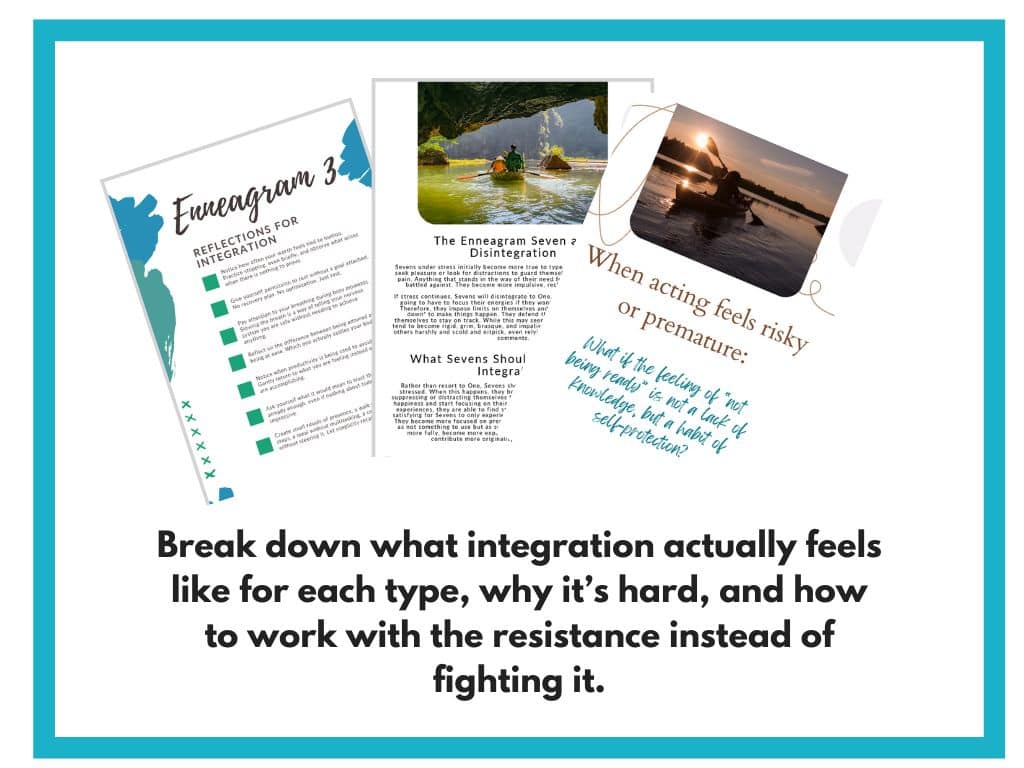
Integration is often described in abstract terms, or buried inside dense theory that’s hard to apply when you’re actually anxious, defensive, or stuck in old patterns. This 27-page Enneagram integration pamphlet is designed to be different. It’s short on purpose. Clear on purpose. Something you can return to when growth feels uncomfortable rather than inspirational.
Inside, you’ll find reflective prompts and gentle guidance for each Enneagram type that help you notice when your usual coping strategies are running the show, and what integration actually asks of you in those moments. Think of it as a way to create real safety instead of relying on habits that once protected you but now limit you.
Because most of us don’t resist growth because we don’t want it.
We resist it because it threatens what has helped us survive.
This booklet helps you recognize that resistance with compassion and clarity. It’s written to be a helping hand on the journey. You can read it on your phone or computer, or print it and keep it nearby as a reference. Get yours and help support the work Psychology Junkie is doing here.







Excellent article! These types of clear and insightful summaries are very helpful as a writer, for building deep a deep understanding not only of characters but the real-world psychology they draw on.