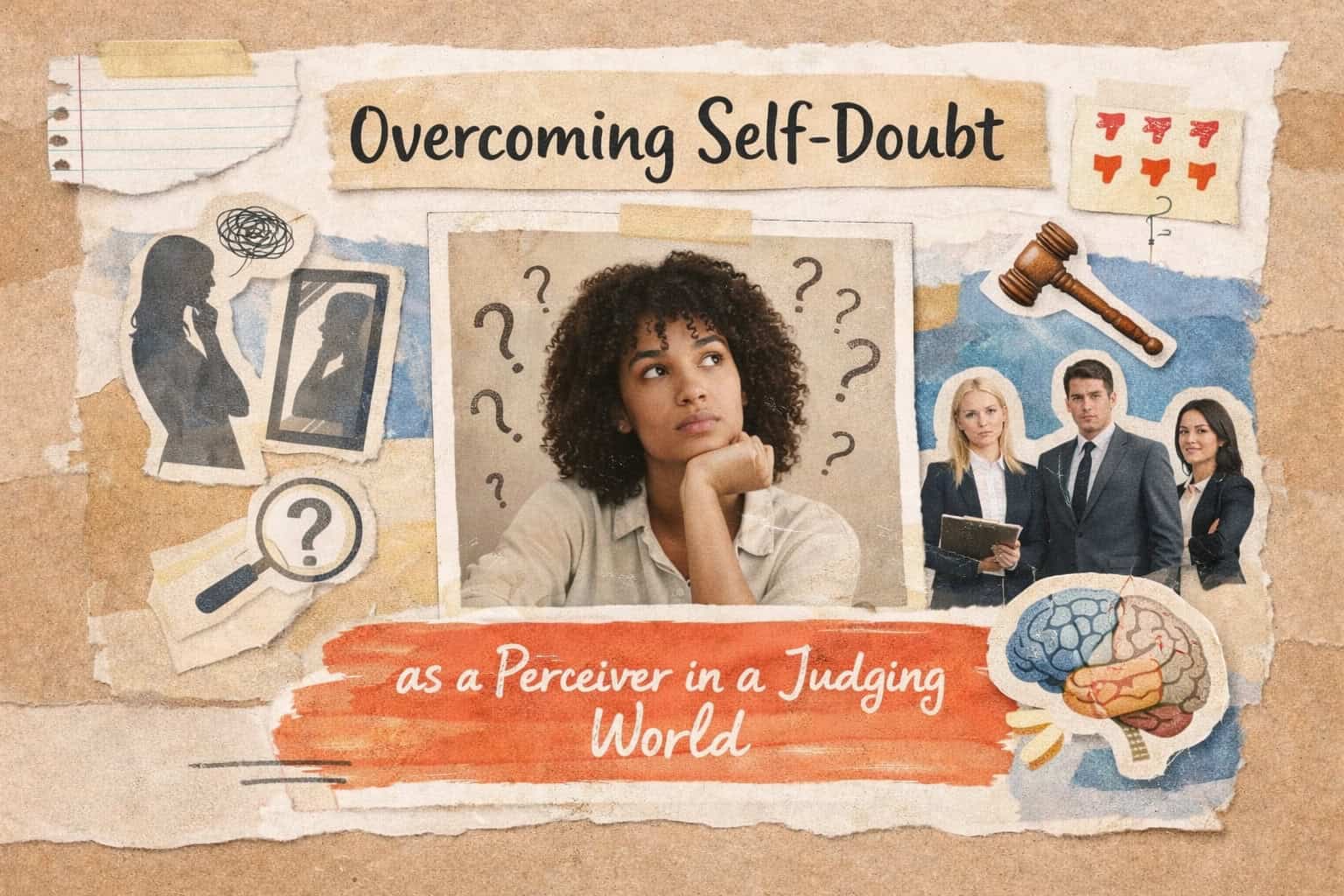
Overcoming Self-Doubt as a Perceiver in a Judging World
If you’re a Perceiver you probably relate to the feeling that you wake up every day in a world that wants you to be a spreadsheet.
Western culture is essentially a giant machine built by and for people with an ESTJ mindset. They like rules, tradition, and they absolutely adore a five-year plan. You, on the other hand, are a Perceiver. You probably have fourteen browser tabs open in your brain at any given moment. It can be exhausting, but it’s also part of what makes you you.
The weight of trying to fit into a Judging world breeds a very specific kind of misery. Sylvia Plath, a fellow Perceiver, nailed it when she said, “The worst enemy to creativity is self-doubt.” And many Perceivers struggle with self-doubt because the world constantly tells you your natural way of existing is incorrect. You’re told to pick a lane. You prefer to drive off the road entirely just to see where the dirt path goes.
Leo Burnett once noted, “Curiosity about life in all of its aspects, I think, is still the secret of great creative people.” But curiosity rarely gets rewarded in a system that values compliance and rigid timelines. You are sometimes left feeling fundamentally broken.
Not sure what your personality type is? Take our personality questionnaire here. Or you can take the official MBTI® here.
The Agony of the Unplanned Life
Perceivers are chronically misunderstood. You do not want to settle on one path. You want to experiment with multiple paths until you find the one that feels least like a prison. You hesitate when it comes to commitments because choosing one thing feels like murdering a dozen other possibilities.
You learn through trial and error. You learn by poking the bear. If you’re a Sensing Perceiver, you probably need to touch the hot stove just to make sure it’s actually hot. You also question everything: the status quo, the rulebook, and all the traditions everyone else seems content to accept. If you’re a Thinking Perceiver, you’ll keep pointing out logical flaws until everyone in the room wants you exiled. If you’re a Feeling Perceiver, you’ll highlight ethical hypocrisies or the soul-crushing obsession with the bottom line at the expense of the human experience.
Your mental ecosystem craves a chaotic blend of work, play, exploration, rabbit trails, and physical movement to produce anything of value. Julia Cameron said it best: “Serious art is born from serious play.” Yet you’re punished for playing.
My ESTP husband spent his entire childhood being reprimanded because he could not sit still at a desk. His energy was treated like a moral failing. Strangely enough (at least to most Judging types), he calculated equations and memorized facts far better when he was allowed to pace the room and burn off that kinetic energy. My ENFP daughter faces the exact same uphill battle. Give her speed drills and rote memorization, and her brain shuts down completely. Let her write stories, draw her answers, and turn in creative projects, and she performs brilliantly.
The Patron Saint of Tired Perceivers
If you need proof that a chaotic, improvisational Perceiver can survive, look at Walt Disney. He was a classic ENFP who was basically robbed of his childhood. At nine years old, he woke up at 3:30 in the morning to deliver newspapers for his father in the freezing winter. Sometimes he just curled up inside a sack of newspapers to sleep. His father was a cold, harsh man with a volcanic temper who took all the money Walt earned.
Disney grew up with massive trauma and a deep familiarity with failure. He eventually started his own animation company, Laugh-O-Gram Studio. It completely tanked. He ended up sleeping on his office floor, showering at the train station, and eating cold beans out of a tin can. He was utterly crushed by the bankruptcy.
He felt like a profound disappointment to everyone who believed in him. But instead of getting a normal job, he dragged his tired, self-doubting self to Hollywood. He faced rejection after rejection. Finally, on his third attempt, a distributor bought his Alice comedies. He and his brother built the Disney Brothers Studio, and you know the rest of the story.
Disney achieved extraordinary success because he refused to stop experimenting. As Oscar Wilde, an ENFP who understood the assignment, said, “You can’t use up creativity. The more you use, the more you have.”
7 Ways to Outsmart Your Own Self-Doubt
You are going to doubt yourself. You are human, and your brain is wired to protect you from the humiliation of failing in public. But you cannot let that fear dictate your life. Here is how you survive and thrive as a Perceiver in a world that wants you to be normal.
1. Follow your chaotic heart
The journey to doing anything worthwhile is already terrible enough. It is infinitely worse when you force yourself down a path that makes you want to crawl under a rug and expire. Disney ignored everyone who told him animation was a dead-end gimmick. Trust your gut. Pursue the strange goals that actually match your natural inclinations. Quit the things that drain your will to live.
2. Learn to tolerate failure
You do everything you can to avoid failure because failure is embarrassing. But behind every successful person is a mountain of absolute garbage they had to wade through. Forgive yourself for messing up. Use the disaster as a stepping stone. Andy Warhol, an ISFP who fully embraced the weirdness of existence, advised, “Don’t think about making art, just get it done. Let everyone else decide if it’s good or bad, whether they love it or hate it. While they are deciding, make even more art.” Michael Jordan, a rumored ISTP, said “I can accept failure. Everyone fails at something. But I can’t accept not trying.”
3. Take small but consistent steps
Trying to do everything at once is a fantastic way to end up eating cereal out of a mug at 3 a.m. while doomscrolling. If your brain resists grand plans, start insultingly small. Pick a bite-sized goal and do it even if it feels laughable. Stack another one tomorrow. You’ll be surprised how quickly you can build actual momentum this way, one low-stakes step at a time, until you accidentally trick yourself into making real progress.
4. Hoard knowledge endlessly
Confidence and competence are locked in a codependent relationship. The more you know about your weird little niche, the better you get at it. The better you get, the less you doubt yourself. Read books, study films, fall down Wikipedia rabbit holes at 3 AM. Use your Perceiver superpower of obsessive curiosity to build a foundation so solid that your self-doubt has nothing to stand on.
5. Embrace pure self-delusion
You have to be a little bit delusional to try anything new. To achieve something that has never been done, you must believe in a reality that currently does not exist. People will call you crazy right up until the moment you succeed, at which point they will claim they believed in you the whole time. Rita Mae Brown said, “I think the reward for conformity is that everyone likes you except yourself.” Choose self-delusion over conforming to a miserable reality.
6. Doubt your own doubts
Your doubts are loud, annoying, and usually completely fabricated. They are just fear wearing a trench coat, trying to keep you safe from potential loss. The irony is that by avoiding the attempt, you guarantee the loss. Give your inner critic a ridiculous name. Write a letter to it. Ask yourself what would happen if the exact opposite of your fear were true. If you are going to be skeptical about anything, be intensely skeptical of your own insecurities.
7. Train your courage daily
Courage is not a personality trait. It is a muscle that, for some, resembles a wet noodle because it’s never used. You build confidence in tiny, agonizing increments. Do the thing that makes you slightly nauseous today. Then do it again tomorrow. Every single time you take action while your brain is screaming at you to stop, you dilute the power of your fear. Put your hand over your tired heart, take a deep breath, and just do the terrifying thing anyway.
Want to Discover More About Yourself?

If you want to dig even deeper into the puzzle of why you think and act the way you do, or if you’re hungry for an instruction manual on how to thrive as your authentic self, check out my eBook: Discovering You: Unlocking the Power of Personality Type.
Inside you’ll find:
- An in-depth exploration of all 16 personality types, so you can finally put words to the patterns and quirks that make you, well, you.
- Straightforward strategies for reaching a “Flow State” and unlocking your best creative energy.
- Insight into how every type, including yours, reacts to stress, grief, relationships, and major life transitions.
- Guidance on understanding children of each type, plus advice on type dynamics in marriage and parenting (go ahead, save your own sanity).
- Tips for communication and goal-setting tailored to each personality type—because shouting into the void is overrated.
Plus, real-world advice for surviving—maybe even enjoying—your own mind, and a crash course in cultivating stronger, more authentic connections with literally anyone.
But don’t just take my word for it. Here’s what readers have said:
“Discovering You is chock full of life lessons I can apply to my life right away. I learned to understand myself, my family, and my children in ways that will impact my life for years and years. Thank you Susan Storm!”
— Linda Rolegan
“Thank you for the amazing tips you keep putting out there. Your writing literally saved my relationship with my daughter.”
— Terri Bruner
Discovering You is over 300 pages long, packed with 53 chapters of insights, practical tips, and hard-won wisdom, because understanding yourself shouldn’t feel like deciphering an ancient curse.
If you’re ready to better understand your own mind, communicate more effectively with the people you love, and maybe even lose the urge to apologize for existing, you’ll find something in these pages that resonates. Your story is worth understanding. Maybe now’s the time.






It’s nice to encounter articles like this. When it comes to making plans, I always thought I was weird because some things didn’t match “tradition.“
I am an INTP. I could not agree more with this article and here is one of my recent biggest no guts no glory plans.
I have a congenital neuro-endocrine disorder. With hormonal implants, it’s generally stable. However, between 2024-2025, 4 neurological emergencies and ER doctors refusing to test anything relevant to the hypothalamic pituitary adrenal access.
So I decided to give a rare disease center permission to remove the hormonal implant by writing a consent form. Including how insufficient neuroendocrine data complicates things even for other doctors. My neurologist accepted it and gave all this with the referral to the Center.
It was a big plan where I did take small steps. It’s the only way to investigate because there are two options. Either end up having an emergency at the center where they check the blood using the right kinds of tests.
Or, not ask anybody to check anything and within a few years die from central nervous system endocrine failure. Those are my 2 options. Despite how risky removing the hormonal implant is, it’s worth finding out what’s going on. And my plan comes to life on 24 March as that’s my arrival date at the Center.
And if something does happen, there’s a difference between not trying anything and then dying, versus die trying. I’m all for it.
I’m an ENFP. In high school I had an English teacher that occasionally gave us a choice of assignments, research paper, book report, or short story. I didn’t have to think twice. Writing stories wasn’t even work for me. It was fun!!! I always got an A on each one, too.