The Myers-Briggs® Personality Type of Lee Jun-Young
South Korean actor Lee Jun-Young brings massive amounts of talent, charisma, and versatility to the world of K-Drama, dance, and music. I was excited to take on the job of profiling him, but the more I tried to research him, the more contrasts I found along the way.
On one hand, you’ve got someone who describes himself as extremely shy. Someone who says he struggles to confess his feelings, keeps emotions private, and avoids causing trouble.
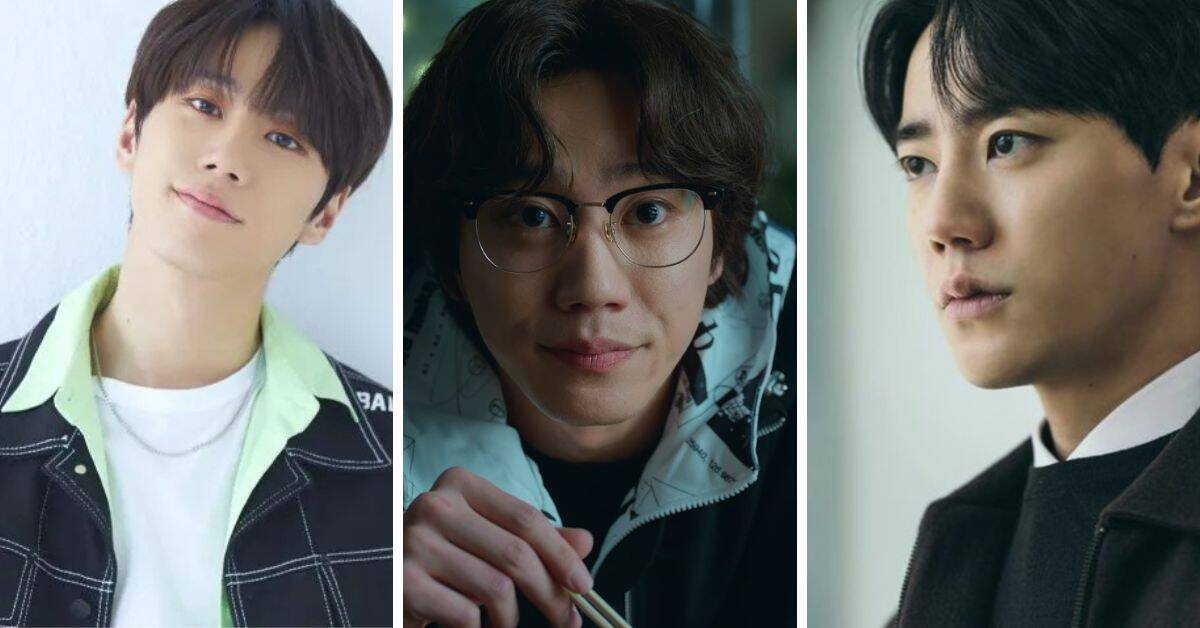
There’s a version of him—the off-camera version—who struggles to make eye contact when meeting someone new. Who says “Hello”…and then stops talking. Who overthinks even a simple question like, “Did you eat?” and spirals into, Wait…what if they already did? What do I say then?
When faced with appearing on a variety show he said, “I was terrified and had no confidence in myself. I don’t even have that many stories to tell.”
On the other hand…this is a man who throws himself into intense fight choreography, trains in multiple martial arts, dances with precision and flow, and willingly steps into psychologically dark roles that demand raw emotional control.
Soft-spoken. Physically fearless. Emotionally contained. Expressive, but not in the way you’d expect.
So what personality type does that actually point to?
Let’s talk about it.
First, a Reality Check About Typing Real People
Before we go too far, we need to be honest about something.
Typing celebrities is…guesswork.
We’re working with interviews, curated public appearances, quotes, and hearsay. That’s a lot of filters.
Lee Jun-young himself has reportedly taken the MBTI multiple times and received INFP and INTJ as results.
That alone tells you something:
- Either the tests are inconsistent (very common)
- Or he relates to multiple descriptions (also common)
- Or the questions themselves are…not great (very, very common)
A lot of online MBTI® tests have a noticeable intuitive bias. They reward abstract answers, philosophical wording, or self-perception as “deep” or “future-focused.” If you’re introspective at all, it’s easy to get pushed toward INFP, INFJ, or INTJ.
I know this. I’ve been trained as a certified MBTI® practitioner for over ten years and I once had an ESTJ, several ISFPs, ISFJs, and even ISTPs take the 16 personalities online questionnaire and they all got INFJ or INTJ.
So take everything here with a grain of salt: including my conclusion. I did the best I could with the information given, but I have not interviewed Lee Jun-young personally and nobody is a better expert on him than himself.
The Case for ISFP (Fi–Se–Ni–Te)
If you strip away labels and just look at how he operates, a pattern emerges.
And that pattern looks a lot like ISFP.
Let’s break it down.
1. A Private Emotional World (Introverted Feeling)
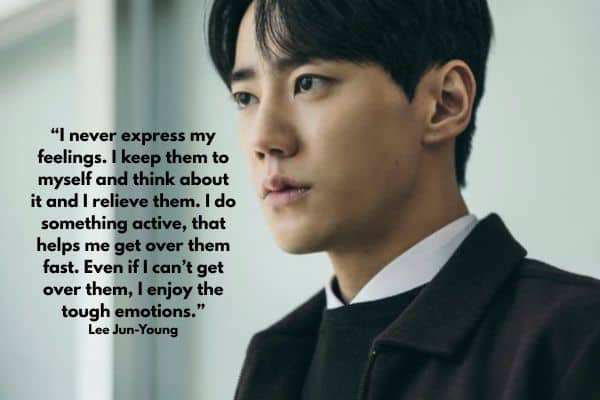
One thing I noticed very quickly is that Jun-young is very private about his feelings, but does seem to feel deeply.
“I never express my feelings. I keep them to myself and think about it.” – Lee Jun-Young
In many interviews he said outright that he:
- Keeps his feelings to himself
- Processes them internally
- Doesn’t express them outwardly
- Even enjoys intense or difficult emotions
- Thinks a lot and even weeps a lot at night
Jun-young said, “even if I can’t get over them, I enjoy the tough emotions.” Many Introverted Feeling types enjoy exploring and contemplating their darker emotions and looking for the meaning behind them. They don’t feel a pressure to lift the mood on their own, instead seeking to understand rather than change their feelings.
Introverted Feeling (Fi) is less about dramatic expression and more about:
- Deep personal experience
- Quiet emotional processing
- Selective vulnerability
- Strong internal values
You see it in how he handles praise, too.
When he followed a drunk driver to prevent an accident—a situation most people would at least accept acknowledgment for—he declined the award because it didn’t “feel right.”
“There are a lot of other people who are more exemplary and brave… I didn’t like that it became public.” – Lee Jun-young
Even compliments make him uncomfortable. When his manager said something poetic about his future “The sun is so bright, just like your future”, he immediately asked him not to say things like that. He said it made him feel so uncomfortable.
Many times Introverted Feeling types feel awkward with overt displays of emotion or recognition. They are more subtle, with their emotions showing up in their actions and creative pursuits more than in their conversations with others.
Introverted Feeling types like to keep their feelings close to the chest. They may look very private, cautious, and selective on the outside because their inner world is their most prized treasure. They don’t just share their emotions and their opinions haphazardly, it has to be with the right person.
To the Introverted Feeling type, doing what you feel is right and staying true to yourself is key; but not in a loud, flashy way, in a controlled, private way that is sometimes aided by self-expressive creativity like art, performance, or even storytelling.
2. The Body as a Language (Extraverted Sensing)
Now here’s where things get interesting, because thanks to online stereotypes, if you only looked at his shyness, you might assume INFP.
But then you look at how he responds to the world in a physical way. Here are some important things to note about Jun-young:
- He’s a trained dancer (hip-hop, popping)
- He has mastered multiple martial arts disciplines
- He wanted to be a street dancer as a child
- He wants to perform his own stunts
- He describes dance as flow and momentum
- He has mentioned processing emotions through physical activity
This, to me, doesn’t showcase the abstract exploration of Extraverted Intuition (what INFPs use) or dominant Introverted Intuition (what INTJs use). Instead, he frequently showcases a oneness with the physical world, a happiness when dancing (he has said that that’s when he feels the most himself), and a willingness to take physical risks and explore the extent to which he can master physical movement.
Extraverted Sensing (Se) is about:
- Being present in the moment
- Responding to real-time stimuli
- Expressing through the body
- Engaging directly with the physical world
And Jun-young doesn’t just “dabble” in this, he lives there.
“I never express my feelings. I keep them to myself and think about it and I relieve them. I do something active, that helps me get over them fast.”
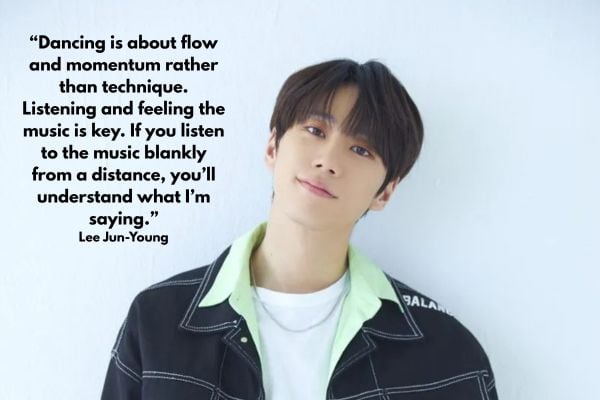
“Dancing is about flow and momentum rather than technique. Listening and feeling the music is key. If you listen to the music blankly from a distance, you’ll understand what I’m saying.”
3. Why This Looks Like Se (Not Ne)
This is where people often get tripped up.
They see:
- Artistic expression
- Emotional depth
- Sensitivity
And immediately think INFP → Ne (Extraverted Intuition).
But ISFP’s also have these same three characteristics. They just balance that with physical immersion, oneness with their environment, and a more grounded, down-to-earth outlook.
Ne (in INFPs) is:
- Abstract idea-driven (looking for theoretical implications and meanings)
- Imagination-oriented
- Verbally exploratory
- Tangential, scattered, imaginative in a conceptual way
Lee Jun-young doesn’t present that way. He’s not bouncing between ideas or theorizing out loud. He’s not speaking in “what ifs.”
Instead, he:
- Grounds himself in movement
- Describes experience physically
- Uses action to process emotion
- Focuses on execution rather than ideation, brainstorming, and hypothetical scenarios
That’s Se. It’s not hypothetical or focused on the conceptual. Instead, it’s immediate, physical, and real.
Even the way he processes emotion points here:
“I do something active… that helps me get over them (feelings) fast.”
He doesn’t talk it out or brainstorm solutions. Instead, he moves physically, and this is where it’s important to draw a line, because a lot of people will still assume Ne (Extraverted Intuition).
But Ne doesn’t look like this. Ne explores theoretical possibilities, generates ideas, jumps between concepts, and talks things out.
He doesn’t.
He actually struggles in environments that require that kind of output. He once said when he was anxious about appearing on a variety show, “I don’t even have that many stories to tell.” Instead of expanding outward into ideas and made-up stories (the world of Ne), he narrows into experience.
You even see it in small, almost throwaway details, like how he eats ramen: “I don’t add toppings. I stick to the original.” It might be subtle, but it’s telling.
Ne asks, “What else could this be?”
or, “What would happen if I changed this or tried it a new way?”
Se says, “This is already enough. Experience it fully.”
Lee Jun-young seems to consistently choose the second.
4. Quiet Vision, Not Loud Strategy (Tertiary Ni)
Jun-young seems to have a sense of where he wants his future to go and enjoys creative exploration to balance his sensitive, action-oriented style.
This could be pointing to tertiary Introverted Intuition (Ni) that shows up in ISFPs. This is the childlike side of the ISFP: It shows up in moments of playfulness or vulnerability. It gives INFPs an interest in the abstract, symbolic, or mythical, but it’s not their main source of flow or energy.
More like a background guide:
- A sense of direction without needing to explain it
- Choosing roles that carry psychological weight
- Gradually reshaping his image over time
He doesn’t talk much about long-term plans or grand visions. But you can feel that something is guiding him underneath it all.
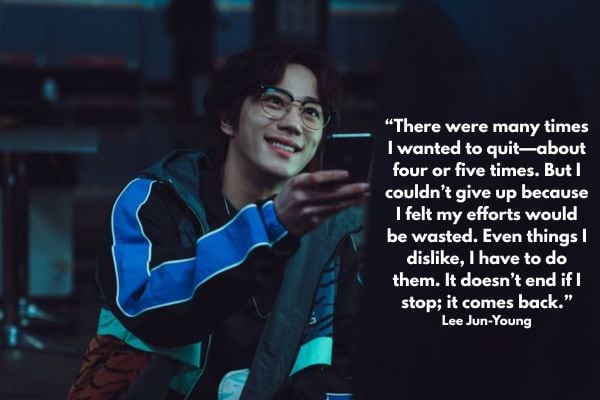
“Even things I dislike, I have to do them… It doesn’t end if I stop; it comes back.”
He also likes to try risky roles, like his role as a Submissive in a BDSM relationship in Love & Leashes. Or his roles playing villainous characters like Geum Song-je in Weak Hero: Class 2. He likes to explore psychological complexity and isn’t afraid to take risks in order to trailblaze new paths.
You see that same thread in his career. He didn’t stay in the safe lane. He didn’t lean into the polished, predictable idol image.
Instead, he gravitated toward roles that are uncomfortable, intense, and psychologically heavy.
Characters built on:
- suppressed emotion
- internal conflict
- controlled volatility
That’s someone following an internal pull toward depth, even if he doesn’t articulate it in abstract terms.
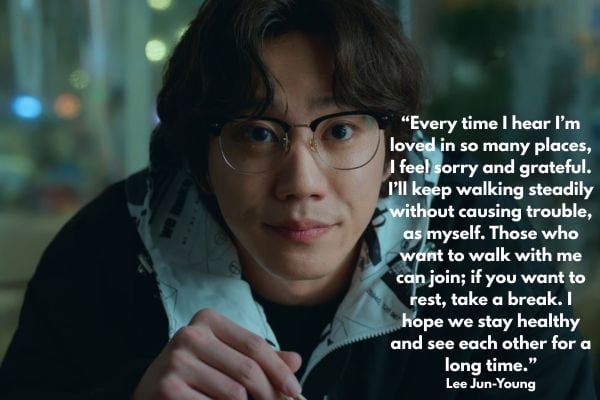
And when he talks about his future, he says “I’ll keep walking steadily without causing trouble, as myself. Those who want to walk with me can join; if you want to rest, take a break.”
5. Discipline Without Identity (Inferior Te)
Jun-young is clearly disciplined, but he’s not commanding, blunt, or detached from his feelings. In fact, in a live stream with Weak Hero 2 co-star Park Ji-hoon, Jun-young asked Ji-hoon to take the lead of the stream. Ji-hoon responded with, “But this is your stream!”
ISFPs tend to seek out others to do the Extraverted Thinking for them, or to help them find more balance with it.
He talks about hard work in terms of:
- Obligation
- Endurance
- Doing what must be done
But he relies on his managers for strategy, leadership, and the logistical aspects of performing. Extraverted Thinking inferior types often do this.
There’s a shyness and self-depracating style to Jun-young, a hesitance to be commanding.
When his manager suggested arriving late somewhere to make a dramatic, “cool” entrance, he shut it down immediately.
“That’s literally what I hate the most.”
6. The Paradox That Defines Him
Here’s what makes him compelling:
He’s emotionally intense, but externally restrained.
He’s shy, but physically fearless.
He avoids attention, but commands presence on stage and screen.
That combination is very ISFP. They don’t perform emotions the way some types do, instead, they channel them into movement, action, and controlled expression.
7. The Complexity With His Image
If you only knew Lee Jun-young through his roles, you’d probably get the wrong idea.
You’d see:
- the intensity
- the controlled anger
- the quiet unpredictability
And assume that’s who he is, but off-screen, the picture changes.
This is someone who:
- struggles with eye contact when meeting new people
- overthinks simple conversations
- prefers to listen rather than lead
- feels uncomfortable being the center of attention
He’s even described by people around him as someone who, at first, barely spoke, just sat quietly, staring ahead, saying the minimum.
When his friend and fellow co-star in Avengers Social Club, Kim Jeong-hye, heard he was going to be on a variety show she worried, saying, “What is he going to say? He just listens to music in the car. I couldn’t think of anything else. What is he going to do? When we first met, I was sitting next to him, and seriously, Jun-young wouldn’t look me in the eyes. Just stared straight ahead and said “Hello.” Didn’t say anything else. I’m shy too, but he’s worse than me.”
There’s a softness to Jun-young, and a kind of gentleness that doesn’t always show up in his roles. He’s said to be sweet with children, close with his manager to the point of feeling like family, and someone who cooks with his dad.
Not exactly the image of the cold, intimidating characters he plays. And that gap matters because it shows something important:
What you see in a role is often what someone has learned to channel, not what they naturally express.
In his case, acting seems to give him access to parts of himself that are harder to access in everyday life, which brings us back to one of his most revealing lines:
“From the moment they yell ‘Action!’… I can legally do anything within the agreed limits.”
Acting and dancing give him permission to break out of his more self-contained shell and express, move, and feel outwardly instead of keeping it all inside.
In real life, he contains himself. On screen, he releases carefully, precisely, within boundaries, and that contrast is part of what makes him so compelling to watch.
Lee Jun-young Quotes:
“I had my first fan meeting last year in Korea. I got emotional. Unless there’s an event or something, it’s not easy to meet my fans. It made me think it was a good decision to endure in this field. Thank you!”
“My classmates would ask me to dance sometimes. Just in front of the classroom. I did hip-hop and poppin’”
“Since I’ve played a lot of evil characters. People tend to recognize me as the character I played.”
“I can’t confess my feelings. I’m a huge introvert.”
“When working as an idol, sometimes there are rumors such as “Hey, someone from this group is interested in you.’ But I’ve never heard any of that. Never happened to me. So I thought everything was a lie. But people said I looked very intense back then. I’ve heard that I look scary because my eyes are intense.”
“I never express my feelings. I keep them to myself and think about it and I relieve them. I do something active, that helps me get over them fast. Even if I can’t get over them, I enjoy the tough emotions.
When asked, “What is your ideal confession?” he said, “I’d make it clear. “I like you. Will you go out with me?” That’s what I’d say.”
“I never get jealous. I hate causing trouble. “Why aren’t you doing that for me?” I’m not like that. I just wait for my turn.”
“I’m extremely shy.”
“Somehow, from the moment they yell “Action!” it becomes a situation where I can legally do anything within the agreed upon limits. Once I realized that, it became a bit more comfortable.”
“The experience of driving a go-kart around Shibuya still remains vivid in my memory.”
“Dancing is about flow and momentum rather than technique. Listening and feeling the music is key. If you listen to the music blankly from a distance, you’ll understand what I’m saying.”
“There were many times I wanted to quit—about four or five times. But I couldn’t give up because I felt my efforts would be wasted. Even things I dislike, I have to do them. It doesn’t end if I stop; it comes back.”
“Every time I hear I’m loved in so many places, I feel sorry and grateful. I’ll keep walking steadily without causing trouble, as myself. Those who want to walk with me can join; if you want to rest, take a break. I hope we stay healthy and see each other for a long time.”
“I’m very considerate. Like Ju Ah in the drama, I tend to completely adjust to my partner,”
FAQ
What personality type is Lee Jun-young?
Based on his behavior, communication style, and patterns over time, he most closely resembles an ISFP (Introverted Feeling, Extraverted Sensing). However, this is an interpretation, not a confirmed type.
Didn’t he test as INFP and INTJ?
Yes. He’s reportedly received both results on MBTI tests.
This is very common. Many online tests:
- Use vague or biased questions
- Favor intuitive responses
- Reflect mood or work/role styles rather than consistent personality patterns
So test results alone aren’t always reliable.
Why not INFP?
INFPs use Extraverted Intuition (Ne), which tends to show up as:
- Idea exploration
- Verbal brainstorming
- A love for posing “What if?” or hypothetical scenarios
- A focus on the abstract or imagined over the real
Lee Jun-young shows much stronger signs of Extraverted Sensing (Se):
- Physical expression
- Real-time responsiveness
- Movement-based processing
- Focus on his deeper feelings (Fi) or physical experimentation (dancing, martial arts, experiences, music)
Why not INTJ?
INTJs typically lead with:
- Strategic thinking
- An interest in the abstract over the real
- Systems and structure
INTJs are more out of touch with the physical world, sensory enjoyment and responsiveness.
Jun-young doesn’t present that way. His approach is more:
- Present-focused
- Experience-driven
- Action-oriented
- Emotionally grounded but private
Can we know his real type for sure?
No, not unless he was really profiled by someone who knows more about the MBTI® than administering the (flawed) questionnaire. What we’re looking at here is a deeper layer of type; his cognitive functions and personality preferences as observed through dozens of interviews, variety shows, and public appearances.
His private self could differ in important ways.
Why focus so much on dancing and physicality?
Because it’s one of the clearest indicators of Se (Extraverted Sensing). Yes, intuitives can also enjoy dancing and physical movement, but in conversation they will often drift the dialogue towards something abstract (deeper abstract meanings and patterns over literal experiences).
The way he describes dance—flow, momentum, feeling the music—points to:
- Embodied awareness
- Sensory immersion
- Real-time expression
That’s a strong argument for Se over Ne.
Sources:
https://news.laodong.vn/giai-tri/park-bo-gum-tiet-lo-ve-tinh-cach-cua-lee-jun-young-1497431.ldo
JunYoung Ended Live – An Introvert’s Move
Seohyun and Jun-React to Love and Leashes