How INFJs Feel About Politics
Politics hits INFJs differently than most people. Where some types can debate for sport or scroll through headlines like they’re checking the weather, INFJs tend to absorb politics the way they absorb everything else: emotionally, intuitively, and with a running moral commentary playing in the background. They don’t just look at what a policy does, they look at who it affects, how it impacts the vulnerable, and whether it aligns with their inner sense of “this is how humans should treat each other.”
I’ve had so many amazing conversations with INFJs of all political persuasions throughout this surveying process, and one thing I’ve seen again and again is that they care about human impact. The left-wing INFJs I know care about immigrants, low-income individuals, and the human impacts of cuts to programs like USAID. The right-wing INFJs I’ve spoken to have been concerned about fraud, misinformation (although both sides care about this), and the plight of the unborn. While I lean more left, this whole survey has been eye-opening for me in learning how much the two sides really have in common (when they aren’t extremists). Many people feel torn between parties; agreeing with certain policies on one side and certain policies on another. At the same time, they worry they are being misinformed, or struggle to communicate with others they believe are being misinformed.
Another thing that showed up again and again was that underneath all their strong feelings and principled stands, INFJs are also scared. Not necessarily scared of one party or another — but scared of polarization, scared of misinformation, scared of what happens when empathy gets drowned out by noise.
This article isn’t about who’s right or wrong, or which political side “makes the most sense.” It’s about understanding one personality type’s patterns: how INFJs tend to see politics, where their values pull them, and why the current climate feels so heavy on their hearts.
Not sure what your personality type is? Take our personality questionnaire here. Or you can take the official MBTI® here.
The INFJ Political Identity
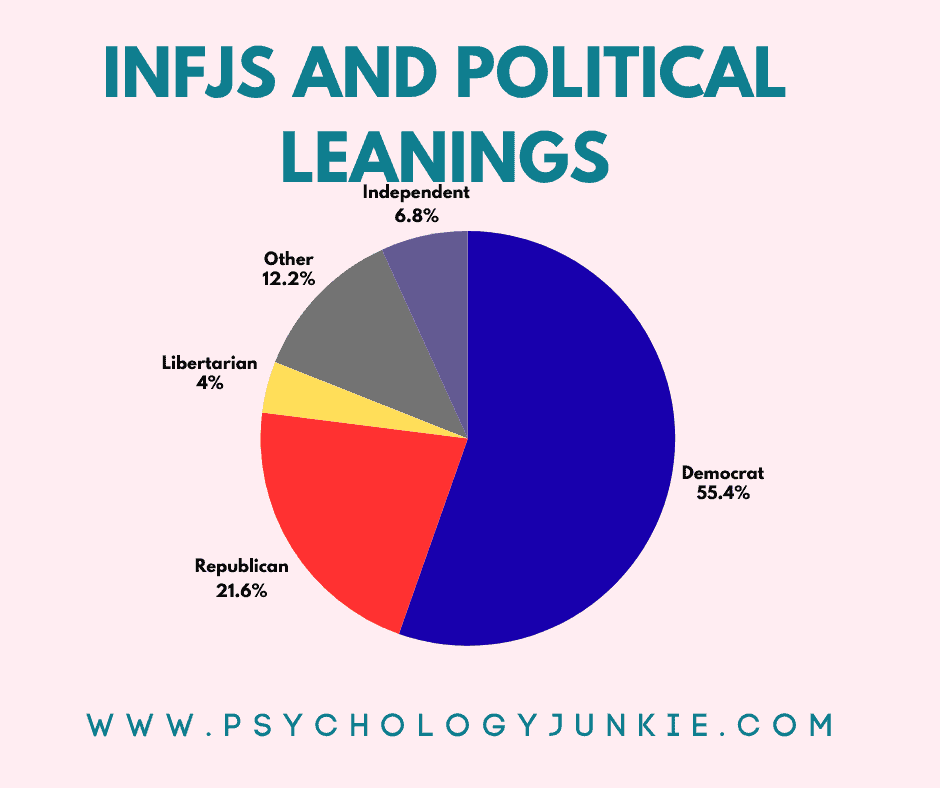
INFJs in this survey leaned more Democratic than many other groups in the survey, but it wasn’t a blind lean.
- 55.41% identified as Democrat
- 21.62% Republican
- 12.2% Other
- 6.8% Independent
- 4% Libertarian
Even with that tilt, 91.67% said they can see and acknowledge their own party’s mistakes. Morality for them isn’t team-based. If something feels unethical, they’ll call it out, even if it’s coming from “their side.”
INFJs pick what feels closest to their values, and then they keep adjusting, reevaluating, and stress-drinking tea about the whole thing (at least, that’s what I imagine).
Low Trust in Institutions — and High Sensitivity to Dishonesty
INFJs rated their trust in the federal government very low:
- 48.65% chose the lowest possible trust rating (a 1)
- 32.43% rated a 2
- 13.51% landed on a 3
That’s over 80% sitting in distrust territory.
INFJs are sensitive to inconsistencies, manipulation, and moral gray areas. When systems feel unclear or dishonest, INFJs have a hard time shrugging it off.
Many INFJs shared that politics has become emotionally overwhelming:
“I often feel total despair about what is happening to our country.”
- Some said they avoid the news for their mental health.
- Some feel despair about polarization.
- Some worry about rising hostility between groups.
- Others spoke about trauma from political conflict within their families.
“National problems feel too huge and hopeless sometimes. I am not apathetic, but I am more protective of my emotional balance than I have ever had to be.”
The Fear of Being Misunderstood or Targeted
A striking 79.45% of INFJs said they feel like they have to hide their political beliefs to avoid judgment or harsh treatment. This wasn’t connected to one party or another — INFJs across the political spectrum said the same thing. Several Republicans feared religious persecution because of what happened with Charlie Kirk. Several Democrats I spoke to feared unjust persecution of immigrants and migrants in their communities who are looking for a safe haven.
They don’t fear disagreement. They fear being attacked, mischaracterized, or treated like the worst caricature of whatever someone thinks their beliefs represent.
“My own personal political beliefs don’t really fit into the 2 camps. … As an independent thinker who doesn’t blindly believe either side, I feel like both parties hate my guts!”
“I feel like an outsider.”
A Deep Longing for Ethical Leadership
INFJs don’t necessarily need leaders who match their exact views. They want leaders who show integrity, empathy, and a clear dedication to human well-being.
“I’m not hopeful for our future or proud of our country currently.”
“I feel afraid of the direction of this country and the extreme hatred that I see and encounter.”
So many INFJs in the survey said they feel disillusioned but still want to believe change is possible. Politics, for them, isn’t about winning. It’s about protecting people — all people — and trying to move society in a direction that feels humane.
Core Political Values and Beliefs
INFJs approach politics like a moral ecosystem: every issue connects to a person, every decision ripples outward, every choice affects someone’s dignity or safety. I think this is a great example of their dominant Introverted Intuition (Ni) at work. Ni is always looking at the patterns. Not just what’s happening now, but how it will show up 5 or 10 years from now. That shows up very clearly in the data.
Social Issues & Equality: The Heart of INFJ Politics
If there is one through-line in INFJ political identity, it’s this: they care about human rights. A lot.
- 72% said the U.S. needs to do a lot more to ensure equal rights across racial and ethnic groups.
- 61.65% want immigration policy to be more open, not less.
- 88.89% believe religion and government should stay completely separate.
One INFJ put it this way:
“It isn’t about party. It’s about rights, respect and dignity for everyone and not letting some win at the expense of others.”
Another shared:
“Our country should have government-backed healthcare for all… Government is meant for the people.”
INFJs are deeply attuned to suffering. When they see inequality, they want to do something about it. Yet many feel helpless or unsure about what to do. The political landscape seems so immense, and many INFJs feel their efforts are insignificant in comparison.
Economics and Corporate Power: A Skeptical Eye
INFJs tend to be idealists, not capital crusaders. And the numbers reflect that:
- 83.78% believe corporations make too much profit.
- 73.61% think taxes on the wealthy should increase (though several noted it should depend on nuance).
- 22.67% listed healthcare as their #1 issue when choosing a candidate — the most commonly chosen top priority.
Science, Climate, and the Environment
INFJs tend to think long-term. They’re scanning the horizon for future consequences while the rest of the internet argues about the latest headline. So it’s no shock that environmental and scientific issues matter deeply to them.
- 76.71% believe climate change is real.
- 69.86% want stronger environmental regulations.
- 79.17% oppose drilling in the Alaska Wildlife Refuge.
- 82.19% believe AI needs stronger regulation.
Their concern is less about politics and more about responsibility — stewardship, sustainability, protecting future generations.
“I see both greatness and chaos coming from our newest technology.”
Another took it even more existential:
“AI has already escaped… Countermeasures are needed.”
INFJs are definitely keeping a watchful eye on AI and are concerned with the far-reaching implications for the economy, safety, and human integrity.
Public Safety and Harm Reduction
INFJs aren’t authoritarian, and they aren’t anti-authority — they’re anti-harm. Their political stances reflect that.
- 82.43% want stronger penalties for distracted driving.
- 69.86% want more restrictions around gun ownership (with very nuanced reasoning on all sides).
Here are three INFJs with completely different views who all make empathetic points:
“Without change in gun culture, changes in legislation won’t make any real difference.”
“If gun control has more restrictions, then more guns would be street-purchased.”
INFJs don’t all agree on the method, but they agree on the mission: fewer tragedies, fewer people hurt, fewer families devastated.
Education, Information, and the Search for Truth
If there is anything INFJs despise, it’s misinformation.
- 67.61% say it’s hard to know what’s true or false in today’s climate.
- 46.48% say they feel like they can’t trust the news.
INFJs want truth delivered responsibly, not sensationalized or weaponized. Many said they rely on fact-checking, careful research, and cross-referencing before forming opinions.
“Skepticism is healthy, hearing other perspectives is healthy.”
“It takes research and fact checking these days!”
CRT was also deeply nuanced for INFJs:
- 39.73% said it should be taught.
- 32.88% said it shouldn’t.
- 19.18% were unsure.
One INFJ said:
“CRT is quite complicated for high schoolers… The politicized definition is watered down.”
How INFJs Engage With Politics

INFJs don’t enter political conversations casually. They enter with a full emotional and ethical backpack of research, intuition, fear, hope, and “please don’t make this a fight.”
Research Before Reaction
Unlike types who trust instinct and go, INFJs pause.
- 70.42% said they research before trusting their instincts.
- 80.28% try to see where the opposing party is coming from.
One INFJ said:
“It takes extensive research. More people are becoming aware of the agendas at play.”
Another:
“There are universal truths I use as my guide: compassion, honesty, helping others.”
A Strong Desire for Understanding (Even When It Hurts)
INFJs desperately want civil dialogue… even though the idea of political debate gives many of them stomach cramps.
- 91.67% believe opposing sides should communicate more openly.
- 80.28% believe they’d understand the other side better if they sat down and talked to them.
But INFJs also know how hard that can be. They’ve seen political debates turn into personal attacks, and that’s a nightmare for them. INFJs are anathema to conflict. A gentle, patient dialogue between two people who truly want to understand is welcomed. A debate built on the foundation of “winning” seems pointless to them.
- 45.07% of INFJs said debate is “important but challenging.”
- 26.76% said “extremely stressful.”
- Only 2.82% called it “invigorating.”
This is (again) quintessential INFJ. They believe debate matters. They believe ideas should be questioned. But the emotional temperature of modern debate feels dangerous to them — like walking into a room where someone is about to throw a chair.
One INFJ said:
“Few things make me this anxious.”
Another:
“It depends on the maturity level of the debatees.”
And another:
“As long as we’re looking for mutual truths, it’s absolutely invigorating.”
How INFJs Feel About the Current Administration
If you want to understand INFJs and politics, here’s the simplest way to put it:
they don’t react to leaders with team loyalty — they react with moral evaluation.
And when it comes to the current administration, the INFJs in this survey felt a lot. Not all the same things, but definitely a lot.
The data shows a clear pattern of concern, distrust, and emotional intensity, but it’s not a monolith. INFJs gave some pretty diverse and nuanced responses.
Let’s start with the numbers:
- 50% rated the administration’s performance as “way below average.”
- 12.50% rated it “far above average.”
- 9.72% rated it “above average.”
- 5.56% said “below average.”
- 5.56% rated it “average.”
So yes — there’s a dominant lean toward dissatisfaction, but there’s also a not-insignificant group who see strengths where others see failings.
- 69.01% believe the administration provokes animosity and disorder.
- 14.08% believe it is skilled at diplomacy and peace-making.
- 49.30% believe it is completely dishonest.
- 42.25% say it is “a little honest and a little dishonest.”
- 2.82% believe it is completely honest.
INFJs don’t mince words when they’re upset — and the quotes reflect it:
“Reasonably skilled when it comes to foreign diplomacy. Annoyingly antagonistic at home.”
“The absolute worst, a true danger to this country. I’m more afraid each day.”
“Above average. In some areas, he is doing well. In other areas, not so much.”
“It has the appearance of a chaos agent… disrupting the status quo in order to change a stagnant situation.”
“We NEED to be kind. Blessed are the peacemakers!”
As you can see, INFJs aren’t carbon copies of each other. What they do share is intensity. Leadership feels personal to them. They feel the moral tone of a nation like a pressure system in the atmosphere, even when it doesn’t directly affect their daily lives. Many INFJs expressed fear about the overall direction of the country, regardless of party:
“I try to remain hopeful for the future, but am growing more fearful that our country is headed toward becoming the next cautionary tale in history.”
Another wrote:
“I believe the government needs an overhaul… We need leaders who are articulate, tactful, and respectable.”
And some brought it down to the simplest possible truth:
“My political beliefs don’t fit either camp. I feel like both parties hate my guts.”
INFJs aren’t just evaluating the administration itself; they’re evaluating the climate surrounding it. The polarization. The rhetoric. The breakdown in dialogue. The way “Civil War” keeps coming up in conversation. Their distress isn’t rooted in “my team is losing.” It’s rooted in “this doesn’t feel humane or healthy, and I can see where this could all ripple out in a few years.”
INFJs don’t expect perfection from leaders.
They expect sincerity.
Integrity.
Kindness.
Clarity.
A commitment to the well-being of people who can’t fight for themselves.
And according to the survey?
They’re worried.
They’re divided.
They’re conflicted.
But they’re paying very, very close attention.
Emotional Undercurrents: What Politics Feels Like to INFJs
For many INFJs, politics feels really overwhelming. They want to find unity and connection between people, but politics seems to throw fire right in the middle of all of it. Who someone votes for can say so much about what they care about and who they feel should be included or excluded. At the same time, thanks to misinformation and social media algorithms, they know that their friend or family member on the other side may have some of the very same values as them, but be influenced by media that is framing policies and candidates in wildly different terms than what they know.
Hope, Worry, and That Heavy Sense of Responsibility
INFJs care about people they’ll never meet. They care about issues that will never show up in their own lives. They care about fairness, compassion, and consequences — even when those consequences are miles removed from their own circumstances.
“We all have to be willing to actually listen and try to understand each other. Are there people on both sides who are really and truly selfish, arrogant, and beyond reason? Absolutely. But I think in general we would find that we all want many of the same things and just disagree on how to get there. If we are willing to stop and listen and actually look to see where each other’s hearts are at, I think we could have better debates, empathy, and ultimately, results! Admittedly, that’s way easier said than done. But we have to try, right?
INFJs sit at the intersection of hope and dread. They can imagine the world as it could be, and feel the weight of the world as it currently is.
I’ve spoken to INFJs who vote red and blue, who are pro-choice and pro-life, who think climate change is real or a hoax. One thing they all share is empathy and a desire to make the world a better place. They may read different news, hear different sides to the story, and take on different perspectives, but they all seem to genuinely care.
“Skepticism is healthy, hearing other perspectives is healthy. News should be info-focused, not opinion-focused.” – An INFJ survey respondent
The Cost of Constant Conflict
Many INFJs said the political climate creates a tremendous amount of stress, fear, and uncertainty.
“I’m tired of both parties alienating the other side and villianizing the other side. And what’s frustrating also is how when one party takes a stance on an issue, the other party takes the exact opposite stance even if it goes against all reason and logic. They can’t compromise and there is no sense to any of it. They make everything black and white and right and wrong even when it’s clear that there is more nuance and they’re exaggerating and ignoring things.”
INFJs aren’t built for the daily outrage cycle. They’re not wired for shouting matches, viral anger, or “destroying” someone in a debate. They want conversations that lead somewhere better, gentler, more humane.
So when the national tone becomes combative, accusatory, or dismissive, INFJs can feel like they’re drowning in discord.
This is why so many INFJs are pulling away from the news or the debates. An INFJ I know from my homeschool group says she allows herself to read the news once per week and that’s it. She calls her representatives over causes that matter to her and speaks out in protests if she feels it aligns with her values. But she’s not going to focus on it every day because she knows that it will undermine her ability to stay present, joyful, and in tune with her children.
“I hope something happens soon before stuff gets real bad. Like more Charlie Kirk scenarios.. pretty soon we will be persecuted for religion, or whatever the case may be. People need to have actual conversations again.” – INFJ survey respondent
But the Hope Never Fully Dies
Even in their distress, INFJs don’t fully check out. They still believe in understanding. They still believe in communication. They still believe humanity can pull itself together if it really tries.
One INFJ captured that paradox perfectly:
“We all have to be willing to listen and try to understand each other… it’s hard, but we have to try.”
Even in their fear, INFJs still reach for unity. Even in their sadness, they still want compassion. Even in their exhaustion, they still imagine a kinder world.
Conclusion: What INFJs Teach Us About Politics
If there’s one thing this survey makes unmistakably clear, it’s that INFJs don’t approach politics casually. They approach it with conscience. With care. With that quiet, stubborn belief that people matter and that what we do to each other matters even more.
INFJs also don’t fit neatly into political boxes because their choices aren’t based on party lines, they’re based on values, ethics, empathy, and long-term consequences. Sometimes that aligns with one side. Sometimes the other. Sometimes neither. And sometimes (a lot of times) it leaves them feeling like the lone lighthouse keeper watching a very confused ocean.
But through all the fear, frustration, exhaustion, and hope, one thing about INFJs never seems to change:
They want a world where people can talk to each other again.
A world where dignity isn’t up for debate.
A world where compassion isn’t treated like weakness.
A world where humanity comes before team colors.
And in a political climate fueled by division, hostility, and noise, INFJs remind us of something simple and rare:
It doesn’t have to be this way. We can choose empathy. We can choose understanding. We can choose to listen.
And if we can’t do it for politics, maybe we can at least try to do it for each other.








Susan
I think this was a very good article. You did a very INFJ job of trying to be fair to all sides (showing respect and valuing all individuals), and not shying away from the real issues. You did a very faithful job of both trying to encourage dialogue and acknowledging the difficulties in doing so. I always feel connected to what you write about us.
If I added one thing from the more conservative side, you mentioned fraud and the unborn as chief concerns. True enough.
But among the many conservatives I know (well into the hundreds and even thousands because of my work), the two areas that are much higher are
1) the belief that a government cannot right all wrongs or guarantee everyone is blessed (financially, health-wise, educationally, etc.) and trying to do so is a fools’ errand that can only lead to the dissolution of the country because it will both bankrupt it and cause more and more people to not depend on themselves and their families properly;
2) the sense that nature and nature’s God have communicated to us that there are absolute truths and the attempt to dethrone them leads to anarchy, division, and the collapse of meaningful social structures. I’m not talking about being unkind to people who are different (that would be very non-INFJ). I am talking about actively promoting homosexuality and trans-rights at the expense of nature and nature’s God’s sense of normalcy and health.
Thanks for your work and happy Thanksgiving. May you and your five children be blessed in every regard.
John Morrison
Ft Worth
I have never felt more understood than in this article. It’s such a relief after losing friends, including my closest, simply from trying to engage in healthy, respectful conversation about this extremely sensitive topic. Thank you for all of the work that went into this, and the validation so rarely received, yet so desperately needed. And thank you for bringing us together, at a time when forces are doing everything to tear us apart.
Hi Susan, I cried as this resonated with me strongly. Thank you for writing such a balanced post. It summed up the fear I carry for the future of Australian politics too, and how tricky it currently can feel to keep communicating and discussing politics with friends and family. But as much as I want to ignore it, I just can’t. I feel somehow compelled to keep speaking up for more human and inclusive alternatives to combat the misinformation and deliberate confusion I see lurking like a distant menacing thunderstorm for our future.
Have any of you looked up the Epstein Files and Trump lately? Though I guess to some INFJs, that isn’t real, lol.