How INTPs Feel About Politics
After many years of being asked by readers to survey the personality types and their views on politics, I finally was able to put together a survey. With over 3000 responses, I now feel ready to dive deep into the political preferences of each of the 16 Myers-Briggs types. So today we’re going to dive into the INTP “Prodigies.”
Ready to begin?

Of the INTPs who took the survey, one theme showed up again and again:
“I don’t fit neatly into any political party, thanks.”
INTPs tend to approach politics like a puzzle with half the pieces missing and the other half mislabeled. They want nuance. They want evidence. They want to understand the moving parts before deciding if the machine even works. So instead of slapping on a party label, most INTPs sort through issues one by one. They mix. They match. They rearrange. And sometimes they look at the whole system and think, “There has to be a better way to do this.”
What follows isn’t a list of “shoulds.” I’m not trying to create partisan wars here. It’s just a snapshot of the patterns that showed up when these INTPs talked about how they actually think about politics, messy parts and all.
Not sure what your personality type is? Take our personality questionnaire here. Or you can take the official MBTI® here.
Overall Political Identity
Not Big on Political Boxes
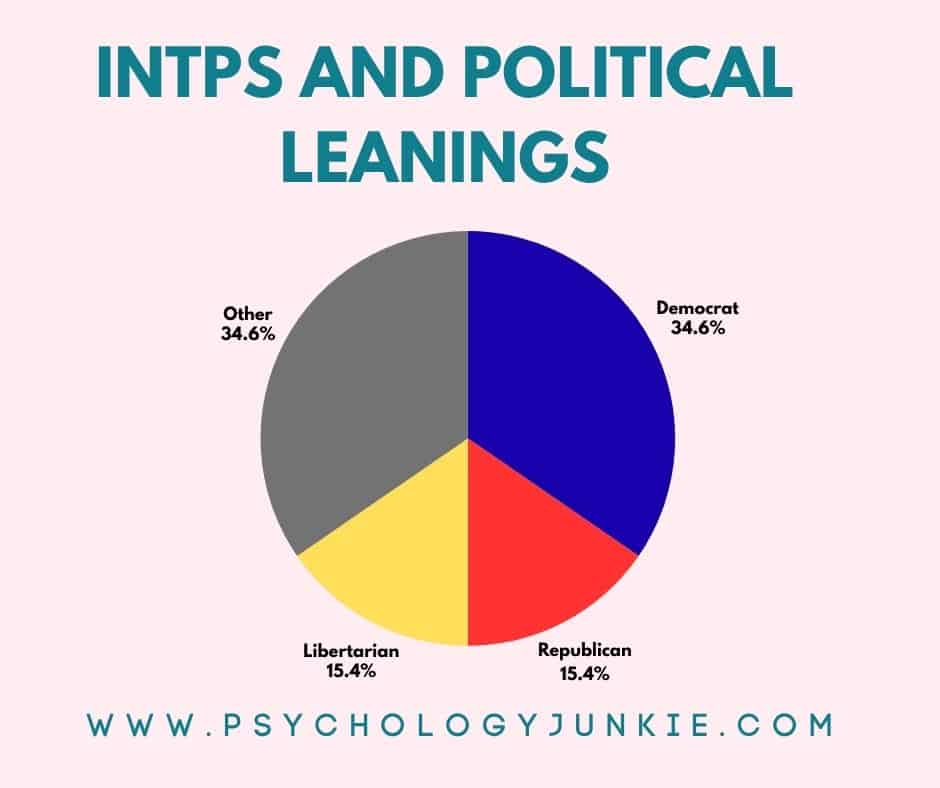
A large portion of INTPs said none of the existing political parties really fit them. Not even a little. This checks out if you’ve ever met an INTP. They don’t love labels unless they’re extremely precise and ideally come with footnotes. Politics rarely offers that.
“Quit the party system, go have dinner with each other, have drinks, as you are working for the people, not a Party. Every congressman or senator represents all Americans’ equality; the people who elected you are equal.” – INTP survey respondent
INTPs tend to build their viewpoints like a quilt where every patchwork is connected:
A square of economic theory here, a patch of social philosophy there, a corner stolen from watching a documentary at 2 AM. The result is something that doesn’t line up with left or right so much as “INTP-shaped.”
Trust… But Mostly Verify
When it comes to trusting big institutions, INTPs are basically the friend who nods politely while googling everything you say. They rated their trust in the federal government on the lower side, and their trust in major news sources wasn’t much higher.
When asked how much they trust the federal government to act in the public’s interest, here’s how it shook out:
- 36.62% gave the government the lowest score possible (1)
- 34.62% gave it a 2
- Only 26.92% went with a middle-of-the-road 3
If a headline feels exaggerated? They cross-check it.
If a politician sounds too confident? They raise an eyebrow.
If someone says “everyone knows…”? The INTP immediately does not know and now must investigate.
Big Fans of Actual Conversation
Even with all the skepticism, INTPs still believe in talking things out. They genuinely want political conversations to work. They want people to listen to each other. They want nuance. They want logic. (They would also like fewer people yelling, but that’s another story.)
Out of the INTPs surveyed:
73.08% said they’d stay friends with someone from the opposing political party
88.46% said political groups should communicate more to understand each other
80.77% said they pause their instinctual reactions and research before forming a political opinion
INTPs don’t mind disagreement. They mind when disagreement turns into a cage match where everybody forgets the original point and just throws chairs because someone’s uncle once said something on Facebook.
Core Political Tendencies of INTPs
INTPs don’t vote like a bloc. They vote like a committee of small, overcaffeinated philosophers arguing inside one brain. But even with all that internal debate, the survey revealed some clear patterns in what INTPs tend to value politically.
Let’s break it down.
Social and Cultural Views: Fairness Over Group Identity
If you look at the data, INTPs generally lean toward social openness.
A few highlights:
- 77.78% said America’s openness to people from all over the world makes the nation stronger.
- 74.07% want religion and government kept entirely separate.
- On immigration:
- 51.85% want a more open immigration system.
- 33.33% think the current level is fine.
- Only 14.81% prefer tighter restrictions.
Equality also matters to INTPs:
- 55.56% said the U.S. still needs to do “a lot” to ensure equal rights across racial and ethnic backgrounds.
- 25.93% said “a little”.
- Just 18.52% said “nothing at all.”
Government & Policy Views: Issue-by-Issue, Always
INTPs approach government size the same way they approach grocery store checkout lanes: they don’t care which one they use, as long as it works efficiently and doesn’t make them question the meaning of life.
When asked about government size:
- 55.56% said they’d choose a larger government with more services
- 44.44% said smaller government with fewer services
Certain other patterns emerged:
- 73.08% want increased funding for healthcare for low-income individuals (Medicaid).
- 84.62% want limits on how much money a candidate can receive from donors.
- 61.54% believe the wealthy should pay more in taxes (with some nuance, like “depends on how ‘rich’ is defined”).
When picking a candidate, here’s what mattered most:
- Economy: 29.63%
- Healthcare: 18.52%
- Education: 11.11%
These are the structural issues—the ones that affect everything else.
INTPs like systems. And they want systems that don’t crash every five minutes like Windows 95.
Scientific & Technological Views: The “Let’s Not Blow Up the Future” Category
This was one of the most unified areas for INTPs.
On climate:
- 69.23% say climate change is real.
- 61.54% support increased environmental regulations.
- 72% oppose drilling in the Alaska Wildlife Refuge.
“I lean conservative on social and political issues but wish our conservative representatives would show more concern for environmental issues – not necessarily climate change but mass-production of plastics without adequate recycling options, invasive plant species and endangered animal species and habitats.” – INTP survey respondent
On AI:
- 76% want stronger AI regulation.
- 76.92% say they’re genuinely concerned about AI’s impact on society.
INTPs are future-thinkers. Their brains enjoy toying with simulations. They often sense long term patterns before other types have even finished reading the headline. So when it comes to environmental or technological risks, they tend to err on the side of caution.
Civic Engagement & Dialogue: Hopeful Realists (Who Carry a Spare Set of Facts)
INTPs want political conversations to be better. Less yelling. More thinking. Less “gotcha.” More curiosity. They want respect, nuance, and people actually listening instead of waiting for their turn to be outraged. You can feel this in in quotes like:
“I try to navigate the social political climate with nuance. I wish I could have more conversations with people about these things without inciting panic of identity and defensiveness.”
“Lack of empathy is killing us- and it’s shocking that an INTP has to point this out.”
“I really believe the media as a whole (social, mainstream, etc.) is furthering the division and tension amongst our population, regardless of whether it is an intended goal or not, and that it is imperative that we debate and share ideas with openness and love for one another. Both sides of the aisle get different things right.”
“I see more where each party is coming from than the parties themselves seem to see.”
INTPs don’t want to fight.
They want to understand.
They want others to understand.
They want the whole system to stop combusting for five minutes so everyone can think.
How INTPs Feel About the Current Administration
INTPs don’t tend to get swept up in political hype, good or bad. They sit back, watch how people behave, cross-check the claims, and then quietly form an opinion while everyone else on the internet is lighting torches.
And according to the INTPs who took this survey, their feelings about the current administration can be summed up as:
“…yeah, we’re not impressed.”
Here’s what the numbers say:
- 57.69% rated the administration’s performance as “way below average.”
- 11.54% said “below average.”
- 15.38% said “above average.”
- 7.69% said “far above average.”
- 3.85% landed in the middle with “average.”
So yes, there’s a clear lean, but not a monolithic one. There’s still a spread of viewpoints, because this is INTP-land and uniformity would make them itchy.
- 69.23% believe the administration provokes animosity and disorder.
- 15.38% believe it’s skilled at peacemaking and diplomacy.
- 7.69% weren’t sure.
And when asked whether the administration is honest:
- 50% said “completely dishonest.”
- 26.9% said “a little honest and a little dishonest.”
- 11.54% said “completely honest.”
So the overall impression?
INTPs aren’t thrilled.
A few INTP quotes capture the tone better than any summary:
“Not completely dishonest… but mostly dishonest.”
“The honestly level varies from day to day and who is talking.”
“They are honestly saying they are doing horrible things…”
“I don’t think they’re evil — I just don’t think they’re clear.”
“It’s hard to evaluate because everything is noise.”
INTPs don’t expect perfection from leaders, but they do expect clarity, logic, consistency, and an overall sense of direction. When they don’t see that, they get uneasy — not outraged, not panicked, just… uneasy in that “I feel like we’re missing some screws in this machine” way.
This doesn’t mean all INTPs dislike the administration. Some gave it high marks. Some see strengths others don’t. Some are still evaluating. Because again: INTPs don’t do monolithic thinking.
But as a whole?
They’re skeptical. They’re watching. They’re unconvinced.
And they’re waiting to see whether the next stretch of leadership delivers more coherence, or just more noise.
The INTP Political Mind in a Nutshell
Trying to summarize INTP political behavior is a little like trying to summarize the ocean. You can describe the waves, but underneath, there’s a whole ecosystem doing whatever it wants. Still, a few patterns stood out so clearly in the data that they almost raised their hands and said, “Hi, yes, this is who we are.”
Let’s break it down.
Independent Thinkers, Full Stop
If one phrase captures INTP political psychology, it’s this:
“I’ll decide for myself.”
INTPs don’t outsource their thinking. They don’t accept opinions pre-packaged with a party membership card. They don’t enjoy being told what “someone like them” should believe.
This is why:
- So many said no political party represents their beliefs
- Many admitted they feel politically “between” groups
- 34.62% identified as neither republican, democrat, or libertarian.
Hopeful Skeptics
This part surprised me a little—in a good way.
INTPs may have low trust in institutions:
- Over 70% rated their trust in the federal government at a 1 or 2
- 46.15% said they can’t reliably trust the news
- Many said modern political information feels chaotic or distorted
But here’s the twist:
They’re not nihilistic about it.
Most INTPs still believe:
- 88.46% think political groups should communicate more
- 73.08% would stay friends with someone from the opposite party
- 80% try to understand where opposing views come from
This is what I’d call “hopeful skepticism.” They don’t trust easily… but they genuinely want political life to work better.
Not Immune to Political Exhaustion
INTPs like discussing ideas. They enjoy a good theoretical debate, and they’re certainly not afraid of complexity.
And yet… politics wears them out.
- 40.74% said they sometimes feel they have to hide their political beliefs for fear of being judged.
- 15.38% said political debate is “extremely stressful”
- Many described modern discourse as “chaos,” “noise,” or “emotionally volatile”
It makes sense.
This is a type that wants clarity, logic, and respectful exploration of ideas.
Meanwhile, politics is over here throwing chairs and shouting “gotcha!” across the table.
The Big Picture
When you step back, INTPs tend to approach politics with:
- Independence
- Skepticism
- Curiosity
- Fairness
- A desire for clarity
- Concern about long-term consequences
- A real, quiet hope that people could talk to each other without combusting
They’re the type most likely to say, “Let’s look at the evidence,” “Let’s break this down,” or “That’s an interesting point—have you considered this one too?”
In a political world that often rewards heat over light, INTPs are trying—genuinely trying—to bring some logic, humility, and perspective back into the conversation.
And honestly? We need that.
What INTPs Teach Us About Politics
If there’s one thing this survey of INTPs makes clear, it’s this:
INTPs are independent enough to avoid picking a side just because everyone else is doing it.
They’re skeptical enough to investigate instead of assume.
They’re hopeful enough to believe conversation is still possible.
And they’re tired enough to wish certain conversations came with a mute button and a nap.
INTPs don’t approach politics like a sport or a team battle. They approach it like a big, messy, half-finished puzzle where the box is missing, half the pieces are chewed on, and the other half are duplicates. And yet — they keep trying. They keep thinking. They keep looking for a clearer picture.
Maybe the INTPs aren’t here to win an argument.
Maybe they’re here to remind the rest of us that politics doesn’t have to be a firestorm of outrage and absolutism.
It can be curious.
It can be careful.
It can even be kind.
If you’re an INTP reading this, I hope you feel seen and not boxed in. And if you’re not an INTP, maybe this gives you a little insight into why they approach politics the way they do.








I love reading theses articles and fitting all of the information together to “chew on” and take in. Is there, by any chance, a work-in-progress (because very few things are truly ever finished) book that incorporates it all? A compilation of all articles, thus far, on INTPs?
Thank you so much! I do have a book started, but it’s not finished yet. I’m hoping to get through all 16 types, but I’m only a few chapters into the INTP one so far! Hopefully I can make more progress in 2026 🙂