
The Four Personality Types INTPs Clash with the Most (and How to Help!)
INTPs are often described as easygoing, independent, and skeptical. They enjoy exploring ideas, debating perspectives, and understanding how things work beneath the surface. Because they’re naturally curious and flexible, many INTPs feel they can get along with a wide range of people.
But that doesn’t mean conflict never happens.

There are certain personality types that INTPs report clashing with more often because they approach life using very different mental tools.
So Who Do INTPs Not Get Along With?
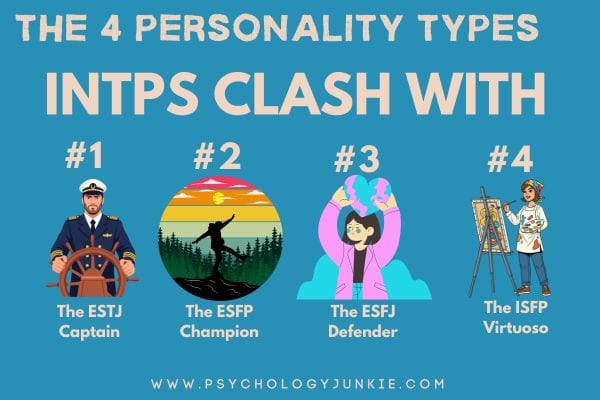
According to our survey of over 80,000 people (you can take the survey here), the types INTPs clashed with the most were ESTJs, ESFPs, ESFJs, and ISFPs.
Why?
Much of it comes down to cognitive functions.
INTPs lead with Introverted Thinking (Ti), a process focused on formulating an inner set of principles. It’s looking for logical consistency and a deep, nuanced understanding of how systems, models, and theories work. They support this with Extraverted Intuition (Ne), which explores possibilities, concepts, and alternative ways of looking at things. Together, these functions make INTPs analytical, exploratory, and often skeptical of anything that feels rushed, rigid, or emotionally driven.
But other personality types prioritize different things. Some focus on efficiency and quick results. Others focus on relationships, shared values, or living fully in the present moment. None of these approaches are wrong, but when people use completely different criteria to interpret the world, misunderstandings are almost inevitable.
To be clear, these aren’t bad relationships. If you’re an INTP married to an ESFJ, we’re not saying to throw down your wedding ring and storm out. The challenges can lead to immense growth if both partners are understanding, patient, and are willing to learn from each other rather than condemn. With awareness and mutual respect, these differences can actually become strengths.
Not sure what your personality type is? Take our personality questionnaire here.
The Four Personality Types INTPs Clash with the Most (and How to Connect)
#1 ESTJs and INTPs
ESTJs are practical, decisive, and focused on getting things done. They’re skilled at organizing systems, managing resources, and keeping projects moving forward. I sometimes call them “The Captains” because they naturally step into roles where they coordinate people, set expectations, and make sure things run efficiently.
For the contemplative, theory-oriented INTP, th ESTJ’s approach can sometimes feel rigid or overly forceful. Meanwhile, the ESTJ may see the INTP as hesitant, overly theoretical, or unwilling to commit to a decision.
Why is the ESTJ pushing for a decision right now?
The INTP may interpret this as rushed or careless.
Why is the INTP still analyzing all the variables?
The ESTJ may interpret this as procrastination or indecisiveness.
Why does the ESTJ seem so confident in their conclusions?
The INTP may interpret this as oversimplifying.
Why does the INTP keep questioning everything?
The ESTJ may interpret this as stubborn or uncooperative.
The Core of the Clash
The tension between these two types often comes down to Introverted Thinking (Ti) versus Extraverted Thinking (Te).
INTPs are primarily concerned with whether something is internally consistent and logically sound. They want to understand the principles behind a system before acting. They feel uneasy making decisions until they’ve explored multiple angles and possibilities.
ESTJs, on the other hand, are focused on efficiency and results. They want to know what works, what can be implemented, and what will move the situation forward. They like quick decisions, especially when the available data is sufficient to act.
To the INTP, this can feel premature or overly blunt. To the ESTJ, the INTP’s caution and continued questioning can feel unnecessary or obstructive.
Another layer of tension comes from communication style. ESTJs are direct, decisive, and blunt. They may state conclusions in a matter-of-fact way that unintentionally triggers the INTP’s skepticism. The INTP, in turn, may respond by dissecting the argument, pointing out flaws or inconsistencies—which the ESTJ may experience as nitpicking or resistance.
There’s also an emotional undercurrent that often goes unspoken. INTPs have inferior Extraverted Feeling (Fe), which means they can be more sensitive to criticism or disapproval than they appear on the surface. A blunt Te remark that feels neutral to an ESTJ can linger longer than expected for an INTP, even if they don’t show it outwardly.
How ESTJs and INTPs Can Connect
Despite their differences, these two types can complement each other extremely well when they learn to appreciate what the other brings to the table. ESTJs bring structure, momentum, and execution. INTPs bring analysis, troubleshooting, and long-term refinement of ideas.
Here’s what works:
For INTPs: Recognize that the ESTJ’s urgency isn’t always impatience, it’s often a genuine desire to solve problems and keep things running smoothly.
For ESTJs: Give the INTP time to think. They’re not avoiding action; they’re trying to prevent mistakes by understanding the system thoroughly.
For INTPs: Try to communicate conclusions more clearly once you’ve reached them. ESTJs appreciate clarity and decisiveness, even if the path there took time.
For ESTJs: Don’t dismiss an INTP’s idea just because it doesn’t fit the norm. Realize that their talent is thinking outside the box, innovating, and experimenting with new approaches. Understand that this could lead to more efficiency in the long run, not less.
When these two types respect each other’s strengths, they can form a highly effective partnership, one that is both efficient and intelligently designed.
#2 ESFPs and INTPs
ESFPs are energetic, spontaneous, and committed to seizing the day and grabbing life by the horns. They notice what’s happening right now: the mood in the room, the opportunities unfolding in real time, the sensory richness of life that many other types miss. They’re warm, expressive, and quick to act when something needs to be handled in the moment.
INTPs, by contrast, tend to live more in their minds. They like time to think, to analyze, to explore possibilities before acting. Their attention often drifts toward ideas, systems, and abstract connections rather than immediate experiences. They want time to contemplate. ESFPs want to act now, without missing a moment.
Put these two together, and it can sometimes feel like they’re living in completely different time zones, one in the present moment, the other in a world of theories and future possibilities.
And in close relationships—families, marriages, friendships, or workplaces—that difference can create a lot of friction.
Why is the ESFP so spontaneous and pulling me into impulsive experiences?
The INTP may feel pressured, over-stimulated, or rushed.
Why does the INTP need so much time to think about things?
The ESFP may feel ignored or disengaged.
Why does the ESFP talk so much about what’s happening right now?
The INTP may feel like the conversation lacks depth.
Why does the INTP seem distracted or mentally elsewhere?
The ESFP may feel like they’re not being fully heard.
None of this means either person is wrong. But it can create a pattern where both feel misunderstood.
The Core of the Clash
At the heart of this tension is a difference between Extraverted Sensing (Se) and Introverted Thinking with Extraverted Intuition (Ti–Ne), along with a subtle emotional layer involving the INTP’s inferior Extraverted Feeling (Fe).
ESFPs trust what they can see, experience, and respond to immediately. They are skilled at reacting quickly and engaging with life as it unfolds. They often learn by doing.
INTPs tend to learn by analyzing first. They want to understand the structure of something before engaging with it. Acting too quickly can feel uncomfortable because it means acting without enough clarity.
In relationships, this can show up in everyday moments:
An ESFP spouse might say, “Let’s just go! We’ll figure it out on the way.”
An INTP partner might immediately start thinking about logistics, timing, or whether the plan makes sense at all.
A coworker who’s an ESFP might jump into solving a problem through trial and error.
An INTP coworker may want to step back, diagram the problem, and think it through first.
From a coaching perspective, I often see that each type misreads the other’s intent. The ESFP may assume the INTP is uninterested or disengaged. The INTP may assume the ESFP is being impulsive or careless. In reality, both are simply using their natural strengths.
There’s also an emotional factor that doesn’t always get talked about. INTPs often care about people more than they outwardly show, but because Fe is their inferior function, they may struggle to express warmth or reassurance in the moment. ESFPs, who are highly attuned to emotional tone and presence, may interpret this as indifference, even when it isn’t. On top of that, ESFPs tend to act based on their personal values and feelings (“What’s important to me right now?”). INTPs tend to act based on their logical principles and what seems most sensible to them (“What makes sense based on my logical principles?”) This can lead to major disagreements on decisions.
How ESFPs and INTPs Can Connect
When these two types understand each other, they can actually balance one another beautifully. ESFPs bring vitality, warmth, and engagement with life. INTPs bring insight, thoughtful analysis, and creative problem-solving.
Here’s what works:
For INTPs: Make small efforts to be present. You don’t have to become someone who lives in the moment all the time, but giving full attention—even briefly—means a lot to an ESFP.
For ESFPs: Give the INTP time to think before expecting an answer or action. Silence doesn’t mean disinterest; it often means they’re working through something internally. And if they’re not ready for a spontaneous adventure, realize it’s not personal. Their bandwidth for physical intensity and spontaneity is lower than yours.
For INTPs: Verbalize appreciation occasionally. Even a simple “I enjoyed spending time with you today” can carry a lot of weight.
For ESFPs: Don’t assume the INTP’s quieter style means they don’t care. Many INTPs show love through problem-solving, sharing ideas, or exploring concepts or ideas that matter to you.
For both: Alternate approaches. Sometimes act first and think later; sometimes think first and act later. Meeting halfway builds trust quickly.
When these two learn to respect each other’s rhythms, the relationship often becomes surprisingly strong. The ESFP helps the INTP experience life more fully, while the INTP helps the ESFP step back and see patterns, connections, and possibilities they might otherwise overlook.
#3 ESFJs and INTPs
ESFJs are all about people and connection. They notice shifts in tone, tension in conversations, and the small cues that tell them whether someone feels included or left out. They often take it upon themselves to keep relationships running smoothly, to check in, to make sure everyone is okay.
INTPs, on the other hand, tend to focus first on understanding systems, ideas, and problems. Relationships matter to them, often more than people realize, but emotional communication doesn’t always come naturally or quickly. They need time to process feelings, and they may express care in indirect ways: solving problems, sharing information, or quietly being there when needed.
In families, friendships, or workplaces, this difference can easily create misunderstandings.
Why does the ESFJ keep asking how everyone feels about something?
The INTP may feel the conversation is circling endlessly without reaching a clear conclusion.
Why does the INTP respond to emotional concerns with analysis or solutions?
The ESFJ may feel dismissed or unheard.
Why does the ESFJ seem so concerned about what others think?
The INTP may interpret this as conforming or overly dependent on social expectations.
Why does the INTP appear detached or blunt in discussions?
The ESFJ may interpret this as coldness or lack of empathy.
These reactions are rarely intentional. More often, both people are trying to help, but in ways the other doesn’t immediately recognize.
The Core of the Clash
This pairing deals with one of the most striking contrasts in personality type: dominant Extraverted Feeling (Fe) versus inferior Extraverted Feeling (Fe)—but there’s another layer underneath that often causes just as much friction: tradition and shared values versus skepticism and analysis.
For ESFJs, Fe is deeply connected to shared values, traditions, and the values that hold communities together. Many ESFJs feel a sense of responsibility to preserve what works: family traditions, cultural expectations, and ways of doing things that have proven meaningful over time. These things are part of how ESFJs create stability and belonging for the people they care about.
INTPs, on the other hand, tend to approach systems—including traditions—with a questioning mindset. Their dominant Introverted Thinking naturally looks for inconsistencies, hidden assumptions, or areas where something doesn’t logically hold up. Their auxiliary Extraverted Intuition then asks, What if we did this differently? Is there a better way?
To the INTP, this is curiosity.
To the ESFJ, it can sometimes feel like dismantling something meaningful.
In real life, this might show up in small but emotionally loaded ways:
An ESFJ might value a holiday tradition because it brings people together and creates a sense of continuity.
An INTP might casually question why the tradition exists or suggest changing it.
From the INTP’s perspective, this is harmless exploration.
From the ESFJ’s perspective, it can feel dismissive of something that carries emotional and relational weight.
There’s also a difference in how each type approaches beliefs and values. ESFJs often place trust in shared wisdom: what has worked, what is known, what people rely on. INTPs tend to trust internally verified reasoning first, even if it contradicts widely accepted ideas.
Because of this, INTPs may poke holes in ideas, social rules, or traditions without realizing how personal that can feel to someone whose sense of connection is tied to those things.
At the same time, ESFJs may unintentionally put pressure on INTPs to conform socially or emotionally in ways that feel uncomfortable or artificial to them. An INTP who is asked to “just go along with it” or to express feelings in a particular way may feel misunderstood or even judged.
And beneath all of this sits the emotional dynamic of inferior Fe. Many INTPs are more sensitive to social disapproval than they appear, and when they feel criticized or rejected, they may withdraw or become isolated and defensive rather than explaining what’s going on inside.
From a coaching perspective, I often see ESFJs feeling that the INTP is dismissive or disconnected, while INTPs feel they are being expected to agree, conform, or respond emotionally before they’ve had time to think.
In reality, both are usually trying to protect something important:
The ESFJ is protecting connection and shared meaning.
The INTP is protecting truth and intellectual integrity.
How ESFJs and INTPs Can Connect
When these two understand what the other is actually trying to protect, things change quickly. ESFJs are often protecting connection, continuity, and the emotional glue that holds people together. INTPs are often protecting truth, fairness, and the freedom to question ideas honestly.
Both of those instincts are valuable.
Here’s what works:
For INTPs:
Before questioning a tradition or belief, try to understand what it represents to the ESFJ. Many traditions aren’t really about logic. Instead, they’re about belonging, memory, or care. Acknowledging that first (“I can see this means a lot to you”) makes your curiosity feel less like criticism.
For ESFJs:
Try not to interpret every question as an attack. INTPs question things instinctively, the same way you instinctively look for ways to support people. Their curiosity is usually about understanding, not tearing things down.
For INTPs:
Be mindful of timing and tone. Pointing out logical inconsistencies in the middle of an emotionally meaningful moment rarely goes well, even if your reasoning is sound.
For ESFJs:
Allow space for independent thinking. The INTP isn’t rejecting your values by questioning them, they’re trying to understand them deeply enough to believe in them from an authentic place.
For INTPs:
Express appreciation more often than feels necessary. ESFJs often show care through effort—planning, remembering details, maintaining relationships—and noticing that effort builds a lot of goodwill.
For ESFJs:
Give the INTP time to process their thoughts and feelings internally. They often feel like their feelings are cloudy and confusing, and pressure tends to make them shut down rather than open up.
For both:
Assume good intent first. Most conflict in this pairing isn’t about lack of care, it’s about different ways of showing care.
When these two meet in the middle, they can balance each other in meaningful ways. The ESFJ helps the INTP stay connected to people and the present moment. The INTP helps the ESFJ step back, analyze situations more objectively, and sometimes question traditions that no longer serve the people they were meant to help.
#4 ISFPs and INTPs
ISFPs are gentle, cautious, and oriented by what feels important, meaningful, and right to them on a personal level. They tend to move through life guided by an internal sense of integrity—an awareness of what aligns with their values and what doesn’t. They may not always explain those values out loud, but they feel them intensely.
INTPs, by contrast, tend to navigate life through internal logic. They’re less focused on what feels right and more focused on what makes sense. Their first instinct when encountering an idea, a belief, or even a strong opinion is to examine it, question it, and test it for consistency.
In everyday relationships this difference can create misunderstandings that feel surprisingly personal.
Why does the ISFP feel hurt when the INTP is “just debating”?
The INTP may see the conversation as an exchange of ideas, while the ISFP experiences it as criticism of something meaningful.
Why does the INTP keep analyzing everything?
The ISFP may feel the INTP is overthinking or missing what is obvious on a human level.
Why does the ISFP trust their instincts about people so strongly?
The INTP may feel those judgments are subjective or unsupported by evidence.
Why does the INTP lack personal passion?
The ISFP may feel that the INTP lacks personal conviction or passion about beliefs, values, and likes/dislikes because they focus so much more on analytical, detached understanding than personal feeling.
Neither person is trying to frustrate the other (most of the time), but their ways of arriving at truth are very different.
The Core of the Clash
At the heart of this pairing is a contrast between Introverted Thinking (Ti) and Introverted Feeling (Fi), two processes that both search for truth, but in completely different ways.
INTPs look for internal logical coherence. They want to understand how things work, what the underlying principles are, and whether something holds up under their personal scrutiny. Questioning is natural to them; it’s how they refine their understanding.
ISFPs look for internal emotional and ethical coherence. They want to know whether something aligns with their values, whether it feels authentic, whether it honors what matters to them. When something violates those values, it can feel deeply wrong, even if they struggle to explain exactly why.
To the INTP, truth is something to be analyzed.
To the ISFP, truth is something to be felt and lived.
Because both processes are introverted, neither type always explains their reasoning out loud. That can make misunderstandings harder to resolve, because each person may assume the other “should” understand what feels obvious to them.
But there’s another layer to this dynamic that often gets overlooked: the auxiliary function clash.
ISFPs support their values with Extraverted Sensing (Se). This makes them highly aware of the present moment, the environment, and what’s happening right now. They tend to learn through direct experience and may prefer action over extended theorizing.
INTPs support their logic with Extraverted Intuition (Ne). This pulls their attention toward possibilities, theories, and alternative interpretations. They usually enjoy exploring ideas more than acting on them immediately.
This can create a subtle but persistent friction.
An ISFP may think, “Why are we still talking about this? Let’s just do something.”
An INTP may think, “Why are we acting before we’ve explored all the possibilities?”
The ISFP’s focus on the tangible present can feel grounding to some people, but to the INTP it can sometimes feel limiting or dismissive of deeper exploration. Meanwhile, the INTP’s theorizing can feel stimulating to some, but to the ISFP it can feel disconnected from real life.
There’s also an emotional difference in how each type handles conflict. ISFPs often withdraw to process feelings privately and protect their inner world. INTPs may detach and analyze the situation, sometimes appearing emotionally neutral even when they care deeply. Both reactions can be misread as indifference by the other.
From a coaching perspective, I often see ISFPs feeling that INTPs are too critical or detached, while INTPs feel that ISFPs are too sensitive or unwilling to examine ideas objectively. In reality, both are simply protecting what matters most to them—authenticity on one side, accuracy on the other.
How ISFPs and INTPs Can Connect
When these two learn to understand each other, they can develop a quiet but meaningful respect. ISFPs often help INTPs reconnect with the present moment, their senses, and the human side of life. INTPs often help ISFPs see patterns, possibilities, and perspectives they might not have considered.
Here’s what works:
For INTPs:
Be careful about debating topics that are deeply personal to the ISFP. If something connects to their values or identity, analysis can feel like invalidation, even when that’s not your intention.
For ISFPs:
Try to remember that questioning is how INTPs show engagement. If they didn’t care, they usually wouldn’t bother analyzing something at all.
For INTPs:
Acknowledge feelings before offering analysis. Even a brief statement of understanding can prevent a lot of hurt.
For ISFPs:
If you withdraw to process feelings, it can help to let the INTP know what’s happening.
For INTPs:
Occasionally step into the present moment—shared experiences, activities, or creative pursuits often mean more to ISFPs than long discussions.
For ISFPs:
Be patient with the INTP’s need to explore possibilities. Their brainstorming is part of how they arrive at clarity.
For both:
Respect that both logic and values are necessary. A life built only on logic can feel empty; a life built only on feeling can feel unstable. Together, these perspectives can create balance.
When these two types appreciate each other’s strengths, they often discover that they bring something essential to one another. The ISFP brings heart, presence, and authenticity. The INTP brings insight, curiosity, and perspective. And together, those qualities can make for a relationship that is both grounded and thoughtful.
What Do You Think?
Do you have experiences with these personality types? Have you seen these dynamics play out in your family, friendships, or workplace?
I’d love to hear your perspective in the comments. Often the most helpful insights come from people who have lived these relationships and learned what works.
Find out more about your personality type in our eBooks, Discovering You: Unlocking the Power of Personality Type, The INFJ – Understanding the Mystic, The INTJ – Understanding the Strategist, and The INFP – Understanding the Dreamer. You can also connect with me via Facebook, Instagram, or YouTube!