
How ISFJs Say “I Love You”
If you’ve ever been close to an ISFJ, you’ve probably been loved in ways you didn’t even recognize at the time.
Their version of “I love you” can show up as making your favorite meal after a difficult week, sending a text asking how your appointment went, or gently draping a blanket over your shoulders because they noticed you looked cold before you did. ISFJs have an amazing way of paying attention to the little things that make people feel cared for, and once they know those things, they rarely forget them.

One of my favorite examples comes from my own life. When I was about five months pregnant with my first child, I casually mentioned to my ISFJ mom that I’d been craving Fruit Loops. The next time I saw her she’d gone to the grocery store and bought five boxes. It still makes me laugh because…well…five boxes is a LOT of Fruit Loops. But it was so completely her. That’s the kind of detail ISFJs hold onto. If something brings comfort to someone they love, it gets filed away somewhere in their mind as information worth remembering.
For many ISFJs, love is something they gradually build into another person’s daily life. They pay attention to what helps you feel safe, what eases your stress, what routines make life easier, and what little gestures remind you that someone is thinking about you. Long before they tell you they care, they’ve usually found a dozen practical ways to show it.
You can take our free personality questionnaire here You can take Personality Hacker’s highly accurate personality questionnaire. You can take the official Myers-Briggs Type Indicator® for $49.95
Table of contents
- They Make You Feel Safe to Be Yourself
- They Remember the Small Things
- They Make Life Easier
- They Listen to Understand, Not to Respond
- How ISFJs Feel Most Loved
- One Thing Many ISFJs Struggle With
- How to Bring Meaning and Depth Into Your Relationship with an ISFJ
- ISFJs and Conflict
- Some Rules for Healthy Conflict
- What Do You Think?
- Other Articles You Might Enjoy:
Estimated reading time: 15 minutes
They Make You Feel Safe to Be Yourself
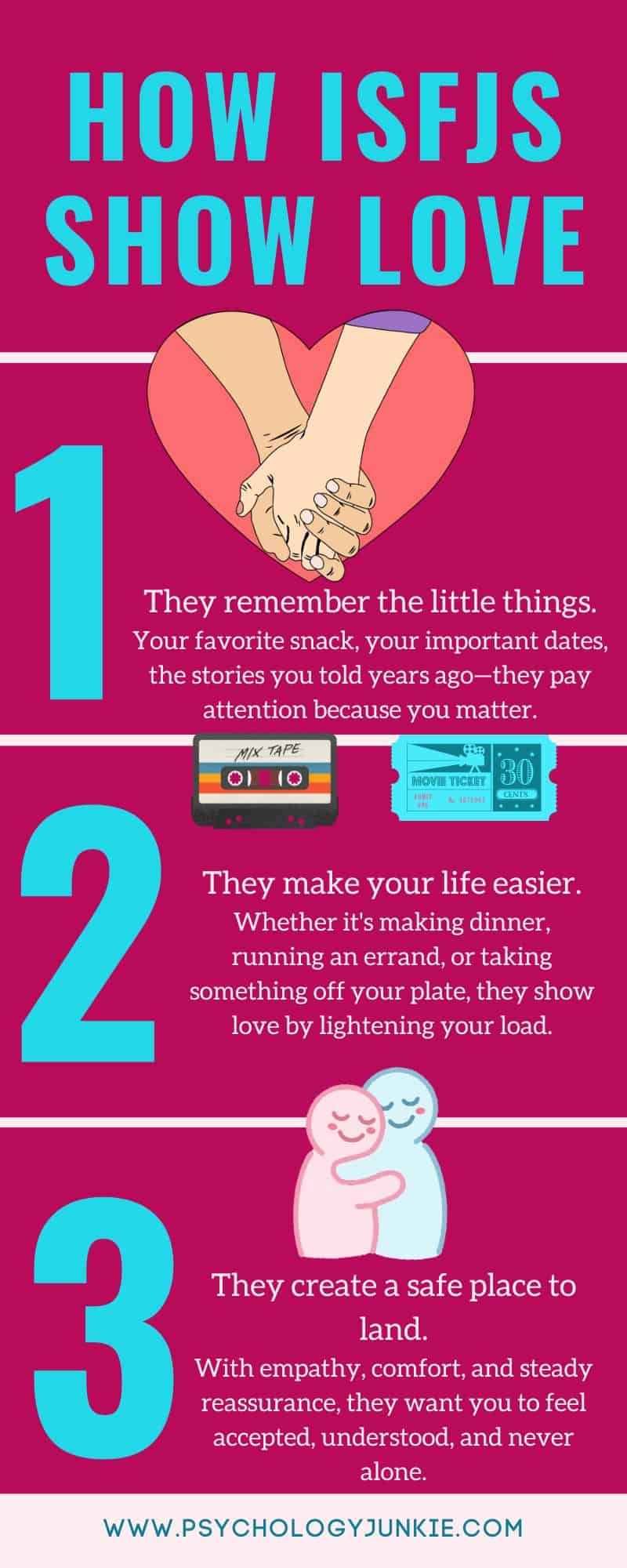
One thing I’ve noticed about many ISFJs is that, more than anything, they want people to feel emotionally safe. If you’re hurting, they’re usually less interested in giving you a strategy than they are in making sure you don’t have to carry everything by yourself.
That often comes across in seemingly ordinary ways. They might make you tea, put on some quiet music, or sit with you while you untangle something difficult. They have a gift for creating an atmosphere where people can let their guard down. I’ve known several ISFJs who instinctively know how to make a room feel calmer just because they notice what puts people at ease. A warm blanket, a favorite snack, a candle burning in the background – they notice these little details more than many other personality types do. To them, organizing those details is just another way of communicating, “You don’t have to brace yourself here.”
Emotionally, they tend to respond in much the same way. Rather than rushing to fix the problem, they’re often trying to understand what it feels like to be in your position. You might hear them say, “When I went through something similar, I felt that way too,” or, “You’re not a burden. You’re just having a hard time.” They want to make sure that you don’t feel alone while you’re carrying whatever you’re carrying.
They Remember the Small Things

If you’ve ever wondered how an ISFJ can remember something you mentioned in passing six months ago, you’re not alone. It’s one of those qualities that can feel almost eerie, especially to us INTJs who have no idea how this is even possible.
ISFJs are paying attention because people matter to them. As they’re getting to know someone, they’re constantly collecting little pieces of information that help them understand how to care for that person well. They notice your favorite coffee order, the restaurant you always suggest, the story about your grandmother you’ve told three times because it still makes you laugh, or the fact that you get anxious before doctor’s appointments even if you insist you’re “not worried.”
Those details become part of how they love you.
I’ve known ISFJs who remember birthdays for people they haven’t seen in years. Others remember that a friend has an important meeting coming up and send a text that morning just to say, “I was thinking about you today.” Most of the time they don’t even realize how unusual this act of caring is. But from what I’ve seen, they’re often paying attention in a way that many people don’t.
To an ISFJ, remembering is an act of caring. It’s their way of saying, I was listening. You mattered enough for me to remember.
They Make Life Easier
One of the easiest ways to tell an ISFJ loves you is to pay attention to your own life. If you’re close to one, chances are it’s become a little easier without you fully realizing why.
Maybe they picked up groceries because they knew you’d be working late. Maybe they folded the laundry before you got home, remembered to refill your prescription, or checked the weather and reminded you to bring a jacket because they knew you’d forget. These aren’t usually dramatic gestures, and that’s exactly why they can go unnoticed. They’re infused into everyday life so naturally that it’s easy to mistake them for coincidence.
David Keirsey once described ISFJs as people who often aren’t noticed until something goes wrong. I think that’s because they’re constantly preventing little problems before anyone else realizes they exist. They see the loose thread before the sweater unravels. They replace the batteries before the smoke detector starts chirping at two in the morning. They think ahead because making life smoother for the people they love genuinely brings them satisfaction.
The downside, unfortunately, is that this kind of love is almost invisible when everything is working well. People notice the crisis that never happened a lot less than the crisis that did.
They Listen to Understand, Not to Respond
One of the things I appreciate most about the ISFJs in my own life is that they have a way of making you feel heard without making the conversation about themselves. When you’re talking about something difficult, they usually aren’t mentally rehearsing what they’re going to say next or waiting for a chance to tell a better story. They’re trying to understand what the experience actually felt like for you.
That doesn’t mean they’ll never offer advice. They certainly can. But more often, they’ll respond with empathy before they respond with solutions. They might tell you about a time they went through something similar, which, with some types can admittedly feel like hijacking the conversation. But with ISFJs it feels like they’re trying to communicate that you’re not strange for feeling what you’re feeling.
How ISFJs Feel Most Loved

One thing I’ve noticed after working with so many ISFJs over the years is that they aren’t usually asking for extravagant gestures. In fact, that might feel overwhelming or embarrassing (or both) to them.
Instead, they want to know that the care they pour into other people isn’t disappearing into the background unnoticed.
For many ISFJs, words of affirmation tends to be their preferred love language. Because they often do so much behind the scenes, hearing someone say, “I noticed what you did,” or, “Thank you for thinking of me,” can mean more than most people realize. They want to know that their efforts matter to someone, and that what they’re doing isn’t invisible.
I’ve heard ISFJs tell me over and over again that one of the most meaningful things another person can do is simply notice. Notice that they cleaned the kitchen without being asked. Notice that they remembered everyone’s birthdays. Notice that they stayed up helping when everyone else had already gone to bed.
Quality time also tends to rank very highly for many ISFJs, but not just any quality time. They appreciate moments where someone is genuinely present. Phones are put away. The television isn’t competing for attention. You’re not half-listening while scrolling through emails. You’re just together, sharing a conversation, taking a walk, cooking dinner, or laughing over something completely ridiculous.
To an ISFJ, presence is its own kind of reassurance. It says, “There’s nowhere else I’d rather be right now.”
Small gestures matter, too, often more than expensive gifts. A handwritten note tucked into a lunch bag, bringing home their favorite dessert after a difficult day, or remembering an anniversary that everyone else forgot. ISFJs see the beauty and magic in the details, so when you imbue some love into the details of their lives it means a lot to them.
Many ISFJs also really treasure conversations about family history, childhood memories, and shared experiences. They have a deep appreciation for the stories that shape people’s lives. Sitting around the dinner table swapping memories or asking about someone’s grandparents may not sound especially romantic, but for many ISFJs, those conversations create a feeling of closeness that’s difficult to manufacture any other way.
One Thing Many ISFJs Struggle With
The difficult part about loving this way is that it can become almost invisible.
If you’re always the person remembering birthdays, checking in on people, keeping traditions alive, smoothing over disagreements, and working to make sure everyone has what they need, eventually people start to assume that’s just who you are. They stop seeing the thought behind it because the thoughtfulness has become expected and taken for granted.
I’ve spoken to so many ISFJs who have said things like:
“I just wish someone would notice.”
or
“I wish someone would ask how I’m doing.”
The challenge is that many ISFJs don’t say those things out loud. Their natural instinct is to keep giving, hoping someone will eventually recognize the effort on their own. Sometimes that happens. Sometimes it doesn’t.
Joel Mark Witt and Antonia Dodge from Personality Hacker put it well when they wrote that ISFJs can’t run on fumes forever. If they continually ignore their own needs while caring for everyone else, exhaustion eventually catches up with them. At that point they may withdraw, become silently resentful, or find themselves crying alone instead of letting anyone know they’ve reached their limit.
How to Bring Meaning and Depth Into Your Relationship with an ISFJ
If you’re reading this and wondering how you can build the kind of relationship an ISFJ truly feels at home in, here are a few ideas. None of them require a lot of money or elaborate planning.
- Notice the little things they do and tell them you noticed. If they made your favorite meal, remembered an important appointment, packed your lunch, or subtly took care of something stressful before you even realized it needed doing, don’t let it pass without acknowledging it. A simple “Thank you for thinking of me” or “I noticed what you did, and it meant a lot” goes much further than most people realize.
- Create small traditions together. ISFJs often cherish rituals because they create a sense of stability and shared history. Have pancakes every Saturday morning, watch the first snowfall together each winter, go for an evening walk after dinner, or celebrate little milestones that other people might overlook. These traditions become anchors in the relationship.
- Be fully present during one-on-one time. Put your phone away when you’re having dinner together or talking at the end of the day. Ask questions about how they’re doing and listen without constantly checking notifications. Giving someone your undivided attention is one of the clearest ways to communicate, “You’re important to me.”
- Ask how you can lighten their load. ISFJs have a habit of taking on responsibilities without announcing them. Every so often, ask, “What’s something I could take off your plate this week?” Better yet, notice something that needs doing and do it before they have to ask.
- Create a comfortable atmosphere together. Cook dinner side by side, light a candle, put on music you both enjoy, make hot chocolate on a rainy afternoon, or curl up under a blanket while watching a favorite movie. ISFJs often experience love through the environment that’s created as much as through the conversation itself.
- Talk about family stories, favorite memories, and meaningful experiences. Ask them about their childhood, family traditions, vacations they still remember, or people who shaped their lives. ISFJs often treasure these conversations because they help preserve the people and experiences that matter most.
- Be dependable. Follow through when you say you’ll do something. Show up when you promised you would. Remember important dates without being reminded every time. Reliability builds trust for ISFJs in a way that words alone rarely can.
- Encourage them to receive care as well as give it. Plan something just for them. Bring home their favorite dessert after a hard day. Tell them to sit down while you make dinner. If they’re always the one checking on everyone else, make a point of checking on them. Sometimes the greatest gift you can give an ISFJ is the chance to simply rest while someone else takes care of them for a change.
ISFJs and Conflict
If you’ve spent much time around ISFJs, you’ve probably noticed that they don’t usually wake up looking for an argument. Most would much rather preserve harmony than prove a point. That doesn’t mean they don’t have opinions or convictions—they absolutely do—but their first instinct is often to protect the relationship rather than win the disagreement.
The problem is that this can sometimes work against them.
Many ISFJs are so aware of how their words might affect someone else that they’ll soften what they’re feeling, postpone difficult conversations, or convince themselves they can “just let it go.” Sometimes that’s healthy. Sometimes it simply means the hurt gets pushed further underground.
I’ve talked with many ISFJs who said they replay difficult conversations in their minds for days before saying anything. They’ll wonder if they’re being too sensitive, if they’re asking for too much, or whether bringing up the issue will only make life harder for everyone involved. By the time they finally say something, they’ve usually spent far longer thinking about it than the other person realizes.
That hesitation doesn’t mean they don’t care. In fact, it’s often the opposite. They care so much about preserving the relationship that speaking honestly can feel incredibly risky.
Of course, every ISFJ is different, and life experience plays a huge role. Some become surprisingly direct as they mature, especially after learning that avoiding conflict doesn’t actually prevent it. But even then, most still prefer conversations where both people are trying to understand each other rather than score points.
One thing that often surprises people is that ISFJs do have a breaking point. They may tolerate hurt for a long time, but if they continually feel dismissed, unappreciated, or emotionally unsafe, they can suddenly withdraw in ways that seem unexpected. To the other person it feels like it happened overnight.
To the ISFJ, it probably started months ago.
Some Rules for Healthy Conflict
- ISFJs often need time to sort through their feelings before they know exactly what they’re upset about. In the middle of an argument they may become unusually quiet, struggle to find the right words, or simply say, “I’m fine,” when they really aren’t. Giving them a little space to process can help them communicate more honestly later.
- Don’t assume silence means everything is okay. Many ISFJs dislike creating conflict and may minimize their own feelings in order to keep the peace. Gently ask open-ended questions like, “How are you really feeling about this?” or, “Is there anything you’re holding back?” and give them time to answer without rushing them.
- Express appreciation even during difficult conversations. Beginning with something like, “I know how much you do for our family, and I appreciate that,” doesn’t weaken your point—it reminds both of you that you’re on the same team before discussing what needs to change.
- Use “I feel” statements instead of assigning motives. Saying, “I’ve been feeling overwhelmed because I’ve been handling most of the responsibilities lately,” is much easier for an ISFJ to hear than, “You never care about helping me.” Focusing on your experience keeps the conversation collaborative rather than accusatory.
- Address problems while they’re still small. ISFJs sometimes tell themselves they can overlook hurt feelings for the sake of harmony, but those hurts have a way of accumulating over time. It’s usually healthier to have a gentle conversation early than to carry months of quiet resentment.
- Be careful with harsh criticism or raised voices. Most ISFJs respond much better to calm, respectful conversations than emotionally charged confrontations. That doesn’t mean you should avoid difficult topics—it simply means the delivery matters. Kindness makes honesty easier to hear.
- Remember that disagreement doesn’t mean the relationship is in danger. Many ISFJs instinctively associate conflict with disconnection. Reassuring them that you’re bringing up an issue because you value the relationship—not because you’re giving up on it—can help them stay engaged instead of withdrawing.
- Take a break if emotions become overwhelming. If either of you starts feeling defensive, flooded, or unable to listen well, it’s okay to pause the conversation and return to it later. A short break gives both people time to think, regulate their emotions, and come back with clearer minds instead of saying things they’ll regret.
What Do You Think?
Did you discover something new in this article? Is there an insight or experience you’d like to share with other readers? Let us know in the comments!
Want to Understand the ISFJ Personality Even More?

If this article resonated with you, there’s so much more to discover.
The Care and Keeping of the ISFJ is a deep dive into the inner world of one of the most thoughtful—and often misunderstood—personality types. While many people see ISFJs as simply “kind” or “helpful,” there’s a rich psychological world beneath that quiet exterior. This book explores what motivates ISFJs, why they sometimes struggle to put themselves first, and how they can build a life that honors both their compassion and their own needs.
Inside you’ll discover:
- A detailed exploration of the ISFJ cognitive functions and how they shape the way you think, relate, and make decisions.
- Practical guidance for navigating relationships, parenting, friendships, and the workplace as an ISFJ.
- Insights into common challenges like people-pleasing, burnout, conflict avoidance, and setting healthy boundaries.
- Real-life examples, journaling prompts, and practical exercises designed specifically for the ISFJ personality type.
- Actionable strategies to help you grow with confidence while staying true to who you are.
Whether you’re an ISFJ looking for greater self-understanding or someone who wants to better understand the ISFJ in your life, this book will help you appreciate the quiet strengths, hidden struggles, and remarkable resilience of The Protector.