
The Four Personality Types ISFJs Clash with Most (and How to Connect)
ISFJs are the personality types who keep things comforting, stable, and kind in life. They notice things most of us miss. Who looks tired but won’t say it. Which kid always gets left out of games. The exact way Grandma likes her tea.
ISFJs also keep track of the small things that hold life together, and they do it so consistently that people start to assume it just… happens. Like towels magically folding themselves or birthdays remembering themselves.

It doesn’t just happen. ISFJs are making it happen.
Because they’re patient and considerate, ISFJs can get along with a wide range of people. They’re often the ones smoothing over conflicts, keeping routines steady, and making sure everyone feels comfortable. But even the most easygoing person runs into friction sometimes, especially when someone’s way of moving through the world feels completely different from their own.
There are certain personality types ISFJs report clashing with more often. Not because anyone is bad or impossible, but because they’re operating from very different instincts about what matters, what should change, and how people ought to treat each other.
So Who Do ISFJs Clash With the Most?
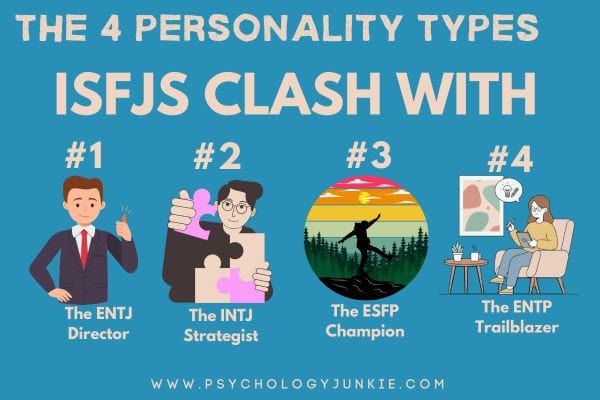
According to our survey of over 80,000 people (you can take the survey here), the types ISFJs clashed with the most were ENTJs, INTJs, ESFPs, and ENTPs.
A lot of this comes down to cognitive functions. Don’t worry if you don’t know what those are! They’re essentially the parts of the mind every personality type uses when they perceive the world and make decisions.
ISFJs lead with Introverted Sensing (Si). This means they naturally pay attention to what has worked before, what is reliable, and what keeps people safe and cared for. Their second function, Extraverted Feeling (Fe), tunes them into people’s needs, emotional currents, and the health of relationships.
Put those together and you get someone who values stability, kindness, and doing things thoroughly. Someone who thinks about consequences. Someone who usually doesn’t want to throw out a working system just because a new one sounds exciting.
Other types, especially intuitive or thinking-dominant types, are wired to challenge systems, move quickly, and push for change. Those differences can be incredibly useful in the right balance. Without understanding, though, they can also be exhausting.
Let’s look at the first pairing.
ENTJs and ISFJs
ISFJs want a life that feels stable, calm, tranquil, and dependable. ENTJs want to trailblaze something new, restructure, and make life more efficient.
ENTJs look at situations and immediately see inefficiencies. They notice bottlenecks, wasted effort, outdated methods. Their brain starts rearranging the furniture before most people have even realized the room exists.
This can be impressive. It can also be a little terrifying if you’re someone who just finished organizing the room and were hoping to sit down for five minutes.
In real life, this difference shows up in very human ways.
An ENTJ manager might say, “We’re changing this entire process starting Monday.”
An ISFJ employee might think, “But we just figured out how to make it work… and what about the people who are going to struggle with this?”
An ENTJ spouse might be focused on long-term financial or career goals.
An ISFJ partner might be thinking about whether everyone in the family is overwhelmed right now and needs stability before another big change.
Neither perspective is wrong. But they can feel like they’re speaking different dialects of the same language.
Why is the ENTJ pushing so hard, so fast?
The ISFJ may feel like people are being treated as pieces on a chessboard.
Why does the ISFJ want to keep doing things the old way?
The ENTJ may feel like progress is being blocked for emotional reasons.
Why does the ENTJ sound so blunt?
The ISFJ may feel criticized or discouraged, especially if they’ve poured a lot of care into what they’re being told to change.
Why does the ISFJ hesitate to challenge the ENTJ directly?
The ENTJ may assume everything is fine… until it suddenly isn’t.
I’ve seen this dynamic play out in families a lot. One person is trying to optimize things and plan for the future. The other is trying to protect the present and preserve the past. Both care deeply. Both feel misunderstood.
The Core of the Clash
At the center of this pairing is a difference between Extraverted Thinking (Te) and Si paired with Fe.
ENTJs want to know what works, what moves the needle, and what gets results. If a system is inefficient, their instinct is to fix it immediately. Waiting, to them, feels irresponsible.
ISFJs trust their lived experience. They want to know what has worked reliably, what people can handle, what won’t create unnecessary stress or chaos. Moving too fast can feel reckless.
To the ENTJ, the ISFJ may look overly cautious, even resistant.
To the ISFJ, the ENTJ may look impatient, even insensitive.
There’s also a difference in how feedback is delivered and received. ENTJs communicate in a direct, problem-solving way. They point out flaws quickly because they want to fix them. They aren’t always thinking about how that lands emotionally in the moment.
ISFJs, on the other hand, put a lot of personal care into their work. So when something is criticized bluntly, it can feel less like a neutral correction and more like a quiet punch to the ribs.
Another layer is pacing. ISFJs tend to prefer gradual, gentle, incremental change. ENTJs are comfortable making large changes quickly if it improves the long-term outcome. That difference alone can create ongoing friction if neither side understands it.
From a coaching perspective, I often see ISFJs feeling unappreciated and pressured, while ENTJs feel slowed down and frustrated. In reality, both are trying to do something valuable. One is protecting stability and people. The other is pushing for progress and improvement.
How ENTJs and ISFJs Can Connect
When these two start to understand each other, something interesting happens. The ENTJ might see that the ISFJ isn’t resisting change out of stubbornness. Instead, they’re seeing risks and human consequences that haven’t been considered yet. The ISFJ begins to see that the ENTJ isn’t trying to bulldoze people as much as trying to prevent stagnation and long-term problems.
Here’s what helps.
For ISFJs:
Try to say your concerns out loud earlier. ENTJs want clear input and hate being blindsided by pent-up resentment. If you see a practical or human problem coming, speak up. You’re often right more than you think.
For ENTJs:
Slow down just enough to acknowledge effort and listen. A few words of appreciation go a long way with ISFJs. They don’t need a speech. Just evidence that you see what they’re doing.
For ISFJs:
It’s okay to let some systems evolve. Not every tradition needs to be preserved exactly as it is. Some changes really do make life easier.
For ENTJs:
Try to avoid “fixing” the traditions, rituals, or details of an ISFJ’s home life. Those things might be comforting, even if they’re not exactly efficient.
For both:
Assume good intent. Most of the tension here comes from different priorities, not lack of care. An ENTJ who is loving and compassionate may still be blunt and jarringly direct. An ISFJ who cares about efficiency and logic may still struggle with frequent criticism or advice.
When these two respect each other’s strengths, they can be an incredibly effective team. The ENTJ sees where things could go. The ISFJ sees what it takes to keep things working day to day. Vision and steadiness, speed and care, the future and the present, actually cooperating for once instead of arguing in the kitchen at 10 PM.
INTJs and ISFJs
At first glance, INTJs and ISFJs can actually seem surprisingly similar. Both are usually responsible. Both tend to think before they act. Both can be private, observant, and focused on doing things well rather than drawing attention to themselves.
But once you get past that surface similarity, the differences start to show.
ISFJs tend to trust what is known, what has been tested, what experience has proven to be reliable. INTJs tend to trust what they see coming, what patterns suggest, what could be improved or reinvented.
One is grounded in lived experience.
The other is oriented toward future vision.
Neither approach is wrong. But when those instincts collide, it can feel like one person is constantly pressing the accelerator while the other is carefully checking the map, the weather, and whether everyone packed snacks before the car even starts.
In real life, this shows up in small, everyday moments.
An INTJ might say, “This system doesn’t make sense. We should redesign it.”
An ISFJ might think, “But it works, and people understand it. Why fix what isn’t broken?”
An ISFJ might keep traditions or routines because they bring comfort and continuity.
An INTJ might question those traditions because they genuinely want to understand whether they still serve a purpose. This can feel like an attack to an ISFJ.
And sometimes that questioning lands harder than intended.
Why does the INTJ keep challenging things that feel meaningful or stable?
The ISFJ may feel unsettled, or even quietly hurt.
Why does the ISFJ resist changing something that could be improved?
The INTJ may feel frustrated, wondering why obvious solutions aren’t being implemented.
Both people can end up feeling like the other is being unreasonable, when in reality they’re just protecting different things.
The Core of the Clash
At the center of this pairing is a contrast between Introverted Intuition (Ni) and Introverted Sensing (Si).
Both functions focus on looking inward and reflecting, which is why these two types can initially feel comfortable around each other. But the way they use that reflection is very different.
ISFJs look backward to understand the present. They draw on experience, memory, and what has proven dependable in their own lives. They want stability, continuity, and groundedness in wisdom that has stood the test of time. As sensors, they care about the details in life. They find joy in the simple moments that bring life a sense of beauty and tranquility. Small details that others might find “insignificant” stand out to them.
INTJs look forward to understand the present. They notice patterns and trajectories, asking where things are heading and what could be optimized before problems arise. They feel skeptical of traditions from the past, and get bored with a focus on the details of the present. Instead, they want to focus on concepts, ideas, and cosmic meanings.
To an INTJ, the ISFJ can sometimes seem overly cautious or attached to tradition.
To an ISFJ, the INTJ can sometimes seem dismissive of experience or too quick to change things that people rely on.
There’s also a difference in emotional tone. ISFJs, with auxiliary Fe, are often attentive to how decisions affect people and relationships. INTJs, with auxiliary Te, tend to focus first on what works and what will achieve the goal. Neither perspective excludes the other, but they prioritize different things first.
Because of this, feedback can sometimes land poorly. INTJs may state conclusions in a straightforward way that feels neutral to them but sounds blunt to an ISFJ. ISFJs may hint at concerns or soften their objections to preserve harmony, which can make the INTJ feel like the real issue isn’t being stated clearly.
From a coaching perspective, I often see ISFJs feeling that INTJs are too detached or critical, while INTJs feel that ISFJs are too cautious or resistant to necessary change.
How INTJs and ISFJs Can Connect
When these two begin to understand each other, they often discover a surprising respect. Both value competence. Both care about doing things well. Both are often more thoughtful and loyal than people realize.
Here’s what helps.
For ISFJs:
Try to see questioning as curiosity rather than criticism. When INTJs challenge an idea or tradition, they’re usually trying to understand it or improve it, not dismiss it.
For INTJs:
Be mindful of how you deliver feedback. A few words acknowledging the ISFJ’s effort or personal history can make your insights much easier to hear.
For ISFJs:
It’s okay to experiment sometimes. Not every change is a threat to stability and some changes prevent larger problems later.
For INTJs:
Not every tradition is irrational. Some practices exist because they support people in ways that aren’t immediately obvious from a purely logical standpoint.
For both:
Talk openly about concerns instead of assuming the other person understands. These two types often think a lot and say less, which can lead to silent misunderstandings.
When INTJs and ISFJs work together well, they can be remarkably effective. The INTJ sees what could be improved. The ISFJ ensures what already works doesn’t collapse in the process. One looks ahead and the other keeps the foundation steady. And most of the time, both are necessary.
ESFPs and ISFJs
ESFPs are the adventurers of everyday life. They notice what’s happening right now, what feels exciting, what could make the moment brighter or more alive. In my experience I’ve noticed they have a way of bringing movement and color into spaces that might otherwise feel routine or heavy. They’re the ones who suggest the last-minute road trip, turn on music while everyone’s cleaning, or convince people to laugh when the day has been long.
But for ISFJs, who like life to feel steady, predictable, and well-planned, that energy can sometimes feel a little… chaotic. The ISFJ might wonder, Why are we changing plans again? Didn’t we just decide this yesterday? Meanwhile, the ESFP might feel stifled or puzzled, thinking, Why does everything have to be so planned out and predictable? Can’t we just enjoy the moment a little?
Neither person is trying to frustrate the other. They’re just wired differently, and those differences show up most clearly in how they approach time, plans, and responsibility.
The Core of the Clash
The main challenge between ESFPs and ISFJs comes down to the difference between Extraverted Sensing (Se) and Introverted Sensing (Si).
ESFPs lead with Se, which focuses on the present moment, direct experience, and what’s happening right now. They tend to respond quickly to opportunities and often feel most alive when they’re engaged in something active or spontaneous.
ISFJs lead with Si, which focuses on memory, experience, and what has been reliable over time. They tend to feel most comfortable when life has some structure and predictability, when responsibilities are handled, and when people know what to expect.
This difference often creates a disconnect. ESFPs may feel like ISFJs worry too much or get stuck in routines that drain the fun out of life. ISFJs, in turn, may feel like ESFPs don’t always think ahead or consider the consequences of impulsive decisions.
Time and time again I’ve spoken with ISFJs who feel exhausted by constant last-minute changes or unpredictability. They like to prepare and to know what’s coming. It helps them relax. When plans change repeatedly, it can feel like trying to build a house on shifting sand.
In the same way, ESFPs can feel weighed down by too much routine or caution. They often experience life as something meant to be lived, not carefully managed, and when everything feels scheduled or controlled, they may feel restless or boxed in.
There’s also a difference in how stress is handled. ISFJs often respond to stress by tightening their routines and trying to restore order. ESFPs often respond by seeking activity, movement, or a change of scenery. Each can look at the other and think, That makes no sense at all.
How ESFPs and ISFJs Can Connect
While these two types approach life differently, they can help each other grow when they respect what the other brings. ISFJs can help ESFPs create stability and follow through on commitments that matter. ESFPs can help ISFJs relax, enjoy the present, and remember that life isn’t only about responsibilities.
Here’s what works:
- For ESFPs: Try to respect the ISFJ’s need for planning and predictability. While it might feel like it’s about controlling everything, it’s really about creating a sense of security so people can actually relax.
- For ISFJs: Be open to spontaneity now and then. Not every unplanned moment leads to chaos. Some of the best memories start with someone saying, “What if we just… went?”
- For ESFPs: Follow through on commitments, especially small ones. Reliability builds trust with ISFJs faster than anything else.
- For ISFJs: Notice the ways ESFPs bring warmth and joy into your life. Their spontaneity isn’t carelessness, even if it may feel like it to your wiring. Often it’s their way of helping people feel alive again.
- For both: Talk openly about expectations. Many conflicts here come from assumptions rather than real disagreements.
When these two types meet in the middle, they often create relationships that feel both lively and steady. ISFJs bring care, consistency, and attention to detail. ESFPs bring energy, humor, and a reminder that life is happening right now, not someday in the future.
ENTPs and ISFJs
ENTPs are explorers of ideas. They see possibilities everywhere, connections that other people miss, and new ways of doing things that feel exciting and alive. If you’ve ever seen Caractacus Potts in Chitty Chitty Bang Bang you might have caught a glimpse of their mindset. Their minds are always rearranging the furniture of reality, asking, What if we tried this instead?
They’re often quick, curious, and playful with ideas. Debate, to them, can feel like a sport or a creative exercise. It’s energizing, even fun!
But for ISFJs, who need stability, practicality, and emotional consideration, that constant questioning can sometimes feel unsettling or even exhausting. The ISFJ might think, Why are we arguing about something that works perfectly fine? Why fix what isn’t broken? Meanwhile, the ENTP might feel puzzled, thinking, Why wouldn’t you want to explore respect all the possibilities? What if there’s a better way?
Neither person is trying to create conflict. They’re just wired to approach the world from very different starting points.
The Core of the Clash
The main challenge between ENTPs and ISFJs comes down to the difference between Extraverted Intuition (Ne) and Introverted Sensing (Si).
ENTPs lead with Ne, which looks for possibilities, alternatives, and new angles. They enjoy exploring hypothetical scenarios and questioning assumptions. For them, ideas are flexible and meant to be tested.
ISFJs lead with Si, which looks to experience, memory, and what has proven dependable. They tend to trust what they’ve seen work consistently and may feel uneasy when too many variables are introduced at once.
This difference often creates a disconnect. ENTPs may feel that ISFJs are too cautious or resistant to change. ISFJs may feel that ENTPs create unnecessary instability or complicate things that are already working.
Time and time again I’ve spoken with ISFJs who feel drained by constant debates or theoretical conversations that never seem to land anywhere practical. They want discussions that lead to clear outcomes, rather than a lot of speculation.
At the same time, ENTPs can feel stifled when their ideas are dismissed too quickly. Brainstorming is how they think. Questioning is how they learn. When that process is shut down, it can feel like being told to stop breathing halfway through a sentence.
There’s also a difference in emotional tone. ISFJs pay close attention to how words affect people. ENTPs may not always notice when a playful debate starts to feel personal to someone else. What feels like intellectual sparring to one person can feel like criticism to the other.
How ENTPs and ISFJs Can Connect
While these two types approach life very differently, they can help each other grow in meaningful ways. ISFJs can help ENTPs slow down, follow through, and appreciate what already works. ENTPs can help ISFJs see new possibilities and feel more comfortable with change.
Here’s what works:
- For ENTPs: Try to notice when a debate is no longer fun for the other person. Not every conversation needs to be a thought experiment.
- For ISFJs: Be open to brainstorming, even if not every idea is practical. Exploration doesn’t always mean action.
- For ENTPs: A little reassurance goes a long way. Let ISFJs know you respect their experience and the effort they put into maintaining stability.
- For ISFJs: Try not to shut down ideas immediately just because they’re unfamiliar. Some innovations really do start as strange-sounding possibilities.
- For both: Be patient with pacing. One type moves quickly through possibilities. The other moves carefully through experience. Neither pace is wrong.
When these two meet in the middle, they often create a surprisingly strong balance. ISFJs bring steadiness, care, and continuity. ENTPs bring curiosity, adaptability, and fresh perspective. One helps life stay grounded. The other helps it keep evolving.
What Do You Think?
Do you have experiences with these personality types? Have you seen these dynamics in your family, friendships, or workplace?
I’d love to hear your perspective in the comments. Often the most helpful insights come from people who have lived these relationships and learned what works.
Find out more about your personality type in our eBooks, Discovering You: Unlocking the Power of Personality Type, The INFJ – Understanding the Mystic, The INTJ – Understanding the Strategist, and The INFP – Understanding the Dreamer. You can also connect with me via Facebook, Instagram, or YouTube!