

The ENFJ Cognitive Functions: An In-Depth Guide
ENFJs. The charismatic, big-hearted strategists who seem to know exactly what you need before you do. They’re like the psychic motivational speakers of the personality world—part therapist, part life coach, part overcommitted PTA president. But what actually makes them tick? Why do they have an uncanny ability to read people? And why do they sometimes push themselves to the brink of burnout trying to fix everyone’s lives except their own?
Well, my friend, much of it boils down to cognitive functions. These are the mental processes that shape how ENFJs interact with the world, make decisions, and (occasionally) overextend themselves trying to save humanity one emotionally repressed introvert at a time.

Let’s break down how this works, starting with the top two functions—the ones that basically run the ENFJ show.
Not sure what your personality type is? Take our personality questionnaire here. Or you can take the official MBTI® here.
The ENFJ’s Cognitive Functions: How They Actually Work
Table of contents
- The ENFJ’s Cognitive Functions: How They Actually Work
- Dominant Function: Extraverted Feeling (Fe) – “The Emotional Conductor”
- Auxiliary Function: Introverted Intuition (Ni) – “The Grand Visionary”
- Tertiary Function: Extraverted Sensing (Se) – “The Impulsive Sidekick”
- Inferior Function: Introverted Thinking (Ti) – “The Overthinking Gremlin”
- The ENFJ’s Shadow Functions: When Things Go Sideways
- Opposing Role: Introverted Feeling (Fi) – “The Lone Wolf Values System”
- Critical Parent: Extraverted Intuition (Ne) – “The Overactive Conspiracy Theorist”
- Trickster: Introverted Sensing (Si) – “The Unreliable Historian”
- Demon: Extraverted Thinking (Te) – “The Ruthless Overlord”
- Final Thoughts: The Beautiful Story of Being an ENFJ
- Other Articles You Might Enjoy:
Estimated reading time: 13 minutes
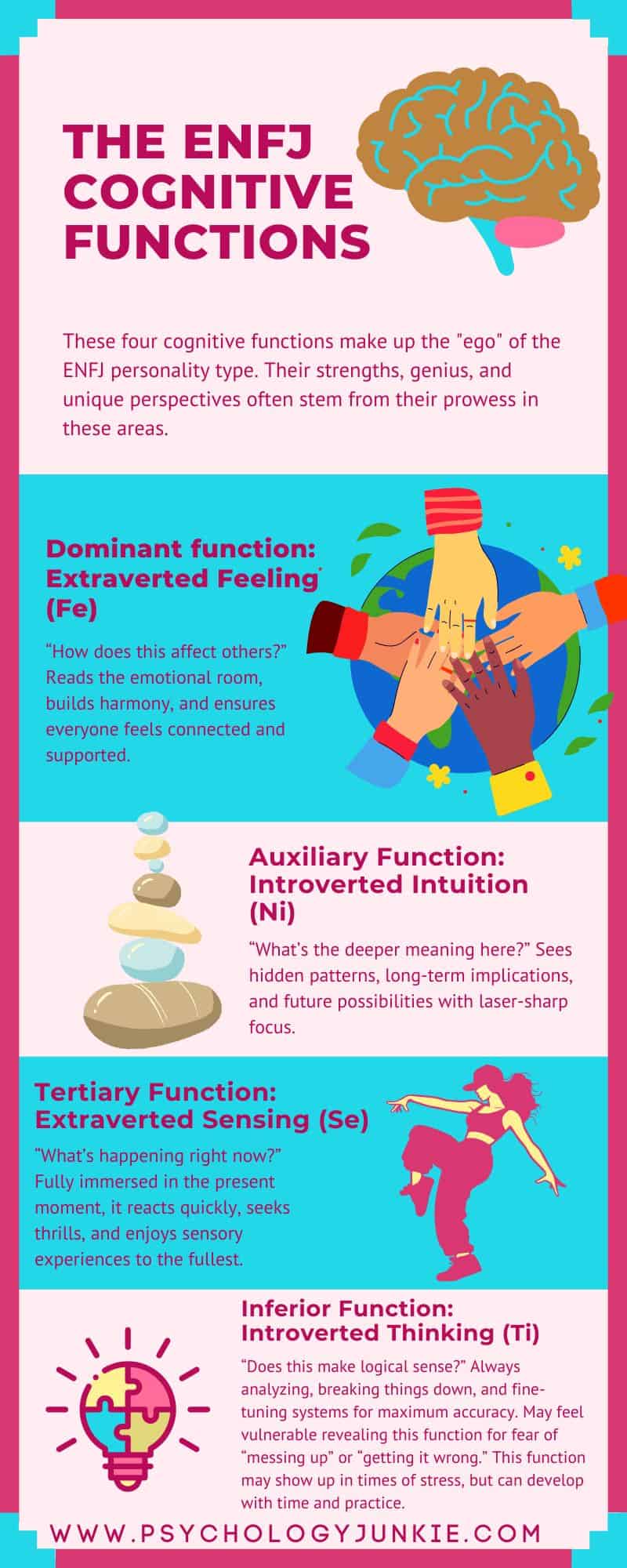
Dominant Function: Extraverted Feeling (Fe) – “The Emotional Conductor”
If the human experience was an orchestra, ENFJs would be the conductors—watching every musician (person), anticipating every crescendo (mood shift), and making sure the entire performance (social environment) stays in harmony.
What It Does:
- Picks up on people’s emotions, social dynamics, and unspoken cues with eerie accuracy.
- Prioritizes group harmony and emotional well-being, sometimes at the expense of personal needs.
- Reads people so well it’s borderline unsettling—like an emotional Sherlock Holmes.
- Makes decisions based on collective values and what’s best for the group.
How This Shows Up in Real Life:
- They know when you’re lying about being “fine.” They just do.
- They just might be the friend who remembers your grandma’s childhood trauma, your favorite coffee order, and the things that make you light up.
- They can talk a room full of tense people off a metaphorical ledge with a well-timed joke, heartfelt speech, or an inspiring “we’re all in this together” moment.
- They will throw themselves into fixing someone’s emotional mess, sometimes ignoring their own mental exhaustion in the process.
Where This Gets Messy:
- Fe can get so focused on external harmony that ENFJs ignore their own emotions until they explode into an overdramatic, “I do so much for everyone and no one appreciates it!” moment.
- They might struggle with confrontation, smoothing things over instead of addressing problems head-on.
- If they sense someone’s pulling away, they can get clingy—like a human golden retriever who just needs you to be okay.
As an MBTI® practitioner, I’ve lost count of the number of ENFJs I’ve met who’ve run themselves into the ground helping everyone else process their feelings, only to end up emotionally wrung out because no one thought to check in on them. ENFJs, take note: You are not a public emotional support hotline. Set some boundaries. Drink some water. Let people clean up their own messes once in a while.
Auxiliary Function: Introverted Intuition (Ni) – “The Grand Visionary”
Now, if Fe makes ENFJs the emotional conductors, Ni is what makes them seem weirdly prophetic. While Fe keeps an eye on people’s emotional states, Ni is playing 4D chess with reality, trying to map out the future in ways most people don’t even consider.
What It Does:
- Sees patterns, future possibilities, and overarching themes in a way that’s almost spooky.
- Makes connections between seemingly unrelated things, forming deep insights and “aha” moments.
- Focuses on the big picture—often so much so that they forget to eat lunch or notice the pile of dishes in the sink.
- Drives a near-obsessive focus on purpose, meaning, and the grand plan.
How This Shows Up in Real Life:
- ENFJs often have these flashes of insight about where someone’s life is headed—sometimes before that person has even figured it out.
- They can predict social trends, organizational shifts, and relationship dynamics long before they happen.
- They are constantly analyzing: “What’s the deeper meaning? What’s the endgame? What’s the real story behind what’s happening?”
- They get frustrated when people can’t see the big picture as clearly as they do.
Where This Gets Messy:
- Because Ni operates in the background, ENFJs might struggle to explain why they know something will happen—they just do, and when people don’t listen, it’s aggravating.
- They can become so hyper-focused on a future vision that they bulldoze people who don’t immediately see what they see.
- When their plans don’t go the way they envisioned, they can spiral into a frustrated “What am I even doing with my life?” existential crisis.
One ENFJ I worked with told me she knew her friend was going to break up with their partner long before they did. “I could see it coming six months ago,” she said, frustrated. “They weren’t aligned anymore.” But of course, when she tried to warn her friend, they dismissed her. Then, half a year later, the breakup happened exactly the way she predicted, and all she could do was resist the urge to say, “I TOLD YOU SO.”
So, ENFJs, if you ever feel like you’re trapped in a time loop where you keep seeing things unfold before they happen, just know—it’s not just you. Ni is doing its thing. You can’t force people to see the future the way you do, but you can make a mental note and let them figure it out on their own time.
Tertiary Function: Extraverted Sensing (Se) – “The Impulsive Sidekick”
If Fe is the emotionally intelligent leader and Ni is the all-seeing strategist, then Se is the rogue, thrill-seeking sidekick that shows up at the most unexpected moments. It’s like that one friend who convinces you to do karaoke at 2 AM when you know you have a meeting in the morning. You don’t always listen to them, but when you do—it’s an experience.
What It Does:
- Focuses on the present moment, engaging with the physical world in a direct, immersive way.
- Soaks up sensory details—sights, sounds, tastes, textures, the whole shebang.
- Loves real-world action, spontaneity, and living in the moment (when it remembers to).
- Adds a playful, adventurous streak to the otherwise serious and idealistic ENFJ.
How This Shows Up in Real Life:
- ENFJs might get these random bursts of “let’s do something crazy!” energy—booking a spontaneous trip, going all-in on a last-minute event, or deciding that right now is the time to rearrange all the furniture in the house.
- They may have a thing for good aesthetics—dressing sharply, appreciating fine art, or somehow always having great Instagram-worthy photos of everything.
- Sometimes, they’ll get sucked into sensory indulgences—over-shopping, stress-eating, or binge-watching an entire show in one sitting, despite definitely having things to do.
- They love experiences that feel exciting—concerts, dancing, intense storytelling, anything that lets them fully engage with life.
Where This Gets Messy:
- Because Se is tertiary, it’s like an enthusiastic but unreliable sidekick—it wants to jump in, but it’s not always consistent. One day, the ENFJ is all about living in the moment, and the next, they’re stuck in their head again, strategizing a 10-year life plan.
- It can make them prone to sensory overload. They take in a lot at once—so when things get too chaotic, it’s like a mental system crash.
- Their sudden urge for spontaneity might clash with their otherwise structured, future-focused nature. “Should I go skydiving this weekend or finish that long-term career goal I’ve been working on for years?” Tough call.
So, ENFJs, if you ever find yourself randomly craving an extreme sport, a flashy outfit, or a dramatic, movie-worthy life moment—it’s probably Se talking. Enjoy it. Just maybe don’t let it convince you to spend your entire savings on concert tickets.
Inferior Function: Introverted Thinking (Ti) – “The Overthinking Gremlin”
Ah, Ti. The snarky, logic-obsessed gremlin lurking at the bottom of the ENFJ’s cognitive primary function stack. It’s not always their strong suit, but when it does show up, it tends to bring a lot of existential questions, self-doubt, and the occasional impromptu Wikipedia deep dive at 3 AM.
Now to be clear, Introverted Thinking is part of the core of the ENFJ type. They have an inner skeptic who takes apart logic and systems, usually systems involving people, to try to figure out how they work. An ENFJ can hoard information about human psychology, relationships, and dynamics in an effort to better understand humanity as a whole. While it may not be as obvious and confident as Extraverted Feeling, Introverted Intuition, or even Extraverted Sensing, it’s still part of the foundation of what makes an ENFJ really tick.
What It Does:
- Focuses on internal logic, analysis, and understanding how things work.
- Loves precision, categorization, and breaking things down into their component parts.
- Can be skeptical—wants things to make sense on a logical level.
- Shows up more obviously under stress, overcompensating with over-analysis and second-guessing.
How This Shows Up in Real Life:
- ENFJs are usually big picture thinkers, but when Ti kicks in, suddenly every little detail matters—whether it’s a technical mistake in a project, an inconsistency in a friend’s story, or the weird way someone worded a text message.
- They might go down logic rabbit holes—reading up on philosophy, questioning everything about their worldview, or trying (and failing) to argue their emotions away.
- When stressed, they overanalyze—turning a simple decision into a mental chess game where every move has catastrophic consequences. “What if this one choice ruins everything?”
- Sometimes, Ti makes them weirdly blunt. They spend so much time prioritizing harmony (Fe) that when Ti finally speaks up, it just drops unfiltered logic like a mic drop—often surprising even themselves.
Where This Gets Messy:
- Because Ti is inferior, it’s not exactly a well-oiled machine. Sometimes (but not always) it makes ENFJs think they’ve nailed the logic when… they haven’t. (See: confidently explaining something completely incorrect but making it sound convincing anyway.)
- It can trigger imposter syndrome. “What if I don’t actually know anything? What if I’ve just been faking intelligence this whole time?”
- Ti can also make them hypercritical of themselves or others—obsessing over tiny inconsistencies or perceived flaws in an attempt to find some kind of objective truth.
So, ENFJs, if you ever find yourself deep in a self-induced logic crisis, arguing with yourself in the mirror about whether or not free will exists—just take a deep breath. Ti is not your full-time job. Let it help when needed, but don’t let it convince you that questioning your entire existence is a productive use of your time.
The ENFJ’s Shadow Functions: When Things Go Sideways
So, we’ve covered the top four functions—the ones that drive the ENFJ’s daily life. But what about the ones lurking in the background? The shadow functions are like the unruly basement goblins of the ENFJ’s psyche. They don’t show up often, but when they do, things get… weird.
These functions tend to emerge under stress, insecurity, or exhaustion. Instead of the usual confident, inspiring ENFJ energy, you get overthinking, emotional meltdowns, unnecessary rebellion, or an out-of-character coldness that leaves everyone (including the ENFJ) wondering, What just happened?
Now that we’ve acknowledged their existence, let’s take a look at how they operate.
“When the tools available to our ego are not sufficient to defend us from assaults upon our personal integrity, the shadow usually steps in, unconsciously, with its alternative ways of operating, unfettered by moral constraints.”
– Mark Hunziker, Depth Typology“The shadow is the part of us that others see, but we don’t.”
– John Beebe
Opposing Role: Introverted Feeling (Fi) – “The Lone Wolf Values System”
Fi is the ENFJ’s frustrated, rebellious alter ego. While Fe is all about external harmony and shared values, Fi is that little voice in the back of their head whispering, “But what about your feelings?” It’s the function that makes them suddenly annoyed when people expect them to be emotionally available 24/7.
How This Shows Up:
- When people dismiss their emotions or tell them they’re “too much,” Fi quietly simmers in resentment.
- They might go through phases of pushing back against societal expectations—only to feel guilty about it later.
- If they feel unappreciated, Fi kicks in with a dramatic internal monologue: “No one ever considers what I want. Maybe I should just disappear for a while.”
- Sometimes, they just need to do things for themselves—not because it makes someone else happy.
The Struggle:
- Fi isn’t their strong suit, so when they try to “go their own way,” they often feel lost, conflicted, or unsure if they’re actually following their true values or just reacting out of frustration.
Critical Parent: Extraverted Intuition (Ne) – “The Overactive Conspiracy Theorist”
Ne is the function that makes ENFJs overthink every possible outcome, but in a way that isn’t nearly as refined as their usual Ni-driven insights. It shows up like a chaotic brainstorm that won’t shut up—especially when they feel stressed or criticized.
How This Shows Up:
- When they’re stressed and trying to make a decision at the same time, they suddenly start seeing all the bad possibilities. “What if this project flops? What if they secretly hate me? What if society collapses?”
- Ne makes them second-guess their instincts. “Wait, but what if this other thing is actually the right answer?”. The inner voice of Ne can feel critical, demeaning, dismissive, and harsh to them.
- If they feel trapped, Ne feeds them unrealistic escape plans: “I should just quit everything and move to the mountains.”
The Struggle:
- ENFJs crave certainty and vision. When Ne gets out of control, it makes them feel like they have zero idea what’s going on—and they hate that.
Trickster: Introverted Sensing (Si) – “The Unreliable Historian”
Si is the ENFJ’s weak spot when it comes to details, past experiences, and consistency. It’s like trying to recall a memory but only getting blurry flashes of random moments.
How This Shows Up:
- They’ll remember the feeling of an event, but not the specific details.
- Si struggles to keep track of routines, schedules, or the exact way something was done before.
- When stressed, they might suddenly cling to past mistakes, overanalyzing them and feeling trapped by what went wrong.
- They sometimes forget important personal lessons and repeat the same cycle—only realizing it after they’ve done it again.
The Struggle:
- ENFJs are future-focused, so being forced to rely on past precedent or minute details? Ugh. Not their thing.
Demon: Extraverted Thinking (Te) – “The Ruthless Overlord”
Te is the ENFJ’s absolute last resort—their inner drill sergeant that only shows up when everything is falling apart. Normally warm and people-focused, an ENFJ undergoing a chronic level of extreme stress may suddenly become cold, blunt, and hyper-logical. They also might struggle to appreciate Extraverted Thinking in others, seeing TJ types as being intentionally harsh, insensitive, or “mean.”
How This Shows Up:
- Instead of their usual compassionate leadership, they become brutally direct. “I don’t have time for feelings—just get it done.”
- They might detach from emotions completely, making decisions based purely on efficiency.
- If pushed too far, they can bulldoze people, shutting down any debate with an “I SAID WHAT I SAID” attitude.
- Later, once they’ve calmed down, they’ll feel terrible about it and over-apologize.
The Struggle:
- This function drains them fast. They often try to bury any memory of using this function, because they don’t associate it with themselves. If they stay in this mode too long, they end up exhausted, guilty, and questioning their entire existence.
Final Thoughts: The Beautiful Story of Being an ENFJ
At their best, ENFJs are compassionate visionaries—leaders who can see potential in people before they even see it in themselves. They uplift, inspire, and rally the troops like nobody’s business. At their worst? They’re overworked, emotionally drained, doubting everything, and debating whether they should just disappear into the woods for a few months to “find themselves.”
The key takeaway? ENFJs, your strengths are powerful, but so are your limits. You don’t have to be everyone’s life coach. You don’t have to predict every possible outcome. And you definitely don’t have to carry the weight of the world just because it feels like no one else will.
What do you think? If you’re an ENFJ, do these functions resonate with you? Have you ever noticed your shadow functions creeping in during stress? Drop your thoughts in the comments—I’d love to hear how this plays out in your own life!