The Magic of Journaling for INFJs, ENFJs, INFPs, and ENFPs
There’s something sacred about the blank page.
For Idealists — the NF personality types in the Myers-Briggs® system — journaling can be a lifeline. A ritual. A private portal into meaning. While other types might journal to keep track of appointments or vent about their boss, NFs pick up the pen and start a dialogue with the universe. Or the soul. Or that part of themselves that still believes in magic even when the dishes aren’t done and their work feels meaningless.

There’s no such thing as “just writing things down” when you’re an Idealist. Every sentence could spark a new turn in life. Every half-finished metaphor is an invitation to look deeper. It’s not always tidy — clarity rarely is — but it’s luminous and alive and, at its best, life-saving.
Not sure what your personality type is? Take our personality questionnaire here. Or you can take the official MBTI® here.
First, Who Are the Idealists?
According to David Keirsey, Idealists are the NF personality types — INFJs, INFPs, ENFPs, and ENFJs. He links them to the ancient philosopher-kings described by Plato, people who intuit meaning behind reality rather than just taking the world at face value. They are “noetic,” meaning they engage in pure, intuitive thought — often without hard data or concrete proof.
Keirsey describes Idealists as having an “identity-seeking personality.” They’re not just trying to figure out what’s happening — they’re trying to figure out what it means. Why it matters. Who they are in the middle of it all. They’re inductive thinkers, meaning they leap from part to whole, from symbol to Truth, from passing comment to “My entire value system is crumbling, and also I might be in love?”
Why Journaling Is Practically a Spiritual Practice for NFs
For Idealists, journaling isn’t about tracking symptoms or bullet journaling your way into peak productivity. (Though no judgment if you do have a bullet journal — we see you, NFJs.)
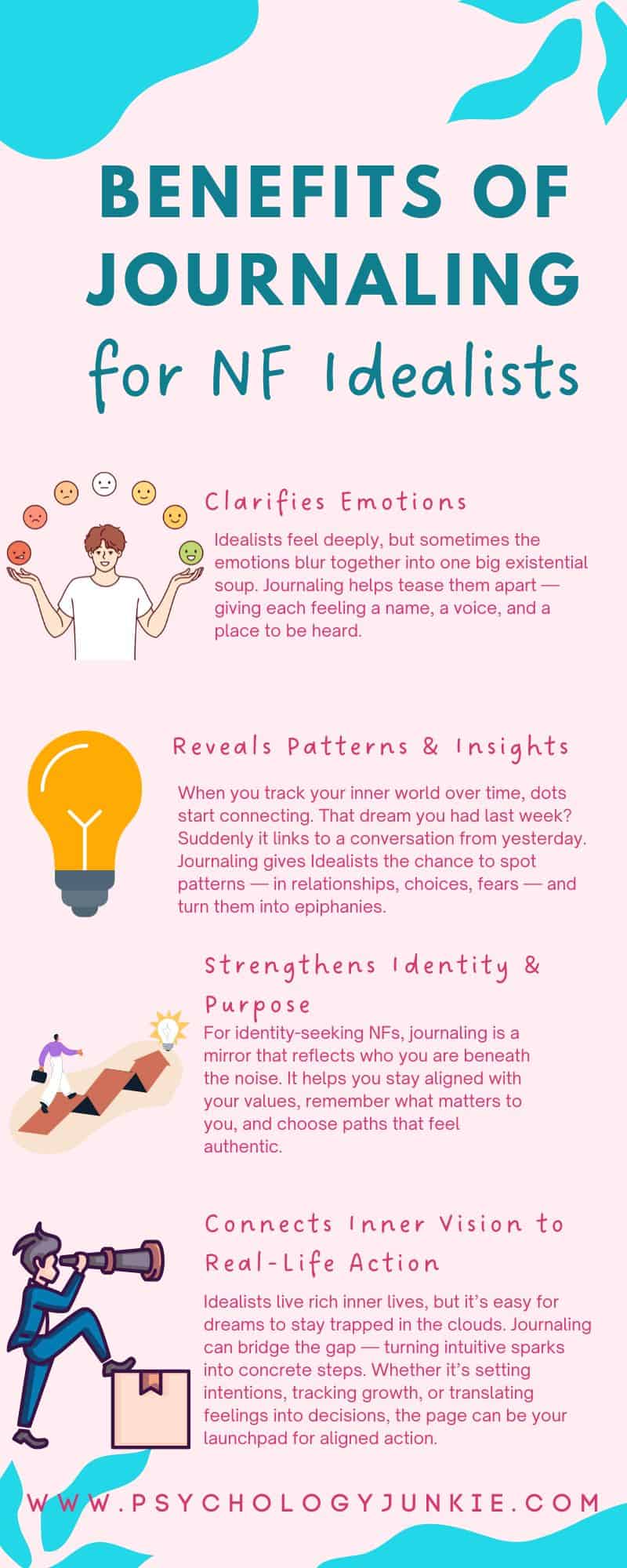
Journaling is where Idealists:
- Translate emotion into language
- Clarify what they believe about themselves and others
- Sense patterns and connections in their experiences
- Transform pain into insight
- Reconnect with their inner moral compass after the world spins them around
It’s not about making sense in a linear, spreadsheet-friendly way. It’s about tuning in to the deeper current underneath the chaos. The part that says, “Hey, something’s happening here. Let’s listen.”
It’s where intuition meets articulation. Where the blurry emotional fog starts to condense into stars.
But Sometimes It’s Spiraling in Disguise.
There’s a fine line between introspection and over-identification. Between poetry and projection. Between insight and rabbit hole.
And when you’re fluent in metaphor and fluent in emotion, it’s easy to turn your journal into an echo chamber of your own worst fears — dressed up in the most beautiful prose.
That doesn’t mean journaling is bad for NFs. It just means that how you journal matters.
To stay anchored in your real values, not just the seductive storylines your imagination hands you.
And to remind yourself: this isn’t just a place to feel. It’s a place to understand.
How to Journal Without Getting Emotionally Sucked Into the Void
Let’s break it down into four principles to get Idealists out of the spiral and into something grounded (without losing the soul-searching magic).
1. Name the Feeling Before You Narrate It
Before you write your poetic reflection on heartbreak as a sandcastle swallowed by the sea, try starting with:
“I feel rejected.”
Just name it. It might feel plain. Boring. Emotionally beige. But it creates a tether. You’re naming reality before reimagining it — which helps you process.
2. Ask: “Is this insight or story?”
Idealists often confuse spiraling for clarity because they’re so good at making meaning. But meaning isn’t always truth. It’s just…meaning. Sometimes you’ve built a beautiful explanation that feels true but isn’t grounded in any facts whatsoever. (We’ve all done it.)
After you’ve written a big emotional breakthrough, ask yourself:
“Is this an insight — or is this just a story I’m telling to make sense of discomfort?”
Both are fine. But knowing the difference will save you a lot of unnecessary self-doubt.
3. Use Structure (If You Feel Like It)
Freewriting is fun until it’s 3 a.m. and you’re crying over a sentence that reminds you of that one time in sixth grade someone told you your laugh was weird.
Try structured prompts:
- “What happened?”
- “How did I interpret it?”
- “What part of that interpretation might be based on fear or assumption?”
- “What’s a kinder possibility?”
- “What do I need right now?”
INFJs especially: This is where your Introverted Thinking can help. Bring in some healthy skepticism. Not everything your mind spins is the gospel truth. Sometimes it’s just your anxiety doing improv.
4. End With a Truth You Can Hold
NFs are inductive. We leap. We intuit. We make connections that others don’t see. But that also means we need anchors — small, affirming truths to close the loop.
Try ending your journal entry with:
- “What I know for sure is…”
- “A truth I want to remember is…”
- “Today, I can choose…”
It gives your deep dive an exit ramp. Otherwise, you risk staying in that mental labyrinth until your pen runs dry or you start quoting Emily Dickinson by accident.
Type-Specific Tips
Now let’s get specific. Because let’s be real — not all NFs spiral the same.
INFP – The Soul Cartographer
If your journal entries had a genre, it would be epic quest meets whispered confessional.
Why it works for you:
You are fluent in emotional nuance. You can sit with your feelings without trying to solve or dismiss them — and that makes your journal a sacred space. It’s where you reconnect with your authenticity when the world asks you to be anything but.
Magic on the page:
Your metaphors are art. Your emotional honesty is fearless. You can take something as messy as shame or longing and turn it into something profound.
But here’s where it gets tricky:
Sometimes your journal becomes a refuge from life instead of a reflection on it. You process so deeply that you forget to resurface. You mourn possibilities that never happened. You write to understand yourself… and then get lost in trying to be understood by an imaginary reader who doesn’t exist.
To try:
- End entries with a grounding truth: “Today, this is who I am, and that is enough.”
- Use prompts like “What part of me is asking to be heard today?” or “What would compassion say right now?”
- Write a letter from your future self who’s survived this exact emotional storm. What do they want to tell you?
- Draw your mood as a landscape. Don’t worry if you’re not “good” at drawing — is it a swamp? A twilight meadow? A galaxy imploding gently?
- List “10 things I know are true today,” even if they’re tiny (e.g., tea is good, dogs exist, I’m still here).
- Design a character who’s living your fear. Write about what happens to them — and how they find a way through.
“Don’t bend; don’t water it down; don’t try to make it logical; don’t edit your own soul according to the fashion. Rather, follow your most intense obsessions mercilessly.”
— Franz Kafka
INFJ – The Meaning Sleuth
Your journal is equal parts sanctuary and strategy session. You write like a philosopher in disguise — one who’s also trying to solve a mystery involving everyone’s hidden motives, past wounds, and unresolved karmic contracts.
Why it works for you:
You’re wired to seek patterns, and your journal is where the puzzle pieces fall into place. A feeling, a dream, a throwaway conversation — you pick up the thread and follow it until it weaves something coherent, something healing.
Magic on the page:
You’re a master of connecting the seen with the unseen. You write to align — with your purpose, your relationships, your inner truth. When you journal, it’s like watching fog lift from a field. There’s still mystery, but now there’s also light.
But here’s where it gets tricky:
You might over-analyze instead of process. You journal about emotions instead of from them. You also might journal other people’s feelings more than your own — which can leave you quietly burning out.
To try:
- Start with “What am I feeling right now in my body?”
- Write in first-person, raw and unedited, before switching into your usual analysis mode.
- Use the question “What do I need right now — even if it feels selfish?” as a regular prompt.
- Use the “iceberg” method: What’s at the surface (the situation), what’s under it (your emotional response), and what’s at the bottom (your core need or belief)?
- Make a “truth tree.” Start with a feeling, branch out into the beliefs it connects to. Which ones are rooted in fear? Which are rooted in love?
- Do a “mirror journal” session where you write as if your dearest friend is going through your problem — what would you say to them?
“The answers you seek never come when the mind is busy, they come when the mind is still.”
— Leon Brown
ENFP – The Inner World Explorer
Your journal is a jungle gym of ideas, emotions, dreams, philosophies, and to-do lists that somehow end in existential revelations. You write like your brain is having a party and every part of you showed up — inner child, philosopher, romantic, mischief-maker.
Why it works for you:
You crave self-discovery. Journaling gives shape to your sprawling inner universe. It helps you understand why you suddenly want to move to Portugal, start a nonprofit, and re-read The Little Prince — all before breakfast.
Magic on the page:
Your voice is electric and alive. You find meaning in detours, wisdom in chaos. And you don’t judge what comes up — which means your journal gets to be honest, wild, and brave.
But here’s where it gets tricky:
Focus can be hard. You bounce between ideas so quickly that you leave insights half-formed. Also, your optimism sometimes turns into self-gaslighting: “Everything’s fine! It’s probably a growth opportunity!” (Meanwhile, you haven’t slept in four days.)
To try:
- Create themed journaling days: “Memory Monday,” “Feeling Friday.” (You’ll rebel eventually, but it’s fun while it lasts.)
- Ask: “What do I want to carry forward from this feeling?” instead of “What’s wrong with me for feeling this?”
- “Three things I’m not allowed to want (but secretly do)” — then challenge the shame around them.
- Use color-coded pens for different emotions or voices. (You’ll rebel against the structure, but it’ll be glorious while it lasts.)
- List 20 “unreasonable” dreams. The ones that light you up but feel “too much.” Then pick one and write 5 small ways to honor it.
“I am not afraid of storms, for I am learning how to sail my ship.”
— Louisa May Alcott
ENFJ – The Emotional Visionary
You journal like you do everything else: with care, intention, and a surprising depth that most people miss because you’re too busy checking in on them. Your journal is your behind-the-scenes — where you take off the cape and figure out what you actually feel.
Why it works for you:
You process best in dialogue, and your journal becomes a safe, private listener. It’s where your own needs have a turn. It’s where you remember that your voice isn’t just meant for cheering others on — it’s meant to tell your truth, too.
Magic on the page:
You’re eloquent and compassionate, even with yourself. You can deconstruct a situation, understand everyone involved, and still ask, “What is my heart saying?” That kind of empathy — balanced with insight — is rare. And you do it instinctively.
But here’s where it gets tricky:
You sometimes write your ideal feelings instead of your real ones. You want so badly to rise above things that you forget that pain doesn’t mean failure. And if your entry turns into a rescue mission for someone else’s feelings? You’re deflecting.
To try:
- Use prompts like “What do I feel that I haven’t admitted to anyone yet?”
- Write without editing for clarity or grammar. Let it be messy.
- Create a playlist of “how I’m feeling” and journal to the lyrics that hit hardest.
- Journal in the second person. Talk to yourself like a best friend would.
- Make a “Should vs. Want” list. Every time you feel torn, split the page: What you “should” do vs. what you want to do. Let it open a conversation.
“If one is lucky, a solitary fantasy can totally transform one million realities.” – Maya Angelou
What Do You Think?
Journaling for NFs can be a sacred act of listening. It’s sitting down with your intuition, your feelings, your shadow and your spark, and saying:
“Okay. I’m here. Let’s figure this out together.”
It’s not about always writing the “right” thing. It’s about showing up honestly — even when your thoughts are tangled, even when you’re contradicting yesterday’s epiphanies, even when you’re not sure what it all means.
Especially then.
Because Idealists aren’t just trying to survive. You’re trying to live meaningfully. To be whole. To tell the truth, even if your voice shakes. To connect the seen with the unseen. And the journal is one of your most loyal companions in that journey.
So pick up the pen. Or open the doc. Or speak into the voice memo app while pacing your kitchen in your emotional support hoodie.
You are allowed to change. You are allowed to feel everything. You are allowed to make sense of the world in your own wild, poetic way.
And you are absolutely allowed to write like your soul is trying to find its way home.