
ESFP vs. ESFJ: Which One Are You?
If you’ve ever watched someone refill your drink, fluff your throw pillows, and compliment your shirt in one fluid motion, odds are you’ve met an ESFJ.
If you’ve ever watched someone show up late, take over the playlist, and then hand you a burrito because “you looked low-energy,” you’ve probably met an ESFP.

Both types are warm, friendly, generous with their energy—and absolute powerhouses in a social setting. But how they go about being sunshiney humans is very different.
So what’s the difference between an ESFJ and an ESFP? Think of it like this:
One thrives on structure, harmony, and being everyone’s emotional thermostat.
The other thrives on freedom, fun, and living life in a spontaneous way.
Let’s dive in.
The Function Stack Breakdown (Or: What’s Actually Powering These People)
Here’s the bare-bones function stack:
- ESFJ = Fe (Extraverted Feeling), Si (Introverted Sensing), Ne (Extraverted Intuition), Ti (Introverted Thinking)
- ESFP = Se (Extraverted Sensing), Fi (Introverted Feeling), Te (Extraverted Thinking), Ne (Extraverted Intuition)
Notice: not a single function is the same. These two types are different under the hood. Like comparing a strawberry smoothie to a spicy mango salsa. Both sweet. Both fun. One is served with a straw. The other with tortilla chips and a warning label.
Meet the ESFJ
ESFJs run on two functions called Extraverted Feeling (Fe) and Introverted Sensing (Si). Translation: They are deeply attuned to how everyone else is feeling (Fe), and they ground that empathy in a solid memory of past interactions, traditions, and shared experiences (Si).
This is the person who texts you to check in after your dentist appointment and actually remembers your cat’s name from a story you told in 2017. Their emotional awareness is outer-focused: they feel when you feel.
They’re planners. They host. They decorate for holidays. They believe in the magic of birthday cards and shared meals. Their happiness often comes from helping others feel seen, safe, and supported. But make no mistake—they also have Opinions™.
Fe-Si doesn’t mean pushover. It means they’ve memorized the Social Rulebook and can easily navigate a variety of settings with a “know how” about what’s expected. It also means they know how to influence social groups, orchestrate the mood, and (usually gently) convince people to behave in an appropriate way that aligns with the group’s values.
Meet the ESFP
Now the ESFP. These types run on functions called Extraverted Sensing (Se) and Introverted Feeling (Fi): They live in the moment, spontaneously finding opportunities in real-time (Se), and make decisions based on what feels emotionally right and authentic to them (Fi).
Where the ESFJ wants to make everyone feel included, the ESFP wants to make everyone feel alive. When the group seems to somber or serious they’ll either A) leave, or B) convince everyone to do karaoke or a spontaneous road trip, you never really know.
ESFPs are impulsive, bold, and often a little unpredictable. They can pivot from cracking jokes to getting real about life’s emotional complexities faster than you can say “Why am I crying at brunch?”
Their Fi is deep, personal, and fierce. They won’t say yes unless they feel it. They won’t pretend unless it’s theater. And if you try to shame them into being “more appropriate,” they’ll likely walk out of your life with no explanation and no forwarding address.
Fe vs Fi: Feelings, But Very Differently
Everyone has emotions. Everyone has values. But the way ESFJs and ESFPs prioritize and process their emotions is very different.
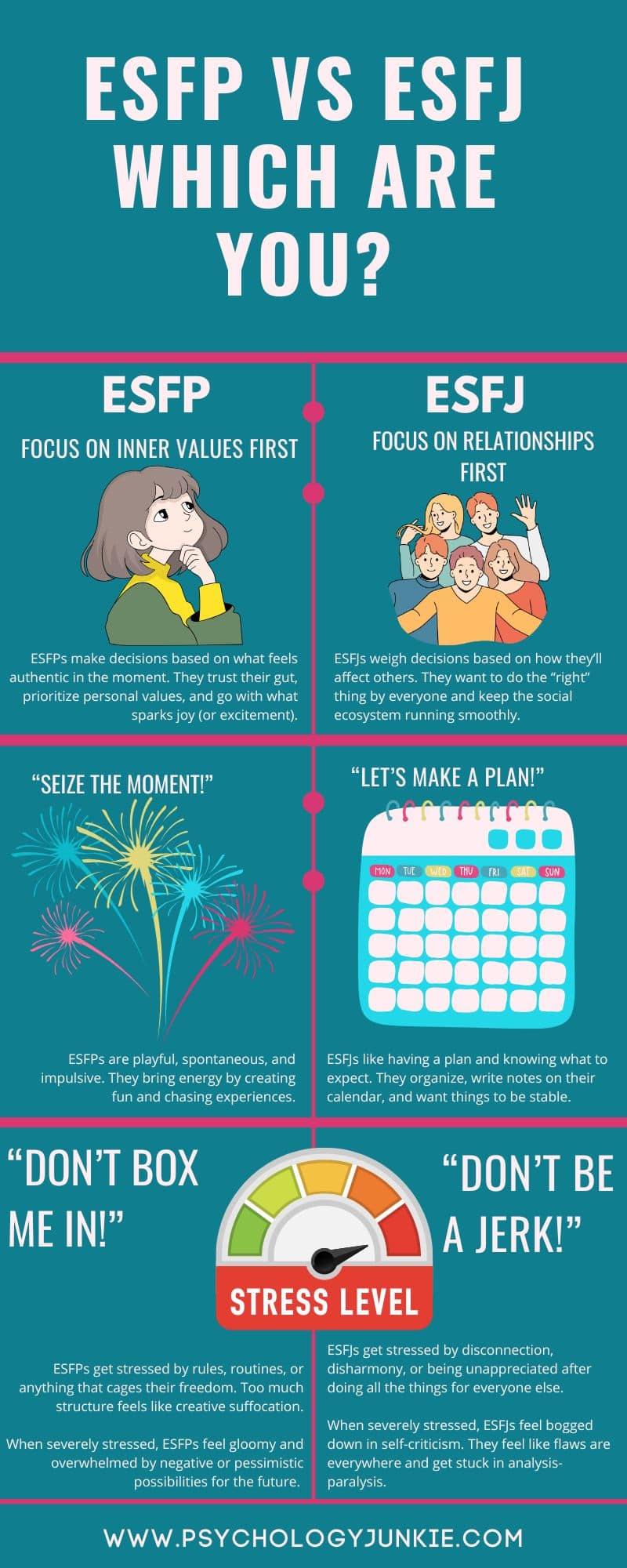
ESFJs (Fe): Emotions are social. They read the room, feel what others are feeling, and work to maintain harmony. Their own emotional experience is often filtered through what’s appropriate, expected, or needed by others.
They’re diplomatic, tactful, and genuinely moved when people feel connected and cared for.
ESFJs are going to feel more emotionally inspired when they’re with others, interacting socially. They feel their feelings best when they’re revealed, talked about, and shared with others.
ESFPs (Fi): Emotions are personal. They feel what they feel, deeply and often silently, until it bursts out in a sudden act of radical authenticity or expressive creativity. Their compass isn’t what the group needs. It’s what their heart is telling them.
ESFPs are going to feel more emotionally intense when they’re alone, processing without distractions. They feel their feelings best while they’re either in action, experiencing the world in a sensory way, or when they’re alone, contemplating.
Fe is about emotional connection. It feels through connection.
Fi is about emotional truth. It feels through private contemplation.
Se vs Si: Now vs Then
Here’s another key contrast:
ESFPs (Se) live in the now. They see what’s in front of them. They feel it, taste it, hear it, move with it. They’re often drawn to adventure, experience, surprises, movement, performance. They like to touch the world.
ESFJs (Si) live in the then (with a bit of now). They compare the current moment to what’s worked in the past. If Christmas always had matching pajamas, then by God, you’re going to wear them this year too. Si gives them a grounded sense of continuity. A reliable thread through time.
So if you invite both to a weekend retreat…
- The ESFJ packs an emergency kit, printed directions, and everyone’s allergy info.
- The ESFP forgets socks, but brings a Bluetooth speaker and turns the trip into a spontaneous dance party in the woods.
How They Handle Conflict
Imagine someone hurts their feelings.
- The ESFJ overthinks it, tries to “be mature,” eventually brings it up via a very thoughtful text, then spirals when they don’t get an immediate reply.
- The ESFP shrugs it off—until they don’t. When the pain hits that personal Fi nerve, they withdraw. Hard. And when they come back, they might pretend nothing happened. Or they might suddenly say everything they’ve been holding back for months.
Fe says: Let’s fix this so we can be okay again.
Fi says: If I have to ask you to care, you already don’t.
One smooths things out. The other sets fire to the bridge if it starts feeling fake.
Stress Spirals: What Happens When They Break
ESFJ under stress = Inferior Ti grip.
Normally warm and emotionally in sync, stressed ESFJs get stuck in their heads, analyzing everything to death. Their inner monologue sounds like a sarcastic accountant with abandonment issues. Suddenly they’re doubting every feeling, second-guessing every conversation, and replaying that one awkward comment from three weeks ago on loop like it’s a cursed mixtape.
They become critical, withdrawn, or weirdly obsessed with being “logical,” but it’s not smooth logic—it’s anxious logic. Think: “Everyone hates me. Here’s an Excel sheet of evidence.”
When their Fe breaks down, they start judging themselves harshly for being too emotional, too needy, too much. And instead of seeking connection, they shut down and try to solve everything solo, which only makes them feel more isolated.
ESFP under stress = Inferior Ni grip.
This is when the sunshine turns into a storm cloud. Normally energetic and full of present-moment sparkle, the stressed ESFP suddenly becomes eerily quiet, withdrawn, and brooding. That’s Ni—their shadow function—taking the wheel and whispering existential dread like a bad poetry slam in their head.
They start seeing patterns that aren’t there. They interpret setbacks as signs that they’re doomed, that life has no meaning, or that everything good is slipping through their fingers. In extreme moments, they may spiral into wild predictions about their future—most of them bleak, all of them vague, and none of them helpful.
Love Languages and Dealbreakers
Both are charming, affectionate, and loyal once they commit. But again: different flavors.
ESFJ in love:
- Gives practical care and steady support.
- Buys gifts with nostalgic meaning. (The necklace reminds her of your first date.)
- Asks a lot of “Are you okay?” questions.
- Needs reassurance and appreciation like plants need sunlight.
ESFP in love:
- Shows affection through shared experiences and fun.
- Gives spontaneous gifts. (The rock reminded them of you. Somehow.)
- Might avoid talking about feelings… until they suddenly really talk about feelings.
- Needs freedom and authenticity. If it starts to feel like a performance (or a cage), they’ll peace out.
ESFJs want security and affirmation.
ESFPs want intensity and freedom.
Career Trends:
ESFJ at work:
- Organized. Reliable. Team-oriented.
- Often takes on too much.
- Hates inefficiency but avoids confrontation unless necessary.
- Loves roles where they can help others: healthcare, education, hospitality, HR.
ESFP at work:
- Energetic. Flexible. Action-oriented.
- Hates being micromanaged.
- Wants their work to matter—and to not be boring.
- Thrives in performance, sales, entrepreneurship, design, anything with movement.
The ESFJ is the team captain who brings snacks and friendly chit-chat.
The ESFP is the star player who showed up late but scored the winning point.
What They Have in Common
Despite their differences, these two types do share a few core traits:
- They’re both extroverted feelers in their own way: one with Fe, one with Fi.
- They’re both socially attuned and tend to light up in group settings (though ESFPs may burn out fast if chit-chat reigns, wanting to take action or DO something. ESFJs may burn out fast if things are too unpredictable or if people aren’t respecting others’ feelings).
- They both want to make people happy—just for very different reasons.
- And they both have a deep desire to live a good life—not just for themselves, but for the people they love.
The ESFJ does it by building a warm, structured nest for everyone to thrive in.
The ESFP does it by creating moments of joy, spontaneity, and raw, beautiful honesty.
How to Spot the Difference (Without Asking For Their Test Results)
Ask yourself:
- Do they mirror other people’s moods and needs? (ESFJ)
Or stay steady in their own feelings and resist group pressure? (ESFP) - Do they create structure and care routines? (ESFJ)
Or create moments and thrilling experiences? (ESFP) - Do they get stressed by unpredictability? (ESFJ)
Or by planning and rigid expectations? (ESFP) - Do they avoid conflict to preserve harmony? (ESFJ)
Or avoid conflict until their inner truth demands expression? (ESFP) - Do they thrive on consistency? (ESFJ)
Or variety and novelty? (ESFP)
Which One Do You Relate to Most?
What do you think? Do you see yourself more in the ESFP or the ESFJ? Let me know in the comments! Or ask questions if you’re still feeling unsure.
Other Articles You Might Enjoy:

ESFP Cognitive Function Guide

The Unhealthy ESFP Personality Type

5 Things ESFJs Absolutely Hate (with Infographic)

The ESFJ’s Cognitive Functions: An In-Depth Guide

7 Things That ESFJs Experience as Children

24 Signs That You’re an ESFP, the Champion Personality Type