
The INFJ Male Experience: When Everyone Confides in You, but Few People Know You
As an INFJ man, you’ve probably noticed that you’re the guy everyone tells things to.
Their relationship problems. Their family history. The thing they haven’t admitted to anyone else, which apparently needs to come out while you’re both standing beside the microwave.

You listen, ask questions, and try to understand what’s underneath the words. But when the conversation ends, you sometimes realize that they know very little about you. I’ve heard this again and again with INFJ men that I’ve coached and worked with over the years. A common experience is for INFJs is being the one who listens to what kept someone else awake at night, who nods, and asks the insightful question. But in turn, many INFJs, men in particular, find themselves being trusted but not feeling especially known or heard themselves.
In the personal accounts I’ve been reading from men who identify as INFJs, this tension kept coming up. They wanted meaningful friendships and relationships, but worried that showing more of themselves would invite rejection. Some felt so comfortable being alone that reaching out started to feel like an unnecessary risk. After all, being everyone’s unpaid therapist can feel meaningful but also draining when the experience isn’t reciprocated in a meaningful way.
These accounts can’t tell us what every INFJ man experiences. But they raise a question worth exploring: What happens when a man wants to be understood, yet has learned to make himself easy to need and difficult to know?
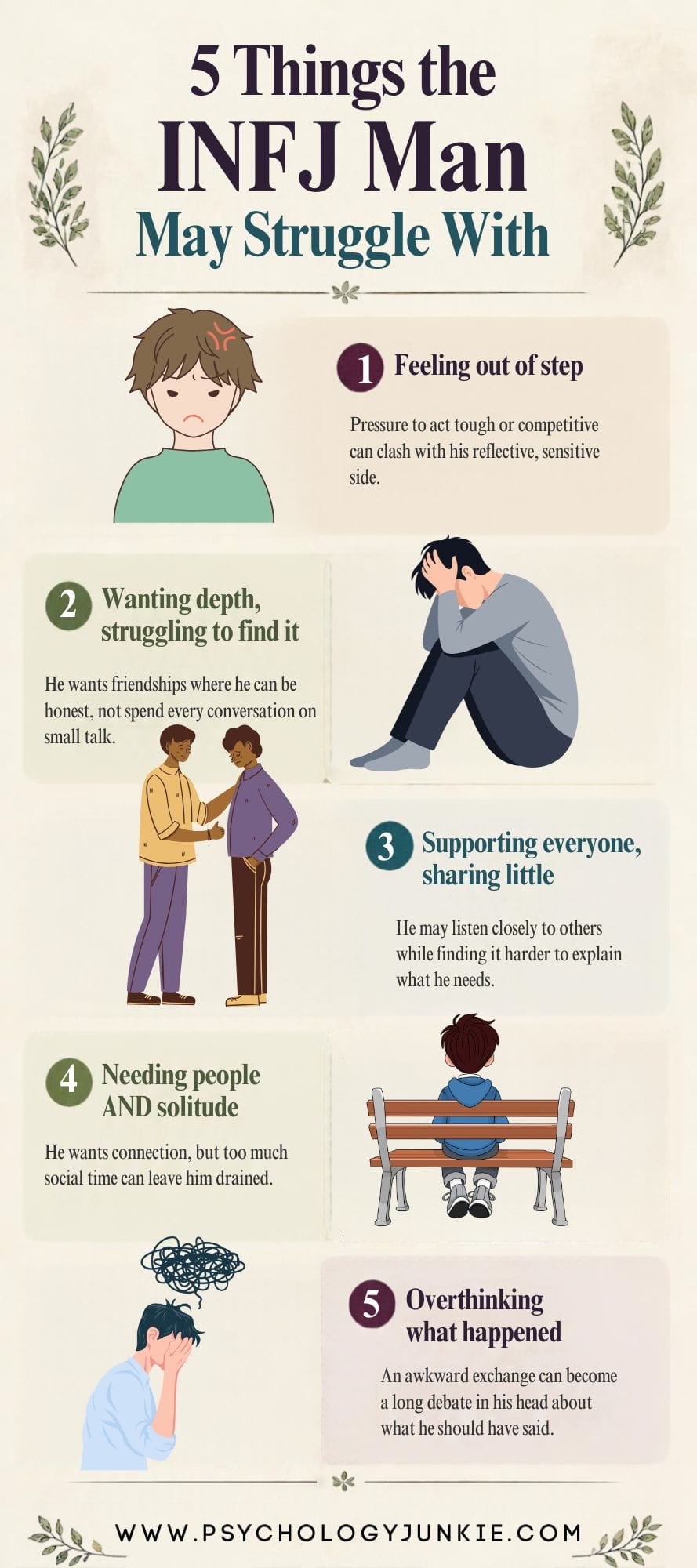
When Your Personality Doesn’t Match the Job Description for “Man”
There’s a particular version of masculinity that many boys encounter early: be “tough”, be decisive, keep your feelings under control, and preferably know what that noise in the car means. In Western society in particular, being an ESTP or ESTJ male is more the expected norm. Depending on your family and culture, the expectations might be subtle or delivered directly. But the messages are often like this: Stop being so sensitive. Don’t let people see that you’re upset. Handle it yourself. Be tough. Be formidable.
And what does “tough” mean anyway? To many in Western cultures it means hiding emotions, being blunt, focusing on material wealth, or picking up a heavy weight. An INFJ boy who cares deeply about conflict, needs time to process his reactions, or enjoys imagining and reflecting can start wondering whether his natural preferences count against him. I’ve spoken to so many INFJ men who were criticized for their empathy, told to “man up” for being sensitive to others’ pain, or were told to “get out of their heads” to focus on things like money, cars, or sports.
An INFJ man might learn to disguise hurt as indifference. He might become agreeable because disagreement feels risky, then criticize himself for not being assertive enough. Or he might develop a tougher public manner that conceals how much he actually notices and feels.
For many INFJ men, it can feel like they have to put on a mask before they can go out into the real world and exist without being reprimanded for it. Or, in contrast, they might feel like people take advantage of their sensitivity and empathy, using it up without offering anything in return.
Of course, none of this belongs exclusively to INFJs. Men of many personality types run into these expectations. But for INFJs this experience tends to sting early on and shape the way they experience the rest of their lives. The world wants decisiveness and boldness, and while INFJs can be decisive and bold, it shows up in a more quiet, contained manner. They reflect, consider, look for patterns, and tend to speak with a gentle tone. The world might say “Boys don’t cry” or “Boys don’t show their feelings” but for the INFJ man, expressing emotions is one of the best ways to understand them and, in turn, make decisions that feel personally meaningful.
The Cost of Always Handling It Yourself
Broader research gives us reason to question some of the expectations men face.
A meta-analysis covering 78 samples and more than 19,000 participants found that conformity to certain masculine norms, including self-reliance, was associated with poorer mental health outcomes and less willingness to seek psychological help. The findings varied by the specific norm; masculinity wasn’t treated as one uniform thing. This wasn’t research on INFJs, and the associations don’t establish causation, but they do challenge the idea that handling everything alone is always healthy.
For a man who already prefers to process things internally, extreme self-reliance can look deceptively natural. You tell yourself you need time to think, and sometimes you do. But sometimes you’re postponing a conversation because you don’t want someone to see you confused, disappointed, or in need of reassurance.
Meanwhile, you may give other people the patience you struggle to extend to yourself. Their uncertainty seems understandable; yours feels embarrassing. I’ve seen this with so many INFJs. They value other people’s emotions and experiences, yet they often feel that their feelings are somehow less important or significant or even shameful.
Being dependable can become a role you don’t know how to step out of. Eventually, even people who care about you may assume you’re doing fine because that’s the only version they’ve been allowed to see.
Being Helpful Can Become a Hiding Place
Within type theory, INFJs pair an inward focus on patterns and meaning with an outward concern for people and relationships. In everyday life, that can look like spending a huge amount of time thinking about what someone meant, how they’re doing, and what might help.
That attention can make you a thoughtful friend. It can also keep the conversation comfortably focused on someone else.
If you’re asking the questions, you don’t have to answer them. If you’re helping someone work through a problem, your own unresolved problems can stay off the table. This might seem like calculation, but you genuinely want to help and may also feel safer in the helper’s chair. But how do you find your people? How do you learn that it’s okay to express your own inner world? Because one of your greatest strengths comes from having a vast inner world full of insights, meaningful thoughts, and a rich imagination.
Being useful might accidentally become your main route to connection. You may start wondering whether people would still seek you out if you had less advice, less patience, or a problem of your own. A friendship needs room for your experience, too. People can appreciate your support without realizing how little they’ve asked about you. Some will respond well when you begin sharing more; others may reveal that they were mainly interested in having an audience.
Either response gives you information you need.
When Solitude Starts Making Your Decisions
Several INFJ men I’ve spoken to in the making of this article described wanting connection while repeatedly retreating from opportunities to find it. Fear of rejection, comparison, and feeling inadequate all appeared in their explanations.
It’s tempting to file this under “introvert problems,” but introversion and fear aren’t interchangeable. Looking inward and needing time to reflect before responding to the outer world is different from wanting a relationship and feeling unable to pursue one.
Solitude can help you recover, think clearly, and enjoy your own interests. It can also make avoidance very comfortable. At home, nobody misunderstands your joke, turns down your invitation, or discovers that you’re less composed than you appear.
Of course, nobody gets the chance to surprise you with acceptance, either. And that’s important, too.
A useful question is: After spending time alone, do I feel more able to participate in my life, or increasingly reluctant to return to it?
You don’t need to become the man who enjoys networking breakfasts. You might need to send the message, accept an invitation, or let a promising friendship survive a slightly awkward conversation. Finding the social opportunities that work for you is extremely helpful. Here are some suggestions I’ve gotten from INFJ men about social opportunities that felt more natural to them.
- A small philosophy or psychology discussion group. A place to explore why people do what they do, preferably where disagreement doesn’t become a competitive sport.
- Regular volunteering with a small team. Habitat builds, community gardens, food banks, or conservation projects offer a useful task and familiar faces over time.
- A book club that welcomes deeper discussion. Literary fiction, science fiction, biographies, or books about society can give people plenty to talk about beyond whether they liked the ending.
- A walking or hiking group. Side-by-side conversation, fresh air, and occasional silence that nobody needs to fix.
- A men’s discussion or support group. Especially one that welcomes honesty about relationships, fatherhood, purpose, and loneliness without pushing an idea that there’s only one correct way to be a man.
- A writing workshop. A natural fit for someone who enjoys developing ideas then sharing them with people who care about words.
- A cooperative board game or tabletop role-playing group. Shared storytelling, problem-solving, and a recurring cast of people. Having a role to play can take some pressure off.
- A film club with discussion afterward. Particularly appealing if you enjoys examining characters, moral dilemmas, and the meaning behind a story.
- A class that meets for several weeks. Pottery, photography, woodworking, cooking, or a language course. Friendship gets more chances to develop when everyone keeps showing up.
- A meditation group or thoughtful spiritual community. For those interested in contemplation, meaning, or faith, with room for questions and personal differences.
- A cause-focused community group. Working on an issue you care about can make socializing feel purposeful.
- A small dinner or recurring coffee gathering. Three or four people, enough time to settle into conversation, and no need to compete with a loud room.
- A low-pressure recreational group. Birding, nature photography, casual cycling, or beginner climbing can provide companionship without requiring constant conversation.
Letting Someone Know You Before You’ve Figured Everything Out
Carl Rogers wrote in On Becoming a Person, “The curious paradox is that when I accept myself as I am, then I change.”
I like that because self-acceptance can sound suspiciously like permission to stay stuck. Rogers saw it as a starting point for movement. Acknowledging where you are gives you something honest to work with.
For an INFJ man, that might mean admitting that you’re lonely without treating loneliness as a personal failure. It might mean recognizing that you’ve been avoiding rejection, then making one small invitation anyway. It might mean working on healing the inner child inside you that somehow felt “less than” for being empathetic, sensitive, and quiet.
If you’re feeling alone, it can mean taking the risk of reaching out, even if it feels awkward. With someone who has shown consideration and discretion, try giving a fuller answer to “How are you?” Tell people you trust what has been occupying your mind. Ask for company. Express an opinion you usually edit out to keep things comfortable. Then notice whether there’s room for you in the relationship.
A Man With Room to Be Himself
Being a mother makes this subject personal to me. I want my sons to have room for tenderness, uncertainty, humor, and conviction without feeling that one cancels out the others. I want that for grown men, too.
If you identify as an INFJ, you may recognize yourself in parts of this experience and disagree with others. Your upbringing, relationships, culture, and individual history matter alongside your personality preferences. But if you’ve become very good at understanding everyone else while keeping yourself out of view, consider this question:
Who knows you beyond what you do for them?
You deserve relationships where you can bring your curiosity, your bad moods, your unfinished ideas, and your need for support. You can keep being a thoughtful listener while giving your own life more room in the conversation.
If you’re an INFJ man, what part of your experience do you wish people understood better? Share your thoughts in the comments.













I’m still the boy I’ve always been, and it’s approaching 6 decades, in love with life.