
Secrets to Happiness for Every Myers-Briggs® Personality Type
Does happiness have anything to do with your Myers-Briggs (MBTI®) personality type? While no type is inherently happier than another, each type has activities and perspectives that tap into their talents and bring them immense joy and meaning.
Today we’re going to explore some of the things that create a sense of joy and fulfillment for each personality type.

Not sure what your personality type is? Take our new personality questionnaire here. Or you can take the official MBTI® here.
This article contains affiliate links to books on Amazon. If you purchase one of these books, I get a small kickback that I can use to pay for hosting and other demands of this site. I only recommend books I love.
Estimated reading time: 16 minutes
Secrets to Happiness for Every Myers-Briggs® Personality Type
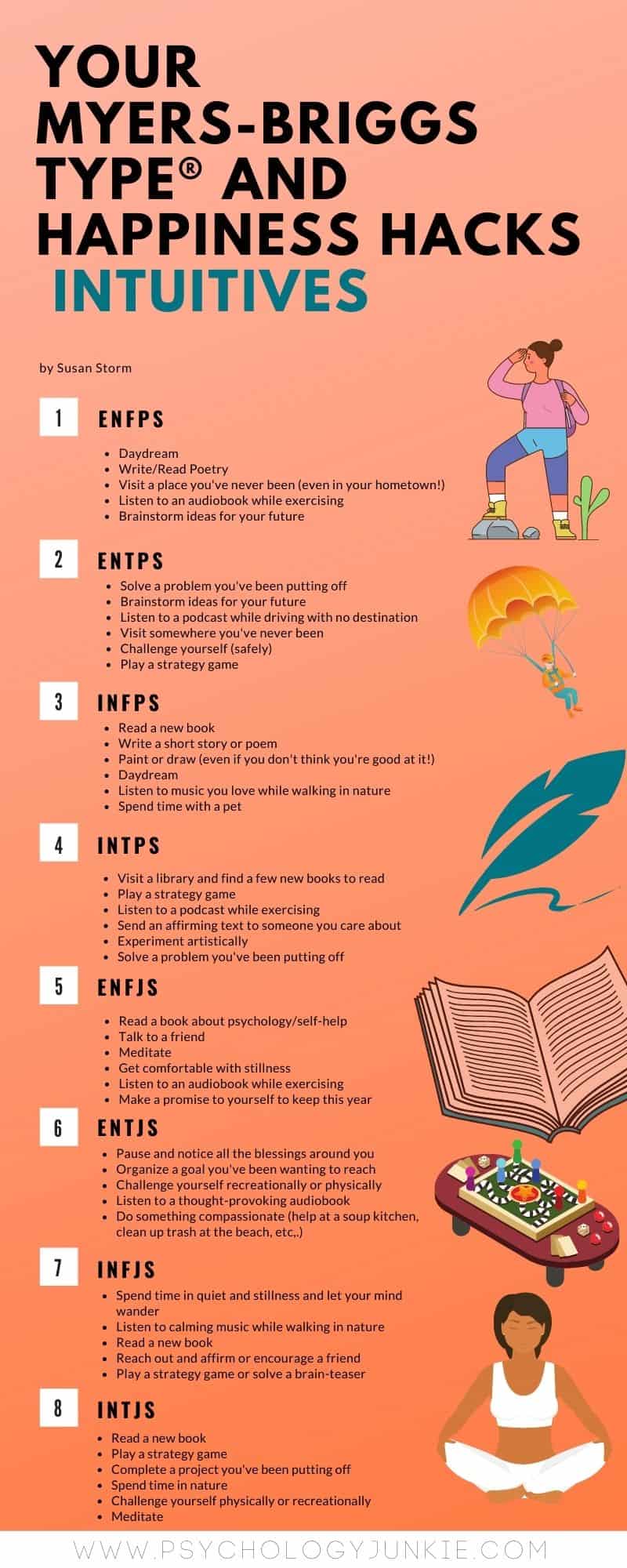
Table of contents
The ENFP
“I dwell in Possibility.”
— Emily Dickinson, “I Dwell in Possibility” (source)
For you, happiness is found when you shake off the expectations of others and get deeply in tune with your core purpose in life.
Take time to breathe in new possibilities, and get in touch with your true convictions and path in life. Meditate. Imagine. Travel. Read poetry, autobiographies, and fantasy books. Make one or two promises to yourself and trust that you’ll keep them – but give yourself the opportunity to explore first.
You can explore by talking to people from many different walks of life, traveling to new cultures, reading a variety of books, trying a variety of tasks. As you explore, make note of what “fills” your soul, and what drains it. Love yourself enough to give yourself this chance to experiment and discover without being chained to the traditions and expectations of others.
Five things that may lift an ENFP’s mood:
- Starting a collaborative project with someone inspiring
- Rearranging a room to reflect a new phase of life
- Making a “things I want to experience” list
- Attending a class with no practical purpose
- Helping a friend imagine a better future
The ENTP
“I dream things that never were; and I say, ‘Why not?’”
— George Bernard Shaw, Back to Methuselah (source)
For you, happiness is found in discovering the potential of something. It’s brainstorming with a variety of interesting people or staying up all night solving a complex problem that stumped everyone else.
Anytime you sense that the boundaries of your mind are shifting ever-so-slightly wider, you feel a sense of contentment that is unmatchable.
In order to find these moments, you need to challenge yourself (something you naturally love). Take on a project that terrifies you, look at something in your immediate vicinity – what could you do with it? How could you change it to make it better? Do something unexpected (but safe) today. Surprise yourself!
Five things that may lift an ENTP’s mood:
- Building a quick prototype instead of perfecting a plan
- Teaching a complicated idea in an entertaining way
- Finding someone who enjoys playful disagreement
- Taking apart an inefficient system and redesigning it
- Creating something satirical, clever, or slightly ridiculous
The INFP
“There is only one way. Go into yourself.”
— Rainer Maria Rilke, Letters to a Young Poet (source)
As an INFP, you derive happiness from putting your unique stamp on a creative project. Whether you’re drawing a picture and experimenting with colors to create something unique, or pouring your imagination out onto the written page – happiness is creating something that’s never been made before. The key is it needs to feel meaningful and authentic to you.
For some INFPs, creative, soul-extracted joy is found in the artistic, while others find this joy in cooking, teaching, entrepreneurship, or even home renovation! Tapping into your creativity and imagination is essential in order for you to feel fulfilled. Bonus happiness points if your creativity is in service of a cause that is important to you.
Five things that may lift an INFP’s mood:
- Having an unhurried conversation with someone emotionally safe
- Making a playlist for a particular memory or feeling
- Reading a book they’ve always loved
- Creating a private space that feels entirely their own
- Doing something kind without needing acknowledgment
Read This Next: 10 Things That Excite the INFP Personality Type
The INTP
“The important thing is not to stop questioning. Curiosity has its own reason for existence.”
— Albert Einstein, quoted in LIFE, 1955 (source)
As an INTP, it’s essential for you to have a variety of projects that entertain your mind and spark your curiosity.
You find happiness in decoding the mysteries of the universe, learning how things work, and imagining new possibilities. Having a stimulating intellectual debate can also make you happy! Swapping ideas, insights, and looking for loopholes is exciting and inspiring to you.
Your natural “headiness” as an INTP can sometimes lead you to become out of touch with your physical world, though. Try to make time for movement and nature. Make sure you’re drinking enough water (set reminders on your phone if you have to!). I’ve known several INTPs who accidentally sabotaged their happiness by letting their physical health decline in pursuit of intellectual goals.
Five things that may lift an INTP’s mood:
- Having several uninterrupted hours with no social demands
- Turning a messy subject into a clear mental model
- Playing a game that rewards strategy and experimentation
- Explaining a favorite subject to an interested person
- Sharing strange, highly specific humor with someone who gets it
The ENFJ
“What do we live for, if it is not to make life less difficult to each other?”
— George Eliot, Middlemarch
For you, happiness is found in seeing human potential and inspiring that potential to be realized.
Is there someone that you feel has a unique ability or gift? Connect with them! Call them up and let them know what you see, or send them a text if that is more comfortable for you.
Authentic, deep human connection builds up your contentment and satisfaction in life. Combine human interaction with other activities that boost happiness levels.
For example, go on a daily jog with a friend, have a comedy movie night (complete with fun snacks) with someone you love. When you’re alone find activities that build your inspiration and sense of the potential. Listen to songs that inspire you, read books that add depth to life’s meaning, meditate, or journal.
Five things that may lift an ENFJ’s mood:
- Mentoring someone who genuinely wants their guidance
- Bringing compatible people together
- Working with others toward a meaningful shared goal
- Receiving thoughtful care without having to ask for it
- Perusing their favorite quotes to find inspiration
The ENTJ
“The most effective way to do it is to do it.”
— Amelia Earhart (source)
Achievement and goal-completion give you a sense of satisfaction and contentment. You thrive when you can see progress being made on your objectives, and when you have a sense that you’re growing and becoming wiser as a person.
One thing to keep in mind is that while growth is satisfying, sometimes you can be so fixated on it that you forget to appreciate where you are now.
Take a moment to look around you. How miraculous is it that life has given you all the things you have right now?! If you were at the end of your life and could time travel back to this moment, what would you appreciate?
It sounds cheesy, but pausing to appreciate the blessings you have can greatly add to your happiness. Spending time outside can also increase your overall well-being. Listen to a thought-provoking audiobook while you walk outside in the morning. Have a work-related meeting outdoors and soak in the sunshine and fresh air. At the end of the day, think of all the things you’ve discovered and learned, and dwell in that gratitude as you fall asleep.
Five things that may lift an ENTJ’s mood:
- Delegating something they should never have been doing themselves
- Mastering a skill that once intimidated them
- Competing with someone they respect
- Removing a recurring bottleneck from their life
- Getting outside and doing something challenging but rewarding
The INFJ
“He who has a why to live can bear almost any how.”
— Friedrich Nietzsche, Twilight of the Idols (source)
Your sense of happiness arrives when you find your part to play in the grand plan of the universe. Finding meaning, purpose, and direction is essential for your sense of well-being. But finding this can be hard. You may spend so much time lost in deliberation and hoping for it that it seems forever out of reach.
Often the path towards your grand plan and sense of purpose comes when you try things even if they may not succeed. Do one random act of kindness today, write one chapter in a book you’ve been putting off writing, find a small “adventure” you could pursue. Tell yourself that you are good just as you are – that you don’t have to change for everyone around you.
Sometimes as an INFJ, you can feel like you’re “not enough,” or like you’re so different that nobody could possibly understand you. This can stop you from believing in yourself enough to take that next step towards your goals. Give yourself permission to experiment, explore, make mistakes, and to love yourself exactly as you are right now.
Five things that may lift an INFJ’s mood:
- Having one conversation that goes beneath the social script
- Turning a hazy vision into a visual map
- Spending time somewhere beautiful and emotionally inspiring
- Finding language for something they have sensed for years
- Protecting an evening from other people’s needs
Read This Next: 3 Weird and Wonderful Secrets of the INFJ Personality Type
The INTJ
“If you have built castles in the air, your work need not be lost; that is where they should be. Now put the foundations under them.”
— Henry David Thoreau, Walden (source)
For you, a sense of happiness comes when you have the freedom to imagine and achieve your greatest goals. In quiet and stillness, you can let your mind ponder and analyze your direction in life. You can spark your curiosity and sense of wonder by reading philosophical books or playing a solo strategy game.
You want to be intellectually challenged, but you also want to achieve something tangible in the real world. Often, you’re happiest when you “swallow the frog” first thing in the morning, finishing your most challenging task before you go on with your day. This sense of achievement frees you mentally to explore, create, and discover new things as the day goes on. Regular exercise also helps to stimulate your mind and give you fresh insights into problems you may be facing.
Five things that may lift an INTJ’s mood:
- Improving a system that has been irritating them
- Making a long-range plan for something personally meaningful
- Developing genuine competence in a difficult subject
- Talking with someone who challenges their conclusions intelligently
- Creating a workspace that reduces unnecessary distraction
Read This Next: 10 Things That Excite the INTJ Personality Type
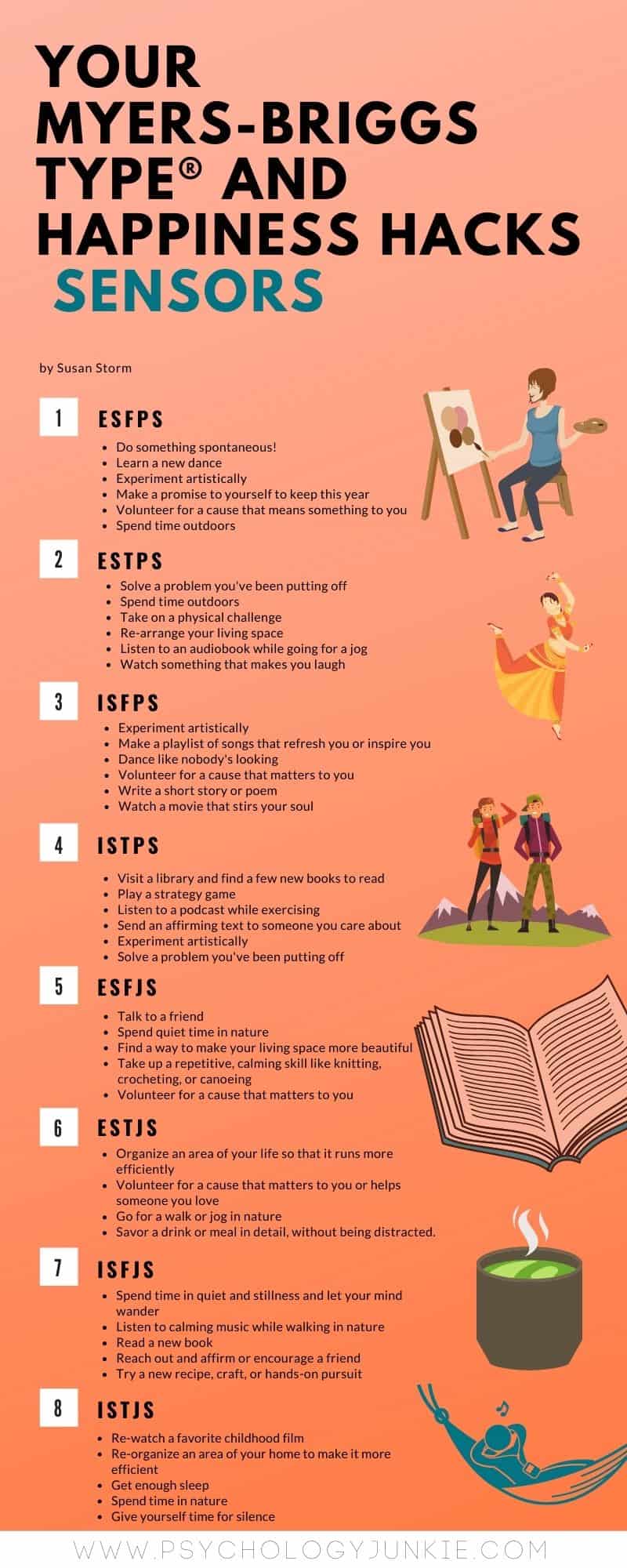
The ESFP
“Afoot and light-hearted I take to the open road,
Healthy, free, the world before me.”
— Walt Whitman, “Song of the Open Road”
As an ESFP, you get a sense of happiness and contentment when all the details in your life are taken care of so that you can be free to pursue adventure and happiness spontaneously.
You enjoy meeting life with a sense of readiness and enthusiasm for whatever opportunity might present itself. Spontaneous travel, pancakes in the middle of the night, kisses in the pouring rain, impromptu comedy performances. A sense of the unexpected and surprising fills your spirit with joy – you crave the sense that in this life anything could happen and anything is possible.
Five things that may lift an ESFP’s mood:
- Dancing without worrying whether they look good
- Wearing something that makes them feel expressive and alive
- Going somewhere with live music or an energetic atmosphere
- Turning an ordinary occasion into a small celebration
- Giving someone an experience they will remember
The ESTP
“Life is either a daring adventure or nothing.”
— Helen Keller, Let Us Have Faith (source)
You get a sense of happiness when the boundaries and rules in your life loosen their grasp and you experience something that makes you feel free.
Spontaneity, excitement, and action are all things that you need on a regular basis. Whether that means unexpectedly hitching a train to anywhere or randomly throwing a party with your closest friends, an exciting surprise gives you the sense that life is worth living.
Being outdoors and active on the regular is also crucial for your sense of well-being. You enjoy exercising outside to boost your endorphins and fill your lungs with fresh air. You’re the type who picks challenging recreational activities; mountain climbing, whitewater rafting, parkour – all these things sound thrilling to you.
Five things that may lift an ESTP’s mood:
- Entering a friendly competition
- Learning a physical skill through hands-on practice
- Fixing a problem under real-world pressure
- Negotiating a deal or finding a clever workaround
- Taking a short trip without planning every stop
The ISFP
“I exist as I am, that is enough.”
— Walt Whitman, “Song of Myself”
You get contentment from living a life that lines up with what’s important to you on a soul level. Finding your purpose and living in alignment with it drives you.
Exploration and freedom are also major satisfiers for you. Having an open-ended schedule and the freedom to explore the world and your own emotions is tantalizing. Like the feeling on a Friday night when the whole weekend lies before you unplanned, untouched, and ready for you to fill with your own random desires and pursuits.
You also gain a sense of meaning when you can make a tangible difference for a cause that’s important to you. Sometimes that means volunteering at an animal shelter, or it could mean creating an artistic expression that conveys one of your deeper emotions.
Five things that may lift an ISFP’s mood:
- Curating an outfit, room, or playlist around a particular feeling
- Working with plants, clay, fabric, food, or another tactile medium
- Spending time with someone who does not demand constant conversation
- Acting on a conviction they have kept private
- Changing an environment that no longer feels like them
The ISTP
“I am no bird; and no net ensnares me: I am a free human being with an independent will.”
— Charlotte Brontë, Jane Eyre
Happiness fills your soul when you are free to pursue your own independent hobbies and interests. You crave a sense of autonomy in the world, and when you’ve gained it, you can finally relax and let yourself breathe.
This doesn’t mean that you don’t want any friendships or relationships, you just prefer them with people who also understand your need for freedom.
Driving aimlessly while listening to your favorite music, jogging along the beach at night when everyone else has left, locking the door to your room so you can read a book or play a computer game. All these things give you a sense of contentment and joy.
Of course, you still enjoy deep, meaningful relationships with loved ones. You get a sense of purpose when you can help someone you love in a tangible way; by fixing something for them or giving them a thrilling experience they’ve never had before.
Five things that may lift an ISTP’s mood:
- Learning to use an unfamiliar tool
- Practicing a skill they’re interested in
- Taking a solo day trip somewhere new
- Streamlining equipment, technology, or a workspace
- Spending time beside someone without having to fill the silence
The ESFJ
“Friendship is always a sweet responsibility, never an opportunity.”
— Kahlil Gibran
You get a sense of happiness and joy when you can connect with someone in a raw, authentic way. When the walls crumble and there’s a sense of transparency and depth that goes beyond small talk and surface-level details.
Sure, you like small talk, but generally as a prelude to more meaningful, personal discussions.
You also gain a sense of contentment from knowing everything in your life has a place, a time, and a sense of order. Having an organized environment, a clear routine, and some soul-filling moments scheduled into your day is crucial to you.
For some ESFJs this will mean sitting on the porch and watching the sunrise while sipping their favorite brand of coffee every morning. For other ESFJs this might mean reading a chapter from a book over Zoom with a long-distance friend every evening. You like a sense that there’s a rhyme, rhythm, and flow to life and you’re free to experience harmony with others along the way.
Five things that may lift an ESFJ’s mood:
- Hosting a small themed dinner or gathering
- Looking through photographs and retelling favorite stories
- Hearing specific appreciation for something they contributed
- Making a shared space more welcoming
- Reviving a tradition that brings people together
The ESTJ
“The reward of a thing well done is to have done it.”
— Ralph Waldo Emerson, “New England Reformers”
A sense of order, structure, and success in life helps you to feel happy and content. You like knowing that you’re progressing every day towards your goals and that the details in your life (bills, healthcare, home and family life) are in order and tended to.
At the same time, regular doses of laughter, spontaneity, and silliness give you true joy. You work hard, but you also thrive when you play hard.
Spending time outside, living close to friends that matter to you, having a comedy movie night and laughing with your spouse while you enjoy your favorite snacks. These relaxed, lighthearted moments help you to feel a sense of peace and contentment that many may not realize who only see your productive side.
Five things that may lift an ESTJ’s mood:
- Resolving a problem everyone else has been avoiding
- Teaching someone a practical skill
- Creating a plan that turns confusion into clear next steps
- Completing a measurable personal challenge
- Organizing an event that people genuinely enjoy
The ISFJ
“There is nothing like staying at home for real comfort.”
— Jane Austen, Emma
You find joy in a life that is meaningful yet stable. A sense of consistency and security gives you the freedom to pursue your individual ideas and activities.
You like having everything in its place, an order for everything, and a sense of peace surrounding your daily routine. A clear structure gives your life a sense of continuity and purpose. When everything is taken care of, you can let your mind and body relax. You can let your thoughts wander. You can explore the significance of things you might not otherwise have noticed.
Spending regular time outside, and having nourishing phases throughout your day where you take care of your senses is crucial for your well-being. Sometimes this means drinking a mug of hot tea while listening to classical music, sometimes it could mean doing yoga in your backyard at sunrise. Giving yourself regular pauses throughout the day to attend to your physical and emotional needs is vital for your happiness.
Five things that may lift an ISFJ’s mood:
- Making or preserving a family recipe
- Creating an album, memory box, or meaningful collection
- Preparing something now that will make tomorrow easier
- Spending time with someone who notices their inner life
- Setting aside an hour when nobody is allowed to need anything
Read This Next: 10 Things You’ll Relate to if You’re an ISFJ
The ISTJ
“The true secret of happiness lies in taking a genuine interest in all the details of daily life.”
— William Morris
As an ISTJ, you find a sense of joy in creating stability for yourself and your loved ones. You want the people you love to know that they can count on you. You want to know that your schedule has been tailored so that your needs are met, and you also have time to be alone and explore your own interests.
It’s the little things that bring you joy, like re-watching a favorite childhood film, leisurely perusing a library, or learning everything you can about a hobby that strikes your interest (gardening, music, technology, etc,.)
Making that final check-mark on your to-do list signals to you that now you can explore your hobbies and interests without distraction or outside pressures. On top of this, keeping your body healthy, getting adequate sleep, and having one or two close friends who you can be yourself around is essential.
Five things that may lift an ISTJ’s mood:
- Restoring or maintaining something built to last
- Researching the history of a place they plan to visit
- Creating a financial or practical plan that increases security
- Developing a personal method for doing something more efficiently
- Repeating a tradition that still feels meaningful, not merely obligatory
What Are Your Thoughts?
Did you enjoy this article? Do you have any thoughts or experiences to add? Let us know in the comments!
Find out more about your personality type in our eBooks, Discovering You: Unlocking the Power of Personality Type, The INFJ – Understanding the Mystic, and The INFP – Understanding the Dreamer. You can also connect with me via Facebook, Instagram, or Twitter!









Great post Susan!
Thank you!!
Hi Susan, as a fellow passionate personality advocate, I love reading your articles
.
Thank you for sharing your wonderful, insightful work.
Take care
Kate
Thanks so much Kate! This means a lot to me 🙂
I love your blog! INFP here. ^.^
MBTI certified myself just two months ago and just started a Youtube channel “INFPhilosopher.” You are one of my inspirations along with Isabel Myers, Linda Berens and Personality Hacker.
Thank you so much!! This makes me so happy 🙂 I will definitely check out your YouTube page!
Thanks so much, Eric!!
Please do an article on how each personality type experiences grief and bereavement.
As an ISTJ it’s frustrating to not count with a truly friend. Great post! Thank you.
Love this article and the infographic, very helpful!
Thank you!!
I read all your articles Susan. I love the way you structure them. So efficient. I am ENTP trying to find ways to quit my government job and start a business or self employment. There are not many articles on that particular theme, which i feel is a very common theme among ENTP people. The things that ENTP love rarely if ever can be found in corporate or governmental jobs. So anyway, i would love to read/watch interviews with ENTP professionals who made this transition successfully. If anyone can provide a relevant link, please do. Thank you and keep up the inspiring work Susan.
I would love to interview ENTP entrepreneurs! That’s actually something that’s been on my list of ideas for a while so thank you for reminding me of it 🙂
Fascinating insights! ENFP here. Permit me to both acknowledge, and appreciate, the effort that you put into your work – t’is both engaging and informative! Kudos!
Thanks so much Kahmed!!
I find myself disagreeing with your statement that no type is inherently happier than another, as it seems that some people are more inclined toward optimism and can more easily find contentment in the present or at least the prospect of a brighter future, while others (like me) are more inclined to be pessimistic and naturally focus on everything that is wrong or can go wrong, as a self-protection mechanism. I’m not sure if this is a product of temperament itself or life experiences, or a combination, but I could see some types being naturally more or less happy than others, as a result. As an INTP I do value time alone but it also makes me happy to be understood, even by just a few, despite my need for solitude.
Thanks Susan – I always enjoy your articles though didn’t see ‘what makes an INFJ happy’. Perhaps that’ll be an add-on? – Maryam Banville
Ok- though I didn’t see a link for INFJ, I did find it in the full list. My bad. Thanks again! – Maryam
Updated article, am I blind bc I’m not seeing infj?
Love your postings, this is one of my favorites.