The ESFJ Personality Type and the Enneagram
When people think of ESFJs, they tend to imagine someone warm, supportive, and deeply loyal. And they’re not wrong—but they’re also not getting the full picture.
Because while some ESFJs are like the emotional first responders of their communities—always available, always checking in—others come off more serious, focused, even sharp. Some seem lighthearted and bubbly. Others are steady, practical, and rule-abiding to a T. So… which is it?

That’s where the Enneagram comes in.
Your Myers-Briggs® type gives us a map of how you gather information and make decisions. But your Enneagram type shows us your inner motivation—what you fear, what you long for, and what shaped your emotional survival strategies. Put the two together, and you get a much more complete picture.
I’ve coached ESFJs who were Enneagram Twos and Enneagram Eights, for example. The Eights are much more outspoken, direct, and cool with confrontation whereas the Twos are more warm, conflict-averse, and effusive. But deep down, they both still have the same personality type in the Myers-Briggs system.
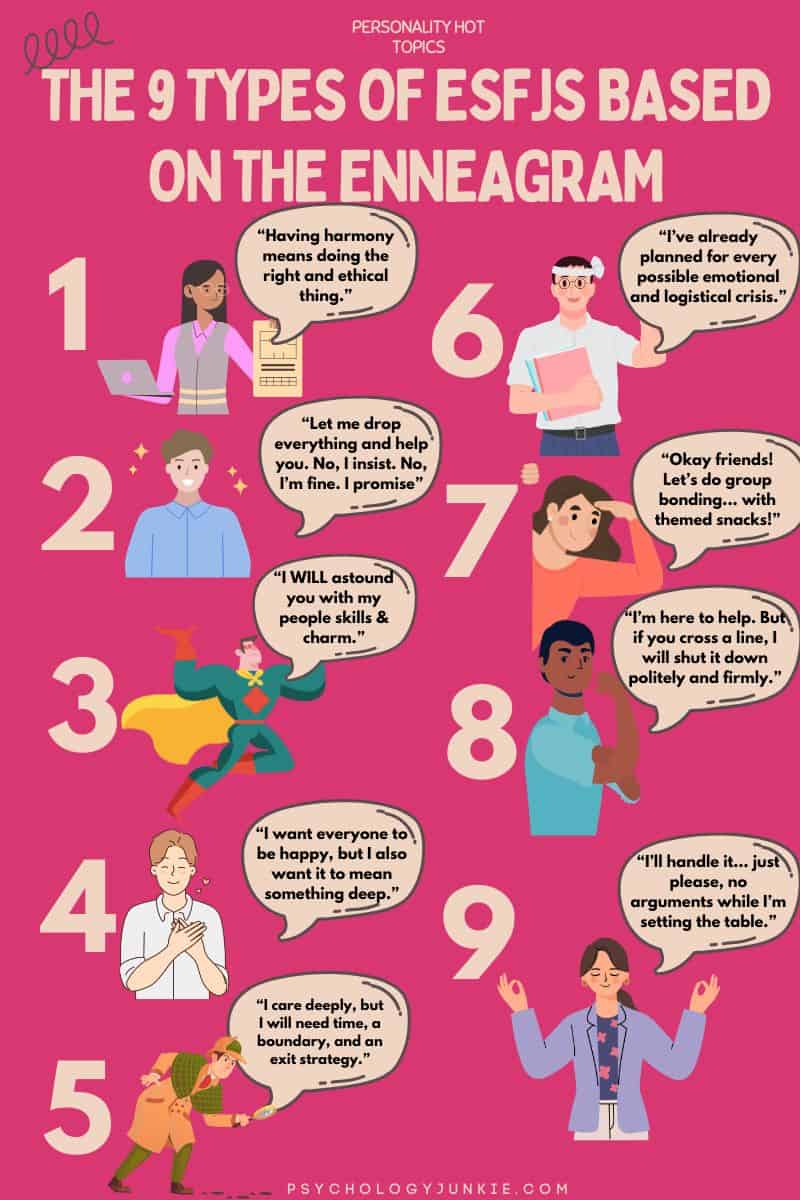
Today we’re walking through nine distinct flavors of the ESFJ, using the Enneagram as a lens. Whether you’re an ESFJ yourself or just trying to understand one, this is where you’ll get clarity on why two people with the same type can behave so differently—and what drives their unique form of care, leadership, or self-sacrifice.
Not sure what your personality type is? Take our Enneagram questionnaire here!
The ESFJ Enneagram One
Core Fear: Being corrupt, evil, or defective
Core Desire: To be good, virtuous, and full of integrity
ESFJ Ones are the “do the right thing no matter what” types. They want to help, yes—but they want to help correctly. They’re not content with being warm and supportive. They want to be ethical, fair, and above reproach. Most spend their lives trying to reach an unreachable goal of perfection.
These are the ESFJs who volunteer and run the spreadsheet. Who bake for the community fundraiser and send a follow-up email reminding people to rinse the cupcake pans before returning them. Their service comes with standards. And they lose sleep if they feel like they’ve failed those standards—or if others are slacking and calling it “good enough.”
I once coached an ESFJ One who said, “If I don’t do it, it won’t be done right. And if it’s not done right, why are we even doing it?” That sentence sums up the ESFJ One experience pretty well: duty, quality, and the exhausting belief that they’re the last line of defense between order and chaos.
When unhealthy, these types can get rigid, controlling, or quietly resentful. They often feel like they’re cleaning up after everyone else—emotionally, logistically, morally. And they don’t always know how to express the burnout that comes with that without sounding judgmental (so they either go silent… or explode in a wave of criticism and guilt).
Because Ones are in the Body/Anger triad, they have issues surrounding anger. But rather than express their anger (like the Enneagram Eight would), they repress it. Instead, they deal with anger through tightly clenched optimism—smiling through gritted teeth, organizing their emotions into a polite checklist, or cleaning something aggressively when they’re too upset to talk.
In childhood, many ESFJ Ones learned that love came with expectations. Be good. Be responsible. Don’t mess up. Don’t be selfish. So they tried to be perfect. They learned to suppress their messier feelings and instead focused on being needed, being good, being someone their parents could be proud of. And that early belief often became a lifelong inner voice.
At their worst, ESFJ Ones can be self-righteous, guilt-ridden, judgmental, and harsh—especially with themselves. They demand too much from their bodies, their relationships, and their emotions.
At their average, they’re structured, loyal, and deeply responsible—setting high standards for themselves and others, and working tirelessly behind the scenes to make sure things run smoothly.
At their best, they’re wise, empathetic, grounded, and forgiving. They learn to listen to their inner critic without letting it take the wheel—and offer grace to themselves and others in equal measure.
The ESFJ Enneagram Two
Core Fear: Being unloved, unneeded, or unwanted
Core Desire: To be loved for who they truly are
This is one of the most common combinations—and it makes sense. ESFJs are naturally focused on the people around them, and Type Two doubles down on that. These are the caretakers, cheerleaders, go-to helpers, and unofficial therapists of their friend groups. If you’re sick, they’ll bring soup. If you’re sad, they’ll remember the exact thing you said three months ago that’s probably still weighing on your heart.
But for the ESFJ Two, the line between care and over-care gets blurry fast.
These types tend to feel like it’s their job to hold everything together—and if they stop helping, the whole system might fall apart. They try to anticipate needs before they’re voiced, give comfort before they’re asked, and rarely let themselves need anything in return.
I worked with an ESFJ Two who said, “I know when someone’s hungry before they do. But I can’t tell when I’m hungry until I’m about to pass out.” We both laughed because it fit with her pattern so well. They’re so attuned to everyone else’s needs that they forget they have their own.
In childhood, many ESFJ Twos were praised for being “so good,” “so thoughtful,” “so helpful.” They quickly learned that love was given in exchange for service and selflessness. So they gave. And gave. And gave. Until giving became identity. Until asking felt selfish. Until saying no felt dangerous.
Because Twos are in the Heart/Shame triad, they tend to have issues revolving around shame or self-worth. For them, self-worth hinges on being needed. If they’re not actively helping, they may feel invisible or unloved. And while they often appear warm and confident on the outside, there’s usually a quiet undercurrent of “I hope I’m enough” humming beneath every interaction.
When unhealthy, ESFJ Twos can become overbearing, guilt-trippy, or manipulative—using their helpfulness as currency for love or loyalty. They might keep giving even when it hurts, secretly hoping someone will notice and reciprocate.
At their worst, they’re martyr-like, clingy, controlling, and emotionally depleted—resentful that no one sees how much they give.
At their average, they’re attentive, nurturing, emotionally intelligent, and highly relational—offering practical support and warm presence in every corner of life.
At their best, they’re self-aware, balanced, loving, and able to help without losing themselves. They know their worth doesn’t hinge on service—and that love doesn’t have to be earned.
The ESFJ Enneagram Three
Core Fear: Being worthless or seen as a failure
Core Desire: To be valuable, successful, and admired
The ESFJ Three knows exactly what’s expected of them and how to appear competent, polished, and impressive. They don’t just want to help—they want to help well. These types often have a strong sense of public responsibility, and they take pride in being respected, put-together, and successful—whether that means running a household, a team, or a nonprofit.
To the outside world, they’re the ones who always show up early, dress well, charm with humor, and somehow make it look easy. But behind that polished exterior is a lot of pressure. A lot of performance. A lot of fear that if they stop achieving, they’ll stop mattering.
In childhood, ESFJ Threes often learned that success or likability was the ticket to affection. So they became whoever they needed to be to win approval. They wore the right face, said the right thing, kept the peace, and earned their gold stars.
Because Threes are in the Heart/Shame triad, they often feel shame underneath their achievements. They may appear confident, but underneath the surface they’re wondering if anyone sees them—the real them, behind the accolades and the calendar full of commitments. They may even feel that they’re not “worth it” unless they’re winning.
When unhealthy, ESFJ Threes may become status-driven, emotionally disconnected, or overly focused on image. They can be so concerned with how they’re perceived that they lose track of what actually makes them happy or being authentic.
At their worst, they’re manipulative, image-obsessed, deeply insecure, and emotionally unavailable—performing their life rather than living it.
At their average, they’re ambitious, polished, organized, likable, and productive—working hard to meet expectations and make a good impression.
At their best, they’re emotionally authentic, deeply present, and grounded in their own values—not just the ones that look good from the outside.
The ESFJ Enneagram Four
Core Fear: Being insignificant, emotionally cut off, or without identity
Core Desire: To find their unique identity and significance
At first glance, this pairing may seem like a contradiction. And admittedly, it’s fairly rare. ESFJs are often practical and people-focused, while Fours are more introspective, individualistic, and more introverted I nature. But put them together, and you get an ESFJ who feels like the “outsider.” This ESFJ can pick up on what’s expected of them, how people feel, and what they want, but still feels like a misfit. They want more than that. More than surface-level conversations and shallow friendships.
These ESFJs are often creative and expressive, but in a more curated, refined way than your typical ESFJ. They might gravitate toward aesthetic organization, personalized gift-giving, or meaningful rituals that reflect their emotional world. They want to feel seen—not just as the helpful one, but as the real them underneath the social role.
I once spoke with an ESFJ Four who said, “Everyone thinks I’m so put-together, but half the time I feel like I’m pretending.” That tension is real for this type. They want harmony, but they also want authenticity. And they often feel like they’re sacrificing one for the other. It’s not an easy life for this combination. The two personality systems (ESFJ and Enneagram 4) tend to feel at odds with each other and this ESFJ often feels conflicted.
In childhood, many ESFJ Fours felt emotionally misunderstood. Maybe they were the sensitive one in a high-achieving family, or the melancholy kid in a chronically upbeat household. So they adapted—acted “good,” showed up for others—but quietly carried the feeling that something about them didn’t quite fit.
Because Fours are in the Heart/Shame triad, they often struggle with issues of shame and worth. They tend to feel that they’re flawed at the core. Unlike Twos and Threes who avoid or repress shame, Fours stare directly into it. They feel it. And then they try to create meaning through it.
When unhealthy, ESFJ Fours may become moody, self-pitying, or passive-aggressive. They might feel trapped between the desire to connect and the fear of being exposed or rejected for who they really are. They give a lot but feel perpetually unseen in return.
At their worst, they’re emotionally volatile, envious, withdrawn, or guilt-ridden—resenting the roles they feel forced to play.
At their average, they’re sensitive, emotionally expressive, and deeply attuned to others—bringing beauty and individuality into the way they care.
At their best, they’re authentic, self-accepting, creative, and emotionally generous—able to express their unique identity while still connecting deeply with others.
The ESFJ Enneagram Five
Core Fear: Being helpless, overwhelmed, or incapable
Core Desire: To be competent, capable, and self-sufficient
This is a rare combination (extremely rare, I’ve never met this combination before)—but it does exist. ESFJs are wired to care, to organize, to be outward-facing. But when combined with a Type Five Enneagram core, they become more reserved, more guarded, and much more focused on conserving energy and knowledge.
ESFJ Fives often feel a deep sense of responsibility—but they’re highly selective about where they give their time. They still want to help, but they don’t want to burn out. So they pull back. They observe. They research. They create systems and structures that serve people—but from a safe distance.
They might channel their interest in people to learning about them rather than interacting with them.
These types often grow up feeling like other people’s emotional demands are too much. Maybe their household was chaotic. Maybe they were expected to be “on” all the time. So they learned to ration their energy. Help from behind the scenes. Offer comfort without letting people in too far.
Because Fives are in the Head/Fear triad, they deal with anxiety. Instead of consciously giving into it, they withdraw from the world. They focus on hoarding time, space, and knowledge. ESFJs aren’t typically known for withdrawal, but in this subtype, you’ll see it in their boundaries: tight schedules, emotional distance, or a strong need for privacy.
When unhealthy, ESFJ Fives may become detached, dismissive, or overly focused on control. They might care deeply while appearing aloof—offering help only in the form of systems, instructions, or resources, while keeping their own emotions locked down.
At their worst, they’re emotionally walled-off, hyper-critical, avoidant, and resentful of others’ needs.
At their average, they’re thoughtful, organized, selective, and quietly helpful—supporting others through structure and planning, not through emotional immersion.
At their best, they’re wise, observant, intentional, and warm in a reserved, sustainable way. They know how to help without overextending—and their support is all the more valuable for it.
The ESFJ Enneagram Six
Core Fear: Being abandoned, unsafe, or without guidance
Core Desire: To feel secure, supported, and prepared
ESFJ Sixes are the dependable planners, the faithful supporters, and the vigilant guardians of their people. This is a type combination I’ve worked with a lot in the past and I’d say this is one of the more frequent Enneagram types of the ESFJ.
ESFJ Sixes don’t just show up for you—they stick around. They’re the ones checking in, double-checking the safety exits, sending reminders, and making sure the group chat knows what time the event actually starts.
These types are warm but wary. Kind but cautious. Their loyalty is hard-earned and long-lasting—but so is their anxiety. While many ESFJs are driven by harmony and connection, Sixes add another layer: the need for security. For predictability. For a clear sense of who’s safe, what’s expected, and what could go wrong if they let their guard down.
One ESFJ Six I worked with said, “If something’s going to fall apart, I want to see it coming.” That’s the Six mindset in a nutshell: care that prepares, love that watches the weather forecast, help that includes a backup plan.
In childhood, many ESFJ Sixes felt the emotional tone of their environment was unstable or unpredictable. Maybe nothing traumatic happened—maybe it was just the quiet sense that if they didn’t keep things on track, no one would. So they tuned in. They became the glue. The peacemaker. The planner. And that habit never really turned off.
Because Sixes are part of the Head/Fear triad, they wrestle with anxiety beneath the surface. They crave guidance, but often distrust authority. They want answers, but question them right after. So they seek out reliable people and systems—and when they find them, they hold on tight.
When unhealthy, ESFJ Sixes can become controlling, reactive, or overly dependent on rules and traditions. They might mask their fear by doubling down on social expectations or latching onto authority figures they haven’t fully vetted.
At their worst, they’re anxious, rigid, over-attached to structure, passive-aggressive, or quietly resentful of feeling responsible for everyone’s safety.
At their average, they’re loyal, dutiful, alert, and incredibly dependable—making sure everyone’s okay and no detail has slipped through the cracks.
At their best, they’re courageous, self-trusting, grounded, and wise—able to offer others true safety not just through planning, but through presence.
The ESFJ Enneagram Seven
Core Fear: Being trapped in pain, limited, or deprived
Core Desire: To be happy, satisfied, and free
ESFJs are typically known for stability, routine, and service. Sevens? They’re known for spontaneity, enthusiasm, and chasing the next thrill. So what happens when you combine the two?
You get the ESFJ Seven: a sunshine-on-a-schedule kind of person. Warm, friendly, high-energy—but also structured enough to make the fun happen. These types bring people together, plan the event, and make sure the playlist is crowd-approved and the snacks are on theme. They’re bubbly, sociable, and full of ideas—but underneath it all is a quiet restlessness.
An ESFJ Seven might think, “If I stop moving, I have to feel things. And I don’t want to feel things right now.” That’s the core struggle. These ESFJs want to bring joy to others, but they also use busyness to outrun their own discomfort. If things get too heavy, they’ll redirect. Reframe. Crack a joke. Suggest a group activity.
In childhood, ESFJ Sevens often felt emotionally overwhelmed—either by neglect, loss, the distraction of their parents. Many times they felt disconnected from their nurturing parental figure; so they distracted themselves with toys or games. They learned to lift the mood, pivot the focus, or distract from the pain. And they became excellent at it. But eventually, all that bottled-up fear or sadness starts asking for attention.
Because Sevens are in the Head/Fear triad, they cope with underlying issues of anxiety. But unlike Sixes who focus on their anxiety, Sevens distract themselves from it. They do this by staying upbeat, distracted, and on the move. While they may look carefree on the outside, there’s often a deeper emotional avoidance happening under the surface.
When unhealthy, ESFJ Sevens may become scattered, overcommitted, or emotionally disengaged—filling their calendar but avoiding their inner world. They might care deeply, but resist slowing down long enough to process their own needs.
At their worst, they’re avoidant, impulsive, restless, easily bored, or emotionally unavailable—chasing stimulation to escape discomfort.
At their average, they’re fun-loving, social, enthusiastic, and inspiring—bringing people together with charm and creativity, but often juggling too much at once.
At their best, they’re grounded, emotionally aware, joyful, and present—offering real connection and optimism that doesn’t bypass the hard stuff.
The ESFJ Enneagram Eight
Core Fear: Being controlled, harmed, or betrayed
Core Desire: To be independent, strong, and in control of their own life
This version of the ESFJ is a little less “supportive school counselor” and a little more “fierce community defender.” ESFJ Eights still want harmony and connection—but they want it on their terms. They care deeply, but they also want to be respected. And they’re not afraid to push back—especially if they sense someone being mistreated, manipulated, or ignored.
These ESFJs lead with heart, but their heart has armor. They’ll organize the potluck, yes—but they’ll also call out your toxic cousin if he starts getting controlling at the dinner table. They have a strong sense of justice, and they won’t sugarcoat the truth just to keep things polite.
In childhood, ESFJ Eights often felt like no one was going to protect them. Maybe they had to grow up fast, take care of siblings, or become emotionally self-sufficient before they were ready. So they became strong. Assertive. Responsible to a fault. They learned to be kind—but not soft.
Because Eights are in the Body/Anger triad, they have underlying issues with anger. But unlike the One who represses their anger, they give into it. Their response to threat or injustice is immediate and external. For ESFJs, that means stepping in, speaking up, and holding the line—even when it costs them popularity.
When unhealthy, ESFJ Eights can become forceful, combative, and distrustful—micromanaging others or bulldozing conversations in the name of “efficiency” or “truth.”
At their worst, they’re domineering, aggressive, reactive, and emotionally walled-off—seeing vulnerability as weakness and kindness as a liability.
At their average, they’re passionate, driven, protective, and outspoken—working hard for their people and expecting others to pull their weight.
At their best, they’re courageous, grounded, honest, and emotionally in tune—using their strength to lift others up rather than control them.
The ESFJ Enneagram Nine
Core Fear: Conflict, disconnection, or fragmentation
Core Desire: To have inner peace and harmony
This might be the gentlest expression of the ESFJ: calm, patient, and deeply in touch with the emotional dynamics around them. ESFJ Nines are the glue in families and social groups. They don’t just want everyone to get along—they need it. Peace is emotional oxygen for them.
These types are incredibly skilled at reading a room and smoothing tension. If something feels off, they’ll be the first to sense it—and the last to bring it up. They’d rather absorb the discomfort than risk rocking the boat. Their energy is often quiet but calming, like someone who always seems to know where the Band-Aids are and how to keep things from falling apart.
In childhood, many ESFJ Nines learned that being easy to get along with was the safest role to play. They may have watched caregivers argue or disconnect, and internalized the idea that their needs were secondary. So they stayed agreeable. Adaptable. Pleasant. And over time, they stopped asking themselves what they actually wanted.
Because Nines are in the Body/Anger triad, they have underlying issues with anger. But unlike the Eight who gives into it, they distract themselves from it by focusing on personal philosophies, mantras, or peaceful mental activity. They may not even know they’re angry until it shows up in passive resistance, chronic fatigue, or sudden emotional outbursts after long periods of silence.
When unhealthy, ESFJ Nines can become avoidant, emotionally shut down, or quietly resentful. They might say yes to everything while building invisible walls to protect themselves from overwhelm.
At their worst, they’re checked out, disconnected, conflict-phobic, and emotionally numb—doing everything except facing the hard stuff.
At their average, they’re warm, accommodating, dependable, and deeply comforting—focused on group well-being and quietly holding everything together.
At their best, they’re present, self-aware, emotionally open, and peaceful in a way that invites others into deeper connection.
What Do You Think?
Which Enneagram type do you relate to most? Has this helped you to get clearer on your specific brand of ESFJ? Let me know in the comments!