Here’s How You Solve Problems, Based on Your Personality Type
One of the greatest gifts that a knowledge of personality type can give you is an ability to understand how different people solve problems. So many arguments and conflicts arise because people don’t solve problems the same way! We sometimes accidentally shut down other people’s solutions without seeing where they are coming from. What if we could understand how the other person in the equation thinks? What if we could see what’s important to them? This article is my small attempt at making that process easier.
Not sure what your personality type is? Take our new personality questionnaire here. Or you can take the official MBTI® here.
Here’s How You Solve Problems, Based on Your Personality Type
Table of contents
- Here’s How You Solve Problems, Based on Your Personality Type
- How ISTJs Solve Problems
- How ISFJs Solve Problems
- How ESTJs Solve Problems
- How ESFJs Solve Problems
- How ISTPs Solve Problems
- How ISFPs Solve Problems
- How ESTPs Solve Problems
- How ESFPs Solve Problems
- How INTJs Solve Problems
- How INFJs Solve Problems
- How ENTJs Solve Problems
- How ENFJs Solve Problems
- How INTPs Solve Problems
- How INFPs Solve Problems
- How ENTPs Solve Problems
- How ENFPs Solve Problems
- What Do You Think?
Estimated reading time: 36 minutes
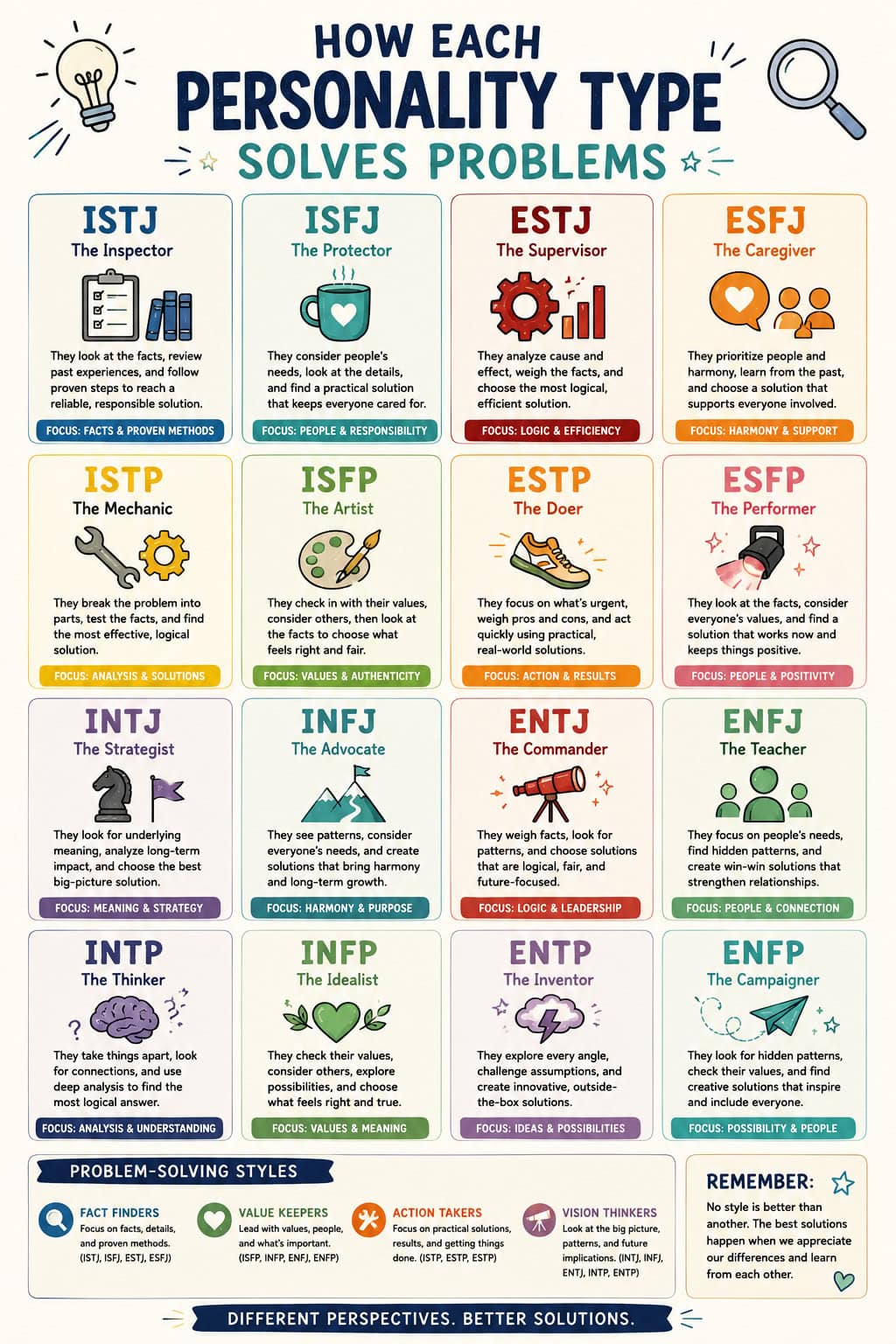
How ISTJs Solve Problems
If you’ve ever watched an ISTJ work through a problem, you’ve probably noticed they almost never start with opinions. Instead, they start with the story.
What happened first? What happened next? Who said what? Which facts do we actually know, and which ones are assumptions? Before an ISTJ feels comfortable making a decision, they want to build a reliable timeline. Once they understand how the situation unfolded, they begin comparing it to their own experience. Have I dealt with something like this before? What worked? What failed? Is there already a proven solution sitting right in front of us?
As an MBTI® practitioner, I’ve noticed that many ISTJs have the ability to spot missing pieces in someone’s story. They don’t trust decisions built on incomplete information so they’re always attentive to “gaps.”
Psychologist Daniel Kahneman once wrote, “Nothing in life is as important as you think it is while you are thinking about it.” ISTJs naturally help people slow down enough to separate facts from emotional momentum. They have a gift for grounding discussions in reality when everyone else is getting swept away by assumptions or worst-case scenarios.
In everyday life, this can show up in surprisingly ordinary ways. If the washing machine suddenly stops working, the ISTJ isn’t likely to panic or start shopping for a replacement. They’re checking when it last worked properly, whether the breaker tripped, what changed recently, and whether this has happened before. The same pattern shows up in relationships. If a friend suddenly seems distant, the ISTJ is often mentally retracing the last few conversations before deciding there’s a problem.
Sometimes this approach saves everyone a tremendous amount of unnecessary stress and sometimes it also drives the more intuitive personality types just a little crazy.
Potential Blind Spots
Every strength has a shadow. Because ISTJs place so much trust in experience, they can sometimes overlook possibilities that don’t fit their existing mental library. If a solution worked ten times before, why wouldn’t it work again? The trouble is that people change, circumstances change, and occasionally the familiar answer isn’t the best one anymore.
They can also become so focused on the observable facts that they miss what isn’t being said. Someone may technically agree with a decision while feeling deeply discouraged by it. Those emotional undercurrents don’t always announce themselves with data. One question I often encourage ISTJs to ask themselves is, “If I had no previous experience with this situation, what possibilities would I consider?” Even spending five minutes entertaining alternatives can uncover options that experience alone might overlook. And every now and then it’s worth remembering that while you don’t need to reinvent the wheel, occasionally someone has invented a much better wheel while you weren’t looking.
Most likely to clash on decisions with: ENFJs, INFJs, and ENFPs. Interestingly, these are often the very people who notice the possibilities, emotional dynamics, or long-term implications that the ISTJ may overlook, making them frustrating collaborators at times…and surprisingly valuable ones.
Read This Next: 24 Signs That You’re an ISTJ Personality Type
How ISFJs Solve Problems
Like ISTJs, ISFJs usually begin by looking backward before they move forward. They want to understand the sequence of events that led to the problem. What happened first? What changed? Has anything like this happened before? Rather than jumping straight into solutions, they build a mental timeline and compare it with what they’ve learned from experience.
Once they have that foundation, though, their attention naturally moves to the people involved. Who is carrying the heaviest burden here? Who’s likely to be hurt by this decision? Is there a way to solve the problem without leaving someone feeling dismissed or overlooked?
I’ve found that ISFJs often remember more than facts. They remember how people were affected. They may recall that a similar decision technically worked five years ago, but they’ll also remember that it left one coworker feeling embarrassed, created tension in the family, or exhausted everyone involved. Their memory is a record of the human experience surrounding those events.
Psychologist Carl Rogers once wrote, “When someone really hears you without passing judgment on you, without trying to take responsibility for you, without trying to mold you, it feels damn good.” ISFJs have a natural gift for helping people feel heard. When they’re solving problems, they’re often asking questions that others forget to ask because they’re thinking beyond efficiency. They’re thinking about trust, relationships, and the kind of solution people can actually live with once the crisis has passed.
You can see this in everyday situations. Imagine a family trying to decide how to care for an aging parent. While someone else may focus on budgets or logistics, the ISFJ is also thinking about who will feel overwhelmed, whether everyone feels included in the decision, and how to preserve the dignity of the person needing care. At work, they’re often the person who notices that a perfectly reasonable policy is creating unnecessary stress for the team and starts looking for a way to fix both the process and the morale.
Potential Blind Spots
Because ISFJs care so much about the people affected by a decision, they can spend so much energy preventing discomfort that they delay necessary change. They may continue using familiar methods because they know those methods are safe, even when a different approach would solve the problem more effectively.
They can also assume that keeping the peace and solving the problem are the same thing. Sometimes they are while sometimes they’re not.
Psychiatrist Viktor Frankl observed, “Between stimulus and response there is a space. In that space is our power to choose our response.” For ISFJs, that space can be an opportunity to ask one important question: “Am I protecting people from harm, or am I protecting them from temporary discomfort?” Those aren’t always the same thing. Growth, honest conversations, and healthy boundaries often feel uncomfortable at first, but they can strengthen relationships over time.
One thing I’ve noticed is that healthy ISFJs become even more effective problem-solvers when they realize they don’t have to carry everyone’s emotional well-being on their own shoulders. Sometimes the most caring thing they can do is offer support while allowing other people to wrestle with their own responsibilities.
And if you’re an ISFJ, here’s a gentle reminder: you don’t have to personally absorb every awkward silence, disappointed expression, or tense family dinner. Contrary to what your nervous system may suggest, you are not the customer service department for everyone else’s emotions.
Most likely to clash on decisions with: ENTJs, INTJs, and ENTPs. These types often prioritize efficiency, innovation, or long-term strategy over immediate interpersonal harmony. That difference in perspective can create friction, but it can also help ISFJs consider solutions they might not have explored on their own, while reminding those intuitive thinkers that people aren’t variables in an equation.
Read This Next: 24 Signs That You’re an ISFJ Personality Type
How ESTJs Solve Problems
ESTJs tend to approach problems by asking, “What’s actually causing this?”
Rather than getting pulled into speculation or emotional reactions, they want to identify the chain of cause and effect. What happened? What evidence do we have? Which parts of this problem are facts, and which parts are assumptions? Once they’ve separated those two things, they begin looking for the most practical, effective solution.
After they’ve analyzed the immediate situation, they often look backward. Have we dealt with something similar before? What worked? What created even bigger problems? Experience matters, but only if it helps them make a better decision today.
ESTJs often become the people everyone turns to when life feels chaotic. They have a knack for taking a tangled mess of information and organizing it into something manageable. While other people are still talking about how overwhelming everything feels, the ESTJ is already figuring out who needs to do what, when it needs to happen, and what resources are available. Some people mistake this for impatience, but more often it’s simply how they reduce uncertainty. Action brings clarity.
Psychologist William James wrote, “The greatest weapon against stress is our ability to choose one thought over another.” ESTJs naturally excel at directing attention toward the parts of a problem they can actually influence rather than becoming consumed by everything they can’t.
You can see this in everyday life. Imagine a family vacation that suddenly falls apart because flights are canceled. While everyone else is expressing frustration or trying to process the disappointment, the ESTJ is comparing alternate flights, calling the hotel, rearranging reservations, and figuring out Plan B before the rest of the group has finished panicking. Of course, this can have an unintended side effect: Sometimes people don’t want a solution first, sometimes they want to know you understand why they’re upset.
Potential Blind Spots
Because ESTJs naturally prioritize efficiency and objective reasoning, they can underestimate how much people’s emotions influence whether a solution actually succeeds. A decision can be perfectly logical on paper and still fail because no one feels heard enough to support it.
They can also become so focused on fixing today’s problem that they overlook the deeper patterns underneath it. Solving the immediate issue is important, but sometimes it’s worth asking why the same kinds of problems keep appearing in the first place. ESTJs are often willing to do the difficult work of thinking carefully through a problem. One area where they can continue growing is remembering that understanding people requires more than analyzing the facts. It also means becoming curious about motivations, fears, and values that aren’t immediately visible.
One question I often encourage ESTJs to ask is, “Will people simply comply with this decision, or will they genuinely buy into it?” The answer often makes the difference between a solution that works for a week and one that lasts for years.
Most likely to clash on decisions with: INFJs, ENFJs, and INFPs. These types naturally notice emotional dynamics, personal values, and future possibilities that an ESTJ may overlook. At the same time, ESTJs often provide the structure and decisiveness that these intuitive feeling types appreciate once the dust settles.
Read This Next: 24 Signs That You’re an ESTJ Personality Type
How ESFJs Solve Problems
When ESFJs encounter a problem, they instinctively begin scanning the room for people before they start looking for solutions.
Who is hurting? Who feels left out? Is someone misunderstood? How is this decision going to affect everyone’s relationships a week from now?
To an ESFJ, solving a problem isn’t just about fixing what went wrong. It’s about restoring trust so people can move forward together. Once they’ve considered the human side of the situation, they usually begin retracing the sequence of events. What led us here? Did we miss warning signs? Have we dealt with something similar before? If a previous solution strengthened relationships as well as solved the problem, they’re likely to remember it and wonder whether it could work again.
Over the years, I’ve noticed that ESFJs often become the emotional historians of their families and communities. They remember birthdays, difficult seasons, conversations from years ago, and the little acts of kindness that helped someone through a hard time. Those memories become part of how they solve problems.
Psychologist Alfred Adler believed that mental health is rooted in what he called Gemeinschaftsgefühl, often translated as social interest or a sense of belonging with others. That idea resonates strongly with many ESFJs. They understand almost instinctively that people are far more willing to work through difficult problems when they feel respected and included. You can see this at work during disagreements. While someone else is busy figuring out who’s technically right, the ESFJ is wondering whether both people have actually felt heard. They know that many conflicts continue not because the solution is missing, but because the relationship has been damaged along the way.
Potential Blind Spots
Because ESFJs naturally tune into the emotional atmosphere around them, they can become so focused on keeping everyone comfortable that they avoid decisions that might create short-term discomfort, even when those decisions would ultimately help everyone involved. They may also take criticism more personally than it was intended. If someone points out a flaw in the plan, the ESFJ can occasionally hear it as a criticism of them rather than simply an attempt to improve the outcome.
Author Brené Brown writes, “Clear is kind. Unclear is unkind.” That’s an idea many ESFJs benefit from remembering. Honest conversations may feel uncomfortable in the moment, but avoiding them often creates far more tension over time.
One question I often suggest ESFJs ask themselves is, “Am I trying to solve this problem, or am I trying to make sure no one feels uncomfortable?” Those goals overlap sometimes, but not always. Healthy relationships don’t require constant harmony. They require enough trust that people can disagree without fearing they’ll lose the relationship.
And if you’re an ESFJ, here’s something worth remembering: if two grown adults are mildly annoyed with each other, you are not legally obligated to become the United Nations.
Most likely to clash on decisions with: INTJs, ENTJs, and INTPs. These types tend to focus first on strategy, efficiency, or logical consistency, while ESFJs naturally prioritize relationships and shared understanding. When they listen to each other instead of assuming bad intentions, they often balance one another surprisingly well.
Read This Next: 24 Signs That You’re an ESFJ Personality Type
How ISTPs Solve Problems
When an ISTP encounters a problem, their first instinct is to understand how the whole thing works. They begin taking the situation apart mentally the way someone might disassemble a watch to see which gear is causing it to stop. What are the moving pieces? Which details actually matter? Which assumptions have people slipped in without realizing it? Rather than accepting the first explanation they’re given, ISTPs like to build their own understanding from the ground up.
Once they’ve mapped out the problem, they start testing it from different angles. Does this explanation actually hold up? Is there a contradiction somewhere? Are we treating opinions as facts? They have a natural talent for spotting flaws in reasoning, which is one reason they’re often so good at troubleshooting everything from broken engines to broken systems.
Over time I’ve noticed that ISTPs are often at their best in situations that overwhelm everyone else. While panic narrows most people’s thinking, ISTPs frequently become even more focused. They strip away the noise and concentrate on the variables they can actually influence. It’s one of the reasons they often seem so calm in emergencies.
You can see this in everyday life. If everyone’s internet suddenly stops working, the ISTP usually isn’t interested in debating whether the provider is having problems. They’re already checking the router, testing the connections, restarting equipment, and eliminating possibilities one by one. The same process happens in relationships. If a conflict arises, they’re often asking themselves, What actually happened? What evidence do I have? Am I reacting to facts or assumptions? This ability to stay grounded can save everyone a great deal of unnecessary drama. It can also make the people around them wonder why they aren’t reacting more emotionally.
Potential Blind Spots
Because ISTPs naturally separate facts from feelings, they sometimes underestimate how important emotions are to solving the problem itself. Someone may fully understand the logic behind a decision and still reject it because they feel dismissed, embarrassed, or misunderstood.
ISTPs can also become so absorbed in analyzing the immediate mechanics of a situation that they overlook larger patterns or symbolic meaning. They know how something happened long before they stop to ask why it keeps happening.
Psychologist Daniel Goleman has argued that emotional intelligence isn’t the opposite of logical thinking but an essential part of effective decision-making. That’s an idea many ISTPs benefit from exploring. Understanding emotions doesn’t weaken objectivity. It often provides information that facts alone can’t explain.
One question I often encourage ISTPs to ask is, “What information might someone’s emotions be giving me that data can’t?” You don’t have to agree with every emotional reaction, but it’s worth becoming curious about what it might be pointing toward. And if you’re an ISTP, remember that saying, “Technically, I’m right,” rarely ends an argument as effectively as you hope it will.
Most likely to clash on decisions with: ENFPs, INFPs, and ENFJs. These personality types naturally focus on personal values, emotional dynamics, and future possibilities, which can feel frustratingly subjective to an ISTP. At the same time, they often notice motivations and relationship patterns that the ISTP may not immediately see, making them surprisingly valuable sounding boards.
Read This Next: An In-Depth Look at the ISTP Personality Type
How ISFPs Solve Problems
When ISFPs face a difficult decision, they focus on what matters to them on an ethical, moral, and individual level first.
Does this decision feel right? Am I being true to what matters most? Is anyone being asked to compromise something they shouldn’t have to compromise? Before an ISFP worries about the mechanics of solving a problem, they often want to know whether the solution matches with their values and preserves the integrity of the people involved.
Once they’ve established that inner direction, they begin looking outward. How will this affect other people? Is someone being overlooked? Are we sacrificing kindness or fairness in the name of convenience? Only after considering those questions do they naturally shift toward examining the concrete facts and practical realities of the situation.
ISFPs often have an unusually sensitive radar for situations that look perfectly acceptable on the surface but feel deeply wrong underneath. They may struggle to explain exactly why at first, but they’re often noticing subtle violations of trust, authenticity, or respect that other people haven’t picked up on yet.
You can see this in everyday life. Imagine a workplace introducing a new policy that saves money but leaves employees feeling undervalued. While someone else may focus on the financial benefits, the ISFP is often wondering whether the company is sacrificing its principles for convenience. They naturally ask questions about integrity that other people may not think to ask until much later.
That ability to notice when something feels fundamentally out of alignment is one of their greatest strengths. Sometimes it’s the very thing that keeps a group from making a decision they’ll eventually regret.
Potential Blind Spots
Because ISFPs care so much about staying true to their values, they can sometimes become attached to one solution without fully exploring other possibilities. If something feels right, it can be difficult to step back and ask whether there might be another approach that honors the same values while working even better.
They may also spend so much time considering the personal impact of a decision that they delay making the difficult choice altogether, especially when every option carries some emotional cost.
Philosopher Søren Kierkegaard wrote, “Life can only be understood backwards; but it must be lived forwards.” Sometimes ISFPs benefit from remembering that waiting for the perfect decision can become its own kind of decision. There are moments when acting with imperfect information is still the wisest course.
Most likely to clash on decisions with: ENTPs, ESTJs, and ENTJs. These personality types often begin with logic, efficiency, or strategic outcomes, while ISFPs naturally begin with authenticity and personal values. Although their approaches can feel worlds apart, each perspective helps compensate for the other’s blind spots, leading to decisions that are both principled and practical.
Read This Next: 24 Signs That You’re an ISFP Personality Type
How ESTPs Solve Problems
Imagine you’re standing in your kitchen and water is suddenly pouring out from under the sink. One person starts wondering whether the plumbing company overcharged last time. Someone else worries about how expensive the repair might be. The ESTP is already under the sink trying to stop the leak. This is one of the things I appreciate most about ESTPs. They have an ability to focus on the problem that’s happening right now instead of getting lost in all the problems that might happen later.
Their mind naturally goes to questions like: What do we know for certain? What’s the biggest problem at this moment? What’s the fastest way to stop things from getting worse? Once they’ve stabilized the situation, they begin analyzing the mechanics behind it. They mentally take the problem apart, organize the moving pieces, and look for the simplest path toward an effective solution.
ESTPs often think best while they’re actually doing something. Give them a whiteboard discussion with no action and they may lose interest. Give them a real-world problem that needs solving, and suddenly they’re completely engaged. Their thinking becomes sharper as reality becomes more immediate.
Psychologist Mihaly Csikszentmihalyi described flow as the state where challenge and skill meet. ESTPs often seem built for those moments. A fast-moving situation that overwhelms other people can bring out some of their clearest thinking.
Of course, every strength has its trade-offs. Because they’re so good at handling immediate problems, ESTPs sometimes move on before asking whether the problem points to something larger. If the leak has stopped, it’s tempting to call the job finished. But what caused the pipe to burst in the first place? Is this part of a bigger pattern?
The same thing can happen in relationships. An ESTP may solve the practical issue while overlooking the emotional lesson hiding underneath it. Someone may say, “I know you fixed it, but that’s not really what I was upset about.” That, of course, can feel confusing if your brain naturally focuses on tangible results.
One question I often encourage ESTPs to ask is, “What problem am I solving beneath the obvious one?” Sometimes the argument isn’t really about the dishes or the budget or the forgotten phone call. Sometimes it’s about trust, respect, or feeling valued.
Most likely to clash on decisions with: INFPs, ENFPs, and INFJs. These personality types naturally look for underlying meaning, personal values, and long-term implications. That perspective can initially feel frustrating to an ESTP, but it often uncovers dimensions of the problem that would otherwise stay hidden.
Read This Next: 24 Signs That You’re an ESTP Personality Type
How ESFPs Solve Problems
One thing I’ve noticed about ESFPs is that they’re often far more practical than people expect. Because they’re enthusiastic, expressive, and people-oriented, they’re sometimes stereotyped as making decisions based purely on emotion. That hasn’t been my experience at all.
When something goes wrong, ESFPs usually start by looking at reality. What’s happening right now? What absolutely needs attention first? What facts do we actually have? They don’t want to spend hours theorizing while the problem gets worse. They’d rather roll up their sleeves and begin making progress.
As they gather information, though, another question starts running in the background:
“Is anyone getting hurt by the way we’re handling this?”
That’s where their decision-making becomes different from some of the other action-oriented personalities. Solving the problem matters. But so does protecting people’s dignity along the way. I’ve seen this play out in families many times. While one person is determined to prove they’re right, the ESFP is often trying to find the solution everyone can actually live with. They don’t usually enjoy conflict for its own sake, and they have a gift for bringing warmth into situations that might otherwise become cold or combative. One of their greatest strengths is their optimism. I’ve seen it show up in situations where other people begin assuming the situation is hopeless. Instead of feeling defeated, the ESFP often becomes the one saying, “Okay…this isn’t great, but we’ll figure it out” and sometimes that’s exactly what everyone needs to hear.
Potential Blind Spots
Optimism can occasionally become impatience. Because ESFPs like momentum, they may gravitate toward the solution that brings the quickest relief instead of the one that addresses the deeper issue. They can also take criticism personally, especially if they’re already trying hard to help. Feedback that was intended to improve the plan may sound like a judgment of their character instead.
I’ve watched this happen with clients more than once. An ESFP will hear one small criticism and suddenly forget the ten encouraging things that were said just before it.
Carl Rogers wrote, “The only person who is educated is the one who has learned how to learn and change.” Sometimes constructive feedback is simply another piece of information, not a condemnation of your worth. One question worth asking is, “Am I defending myself, or am I defending the best solution?” Those aren’t always the same thing.
And one final reminder for the ESFP: you don’t have to be the cruise director of every difficult situation. People are allowed to feel awkward for a while. They’ll survive. So will you.
Most likely to clash on decisions with: INTJs, INTPs, and ISTJs. These personality types often approach problems with detached analysis and long-range thinking, while ESFPs naturally focus on immediate realities and people’s lived experiences. Together, they often create solutions that are both compassionate and well-reasoned.
Read This Next: Here’s What It Means to be an ESFP Personality Type
How INTJs Solve Problems
If you’ve ever asked an INTJ a simple question and gotten a long pause in return, don’t assume they aren’t thinking about it. They’re probably thinking about five other questions you didn’t ask.
When an INTJ runs into a problem, they don’t see it as an isolated event. Their mind naturally peers beneath the surface. Why did this happen? What system produced this outcome? Is this the real problem, or just a symptom of something deeper? They’re less interested in putting out fires than figuring out why the building keeps catching fire in the first place.
Once they’ve settled on what they believe is the root cause, they begin testing it with logic. Does the evidence support this conclusion? Which solution will prevent this problem from happening again? What approach makes the most sense over the long run, even if it’s harder in the short term?
As an INTJ sometimes we think out loud, because even as introverts, speaking helps us to pressure-test our ideas. We use a process called Extraverted Thinking and it works best when we can externally organize our logic by writing, speaking, or making diagrams of some sort. We’ll explain a concept, stop halfway through, realize something doesn’t fit, and immediately revise our own conclusion. It can sound like we’re arguing with themselves, but we’re really perfecting the model in their head.
Psychologist Abraham Maslow once said, “If the only tool you have is a hammer, you tend to see every problem as a nail.” INTJs naturally question whether everyone is using the wrong tool altogether. They have a habit of stepping back far enough to notice assumptions other people never realized they were making. That perspective can be incredibly valuable. While everyone else is discussing this week’s crisis, the INTJ may already be thinking about how today’s decision will affect next year.
Potential Blind Spots
Because INTJs naturally search for deeper patterns and long-term implications, they can occasionally overlook the obvious explanation sitting right in front of them. They may also underestimate how much people’s emotions influence whether a perfectly logical solution will actually succeed.
I’ve seen this happen with clients more than once. An INTJ comes up with an elegant solution that genuinely solves the problem, only to become frustrated when nobody embraces it. From their perspective, the logic is airtight. From everyone else’s perspective, they weren’t invited into the conversation.
Carl Jung wrote, “One does not become enlightened by imagining figures of light, but by making the darkness conscious.” Sometimes the missing information isn’t another abstract insight. Sometimes it’s the frustration, fear, or resistance people haven’t put into words yet.
One question I often encourage INTJs to ask is, “Is this the best solution in theory, or the best solution for these actual people?” Those answers aren’t always identical.
Most likely to clash on decisions with: ESFJs, ESFPs, and ISFJs. These personality types naturally focus on people’s immediate needs, emotions, and the specific details involved. Although their priorities may initially seem very different, they often help INTJs create solutions that work not only on paper, but also in real life.
Don’t Miss: 24 Signs That You’re an INTJ Personality Type
How INFJs Solve Problems
Ask ten people why a conflict happened and you’ll probably get ten different answers. Ask an INFJ, and there’s a decent chance they’ll wonder whether everyone is talking about the wrong conflict.
INFJs automatically look beneath what’s happening on the surface. They notice recurring patterns, hidden motivations, subtle shifts in people’s behavior, and connections that don’t immediately stand out. While other people are trying to solve the visible problem, the INFJ is often asking, What is this really about?
Is this disagreement actually about money…or is it about feeling unheard? Is the employee really unmotivated…or have they just burned out? Is this friendship falling apart because of one argument, or because of a pattern that’s been growing for years?
As an MBTI® practitioner, I’ve found that INFJs often surprise people with insights that seem to come out of nowhere. The truth is, they usually haven’t come out of nowhere at all. The INFJ has been collecting observations, noticing inconsistencies, and connecting dots for quite some time before finally saying what they’ve been seeing.
Carl Jung observed, “Who looks outside, dreams; who looks inside, awakes.” INFJs naturally spend a great deal of time looking inward and beneath appearances. This process often helps them recognize the emotional and psychological roots of a problem that others might overlook. Once they have a sense of what’s really going on, they begin thinking about people. How can this situation be resolved without leaving someone feeling devalued? Is there a path forward where everyone can maintain their dignity? They often have a genuine gift for finding compromises that preserve both truth and relationships.
That ability can make them excellent mediators, but it can also leave them carrying far more emotional responsibility than they should.
Potential Blind Spots
Because INFJs care deeply about understanding the deeper story, they can sometimes overcomplicate problems that have relatively straightforward solutions. Not every disagreement has years of hidden emotional history behind it. Occasionally someone is simply tired, distracted, or having a bad day.
They may also become so focused on restoring harmony that they settle conflicts before they’ve fully expressed their own needs. The room feels peaceful again, but the issue lingers. Psychologist Harriet Lerner has written, “The best way to find yourself in your own family is to be able to lose yourself in it without disappearing.” I think that’s a helpful reminder for many INFJs. Compassion doesn’t require self-erasure. Healthy compromise still leaves room for your own voice.
One question you can ask yourself as an INFJ is, “Am I solving the problem, or am I trying to make everyone feel okay as quickly as possible?” Those goals overlap sometimes, but they’re not the same thing.
Most likely to clash on decisions with: ESTJs, ISTJs, and ESTPs. These personality types naturally focus on concrete facts, practical action, and immediate results, while INFJs are often drawn toward underlying patterns, future implications, and interpersonal dynamics. Together, they help keep each other from becoming either too abstract or too narrowly focused.
Don’t Miss: 24 Signs That You’re an INFJ, the “Mystic” Personality Type
How ENTJs Solve Problems
If you hand an ENTJ a messy problem, one of the first things they’ll do is start organizing it. Their mind naturally begins sorting information into categories. Which facts are reliable? Which objections are based on evidence, and which are based on assumptions? What’s actually slowing us down? Before long, they’re mentally trimming away the distractions so they can focus on what will produce the best result.
Once they’ve established the facts, their attention then goes to strategy. What’s the real obstacle here? If we solve this one issue, what ripple effects will it create? Which decision gives us the strongest outcome not just today, but six months from now?
One thing I’ve noticed is that ENTJs are rarely satisfied with patching problems. They’re much more interested in building systems that make the same problem less likely to happen again. If a team keeps missing deadlines, they don’t just want everyone to work harder. They want to know why the process keeps breaking down in the first place. This is one of the reasons I think that they’re often effective leaders. Instead of just reacting to what’s happening today they’re scanning the horizon for what’s coming next.
Potential Blind Spots
Because ENTJs naturally focus on logic and long-term outcomes, they can underestimate how much buy-in matters. A solution isn’t successful simply because it’s objectively sound. It also has to be accepted by the people expected to carry it out. I’ve seen this happen with more than one ENTJ client. They’ll present a carefully reasoned plan and feel genuinely surprised when people push back. To them, the discussion is about effectiveness. To someone else, it may feel like their concerns or values were dismissed before they even had a chance to speak.
ENTJs can also become so focused on the broader strategy that they miss practical details hiding in plain sight. A brilliant long-term vision still depends on someone remembering the small things that keep it moving.
Carl Jung wrote, “The least of things with a meaning is worth more in life than the greatest of things without it.” Sometimes people aren’t resisting the plan because it’s flawed. They’re resisting because they can’t see where they fit into it.
Most likely to clash on decisions with: ISFJs, ISFPs, and ESFJs. These personality types naturally draw attention to individual needs, personal values, and the human impact of a decision. Although that focus can initially feel inefficient to an ENTJ, it often prevents unintended consequences that even the best strategy can’t fix later.
Read This Next: 10 Things You’ll Relate to if You’re an ENTJ
How ENFJs Solve Problems
One thing I’ve learned from working with ENFJs over the years is that they often notice the problem before anyone says it out loud.
Someone withdraws during a meeting. A friend’s jokes suddenly sound forced. Two coworkers become unusually polite with each other after weeks of easy conversation. While many people focus on the words being spoken, ENFJs are often paying just as much attention to what’s happening underneath them. They naturally ask questions like, What’s changed? What isn’t being said? Is this really about the issue everyone is arguing over, or is something deeper going on?
That ability to recognize patterns in people is one of their greatest strengths. Rather than seeing conflicts as isolated events, ENFJs often view them as part of a larger story. They want to understand how the relationships, personalities, and unspoken needs of everyone involved have contributed to the situation. Once they have a sense of what’s really happening, they start looking for a path forward that allows people to feel heard, respected, and able to move on together. They aren’t usually interested in finding a winner and a loser. They’re looking for a solution that strengthens the relationship instead of simply ending the argument.
ENFJs often have an intuitive sense for where conversations are headed long before anyone else realizes it. They’ll recognize that a frustrated employee isn’t really angry about one meeting, or that a family disagreement isn’t actually about the dirty dishes in the sink. They’re constantly connecting the present moment to a larger pattern, which allows them to anticipate problems before they fully surface.
Potential Blind Spots
Because ENFJs crave harmony so much, they sometimes feel responsible for fixing every strained relationship around them. They may rush toward reconciliation before everyone has had time to process what’s happened, or they may compromise too quickly because unresolved tension feels almost physically uncomfortable. In the process, their own needs can quietly slip into the background.
They can also become so absorbed in interpreting emotional patterns and hidden meanings that they overlook simpler explanations. Not every awkward conversation is the result of a deep psychological wound. Sometimes people are exhausted, distracted, overwhelmed, or simply having a bad day. Looking for complexity is a gift, but it’s worth remembering that the simplest explanation is occasionally the correct one.
Family therapist Virginia Satir once said, “Problems are not the problem; coping is the problem.” I think that’s a helpful reminder for many ENFJs. Healthy relationships aren’t built because conflict never happens. They’re built because people learn how to move through conflict honestly, even when it’s uncomfortable.
One question I often encourage ENFJs to ask themselves is, “Am I helping because it’s truly needed, or because I’m uncomfortable with the tension?” Those motivations can feel similar, but they often lead to very different outcomes. Sometimes the most loving thing you can do is trust that other capable adults can work through their own disagreements without stepping in to smooth everything over.
Most likely to clash on decisions with: ESTJs, ISTJs, and ISTPs. These personality types tend to prioritize observable facts, efficiency, and direct action, while ENFJs naturally focus on relationships, underlying dynamics, and long-term interpersonal health. When they appreciate each other’s strengths instead of assuming the other is “missing the point,” they often arrive at solutions that are both practical and deeply human.
Read This Next: 24 Signs That You’re an ENFJ Personality Type
How INTPs Solve Problems
If you ask an INTP how they solved a problem, don’t be surprised if they begin by explaining why everyone else was asking the wrong question.
That’s because INTPs don’t usually accept a problem at face value. Before they decide how to fix it, they want to understand how it works. They naturally begin pulling the situation apart, sorting information into categories, testing assumptions, and asking themselves whether the pieces actually fit together. If they find a contradiction, they get absorbed by it, needing to untangle it for their mental peace.
I’ve worked with quite a few INTPs over the years, and one thing they have in common is an almost relentless curiosity. They question, pick apart, analyze, and dig out inconsistencies. They want an answer that makes sense. If a solution feels logically incomplete, they’ll often keep thinking about it long after everyone else has declared the meeting over.
That tendency reminds me of Richard Feynman, who famously said, “The first principle is that you must not fool yourself—and you are the easiest person to fool.” Healthy INTPs seem to live by that idea. They’re constantly testing their own conclusions, looking for flaws in their reasoning before someone else finds them first.
Of course, this process can take time. While other people are eager to reach a conclusion, the INTP is still discovering new angles worth exploring. To them, settling too quickly can feel more dangerous than taking a little longer to get it right.
Potential Blind Spots
INTPs can become so interested in analyzing every possibility that they postpone making a decision altogether. They may also underestimate how much emotions influence whether a solution actually succeeds. A brilliant idea isn’t especially helpful if no one feels respected enough to embrace it.
One question an INTP I know asks himself is, “Do I need more information, or am I becoming more comfortable thinking than deciding?” There comes a point where another hour of analysis produces very little additional clarity.
Most likely to clash on decisions with: ESFPs, ESFJs, and ISFPs. These personality types naturally remind INTPs that people don’t experience life as abstract systems. They bring attention to values, relationships, and lived experience, helping balance the INTP’s analytical approach.
Don’t Miss: 10 Things That Terrify INTPs
How INFPs Solve Problems
Every personality type has something they refuse to compromise. For INFPs, that’s usually their integrity. When they’re faced with a difficult decision, they often pause before saying anything at all. They’re checking inward first and asking, Does this feel right? Am I being true to what I believe? Is anyone being asked to betray something important about themselves? Until they’ve answered those questions, it’s difficult to commit wholeheartedly to any solution.
Imagine an INFP trying to decide whether to end a long-term relationship. While friends may immediately start listing the pros and cons, the INFP is likely asking very different questions. Have we truly become incompatible, or are we simply going through a difficult season? Am I giving up too easily? Am I staying because I genuinely love this person, or because I can’t bear the thought of hurting them? They often spend a great deal of time trying to understand not only what the right decision is, but whether they’re making it for the right reasons. That desire to act with integrity can make these decisions feel especially weighty.
Once they know where they stand, their imagination starts opening doors. They begin exploring possibilities, connecting ideas that don’t seem related at first, and wondering whether there’s a completely different way to approach the situation altogether. While other people are choosing between Option A and Option B, the INFP is often wondering why nobody has considered Option C. I’ve found that healthy INFPs are often surprisingly creative problem-solvers because they don’t assume the obvious solution is the only solution. They have a knack for imagining outcomes that satisfy both practical needs and deeply held values.
Psychologist Carl Rogers believed that “What is most personal is most universal.” I think that’s one reason INFPs are often able to connect with people so deeply. They understand that beneath every disagreement is another human being trying to protect something meaningful.
Potential Blind Spots
INFPs I’ve worked with have said that the challenge comes when every value feels equally important. INFPs can spend so much time trying to honor everyone’s feelings and everything that matters to them personally that they struggle to make the difficult choices leadership sometimes requires. One question I often encourage INFPs to ask is, “Which solution best reflects my values, even if it isn’t perfect?” Waiting for a choice that satisfies everyone completely can keep you standing still far longer than you’d like.
And here’s something worth remembering: having compassion for everyone else shouldn’t require putting yourself last every single time.
Most likely to clash on decisions with: ESTPs, ISTPs, and ESTJs. These personality types often emphasize immediate action, efficiency, and objective analysis. While that approach can initially feel blunt to an INFP, it can also provide the grounding needed to turn meaningful ideas into concrete action.
Don’t Miss: 10 Ways to Spark Your Creativity as an INFP
How ENTPs Solve Problems
Give an ENTP a problem and there’s a good chance they’ll come back with five solutions. Give them another ten minutes and there might be fifteen.
ENTPs don’t usually think in straight lines. One idea reminds them of another, which sparks a third, which somehow connects to something they read three years ago, which suddenly makes the original problem look completely different. They’re constantly asking, What if? What if we’re making the wrong assumptions? What if there’s a simpler explanation? What if everyone has accepted a limitation that doesn’t actually exist?
That’s one of the reasons brainstorming energizes so many ENTPs. Possibilities aren’t distracting to them. They’re raw material.
Next, once they’ve generated a pile of ideas, they begin picking them apart with logic. Which ones actually hold up? Which are clever but unrealistic? Which survive close scrutiny? Healthy ENTPs genuinely enjoy challenging their own thinking because they know weak ideas don’t become stronger by avoiding criticism.
I’ve often found that ENTPs are excellent at helping people escape mental ruts. When everyone else keeps proposing variations of the same solution, they’re usually the person asking the question nobody else thought to ask.
Potential Blind Spots
The flip side is that brainstorming itself can become addictive. Sometimes the old solution really is the best solution (I know….yuck). ENTPs may also become so fascinated by the intellectual side of a problem that they underestimate the emotional impact their ideas have on the people around them. A debate that’s exciting to them may feel deeply personal to someone else.
Philosopher Karl Popper argued that progress happens by continually testing our ideas rather than protecting them. That’s a principle many ENTPs naturally embrace. It’s also worth remembering that while ideas benefit from rigorous testing, relationships benefit from gentleness. You might want to ask yourself, “Am I exploring another possibility because it genuinely improves the solution, or because my brain simply enjoys exploring?”
Most likely to clash on decisions with: ISFPs, ISFJs, and ISTJs. These personality types often provide stability, practical experience, and attention to human needs that complement the ENTP’s love of innovation and experimentation.
How ENFPs Solve Problems
If there’s one thing I’ve learned about ENFPs, it’s this: They almost never believe the obvious explanation is the whole story. When something goes wrong, their mind starts connecting dots and they wonder whether today’s conflict has roots that stretch back much further. They notice unusual patterns, surprising possibilities, and unexpected opportunities hidden inside the problem itself. What looks like a dead end to someone else often looks like the beginning of a dozen different paths.
Sooner or later, the question becomes more personal. Does this feel right? Is everyone being treated fairly? Are we solving the problem in a way I can actually live with? Even the most creative solution won’t satisfy an ENFP if it requires sacrificing something they believe is fundamentally important.
One thing I’ve always appreciated about healthy ENFPs is that they often see human potential where other people see limitations. They’re so impressively good at imagining what people, relationships, or situations could become rather than simply accepting what they are today.
Psychologist James Hillman once wrote, “The imagination is not merely reproductive; it is a place of transformation.” That idea captures something essential about many ENFPs. Their imagination is often the engine that helps them discover solutions other people never considered.
Potential Blind Spots
ENFPs can become so captivated by fresh possibilities that they overlook simpler solutions already sitting on the table. They may also become so invested in everyone’s perspectives that objective analysis takes a back seat, making decisions feel more emotionally complicated than they need to be.
One question you could ask yourself is, “Am I searching for a better answer, or am I avoiding committing to a good one?” Sometimes the hardest part isn’t finding possibilities. It’s choosing among them.
Most likely to clash on decisions with: ISTPs, ISTJs, and ESFJs. These personality types often bring practical structure, consistency, and attention to immediate realities, helping ENFPs transform inspiring ideas into decisions that work in everyday life.
Don’t Miss: 10 Things You’ll Relate To If You’re an ENFP
What Do You Think?
Does this article match up with your experience? Let us know in the comments!
Find out more about your personality type in our eBooks, Discovering You: Unlocking the Power of Personality Type, The INFJ – Understanding the Mystic, The ISFJ – Understanding the Protector, and The INFP – Understanding the Dreamer. You can also connect with me via Facebook, Instagram, or YouTube!









Susan,
I’m still in the the middle of working through my best fit type, but just wanted you to know . . . you are a remarkable person, and you are loved deeply. Thank you for all that you do.
Gilbert
Thank you!
Great.
I can turn long time around the, spatial, material or temporal dimension before making a decision.
Ni is the idea, Se is the interest, Ti is the analysis. I validate, or move on to the next idea. A bit like a bee around a close fruits bag…
Hi Susan…your articles never stop to amaze me. Its truly incredible how you gain such deep insights into all the different personality types…
Do you know by chance how I as an ESTJ could better understand meanings of problems in the context of the big picture? I started to lose all the confidence in my decision making ability as I got to know my functions, as if I was limited to certain ways of thinking. Ne gives me tons of hunches but I dont trust my Si to logically differentiate between them. Trusting facts and experiences too much doesnt feel safe, as I usually draw them out of context to sustain my hunch without knowing.
I heared that just ignoring my Si in my contemplations would train my brain to use alternative functions instead. But thats so incredibly draining, ugghhhh I hate using my brain^^
Id just like to gain deeper understandings of what the real problem is. I dont wanna make decisions while stuck in chaos and uncertainty.
As an INTP, I have to see the big picture in order for the details to have relevance. Information is not linear; it’s a web. You can tell me a few factoids at the core of an issue, but with no context they’re just pieces of information floating around in space by themselves. This is why I can’t stand being expected to make a decision based on limited information. I need time to research, put the pieces together on my own terms and come to my own conclusions rather than just rubber-stamp someone else’s choice, especially when the outcome directly affects me – or more often, affects me more than others involved. This process is likely linked to how I argue, as someone could make a statement that is completely irrelevant in my mind because I can’t see where it fits or what direction they’re coming from. Once the context is established I can see the links from a to b to c, but by then I’ll probably want to go deeper into fixing the issue rather than skip steps and just do what is the most expedient – which in my experience is what the more immature types do at least, even certain mature types take time to understand the big picture.