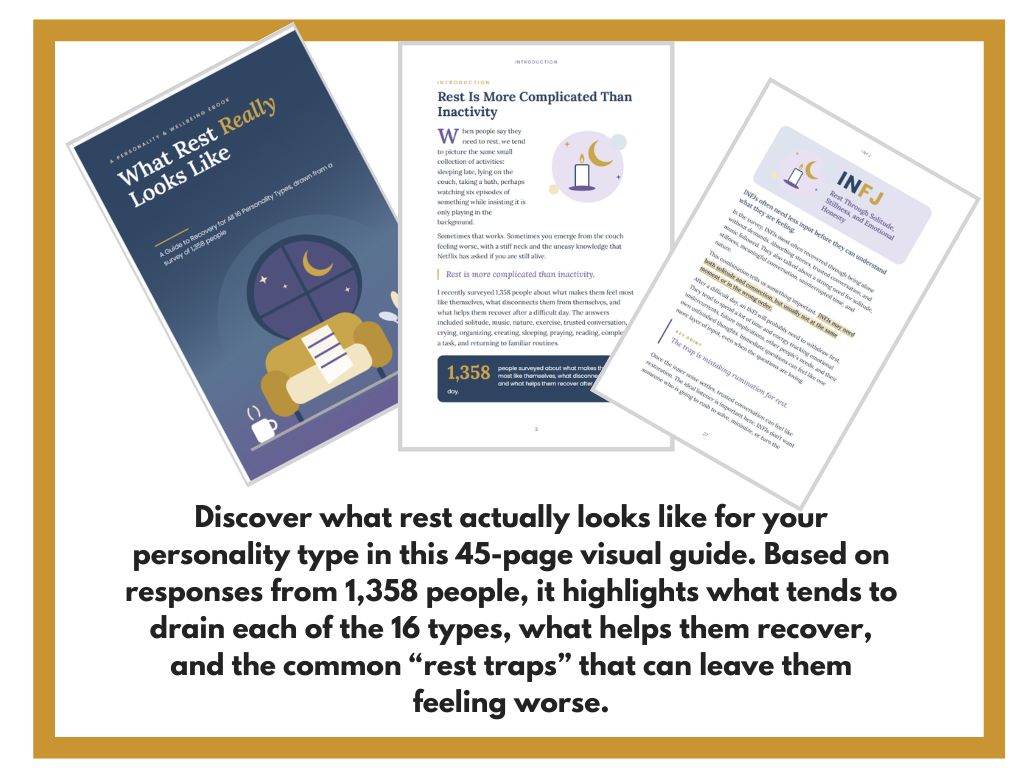
What Rest Means to Each Myers-Briggs® Personality Type
When people say they need to rest, we tend to picture the same small collection of activities: sleeping late, lying on the couch, taking a bath, perhaps watching six episodes of something while insisting it is only playing in the background.
Sometimes that works. Sometimes you emerge from the couch feeling worse, with a stiff neck and the uneasy knowledge that Netflix has asked if you are still alive.

Rest is more complicated than inactivity.
I recently surveyed 1358 people about what makes them feel most like themselves, what disconnects them from themselves, and what helps them recover after a difficult day. The answers included solitude, music, nature, exercise, trusted conversation, crying, organizing, creating, sleeping, praying, reading, completing a task, and returning to familiar routines.
At first glance, some of those things do not look restful at all. Cleaning a kitchen is still cleaning a kitchen. Going for a run requires significantly more effort than lying facedown on the bed. Having an emotional conversation can be exhausting under the wrong circumstances.
But restoration depends on what depleted you.
If you have spent all day making decisions, purposeful action may be the last thing you need. If you have spent the day feeling helpless, completing one manageable task may restore a sense of agency. If you have been performing friendliness for nine hours, solitude can feel medicinal. If you have been isolated with your own thoughts, solitude may be the exact opposite of medicine.
Seneca wrote that “the mind must be given relaxation; it will arise better and keener after resting.” He understood that rest prepares us to return to life with more of ourselves available. It is not always an escape from effort. Sometimes it is a different kind of effort, one that gives something back.
Your Myers-Briggs personality type cannot prescribe the perfect recovery routine. People have bodies, histories, jobs, children, health conditions, financial pressures, and nervous systems that did not consult a four-letter code before developing their opinions.
Still, personality preferences can give us clues. They can help explain why one person recovers by reorganizing the pantry while another needs music, a locked door, and temporary exemption from spoken language.
Here is what rest may actually look like for each of the 16 personality types, based on the survey responses and what we know about their mental preferences.
Table of contents
- ISTJ: Rest Through Order, Privacy, and Predictability
- ISFJ: Rest Through Safety and Release From Responsibility
- ESTJ: Rest Through Resolution and Regained Control
- ESFJ: Rest Through Warmth, Familiarity, and Reciprocal Care
- ISTP: Rest Through Autonomy and Uncomplicated Space
- ISFP: Rest Through Freedom, Beauty, and Sensory Reconnection
- ESTP: Rest Through Movement, Freedom, and a Change of Scene
- ESFP: Rest Through Play, Movement, and Emotional Warmth
- INTJ: Rest Through Uninterrupted Mental Space
- INFJ: Rest Through Solitude, Stillness, and Emotional Honesty
- ENTJ: Rest Through Perspective and Purposeful Withdrawal
- ENFJ: Rest Through Genuine Connection and Shared Humanity
- INTP: Rest Through Solitude and Unrestricted Curiosity
- INFP: Rest Through Creative and Emotional Reconnection
- ENTP: Rest Through Freedom, Stimulation, and Playful Thought
- ENFP: Rest Through Meaning, Expression, and Selective Connection
- Rest Is Whatever Lets You Return
ISTJ: Rest Through Order, Privacy, and Predictability
For many ISTJs, rest begins when the number of incoming demands finally drops.
In my survey, ISTJs most often recovered by being alone without demands. Reading or watching something absorbing came next, followed by music and sleep. When asked what they needed more of in their lives, they frequently chose uninterrupted time, rest, stability, and a meaningful goal.
ISTJs often spend their days noticing what needs to be handled, remembered, maintained, corrected, or finished. Even when they sit down, part of their mind may still be keeping an internal record of every unfinished obligation in the building.
Their most restorative rest often has a boundary around it. Nobody is waiting for an answer. Nothing unpredictable is about to burst through the door. The environment is reasonably settled, and they can give their attention to one familiar, manageable thing.
This might mean returning to a favorite book, working on a solitary hobby, tidying one irritating corner of the house, listening to music, or following a comforting evening routine.
What an ISTJ may need most is permission to stop being responsible for a while. The world can remain slightly unfinished overnight.
Rest may look like: uninterrupted solitude, familiar entertainment, a settled environment, sleep, music, or completing one manageable task and then stopping.
You might also like: ISTJ Grief: How to Cope When Logic Can’t Fix the Problem
ISFJ: Rest Through Safety and Release From Responsibility
ISFJs often need rest from being needed.
Keep in mind, this doesn’t mean they hate helping people. Many ISFJs feel fulfilled when they can be emotionally or practically supportive to someone they care about. The problem begins when care turns into permanent availability.
Conflict, excessive social exposure, too many responsibilities, and constant interruptions were common sources of disconnection for the ISFJs in the survey. Their preferred recovery methods included being alone without demands, sleeping, reading or watching something absorbing, and talking with someone they trusted.
The phrase “without demands” is of course extremely important. An ISFJ may want affection and companionship while having absolutely no interest in managing another person’s feelings. They may want someone nearby who isn’t demanding entertainment, explanation, or a detailed report on why they look tired.
Rest can involve familiar comforts: a well-loved show, soft clothes, a favorite meal, a routine that requires little decision-making, or time in a space that feels emotionally safe. Trusted conversation can also help, especially when the other person listens without immediately handing the ISFJ another problem to solve.
Virginia Woolf wrote, “One cannot think well, love well, sleep well, if one has not dined well.” It is a useful reminder for caregiving types who can become so attentive to everyone else that they treat their own physical needs as a scheduling inconvenience.
Rest may look like: sleep, solitude, familiar comforts, a nourishing meal, gentle routines, or time with someone who expects nothing from them.
You might also like: Understanding ISFJ Grief: How the Protector Processes Pain, Love, and Letting Go
ESTJ: Rest Through Resolution and Regained Control
ESTJs have a hard time resting when anything important feels unresolved.
Telling them to forget everything and relax can have the opposite effect. If their mind is tracking a practical problem, forced idleness may leave more room for that problem to pace around and knock things over.
In the survey, ESTJs mentioned talking with someone they trusted, sleeping, returning to a familiar routine, and cleaning or organizing their environment. They also showed a need for purpose and structure. Life being chaotic will force them into a state of extreme work until life feels like it makes sense again.
For an ESTJ, restorative rest often begins with closing one open loop. They might answer the necessary email, make tomorrow’s list, clear the desk, or decide what the next step will be. Once the situation feels contained, they can actually relax.
Now I’m not saying that ESTJs should just work indefinitely. That’s not good for anyone. They can convince themselves that rest will begin as soon as everything is handled, which is unfortunate because life is messing and having everything handled all at once is almost impossible. There will always be another form, appointment, repair, or person making a baffling logistical choice.
The useful distinction is between purposeful closure and compulsive productivity. One restores a sense of order. The other keeps the nervous system on duty.
Physical rest matters too. Eating, sleeping, moving, and noticing bodily strain are not optional maintenance tasks for less competent people. They are part of staying competent.
Rest may look like: resolving one pressing issue, organizing a limited space, making a plan, talking through a problem, sleeping, or returning to a dependable routine.
ESFJ: Rest Through Warmth, Familiarity, and Reciprocal Care
ESFJs often recover through connection, but not just any connection.
Performing sociability is not the same as being restored by another person. An ESFJ can spend an entire day around people and still feel lonely if they were coordinating, smoothing tension, monitoring everyone’s comfort, or helping the conversation stay alive.
The ESFJs in the survey gave varied answers, which is useful in itself. They mentioned exercise, trusted conversation, prayer or reflection, music, familiarity, affection, and meaningful conversation. Too much time alone tended to make them feel disconnected from themselves.
Their version of rest may be relational, but it needs to be reciprocal. They want people who ask how they are and stay interested long enough to hear the actual answer. They often want affectionate company, shared music, a walk, dinner with someone safe, or time at home with people who do not expect them to manage the emotional atmosphere.
Familiarity can also soothe them. A favorite place, a family ritual, a familiar recipe, or a conversation with an old friend may help the ESFJ settle back into themselves.
The trap is turning rest into another service project. If they invite six people over, cook everything, remember everyone’s dietary requirements, and clean afterward, that may be meaningful. It is not necessarily recovery.
Rest may look like: affectionate company, meaningful conversation, music, movement, prayer, a familiar setting, or receiving the same care they usually provide.
ISTP: Rest Through Autonomy and Uncomplicated Space
ISTPs get their best rest when nobody is hovering.
Among the ISTPs in the survey, being alone without demands was the leading recovery choice by a wide margin. They also mentioned absorbing entertainment, music, trusted conversation, freedom, stillness, privacy, adventure, and meaningful goals.
ISTPs often need social rest and cognitive freedom at the same time. They want room to follow their attention without explaining the plan, reporting their progress, or agreeing on what the activity is supposed to accomplish. Having to check that their idea of a good time is palatable to everyone else can be exhausting for them.
That could mean gaming, watching something interesting, fixing an object, driving, hiking, practicing a skill, working with tools, or sitting in a room where nothing needs to happen. Hands-on activity can be restorative because it gives the mind a concrete problem with honest feedback. The object doesn’t become offended by the ISTP’s tone. It either works or it doesn’t
Trusted conversation can help, but the word “trusted” is doing substantial labor there. ISTPs might open up when they know they will not be cornered, analyzed in real time, or pushed to express more than they have sorted out.
Their rest usually needs to remain voluntary. Even an enjoyable activity can become draining once someone turns it into an obligation.
Rest may look like: being left alone, working with their hands, disappearing into an absorbing interest, spending time outside, moving their body, or talking with one undemanding person.
Find out more about ISTPs: The Four Personality Types ISTPs Clash with Most
ISFP: Rest Through Freedom, Beauty, and Sensory Reconnection
In the survey, ISFPs most often recovered through solitude, music, reading or watching something absorbing, and making or creating something. When asked what they needed to reconnect with themselves, freedom came first, closely followed by solitude. They also wanted more adventure, nature, and creative expression.
This points toward a form of rest that is sensory, private, and self-directed.
An ISFP might recover by listening to music with no other purpose, wandering outside, cooking something that tastes good, drawing, arranging a room, taking photographs, watching a visually beautiful film, or driving somewhere with no demanding agenda attached.
Creative activity is key because it gives their inner world a chance to take form without requiring a long explanation. An ISFP might not want to discuss every feeling, especially while it is still moving through them. Music, color, movement, texture, and imagery can help them process what ordinary language can’t quite explain.
They also need relief from performance pressure. A creative hobby stops being restorative when it becomes content, income, proof of talent, or another arena in which to compare themselves with strangers online.
For the ISFP, rest is often less about doing nothing and more about doing something that feels like it was freely theirs to choose.
Rest may look like: music, nature, private creativity, sensory pleasure, an unplanned outing, beautiful surroundings, or time with no demand to perform.
You might also enjoy: What It Means to be an ISFP
ESTP: Rest Through Movement, Freedom, and a Change of Scene
ESTPs might become more tired when rest is presented as prolonged stillness.
The ESTP sample in this survey was very small (only 74), so these responses are better treated as clues than conclusions. Still, the pattern fits what many ESTPs describe: spending time outside, reading or watching something absorbing, completing a manageable task, talking with someone trusted, getting some freedom, and wanting adventure or intellectual stimulation.
ESTPs are often restored by changing their state or environment. If they have been trapped indoors, they may need movement. If they have been dealing with vague emotional tension, they may need a concrete activity. If they have been controlled by schedules and responsibilities, they may need a few hours in which they can follow their whims.
Rest could mean taking a drive, playing a sport, going for a hike, exploring somewhere new, watching an intense movie, fixing a practical problem, or spending time with a friend who doesn’t need emotional tending to at the time. From my own experience, I’ve noticed that my ESTP husband likes to work out when he’s stressed or go for a drive.
This doesn’t mean ESTPs never need sleep or stillness. Bodies remain stubbornly biological regardless of what someone’s personality type may be. But often the ESTP’s nervous system settles through action before it settles through inactivity.
The danger is using constant stimulation to outrun exhaustion. Adventure can restore energy, but it cannot permanently replace sleep, food, grief, or honest reflection.
Rest may look like: exercise, fresh air, a spontaneous outing, a practical win, engaging entertainment, or relaxed time with a trusted friend.
ESFP: Rest Through Play, Movement, and Emotional Warmth
For many ESFPs, rest needs a little life in it.
The ESFP respondents often chose exercise or movement, solitude, music, and absorbing entertainment after a difficult day. They also talked about a need for freedom, adventure, affection, stimulation, and play.
ESFPs are sometimes expected to recover through even more social activity. People assume that because someone is expressive or outgoing, a crowded room will fix everything. But the truth is less straightforward. An ESFP who has spent all day adapting to people can need time alone just as much as anyone else.
The difference is that restorative solitude may still be sensory and active. They might dance around the house, take a walk with music, cook something enjoyable, watch a favorite performance, spend time with an animal, or go somewhere beautiful without having to manage a group.
Emotional warmth can also be hugely impactful. Affection, laughter, and time with someone who makes room for their real feelings may help more than formal advice. ESFPs often know when an interaction has become too stiff, clinical, or detached from actual human experience.
Play is not frivolous here. It gives the psyche a break from constant self-monitoring and responsibility. Adults need moments in which nothing is being graded, optimized, monetized, or added to a résumé.
Rest may look like: movement, music, playful solitude, affectionate company, sensory enjoyment, laughter, or a small adventure.
INTJ: Rest Through Uninterrupted Mental Space
INTJs appear capable of sitting motionless while conducting an entire international tribunal in their heads. This can look restful from across the room. It is not.
In the survey, INTJs had one of the clearest patterns. Being alone without demands was their leading recovery method, followed by reading or watching something absorbing, music, and sleep. Eighty-seven percent selected solitude when asked what helped them reconnect with themselves. Intellectual stimulation and uninterrupted time were the things they most wanted more of.
The word “uninterrupted” may matter more than the word “alone.” An INTJ can be physically alone while remaining mentally tethered to messages, obligations, noise, and the possibility that someone will need something in four minutes. As an INTJ work from home mom, I feel this a lot. Anytime I’m at my computer trying to work or research, I’m fully aware that at any moment someone could burst through the door with an emotional concern, a request for a snack, or a complaint about a sibling. Whenever I get some time where I’m alone and I know there will be no interruptions, I feel like I’m on cloud nine. I know other INTJs will relate.
For INTJs, the most powerful rest lets the mind follow one thread in depth. This could involve reading, researching an unnecessary but fascinating subject, watching a profound story, listening to music, walking alone, planning a personal project, or creating something without an audience.
INTJs also need physical recovery, even when the mind objects that it has more interesting plans. Sleep deprivation does not become intellectual just because you spent it reading. I’m aware of my own hypocrisy as I write this, considering I’ve gotten about four hours of sleep per night for two weeks.
Rest may look like: protected solitude, deep reading, music, sleep, an uninterrupted project, or enough mental space to finish a thought.
You might also enjoy: Inside the INTJ Brain
INFJ: Rest Through Solitude, Stillness, and Emotional Honesty
INFJs often need less input before they can understand what they are feeling.
In the survey, INFJs most often recovered through being alone without demands. Absorbing stories, trusted conversation, and music followed. They also talked about a strong need for solitude, stillness, meaningful conversation, uninterrupted time, and nature.
This combination tells us something important. INFJs may need both solitude and connection, but usually not at the same moment or in the wrong order.
After a difficult day, an INFJ will probably need to withdraw first. They tend to spend a lot of time and energy tracking emotional undercurrents, future implications, other people’s needs, and their own unfinished thoughts. Immediate questions can feel like one more layer of input, even when the questions are loving.
Once the inner noise settles, trusted conversation can feel like restoration. The ideal listener is important here. INFJs don’t want someone who is going to rush to solve, minimize, or turn the conversation into a debate. The right listener will help the INFJ put language around something that was previously felt as a large, blurry mass.
Nature, journaling, music, contemplative practices, and emotionally deep stories can also help. These activities create enough distance for patterns to become visible.
The trap is mistaking rumination for rest. Solitude restores the INFJ when it allows experience to settle. It drains them when every painful interaction is replayed in their mind for hours on end.
Rest may look like: solitude first, then meaningful conversation, time in nature, reflective writing, music, stillness, or an absorbing story.
You might also enjoy: What Makes INFJs Feel Safe in an Uncertain World
ENTJ: Rest Through Perspective and Purposeful Withdrawal
The ENTJ sample was small (only 41 people), but respondents mentioned writing or journaling, prayer or reflection, absorbing entertainment, time outside, structure, freedom, novelty, purpose, and meaningful goals.
Their version of rest might involve stepping far enough away from a problem to regain perspective. ENTJs often operate by identifying objectives, making decisions, and moving resources and energy toward a result. When exhausted, they might continue pushing because action feels better than uncertainty or chaos.
Unfortunately, more force doesn’t always make things magically clear.
Writing can help because it turns an internal tangle into something visible. Walking, traveling, reading, or spending time outside can widen the mental frame. Even a strategic person needs periods in which life is not a project under review.
Purposeful withdrawal might feel more natural than vaguely “relaxing.” The ENTJ can decide, for example, that the next two hours are protected from work, decisions, metrics, and improvement. That boundary is itself a decision, but at least it is one that prevents another seventeen decisions.
Their deepest rest may come when they no longer have to be the person who knows what should happen next.
Rest may look like: journaling, reflection, nature, a deliberate change of scene, engaging entertainment, spiritual practice, or time free from leadership.
ENFJ: Rest Through Genuine Connection and Shared Humanity
ENFJs often rest through connection, provided they are allowed to be a person inside it.
In the survey, ENFJs frequently chose trusted conversation, spending time outside, physical affection, and play. Connection was their leading reconnection need. They also wanted community, intellectual stimulation, movement, and adventure.
An ENFJ may spend much of the day noticing what other people need, drawing quieter people into conversations, mediating tension, encouraging growth, and trying to keep relationships from fraying. Even enjoyable social contact can become work when they feel responsible for its emotional outcome.
Restorative connection is different. It includes people who notice the ENFJ’s mood without making them to package it attractively. Often ENFJs feel a lot of pressure to be always sunny, affirming, empathetic, and supportive. When exhausted, they may want conversation, but they also want the freedom to have shared silence, frustration, or fatigue.
Play is also important according to the ENFJs we surveyed. ENFJs can become so invested in everyone’s development that every interaction gains a faint atmosphere of personal growth homework. They need experiences with no moral lesson hiding inside them.
Solitude may still matter, especially when they have been overstimulated or carrying emotional material that is not theirs. But extended isolation can leave many ENFJs feeling less like themselves rather than more.
Rest may look like: affectionate company, honest conversation, a walk with someone trusted, playful activity, community without responsibility, or being cared for without having to earn it.
You might also enjoy: The ENFJ Cognitive Functions: An In-Depth Guide
INTP: Rest Through Solitude and Unrestricted Curiosity
INTPs showed one of the strongest preferences for being alone without demands. They also recovered through reading or watching something absorbing, sleeping, and making or creating something.
At the same time, INTPs were among the types most likely to say they felt like themselves with someone who deeply understood them. They wanted intellectual stimulation, meaningful conversation, uninterrupted time, and meaningful goals.
This is not a contradiction. Many INTPs do not want constant interaction. They want interaction that is worth the interruption.
Their most restorative rest gives the mind room to roam without producing anything useful by a deadline. They may read, watch a documentary, investigate a strange question, build something, play a game, listen to an interview, or disappear into a fictional world. Curiosity becomes restorative when it is free from evaluation.
Sleep matters too, although INTPs have been known to respond to fatigue by opening another tab. Mental interest can temporarily hide physical depletion, but the body eventually submits its invoice.
A good conversation can restore an INTP when it includes honest thought, intellectual freedom, and no pressure to reach a socially pleasing conclusion. Small talk may use energy. A two-hour discussion about consciousness, urban planning, or why a film’s time-travel rules do not work may somehow return it.
Rest may look like: undisturbed solitude, sleep, deep-diving into an interest, making something, absorbing entertainment, or one genuinely interesting conversation.
Read This Next: 19 TV Shows You’ll Love as an INTP
INFP: Rest Through Creative and Emotional Reconnection
INFPs often need rest from adapting themselves.
In the survey, they recovered through solitude, trusted conversation, absorbing stories, and music. Creative expression was the thing they most wanted more of, followed by meaningful conversation, uninterrupted time, and intellectual stimulation.
Their rest often involves returning to an inner world that has been crowded out by obligation. Music, writing, art, reading, imaginative hobbies, nature, and emotionally resonant films can help them locate feelings that became difficult to hear during the day.
Crying, while surprising to some people, can also be restorative. It is not always evidence that the evening has gone terribly wrong. Sometimes the body has been waiting for a safe moment to finish an emotional process that had to be postponed at 10:17 that morning.
INFPs can also benefit from a trusted person who listens without correcting the emotion, debating its logic, or offering six action steps. They may already know what they should do. They need enough room to recognize what the experience meant to them.
The key here is that creative rest has to be safe from perfectionism. INFPs don’t need to write a good poem, paint something marketable, or turn every hobby into a public identity. Making something badly can still restore contact with the self.
Rest may look like: music, private creativity, a good cry, meaningful conversation, reading, nature, or uninterrupted time to follow an inner thread.
Find out more about INFPs: How INFPs Can Find Beauty in an Uncertain World
ENTP: Rest Through Freedom, Stimulation, and Playful Thought
ENTPs may need rest from confinement more than rest from activity. In the survey, ENTPs mentioned absorbing entertainment, music, reflection, solitude, freedom, expression, stimulation, intellectual engagement, and creative work. Rigid routines and excessive responsibilities were especially likely to make them feel disconnected from themselves.
In order to feel recharged, they need movement between ideas. They may want to watch something clever, talk with someone inventive, brainstorm a ridiculous project, experiment with a new tool, read about an unexpected subject, or go somewhere that disrupts the usual scenery.
This can look weirdly energetic to people whose idea of rest involves turning the lights down and removing all nouns from the conversation. For an ENTP, stimulation is not always the source of exhaustion. Repetition, restriction, and obligation are often the real drains. Still, there is a difference between enlivening stimulation and compulsive input. Opening twelve new projects may feel wonderful for twenty minutes and leave the ENTP with twelve additional sources of low-grade guilt.
The best rest gives them freedom without creating a trail of future administrative consequences. Humor helps. So does conversation with someone who can play with ideas and insights with them.
Rest may look like: interesting entertainment, music, playful debate, creative experimentation, a change of scene, or freedom to follow an idea with no required outcome.
ENFP: Rest Through Meaning, Expression, and Selective Connection
ENFPs often need a mix of space and connection, which can confuse the people trying to help them.
In the survey, ENFPs recovered through solitude, trusted conversation, entertainment, and time outside. Their reconnection answers were varied, including stimulation, connection, freedom, and stillness. They also wanted deep conversation, affection, community, and a meaningful goal.
An ENFP may want to be alone because they’re just tired of responding to people, then feel restored enough to want one very specific person. They may need stillness, but they don’t want emptiness. They may want stimulation, but only if it connects with something that feels actually meaningful to them.
Rest can involve journaling, music, nature, an absorbing story, a spontaneous outing, affectionate conversation, or returning to an idea that once made them hopeful. Emotional expression matters because ENFPs can become disconnected when they have had to contain too much of themselves for too long.
They also benefit from freedom from compulsory enthusiasm. People may expect the ENFP to remain funny, imaginative, encouraging, and open to possibility even when they are depleted. Sometimes rest means being unimpressive in front of someone safe.
The trap is confusing constant novelty with restoration. A new possibility can revive them, but scattering their attention across too many possibilities can leave them more fragmented.
Rest may look like: solitude followed by selective connection, nature, honest expression, affection, an inspiring idea, playful activity, or an absorbing story.
Rest Is Whatever Lets You Return
One of the clearest findings in my survey was that people wanted both solitude and meaningful connection.
More respondents felt most like themselves when completely alone than in any other situation. But being with someone who deeply understood them was the second most common answer. Meaningful conversation was also the thing people most often said they needed more of in their lives.
Apparently, many of us do not need more social contact. We need less social pressure and better contact.
Rest may mean sleeping, but it may also mean no longer monitoring everyone’s mood. It may mean exercise after a day spent trapped behind a screen. It may mean cleaning one surface because visual disorder has been scraping against your attention. It may mean crying, making something, praying, reading, laughing, or finishing one task that has made you feel powerless all week.
It may also mean doing absolutely nothing and refusing to defend it.
Personality type can help you notice which forms of pressure drain you fastest. It can also help you stop judging forms of rest that do not resemble your own. The person going for a run is not necessarily avoiding rest. The person closing the bedroom door is not necessarily rejecting you. The person reorganizing a drawer may not need to “learn how to relax.” They may already be doing it.
Find out more about your personality type in our eBooks, Discovering You: Unlocking the Power of Personality Type, The INFJ – Understanding the Mystic, The ISFJ – Understanding the Protector, and The INFP – Understanding the Dreamer. You can also connect with me via Facebook, Instagram, or YouTube!