
Inside the INTJ Brain: What’s Actually Going On in There?
INTJs have gotten a strange reputation online. Depending on whom you ask, they are chess-playing masterminds, emotionally unavailable supervillains, or exhausted people trying to redesign the grocery store checkout system because the current arrangement makes no sense.
The truth is less theatrical and more interesting.

INTJs tend to take in information through Introverted Intuition, or Ni. They look for underlying patterns, long-term implications, and the one explanation that connects several seemingly unrelated facts. Their auxiliary process, Extraverted Thinking, or Te, then asks what can be done with that insight.
In plain English: the INTJ mind often moves from What does all of this mean? to Fine, now how do we fix it?
That combination can look wildly perceptive from the outside. It can also leave an INTJ staring into the refrigerator for three minutes because their brain is still working on a problem from Tuesday.
Not sure what your personality type is? Take our questionnaire here!
First, a Necessary Note About “The INTJ Brain”
Today I’m going to reference the work of one of my favorite typology researchers, Dario Nardi. He has used EEG technology to explore how people with different personality preferences use their brains. His findings are fascinating, but they’re best viewed as early observations, not final proof that every INTJ’s brain works in exactly the same way. His study included a fairly small group of participants and wasn’t a large, peer-reviewed experiment.
Even with those limitations, Nardi’s work gives us an interesting glimpse of what INTJ-style thinking might look like in action, especially when we compare it with broader research into insight, pattern recognition, and creative problem-solving. Think of it as a window into the INTJ mind, not a neurological fingerprint that will fit every INTJ perfectly.
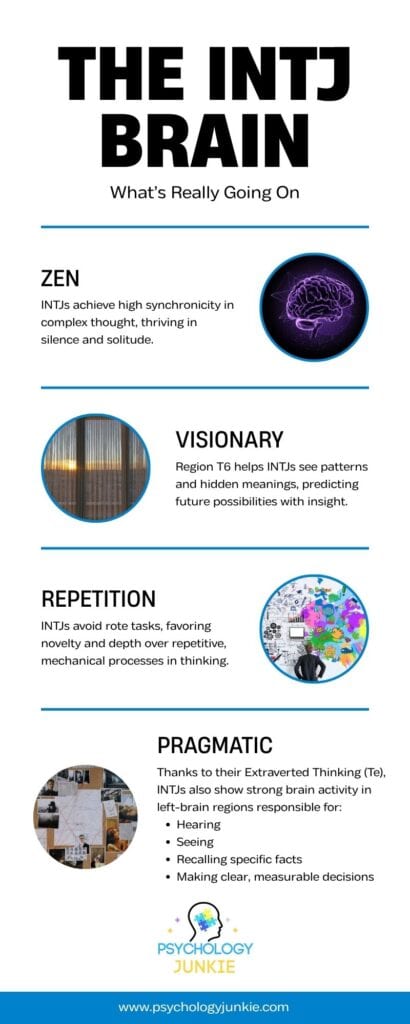
The Whole-Brain “Zen” Pattern
One of Nardi’s most interesting observations was that INTJs sometimes entered a highly synchronized, whole-brain state while working on unfamiliar or difficult problems. Most people are more likely to show this kind of coordination when performing an activity they have practiced extensively. A professional musician may reach it while playing a familiar piece. An experienced athlete might experience it during a well-rehearsed movement.
INTJs, according to Nardi, were more likely to show this pattern when facing something novel, abstract, or uncertain, which makes a strange amount of sense. Give an INTJ an ordinary form to complete, and their mind may wander away in protest. Give them a problem with incomplete information, conflicting evidence, and no obvious solution, and suddenly every light in the building turns on.
You might see this when an INTJ is:
- Trying to understand why a business is steadily losing customers
- Comparing several explanations for a historical event
- Predicting how a family conflict will unfold if nothing changes
- Designing a system that has never existed before
- Reading across psychology, biology, history, and philosophy to find a shared pattern
- Working out the hidden rules of a fictional world
The answer may not arrive through a visible chain of reasoning. The INTJ absorbs information, turns it over internally, and eventually experiences a sense of convergence: That’s it. That explains the whole thing.
Jung described intuition in much the same way: “A content presents itself whole and complete,” even when we cannot explain how it originated.
Mainstream insight research offers a partial parallel. Studies of sudden problem-solving have found that insight involves coordinated activity across several brain areas, including changes in alpha and gamma activity before a solution reaches conscious awareness. The brain appears to be forming connections before the person can put those connections into words. Research on the neural activity of insight and EEG correlates of insightful problem-solving support this broader process, although they were not studies of INTJs specifically.
This may explain a common INTJ frustration: they know where a situation is heading, but they cannot immediately show everyone else the route they took to get there.
What This Looks Like in Real Life
Imagine that a company has missed its revenue goals for three consecutive quarters. One person blames marketing. Another blames the economy. Someone else wants to replace the sales manager.
The INTJ may sit back and listen without saying much. Meanwhile, they are comparing changes in customer behavior, pricing, staffing, product quality, and the timeline of earlier decisions. Two days later, they point to a problem that began eighteen months ago when the company shifted its target audience without adjusting its product.
To everyone else, the conclusion seems sudden. It was not sudden inside the INTJ’s head. It was being assembled below the level of conversation.
This happens in relationships too. An INTJ may notice that someone’s tone changes around a particular topic, that their stated priorities do not match their repeated choices, or that three unrelated arguments share the same emotional root. They are not necessarily judging the person. They are trying to find the pattern that makes the behavior coherent.
Unfortunately, people do not always enjoy being treated like an unsolved systems problem. I’ve lost friends because I made observations about their patterns and the roots of their psychology that they didn’t want to hear. If I’m in auto-pilot mode and getting too comfortable in a conversation, I can say a lot of pretty piercing things about who someone is without realizing it might sting. The intent isn’t to hurt, it’s to make the pattern obvious, but in the process I sometimes fail to realize how unpleasant this can be to the person on the receiving end of it. This has been something I’ve had to work on a lot as an adult; knowing when to point out a pattern, knowing when to stay silent, and how to frame the pattern in a way that helps rather than hurts.
About T6 and “Predicting the Future”
Nardi also noticed activity at an EEG site called T6, located toward the back of the right temporal area. In his model, this site is connected with things like recognizing symbols and faces, reading nonverbal cues, and considering what is likely to happen next.
To clarify, T6 is the location of an electrode on the scalp, not one specific “INTJ region” in the brain. It doesn’t give INTJs supernatural powers or allow them to predict the future with eerie accuracy. What it may help illustrate is the INTJ tendency to gather clues from the present and combine them into a larger forecast.
An INTJ’s version of predicting the future might sound like:
- “If we keep rewarding this behavior, it’s going to become part of the culture.”
- “This plan works right now, but it won’t scale.”
- “They’re fixing the visible problem instead of asking why it keeps happening.”
- “I don’t think those two facts are unrelated.”
- “Everyone is excited about this, which is making me a little suspicious.”
Introverted Intuition isn’t magic. It creates an internal model of what is happening and then runs that situation forward: If these patterns continue, where will they lead?
Sometimes the resulting prediction is perceptive and accurate. Other times, the INTJ gets so attached to their interpretation that contradictory evidence begins to look like an annoying technicality. Even strong intuition needs the occasional reality check.
Why Interruptions Feel So Expensive
INTJs frequently say that they need uninterrupted time to do their best thinking. This is sometimes dismissed as introversion or moodiness, but deep mental integration is genuinely vulnerable to interruption. For an INTJ holding six variables, three possible outcomes, and one half-formed realization in mind, “Can I ask you something really fast?” may not feel fast at all.
This is why many INTJs do their best thinking while:
- Walking alone
- Driving a familiar route
- Showering
- Writing before everyone else wakes up
- Sitting in a room with no conversation
- Working late, when new demands have stopped arriving
Solitude is not always withdrawal. Sometimes it is the workspace where separate pieces finally connect.
Why Rote Repetition Gets Old So Fast
INTJs can be extremely persistent when repetition serves a larger objective. They will practice, revise, measure, and try again if they believe the process is leading somewhere worthwhile.
What they tend to dislike is repetition without discovery. A procedure that must be followed forever because “that’s how we’ve always done it” can make an INTJ feel trapped in an experiment whose results were obvious five years ago. Their first impulse is often to automate it, streamline it, delegate it, or question why it exists.
This can show up in surprisingly ordinary ways:
- Reorganizing a kitchen so fewer steps are required
- Creating email templates rather than rewriting the same response
- Learning keyboard shortcuts nobody else cares about
- Rebuilding a spreadsheet that technically worked
- Researching an entire new system to save four minutes per week
- Becoming irritated when other people prefer familiarity to efficiency
Where Extraverted Thinking Enters the Picture
Introverted Intuition develops the internal model. Extraverted Thinking wants to test, organize, measure, and implement it. It’s the “just do it” part of their personality type.
The official Myers-Briggs description of INTJs captures this pairing well: they “quickly see patterns in external events and develop long-range explanatory perspectives,” then organize their work to carry their ideas through. The Myers-Briggs Company’s INTJ description emphasizes both originality and implementation.
This is an important correction to the stereotype that INTJs live entirely inside their heads. A healthy INTJ does not only want a brilliant theory. They want the theory to survive contact with reality.
Te asks:
- What evidence supports this?
- How will we know if it is working?
- Which step needs to happen first?
- What resources are being wasted?
- Who is responsible for the decision?
- Can we please define what “better” means?
In my work as an MBTI® practitioner, I have found that many INTJs become animated when a conversation moves from general concern to something they can investigate. “Everything is going badly” gives them nowhere to stand. “Here are the three recurring problems and the numbers behind them” gives them something to work with. They may not offer emotional reassurance first. Their version of care often arrives carrying a plan. In fact, for INTJs, showing love often involves problem-solving, organizing, and strategizing for the person they care about.
When the INTJ Brain Works Against Itself
Every strength has an overused version. Pattern recognition can become certainty. Independence can become refusal to consult anyone. Strategic thinking can turn into living twelve months ahead while barely inhabiting the present.
An INTJ may need to watch for:
- Treating a strong impression as proven fact
- Researching indefinitely because action still feels premature
- Dismissing useful feedback because the other person explained it badly
- Optimizing systems that were never the real problem
- Assuming that emotional factors are irrelevant because they are difficult to measure
- Becoming so focused on future consequences that current experience feels like an interruption
The INTJ mind is at its best when intuition proposes and reality answers. The inner vision matters, but so do the inconvenient details, the human reactions, and the evidence that refuses to fit.
How to Work With Your INTJ Brain
If you are an INTJ, you probably do not need advice about thinking harder. You may need better conditions for thinking clearly.
Try:
- Protecting one substantial block of uninterrupted time rather than collecting ten tiny work periods
- Writing down the evidence behind a prediction before treating it as certain
- Explaining the intermediate steps when other people cannot follow your conclusion
- Asking whether a problem needs a better system or a more human response
- Leaving room for sensory experience that has no productivity goal attached
- Revisiting your long-term model when new evidence appears
The INTJ brain is not a crystal ball, a supercomputer, or a secret headquarters staffed by tiny chess masters. It is a mind inclined toward synthesis: collecting fragments, finding the underlying structure, and using that structure to build something more coherent. When given enough space, enough information, and a difficult enough question, it can do some of its finest work.
Other Articles You Might Enjoy:

18 Ways Tertiary Fi Shows Up for INTJs

14 TV Shows You’ll Love as an INTJ

Why INTJs Disappear (and Why it’s Usually Not Personal)

INTJ Grip Stress: What it is and How to Cope

27 Signs That You’re an INTJ, the “Strategist” Personality Type








According to AI, I am an INTJ with secondary overlaps to INFJ when dealing with interpersonal problems or complexities, and INTP when engaged in deep research activities. This interests me because I do tend to score either INTJ, INFJ, or INTP on MBTI tests.
I asked AI to predict my MBTI type based on my publications – mostly refereed journal articles and three editions of my textbook, plus anything it could glean about my career as a research professor, and earlier careers as entrepreneur management consultant and trainer. It obtained a surprising amount. It said I was INTJ with contextual secondary overlaps with INTP and INFJ.
The advantage of being INTJ/INTP is that INTP facilitates in-depth analysis of a wide range of possibilities but its weaknesses are closure and deadlines. The advantage of INTJ is that it is very good with deadlines and it facilitates in-time closure.
As for the INTJ/INFJ secondary overlap, originally I trained to become a group psychotherapist and learned Fe style communication in that context.
AI tells me secondary loops are possible when one’s interval level scores on an MBTI dimension are very close so the numerical difference between secondary and tertiary is very slight suggesting almost equal strength. I generally score very close between T and F which AI seems to suggest allows me to function as either Te or Fe situationally. When I did my MBA, my T score magnified but equalized with F again after several years of teaching business as a prof. INTJ is a very useful style for studying for an MBA if one is attending an applied case study based school like Harvard, or for me, Ivey (the Canadian Harvard).
I also score very close between J and P, and I suppose that allows me to switch between INTJ and INTP, a bit like a quasar star, depending on the situation.
Does that make sense? You are the expert on MBTI and, presumably Jungian personality type theory. I am only “feeling” my way along as in a dark corridor. My expertise is business strategy in international business contexts – building effective business relationships between people from different cultural backgrounds.
Regards,
Neil R. Abramson, MBA, PhD