
Here’s the Influential Woman in History Who Has Your Myers-Briggs® Personality Type
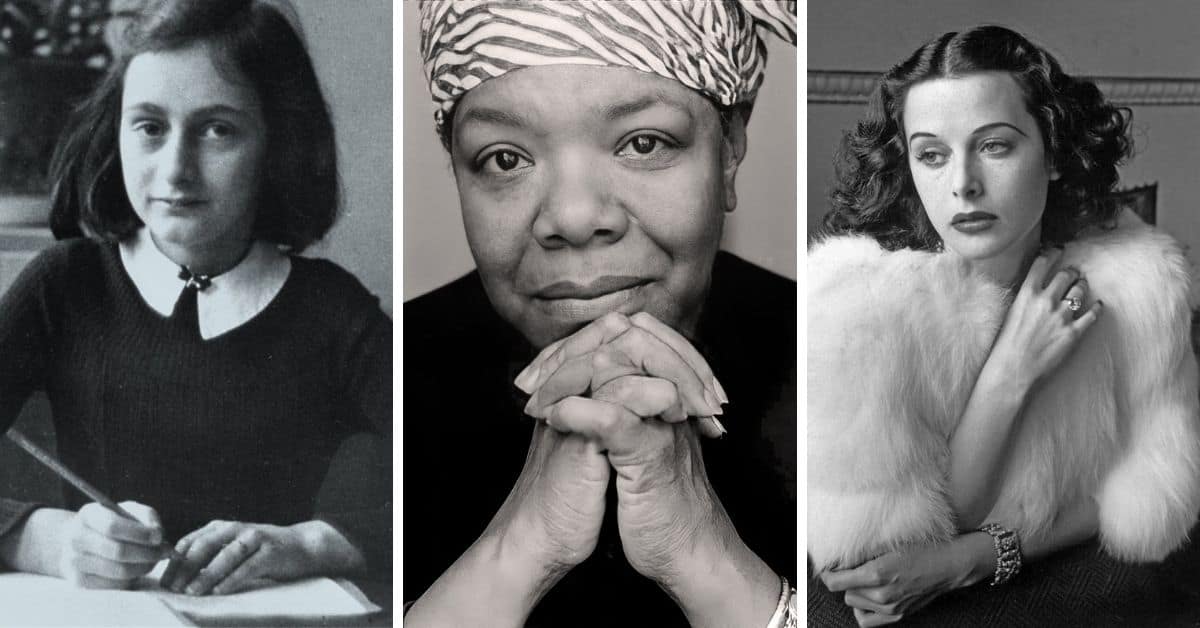
Have you ever wondered which famous and inspiring woman in history has your personality type? Back when I was a kid (way back in the ’80s and ’90s), I used to love perusing the biography section of the library. My favorite person to research was George Washington Carver, but after that I bulldozed my way through biographies of Harriet Tubman, Helen Keller, and Anne Frank.
Exploring the biographies of people who’ve come before us can inspire us to do great things and to dream big! In today’s article we’ll only scratch the surface of what these women accomplished. I hope you’ll be inspired to head to your local library and discover more about these women and go after your own ambitions and dreams.
Not sure what your personality type is? Take our new personality questionnaire here. Or you can take the official MBTI® here.
Table of contents
- Here’s the Famous Woman in History who Has Your Myers-Briggs® Personality Type
- The ENFP – Anne Frank
- The ENTP – Catherine the Great
- The INFP – Harriet Tubman
- The INTP – Chien-Shiung Wu
- The ENFJ – Maya Angelou
- The ENTJ – Queen Elizabeth I
- The INFJ – Jane Addams
- The INTJ – Jane Austen
- The ESFP – Sappho
- The ESTP – Helen Gibson
- The ISFP – Frida Kahlo
- The ISTP – Hedy Lamarr
- The ESFJ – Dolley Madison
- The ESTJ – Ann Preston
- The ISFJ – Mother Teresa
- The ISTJ – Queen Elizabeth II
- What Are Your Thoughts?
Estimated reading time: 28 minutes
Here’s the Famous Woman in History who Has Your Myers-Briggs® Personality Type
The ENFP – Anne Frank
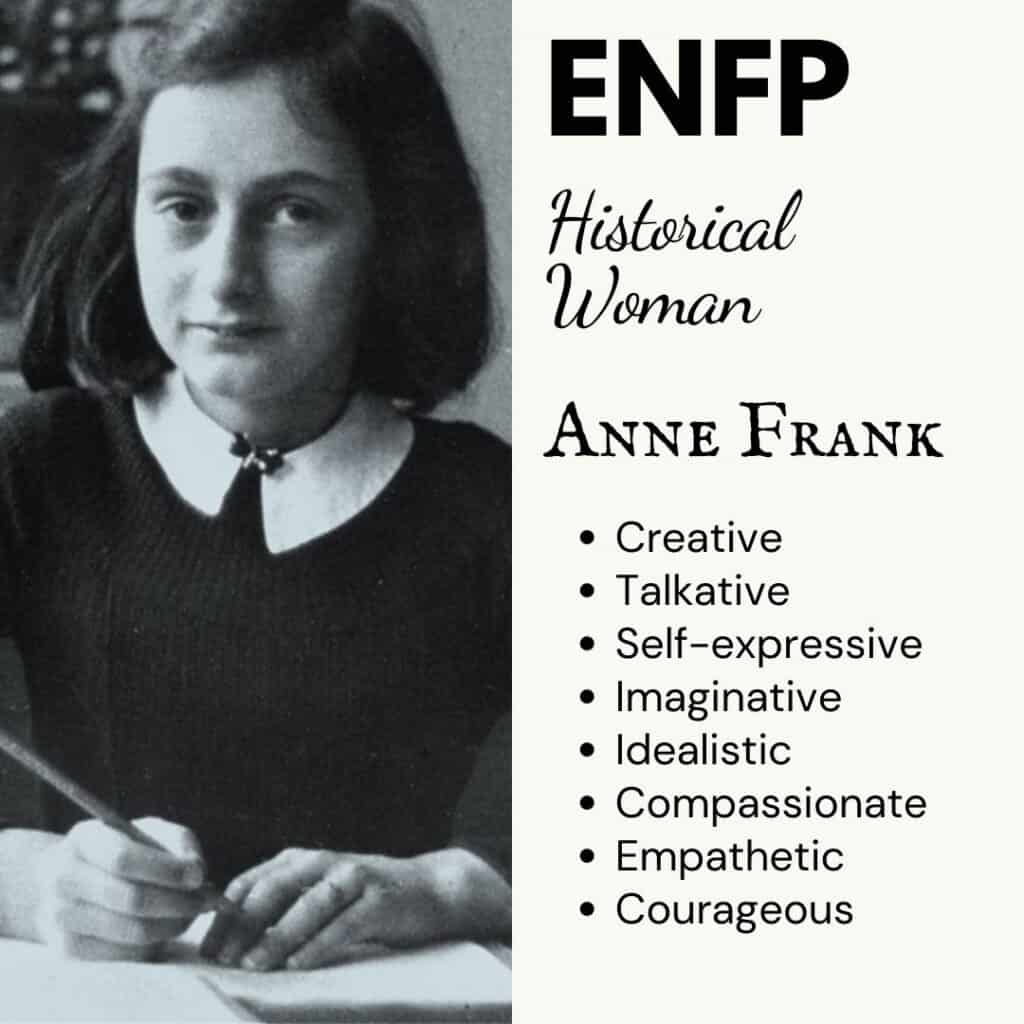
“How wonderful it is that nobody need wait a single moment before starting to improve the world.” – Anne Frank
Idealistic and inspiring, Anne Frank refused to give up on the goodness of people. Even though she faced some of the worst humanity has to offer, she maintained hope that people could change. Before the Nazi occupation, Anne Frank was an outgoing, vivacious girl who loved to write. She also loved Greek mythology, cats, movie stars, and boys! Known for being talkative, she was made to write several essays on the subject of “A Chatterbox” in school. Like many ENFPs, Anne needed an outlet for the overflowing ideas and stories in her head.
When the Frank family went into hiding, Anne’s world was turned upside down. She was forced to give up her friends, school, and any sense of normalcy or freedom. Later, when she was taken to the concentration camp, she was separated from her family and faced starvation, sickness, and the constant threat of death. Even in the face of these horrific conditions, Anne maintained hope. In her diary she wrote:
“I keep my ideals, because in spite of everything I still believe that people are really good at heart.”
Throughout this turmoil, Anne found solace in writing. She poured her heart out in her diary, documenting not only the events of daily life but also her hopes, dreams, and fears. She also used her diary as a way to work out her own identity and to process the confusing events going on around her. Anne’s diary has become one of the most widely read books in the world and continues to inspire people of all ages with its message of hope. ENFPs will relate to Anne’s passion for writing, her love of people, and her indomitable hope.
Read This Next: Dealing with Emotional Overwhelm as an ENFP
The ENTP – Catherine the Great
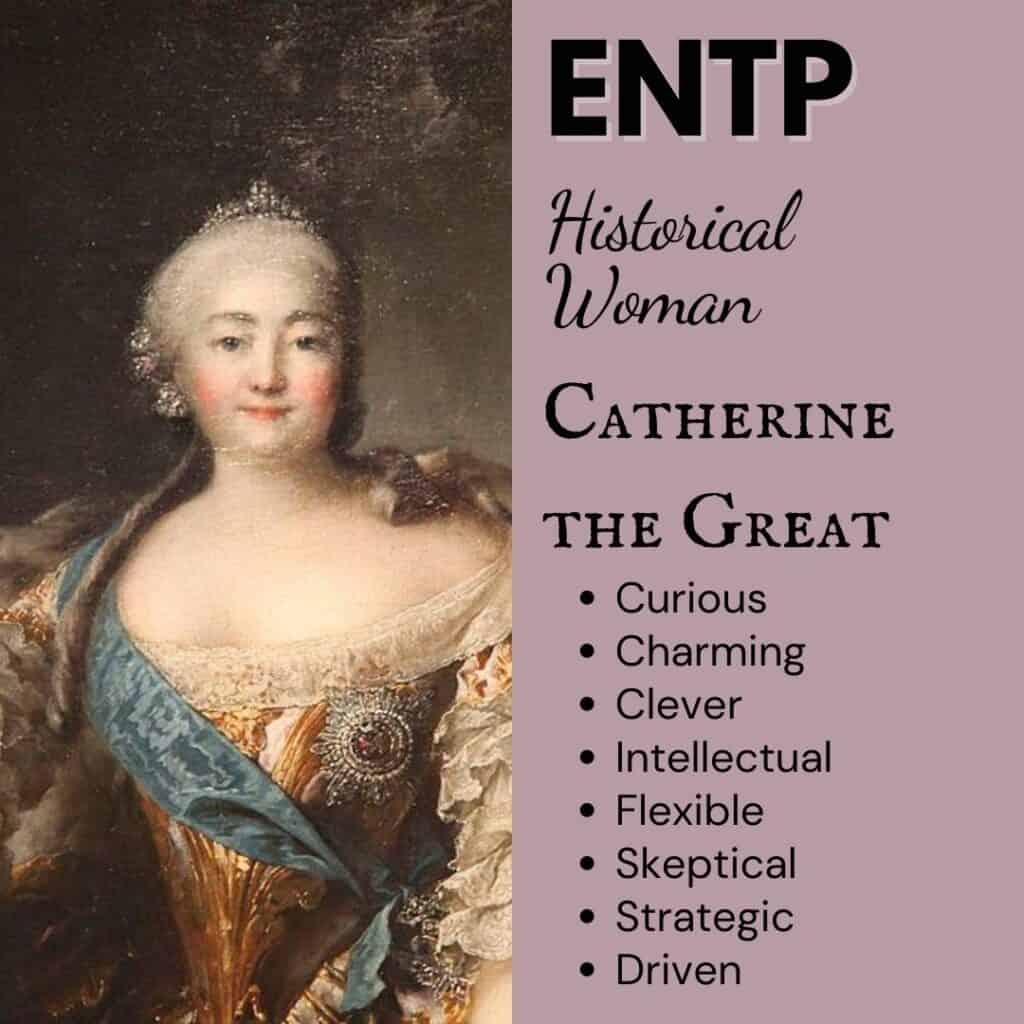
“I am one of the people who love the why of things.” – Catherine the Great
Catherine the Great is not the kind of historical figure you describe as “manageable.”
She arrived in Russia as a young German princess who didn’t even speak the language, married to a future emperor she neither respected nor trusted, and somehow ended up ruling one of the largest empires in the world by causing a coup that removed her own husband from power. Whatever else you say about her, you cannot accuse her of thinking small.
What fascinates me about Catherine isn’t just the drama of how she took the throne, but what she did once she had it. She wasn’t content to sit inside ceremony. She read constantly, corresponded with Enlightenment thinkers, and amassed one of the largest private book collections in Europe. She wrote plays, debated philosophy, and engaged with ideas the way some people engage with sport. That intellectual restlessness feels very ENTP to me.
Catherine, like many ENTPs, saw power as something to experiment with. She was energized by reform, implemented educational initiatives, promoted certain forms of religious tolerance, and explored ways to modernize Russian law and governance. Some of her reforms were inconsistent and some stalled or were compromised by the realities of ruling an enormous empire. But she was never intellectually passive. She wanted Russia to evolve.
In personality terms, this looks like someone who thrives on possibility. ENTP energy often questions assumptions simply because they can see alternatives. They’re less attached to tradition for its own sake and more interested in whether something works. Catherine displayed that streak repeatedly. She was willing to disrupt convention, to challenge existing structures, and to imagine a different future for her country.
She was also socially agile. Contemporary accounts describe her as witty, charming, and capable of holding her own in conversation with some of the sharpest thinkers of her time. That combination of mental agility and social fluency is powerful. It allows someone not only to generate ideas, but to persuade others to entertain them.
Of course, she was not a flawless reformer. No ruler of an empire that size could be. Her reign included contradictions, political compromises, and decisions that modern readers rightly critique. But even in those complexities, she did not shrink herself to fit expectations. She wanted to expand possibilities, and no one could stop her from that.
While Catherine the Great certainly made some pretty big mistakes, it’s hard not to admire the sheer audacity of her trajectory. A foreign teenager with no power becomes empress. A voracious reader becomes a central political force in Europe. A woman in the 18th century reshapes an empire.
That kind of momentum comes from a mind that refuses to stop asking, “What if we did this differently?”
Read This Next: A Look at the ENTP Leader
The INFP – Harriet Tubman
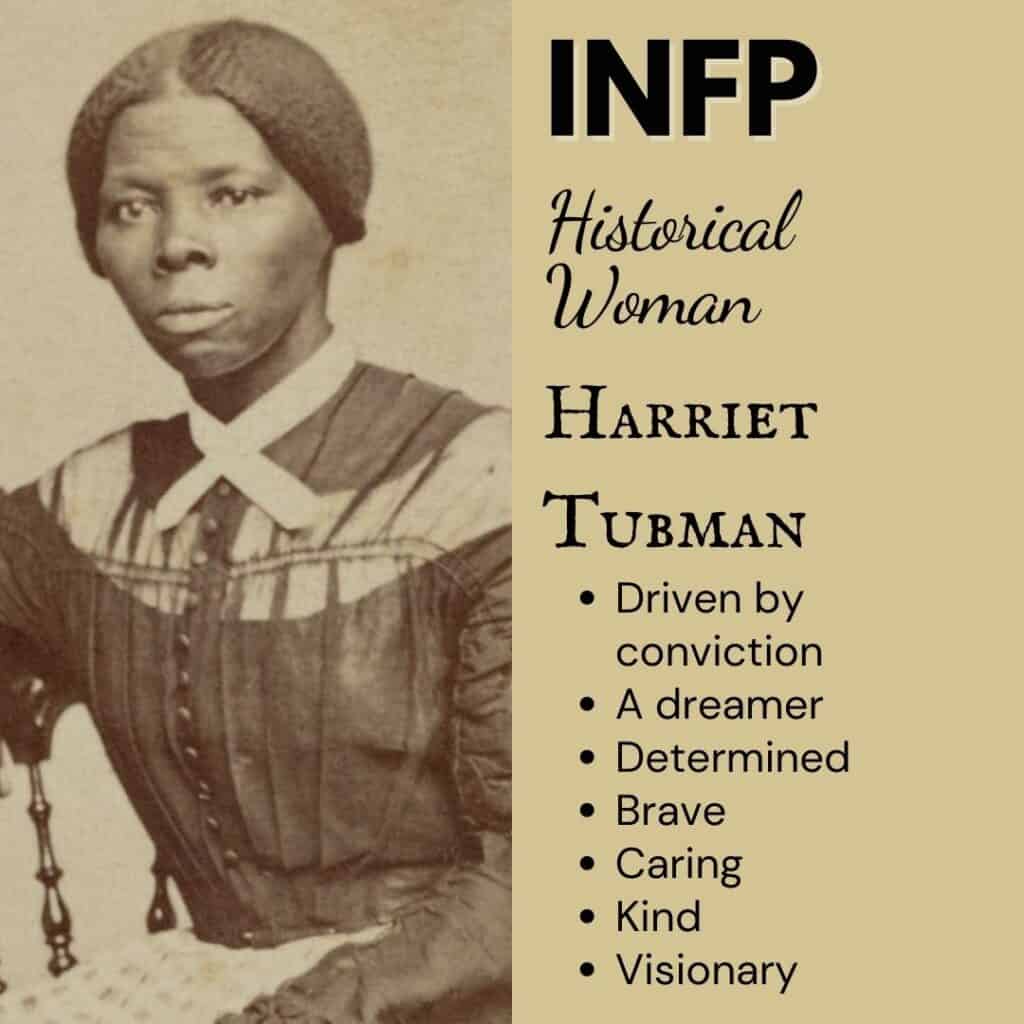
“Every great dream begins with a dreamer. Always remember, you have within you the strength, the patience, and the passion to reach for the stars to change the world.” – Harriet Tubman
Harriet Tubman was born into slavery in 1822, and from the beginning her life was marked by violence. She was beaten, hired out, overworked, and treated as property. When she was around twelve years old, she stepped in to protect another enslaved person from being beaten. The overseer threw a heavy metal weight at her head. It fractured her skull. She received no medical care and lived the rest of her life with chronic pain and episodes that today would likely be diagnosed as narcolepsy.
And yet, when I read her story, what stands out isn’t only the brutality. It’s the through-line of conviction.
Some people survive oppression and try to disappear into safety. Harriet Tubman escaped slavery in 1849. She could have stayed in the North and built a quiet life for herself. Instead, she chose to return to the South again and again as a conductor on the Underground Railroad, guiding hundreds of enslaved people to freedom. Each trip put her life at risk. Each trip required strategy, secrecy, and enormous emotional strength.
For INFPs especially, there is something powerful here. At their healthiest, INFPs are anchored by an internal sense of right and wrong that does not shift under pressure. Harriet Tubman embodied that. Her loyalty was to freedom itself, and once she knew what was true and just, she organized her entire life around it.
She also spoke openly about her visionary experiences, which she believed were messages from God. Whether one interprets those as spiritual experiences or trauma-related phenomena, what matters is how she related to them. She trusted her inner guidance. She experienced the world as someone deeply attuned to meaning. For her it wasn’t just about politics, it was about following her heart and her spiritual nature.
After the Civil War, she did not retire into comfort. She settled in Auburn, New York, purchased land, planted an orchard, and opened her home to elderly and formerly enslaved people. That property eventually became the Harriet Tubman Home. Ultimately, the same woman who navigated forests at night to outmaneuver slave catchers also dreamed of growing apple trees so others could eat freely.
If you’re an INFP, Harriet’s life speaks to the quiet strength of living by conviction. It reminds you that idealism is not weakness when it is paired with action. It shows that dreams, when rooted in moral clarity, can move people across borders, through fear, and into freedom.
She did not choose the easier path. She chose the truer one. And she kept choosing it, over and over again.
Read This Next: 24 Signs That You’re an INFP, the Dreamer Personality Type
The INTP – Chien-Shiung Wu
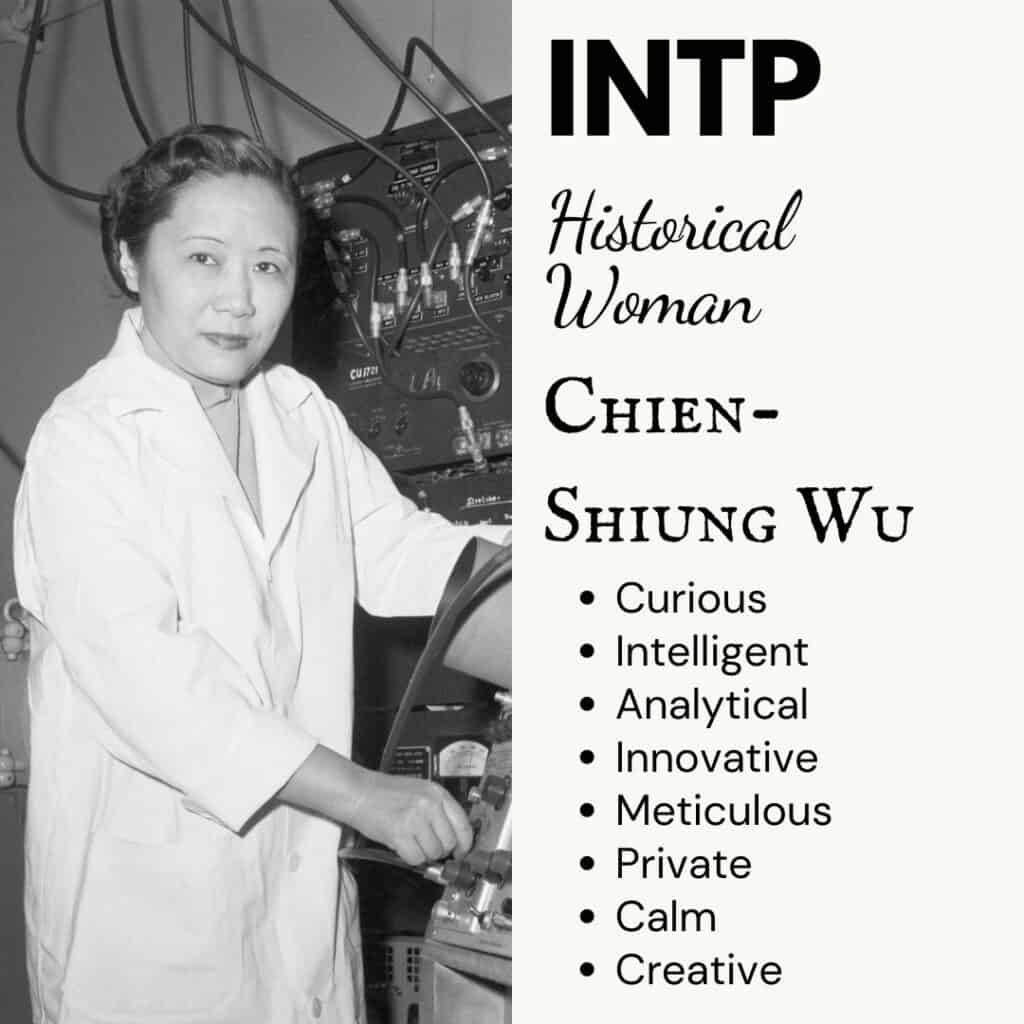
“There is only one thing worse than coming home from the lab to a sink full of dirty dishes, and that is not going to the lab at all!” – Chien-Shiung Wu
When we talk about courage, we don’t always imagine a laboratory.
We don’t always picture a woman standing at a workbench, running the same experiment again and again, checking every variable, honoring every detail. But that’s exactly where Chien-Shiung Wu practiced her courage.
Wu was one of the most gifted experimental physicists of the 20th century. She was born in China and came to the United States to study at UC Berkeley during a time when both racism and sexism were daily realities. She entered rooms where she was underestimated before she ever spoke.
And still, she did the work.
It might not have been flashy, but it was the kind of work that required humility and the willingness to say, “Let’s test this again. Let’s make sure. Let’s not assume.”
In 1956, Wu conducted an experiment that challenged one of physics’ most trusted assumptions: the law of conservation of parity. For decades, scientists believed this principle was unshakable. Wu’s experiment demonstrated that it wasn’t, and that took bravery.
It’s one thing to question a person. It’s another to question a law that governs how we understand reality.
Her male colleagues received the Nobel Prize for the discovery in 1957. She did not. Many historians agree that sexism and racism likely played a role. There’s no way to read her story without acknowledging the injustice. But what really struck me most, personally, is that even facing all the discrimination she did, she never gave up or quit.
She kept researching, teaching, and mentoring. She kept building pathways for other women in science. She later received the National Medal of Science and the Wolf Prize in Physics, recognition that, while meaningful, came after years of being overlooked.
Wu’s story reminds us that courage doesn’t always look like a speech or a spotlight moment. Sometimes it looks like staying at the table and continuing to show up for your work when you haven’t been properly credited. Sometimes it looks like trusting that the integrity of what you’re building matters, even when the applause doesn’t come.
If you’re an INTP, you may recognize something familiar here.
The love of research, the desire to understand, and the comfort with working behind the scenes.
Wu didn’t chase recognition. She chased understanding. And in doing so, she reshaped her field. And that, in its own way, is a profound act of courage.
Read This Next: 24 Signs That You’re an INTP, the Prodigy Personality Type
The ENFJ – Maya Angelou
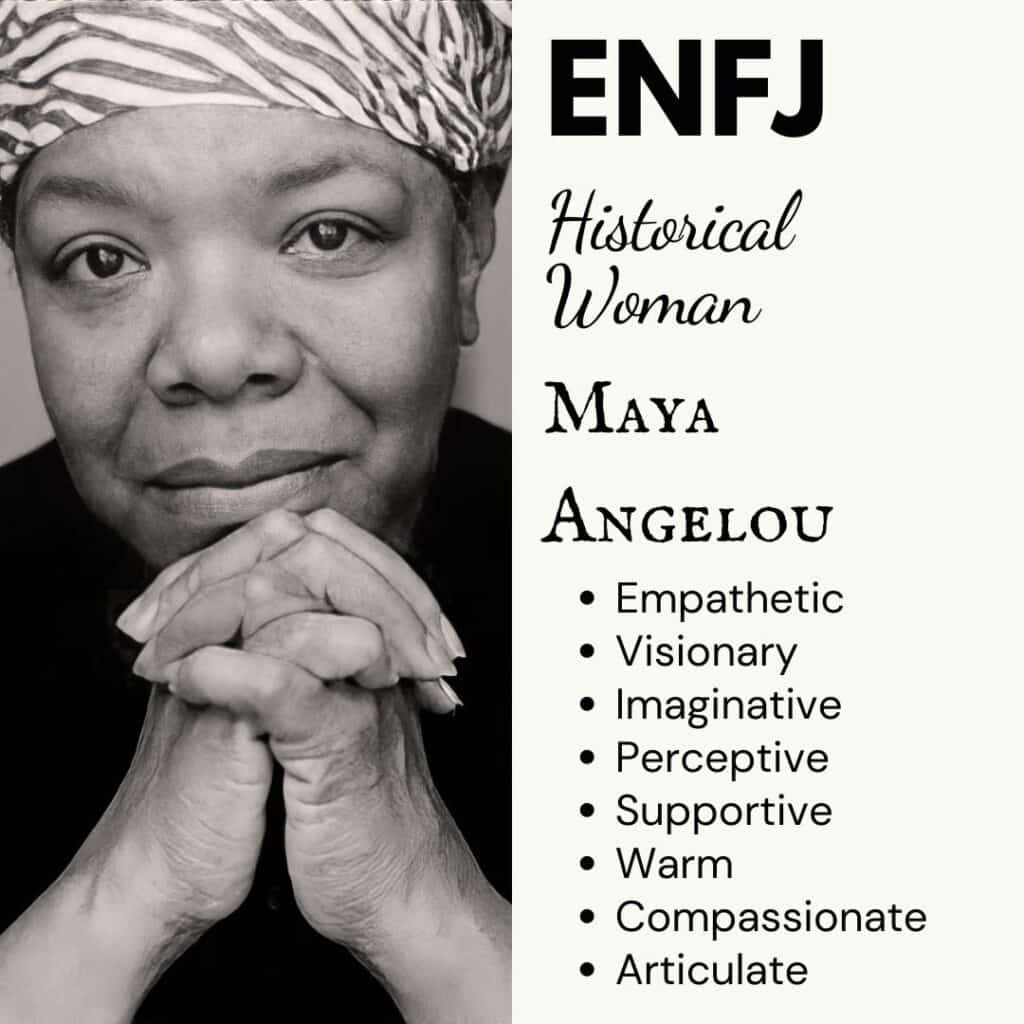
“I like for people to say I’m kind. It means that I’m still learning and that I’m able to forgive.” – Maya Angelou
Maya Angelou survived more than most people ever should have to.
She grew up in poverty in the segregated South. She endured racism, sexual abuse, and years of feeling silenced by trauma. For a long time, she barely spoke at all. And yet somehow, she became one of the most powerful voices of the 20th century.
Angelou didn’t pretend her pain didn’t exist. She wrote about it, named it, and turned it into something that gave other people language for their own suffering. Her most famous memoir, I Know Why the Caged Bird Sings, was published in 1969 and shook the literary world. It was honest about racism, abuse, and shame. And somehow, even in the heaviness of it, there was dignity.
And beyond writing, she worked alongside Martin Luther King Jr. and served as the Northern Coordinator for the Southern Christian Leadership Conference. She used her platform to reflect on injustice while also actively pushing against it.
What stands out to me about Angelous is her overall posture toward the world. After everything she endured, she chose generosity and warmth. She aimed, against all odds, to believe in people anyway.
If you’re an ENFJ, there’s something so affirming about her life. The belief that your voice matters. The instinct to use your influence for something bigger than yourself. The refusal to let bitterness be the final word.
Angelou didn’t deny her pain. She transformed it into something that reached out to others in the darkness and made them feel less alone.
She proved that compassion can be powerful. That leadership can be rooted in empathy. And that even the most wounded stories can become a source of light for others.
Read This Next: Inspiring Morning Routines for INFJs, INFPs, ENFJs, and ENFPs
The ENTJ – Queen Elizabeth I
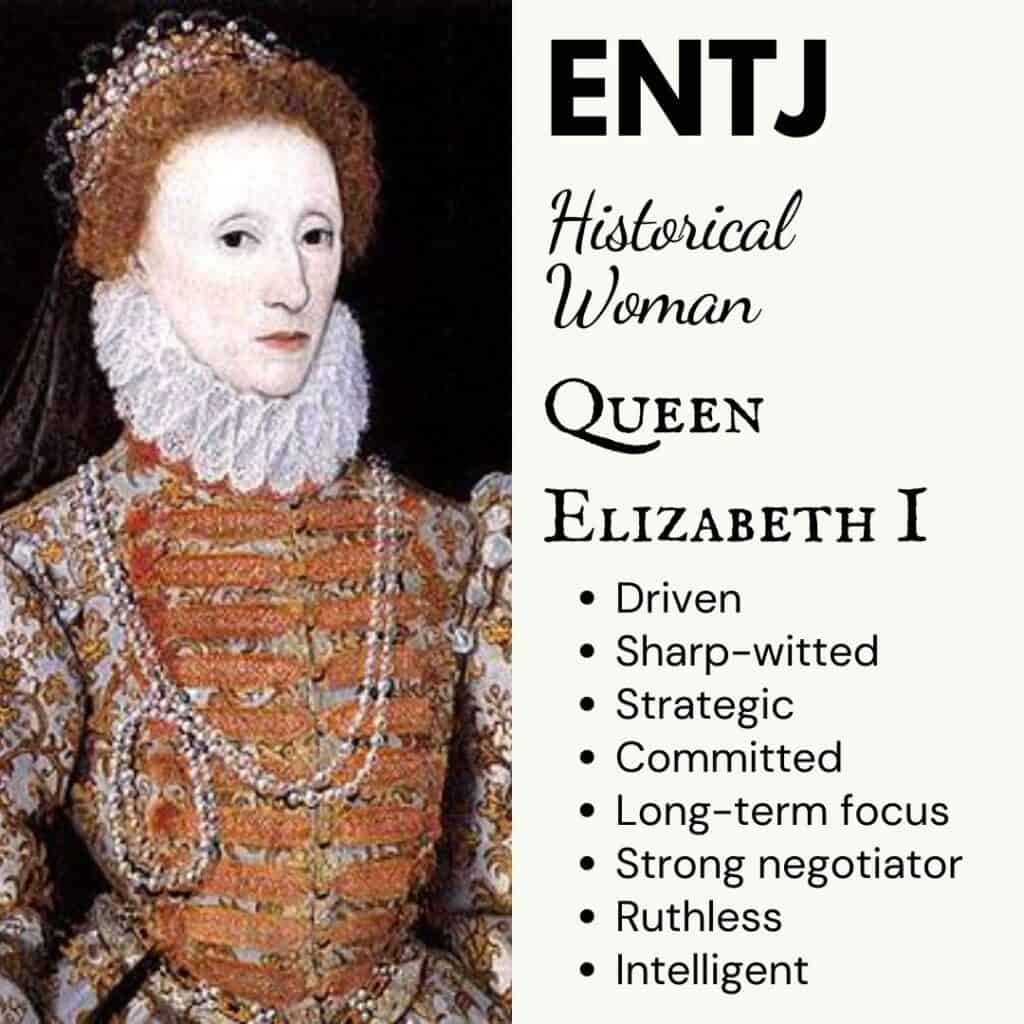
“I know I have the body but of a weak and feeble woman, but I have the heart and stomach of a king, and of a king of England too.” – Queen Elizabeth I
Queen Elizabeth I is one of the most well-known monarchs in history. She ruled over England for 45 years, during a time when the country was engaged in religious conflict and economic turmoil. Elizabeth was a skilled politician and a master of public relations, and was noted for her strong personality and sharp wit. Like many ENTJs, she could speak her mind, and she knew how to do it strategically.
Elizabeth’s reign is often considered to be one of the most successful in English history. She restored economic stability to the country and increased its international standing. She also helped to end the country’s religious conflicts by founding the Church of England. While she was a controversial figure in her own time, and she continues to be controversial today, she was certainly ambitious and visionary. Some people view her as one of the greatest monarchs in history, while others believe that she was a tyrannical ruler who caused great harm to her subjects.
ENTJs will admire Queen Elizabeth I’s intelligence, strength of character, and political acumen. They will also appreciate her ability to make difficult decisions and her commitment to her country. Elizabeth was a true visionary and a natural leader, which are qualities that ENTJs can relate to.
Read This Next: 10 Things You’ll Relate to if You’re an ENTJ
The INFJ – Jane Addams
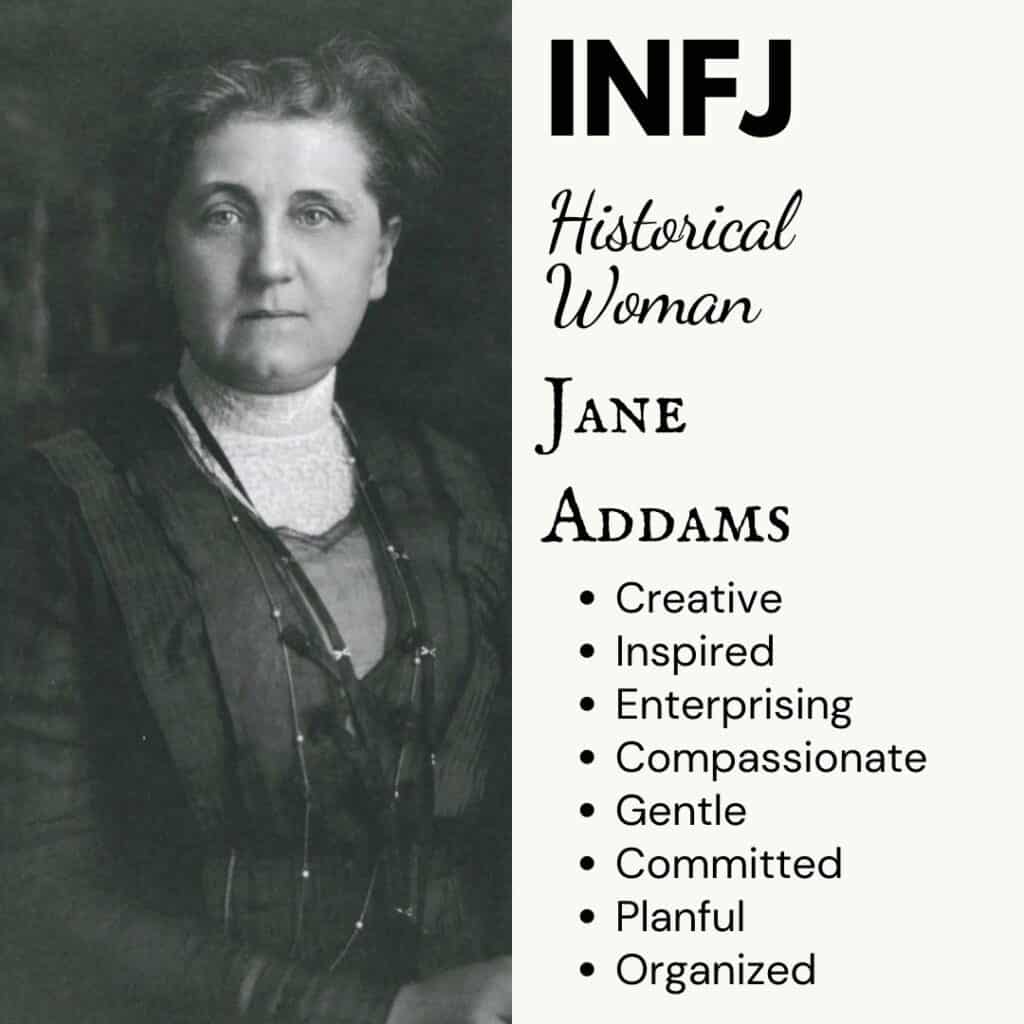
“Nothing can be worse than the fear that one had given up too soon and left one unexpended effort which might have saved the world.” ― Jane Addams
When we talk about idealism, it’s easy to imagine something flighty and impossible. A dream that never actually impacts the real world. But Jane Addams brought her ideals to life in a real, tangible way that transformed lives.
Jane Addams saw suffering in the streets of Chicago, immigrants trying to survive, families working impossible hours, communities pushed to the margins, and she decided that compassion needed structure and systems that provided safety nets and hope.
So she co-founded Hull House. This was a community center that offered education, childcare, healthcare, cultural programs, and advocacy. It treated people not as problems to be fixed, but as neighbors to be supported.
When I was researching women from history, the more I read about Addams, the more I felt the INFJ tone.
She wasn’t content to put out small fires. She wanted to understand why the fires kept starting. She wrote and spoke about democracy, social justice, and peace. She studied poverty and crime so that she could trace it back to its roots. She believed social problems were interconnected, and that you couldn’t fix one injustice without looking at the system surrounding it.
One of her most well-known lines was:
“The good we secure for ourselves is precarious and uncertain until it is secured for all of us and incorporated into our common life.”
If you’re an INFJ, you’ll relate to the idea that community, compassion, and hope are meant for all people, not just a select few. You’ll relate to Addams vision; the way it didn’t just stay in her head, but became translated into a whole movement. You’ve probably dreamt of such movements yourself.
Addams reminds us that idealism isn’t naïve when it’s paired with action. It’s powerful. She believed people could change the world, and instead of waiting for someone else to prove it, she started.
Read This Next: 4 Reasons You Might Be Lonely as an INFJ
The INTJ – Jane Austen

“There is a stubbornness about me that never can bear to be frightened at the will of others. My courage always rises at every attempt to intimidate me.” – Jane Austen
Jane Austen is known for her Regency novels. They’re witty and full of sharp social observation, but underneath the manners and marriage plots is something much cooler: a woman bravely dissecting the power structures of her time.
Austen lived a relatively quiet life in the English countryside. She didn’t crave fame. In fact, she published anonymously at first. But even as an introvert she watched people closely, tracked their motives, and understood the economic realities beneath “romantic” decisions. In her world, marriage wasn’t just about love. It was about security, survival, and social positioning. And, ultimately, she refused to sentimentalize that. That was kind of badass for her time.
Unlike many women of her era, she never married. That certainly wasn’t easy. It meant living with a certain amount of vulnerability, but she chose a life of the mind over a life of convenience.
In Emma, she writes, “A woman is not to marry a man merely because she is asked…” At that time, the statement was radical. It pushed against the idea that a woman’s worth is secured by attachment. It insists on discernment, standards, and autonomy.
Austen trusts the reader to see the absurdity of shallow charm and the quiet strength of integrity. Her novels endure because she understood something unchanging about human nature. She understood pride, blind spots, self-deception, manipulation, and growth. She saw past the performance and into the structure underneath, all while appearing polite.
If you’re an INTJ, you can take something from Austen: Sometimes the sharpest power is the one that observes, analyzes, and then writes something so powerful it outlives you.
Instead of conforming to expectations, Austen studied them. And then she exposed them, one perfectly constructed sentence at a time.
Read This Next: 24 Signs That You’re an INTJ, the Strategist Personality Type
The ESFP – Sappho

“Once again love drives me on, that loosener of limbs, bittersweet creature against which nothing can be done.” – Sappho
Sappho lived on the island of Lesbos in the 6th century BCE, and even though most of her poetry survives only in fragments, what remains has startled people with its intimacy and intensity. She doesn’t describe love as an idea; she describes the racing pulse, the trembling hands, the sudden loss of voice when someone beautiful steps into view. You don’t walk away from her poetry thinking, “That was clever.” You walk away thinking, “I’ve felt that.”
That quality feels very aligned with the way ESFP energy tends to show up. There’s an immediacy to it, a full-bodied presence. Instead of stepping back from experience to analyze it, there’s a willingness to inhabit it. In personality terms, this looks like a deep trust in lived experience. Sensations, reactions, and the atmosphere in a room. For someone wired this way, emotion isn’t something to suppress or tidy up; it’s something to express and share.
Sappho seemed to trust her inner emotional compass as well. There’s a personal intensity in her writing that suggests she didn’t filter herself for the comfort of others. In a culture that had strict expectations, especially for women, her frankness about love and desire was bold. That kind of openness takes courage because it risks judgment. Yet she wrote anyway, and she wrote with clarity. You can sense that she valued authenticity over approval.
What makes Sappho endure isn’t just that she wrote about love. It’s that she captured the texture of being human. The longing, the pain (emotional and physical), the delight, the vulnerability. She treated those experiences as worthy of art. For ESFPs, who often experience life with intensity and immediacy, her legacy can feel validating. Your responsiveness to the moment isn’t superficial or excessive. In the right hands, those qualities become poetry that survives for thousands of years.
Sappho reminds us that staying close to our lived experience, rather than distancing ourselves from it, can be a powerful form of wisdom.
Read This Next: 10 Things ESFPs Look for in a Relationship
The ESTP – Helen Gibson
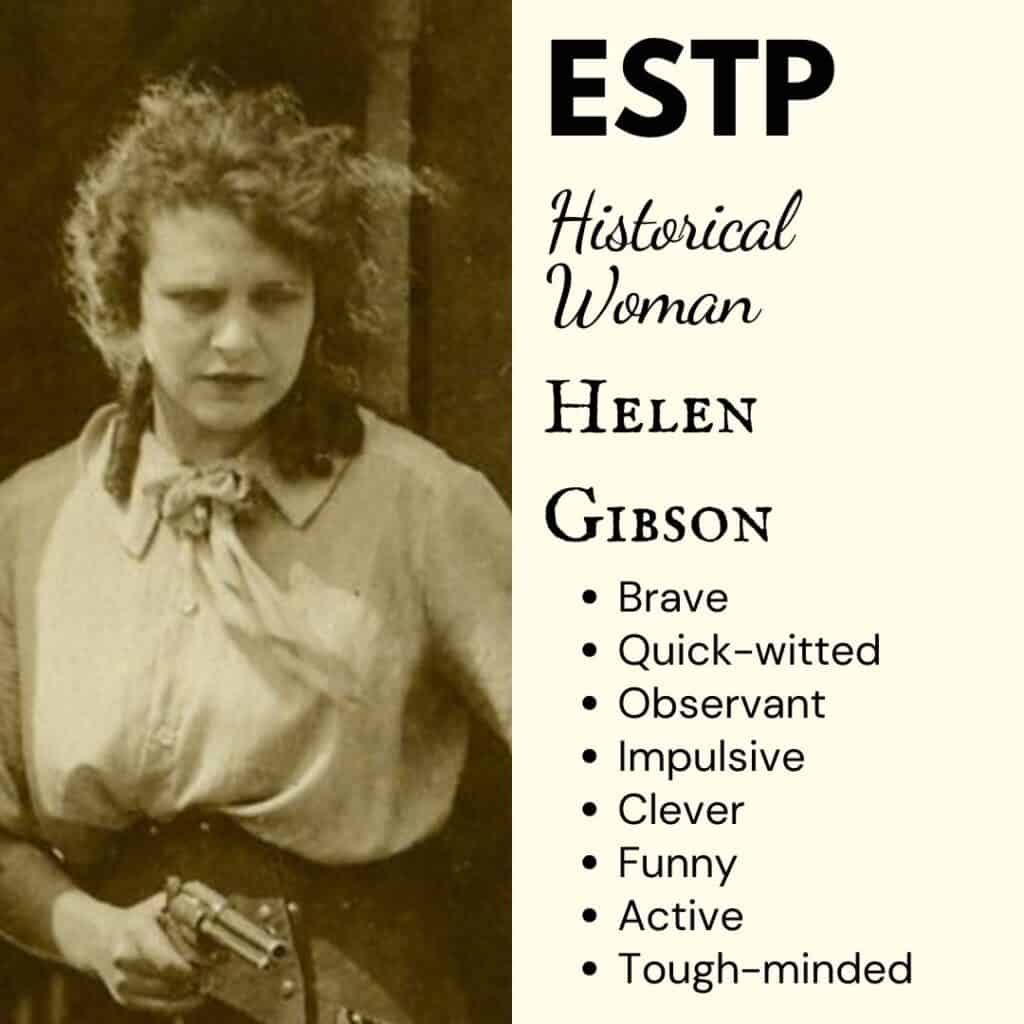
“I have heard that they call me ‘The Girl with Nine Lives.’ Well, if the description is right, I am pretty certain that I have lost eight of the nine already, for it is a rather weird coincidence that in my career as the ‘hazardous Helen’ there have been just eight occasions when I really did come within a fraction of an inch of losing my life. But I am not afraid; I am just going to keep on carrying out the actions of thrilling scenarios. Only I hope the ninth extra narrow escape is a long, long way off.” – Helen Gibson
Helen Gibson was the first female stuntwoman in Hollywood, and she quickly became known for her death-defying feats and quick wits. She was a gifted athlete and fearless daredevil, who performed stunts that no other woman had dared to attempt. From an early age, Gibson was determined to live life on her own terms. She was a trailblazer in her field, and she paved the way for other women to follow in her footsteps. She said of her childhood,
“(I) was already practicing picking up a handkerchief from the ground at full gallop. When veteran riders told me I could get kicked in the head, I paid no heed. Such things might happen to others, but could never happen to me, I believed. We barnstormed all over the US and the season ended all too soon. I was sorry when I had to go home, and could hardly wait to open in Boston in the spring of 1911.”
In typical ESTP fashion, Gibson was pragmatic and logical. When she married her first husband, Edmund Richard (Hoot) Gibson, it was because she saw the potential for a good partnership and a way for both of them to earn more money. She was not interested in being a traditional wife and homemaker; she wanted an equal partner who would support her career and who could have fun with her!
Gibson was known for her humor, wit, and her ability to think on her feet. She was always ready with a quip or a come-back, and she was not afraid to speak her mind. She was a woman ahead of her time, and she is an inspiration to all who seek to live life on their own terms.
Read This Next: 10 Reasons Why ESTPs Make Amazing Friends
The ISFP – Frida Kahlo
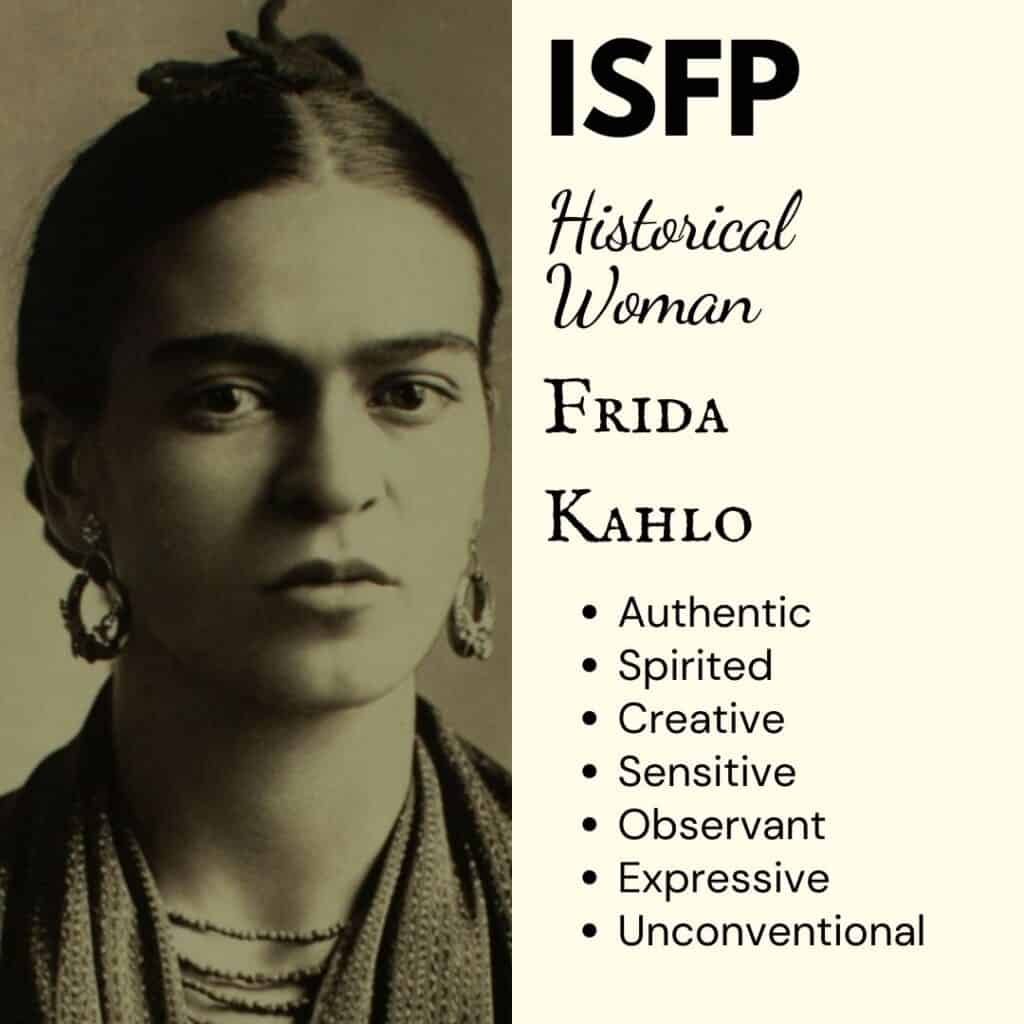
“I paint myself because I am so often alone and because I am the subject I know best.” – Frida Kahlo
Frida Kahlo was a Mexican artist, who is best known for her self-portraits and symbolic creations. Unfortunately, Kahlo’s life was far from easy. As a child she was stricken with polio and ever after had to struggle to walk with a right leg and foot that were much smaller than her left. However, that didn’t stop her from challenging herself physically and creatively. When recounting her childhood, she spoke of her involvement in soccer, swimming, and even wrestling! But it was art that truly had Frida’s heart. Her intensely vivid and symbolic paintings reveal a deeply personal side of her. In them, she often explored themes such as illness, death, and heartbreak. Her miscarriages, her failed relationships, and her struggles with mental health are all recurring themes in her work.
Despite the pain that Kahlo often depicted in her paintings, she was known for being a lively and vibrant person. She was passionate about her art, and she had a strong sense of self. She was also known for being fiercely independent, and she didn’t let anyone or anything stand in her way.
Kahlo was an ISFP, and she is a perfect example of the type. She was in touch with her emotions, and she used her art as a way to express herself. She was also independent and determined, following her own path regardless of what others may have thought.
Read This Next: 24 Signs That You’re an ISFP, the Virtuoso Personality Type
The ISTP – Hedy Lamarr
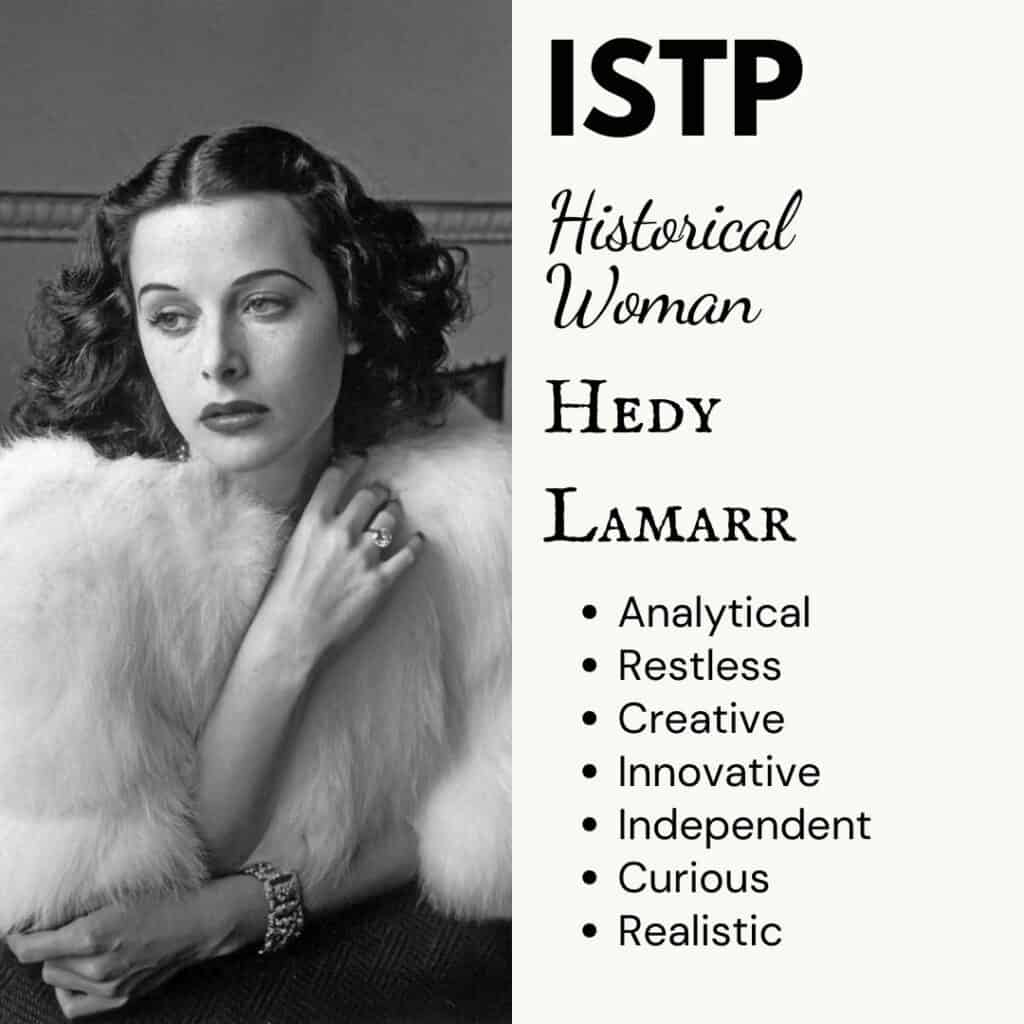
“Any girl can be glamorous. All you have to do is stand still and look stupid.” – Hedy Lamarr
Hedy Lamarr was a Hollywood actress known for her beauty and acting chops. But what few people know is that Lamarr was also a brilliant inventor. She developed a frequency-hopping signal that was used during World War II to help the Allies defeat the Nazis. She also held a patent for a technology that became the basis for modern WiFi, Bluetooth, and GPS systems.
Lamarr’s interest in inventing started at a young age. At only five-years-old, she could be found taking apart and reassembling her music box to figure out how the machine worked. Like most ISTPs, she was interested in how various systems worked and how different technologies operated. Her scientific mind was soon noticed in Hollywood by none other than legendary inventor, Howard Hughes. Hughes helped fuel her innovative mind and she, in turn, designed a new wing shape that that made his planes more aerodynamic.
Unfortunately, Hedy often felt underwhelmed by her partnerships in Hollywood and in Marriage. She once said, “I must quit marrying men who feel inferior to me. Somewhere there must be a man who could be my husband and not feel inferior.” Her curiosity, intellect, and need for independence didn’t always go hand-in-hand with the traditional views of women and Hollywood starlets in her day.
ISTPs will find in Lamarr a kindred spirit – someone who is interested in the world around them and how things work. They will also appreciate her independent streak and her willingness to forge her own path, even when it was not the common or traditional thing to do in her time.
Read This Next: 10 Things You Should Never Say to an ISTP
The ESFJ – Dolley Madison
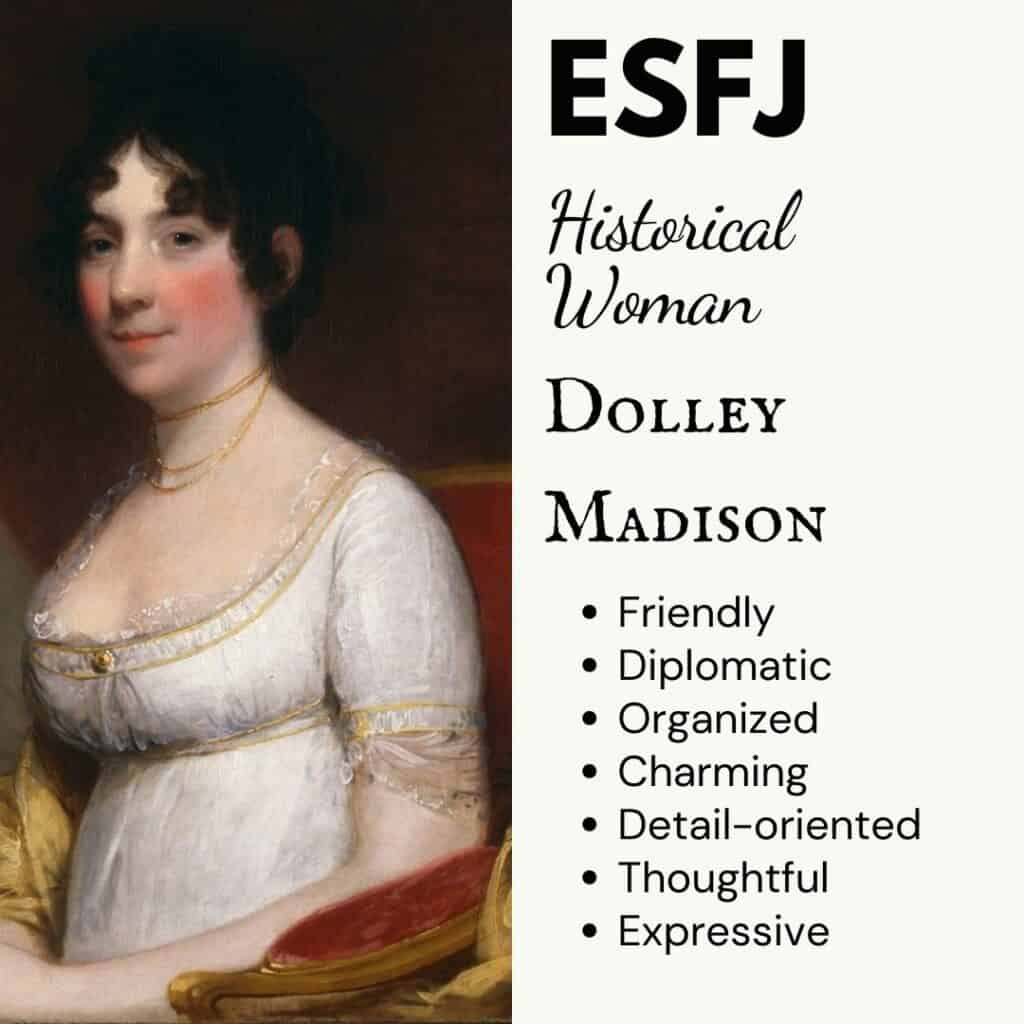
“She welcomed all classes of people, greasy boots and silk stockings.” – Senator Elijah Mills
Dolley Madison was the wife of President James Madison, and she is considered to be one of the most popular First Ladies in American history. She was known for her kindness, her warmth, and her ability to make everyone feel welcome. As I was studying her I could recall so many ESFJs I’ve known who would relate to her priorities, values, and generosity.
A lover of fashion, people, and parties, Madison knew how to make the White House an inviting and cordial place. But Dolley’s skills weren’t only relegated to parties and fashion, however. She was gifted in the art of diplomacy and was often called upon by her husband to help him resolve conflicts. As an example, when President Madison dismissed his secretary of state, Robert Smith, she invited him to dinner to make sure there were no ongoing hard feelings. When he refused her invitation, she called on him personally. According to some historians, when many Americans complained that Madison had led them into an unnecessary war, she used her invitation lists to win him favor and a second term.
Dolley, like many ESFJs, was also someone who valued aesthetics and elegant living. She oversaw the furnishings and decorations of the White House and established the tradition that the mansion would reflect every First Lady’s tastes and ideas.
In Dolley ESFJs will find a First Lady who was kind, hard-working, and relatable. They will also see someone who used her skills to build relationships and foster goodwill. Her attention to detail and her focus on interpersonal relationships and harmony are qualities that ESFJs will naturally aspire to.
Read This Next: 10 Stress-Busting Tips for ESFJs
The ESTJ – Ann Preston
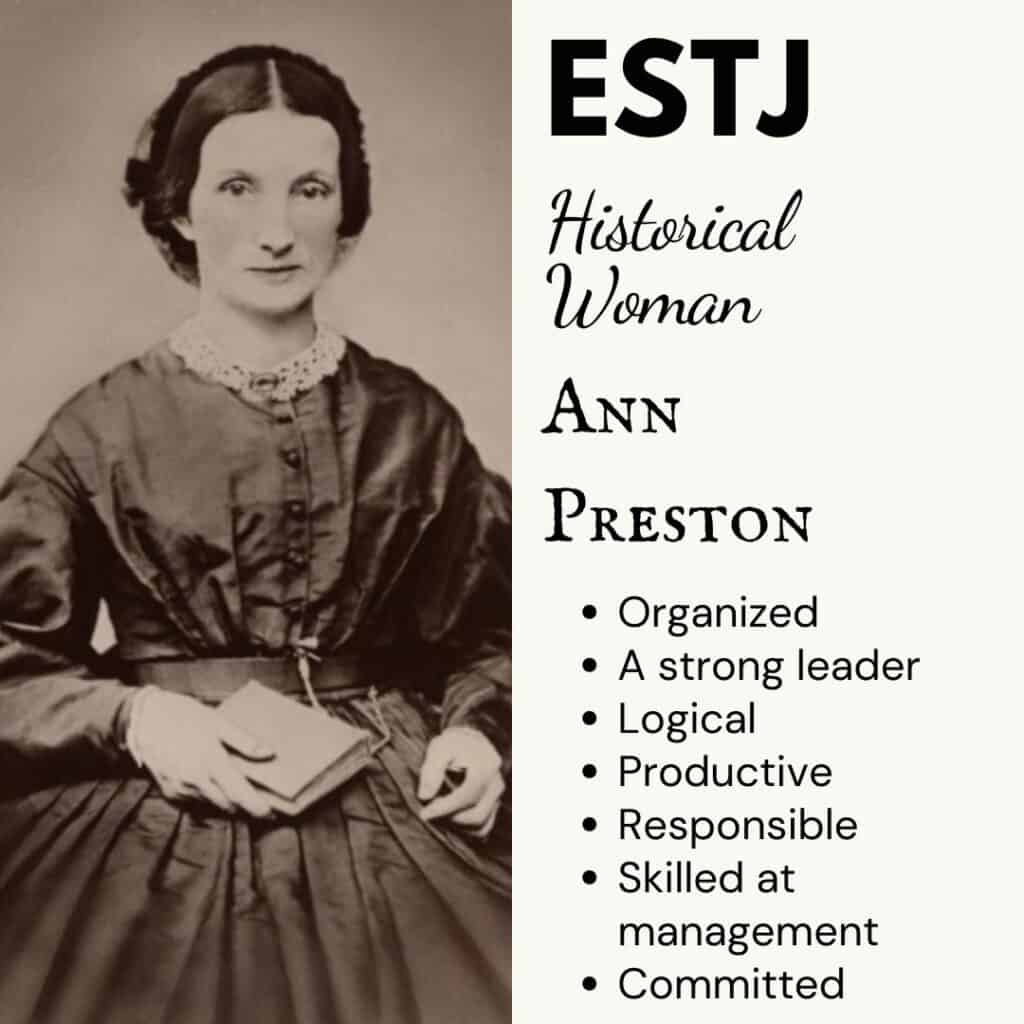
“Wherever it is proper to introduce women as patients, there also it is in accordance with the instinct of truest womanhood for women to appear as physicians and students.” – Ann Preston
Ann Preston was a Quaker physician and educator who fought for the inclusion of women in medical schools and the medical profession. In a time when most women were not allowed to attend medical school, she graduated at the top of her class from Female Medical College of Pennsylvania.
Life for Ann wasn’t easy, and she often met opposition when she tried to campaign for the rights of women. When she worked to make it possible for women to attend clinical lectures, she was often faced with “booing” and jeering from the men attending. Yet these outbursts never dissuaded her in her mission. She knew opening up the medical field to women would change the world and make it a better place.
Like most ESTJs, Ann was a responsible and driven person. In childhood she often took care of her family and seven siblings due to her mother’s frequent illnesses. She was also highly organized, serving as the first female dean of the Female Medical College of Pennsylvania.
Ann’s drive and determination is something that ESTJs will relate to. They will also appreciate her organizational skills and her ability to take charge when needed. Ann was known as being highly organized but also social and inviting. While she never married, she led a rich and active social life, and formed a household “where dear friends live with me in harmonious relations, and do much to make this an orderly home circle.”
The ISFJ – Mother Teresa
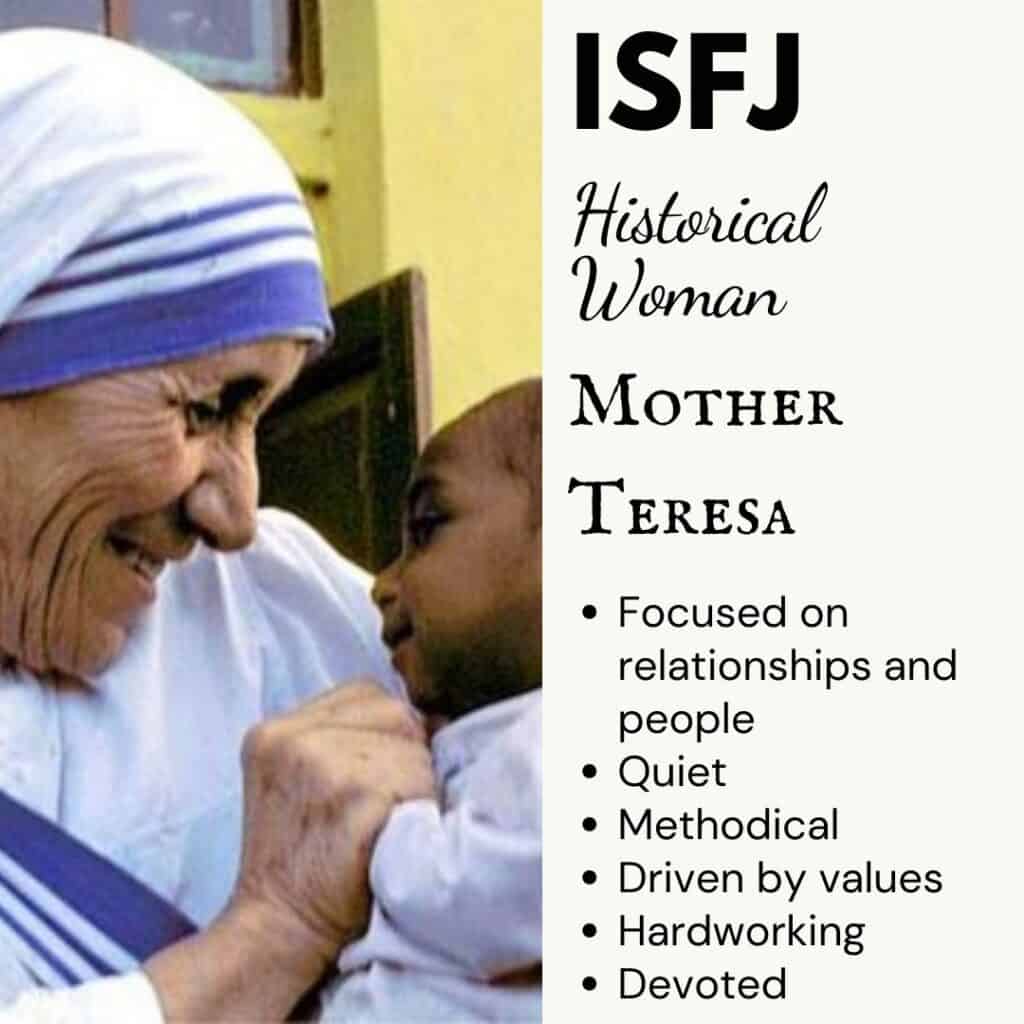
“Kind words can be short and easy to speak, but their echoes are truly endless.” – Mother Teresa
Mother Teresa is one of the 20th centuries greatest humanitarians and a powerful example of generosity and faithfulness. Born as Agnes Gonxha Bojaxhiu in Macedonia, she was given an extraordinary example of charity by her mother, Drana Bojaxiu. Agnes’s mother believed that every meal should be shared with others, and would open her home to the poor and destitute so that people could find acceptance and nurturing for their body and soul. When young Agnes asked her mother who the other people were at the table, her mother would respond, “Some of them are our relations, but all of them are our people.”
Agnes took her mother’s charitable perspective to heart and decided to devote her life to helping others as well. At age 12 she started her religious education, and in 1929 she took her final vows and was given the name Teresa, after Saint Thérèse of Lisieux. In 1937, she took her Final Profession of Vows to live a life of poverty, chastity, and obedience. Upon taking the vows, she was given the title of “Mother” and became known thereon as Mother Teresa. “Give me the strength to be ever the light of their lives, so that I may lead them at last to you,” she wrote in a prayer about her service to others during this time.
In 1946, a pivotal moment set Mother Teresa on the course that would make her world-renowned. While riding a train from Calcutta to the Himalayan foothills for her annual retreat, she received “a call within a call” from God telling her to leave the comfort of the convent and go out into the streets to help the poorest of the poor. And so she did. Afterwards, she spent the rest of her life living among and helping some of the most destitute people in India.
Whether Mother Teresa was establishing a home for the dying or creating open-air schools, she did everything with an attitude of service. She was selfless, compassionate, and always put the needs of others above her own. These qualities are what healthy ISFJs are often known for. Cautious and uncomfortable with change, Mother Teresa nevertheless accepted risks and change because she had to follow her faith and what her heart told her was right. Her altruistic, empathetic outlook on life are examples that people of any personality type can aspire to.
Read This Next: A Look at the ISFJ Leader
The ISTJ – Queen Elizabeth II
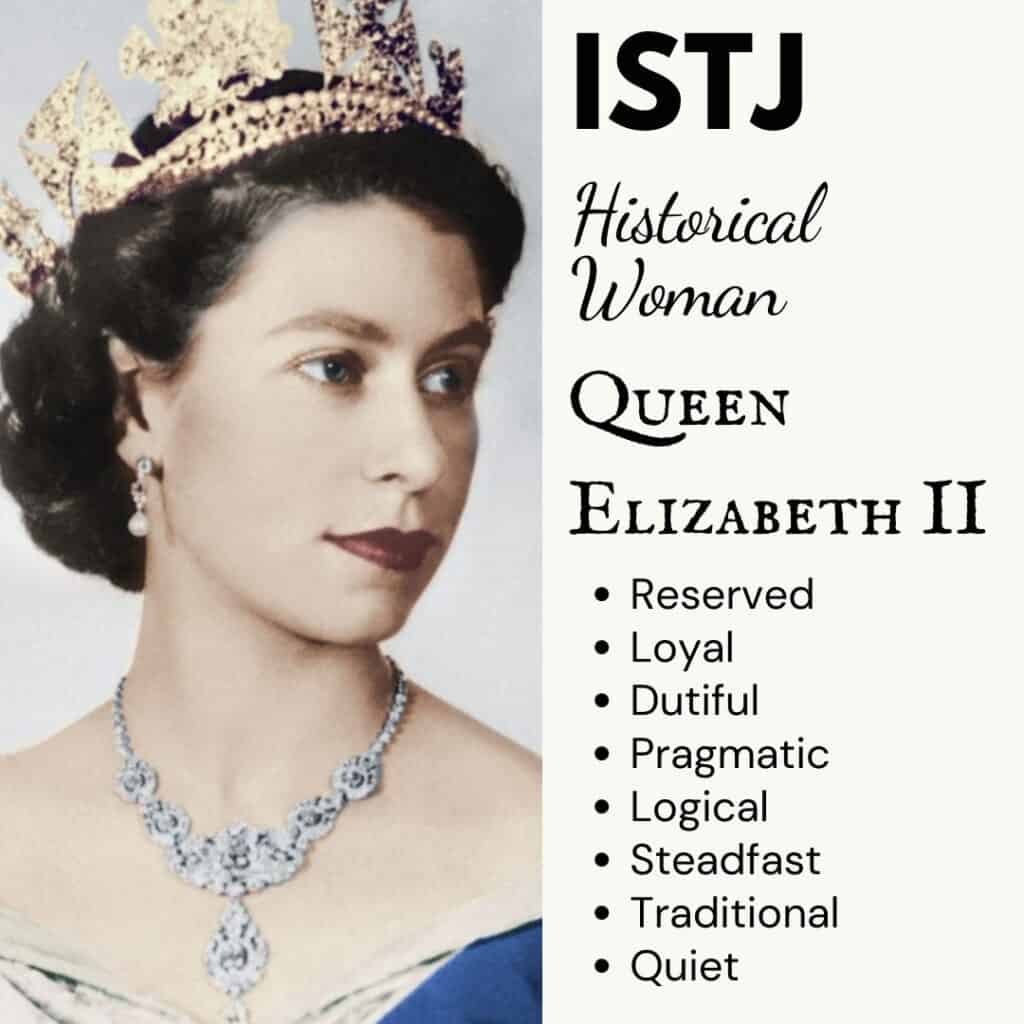
“It’s worth remembering that it is often the small steps, not the giant leaps, that bring about the most lasting change.” – Queen Elizabeth II
Queen Elizabeth II reigned for over 70 years, which is almost difficult to comprehend. Entire generations were born, grew up, and grew old under the same monarch. Political parties rose and fell. Cultural revolutions came and went.
Queen Elizabeth wasn’t expecting to be queen. Her father, George VI, only became king after the abdication of Edward VIII, which suddenly made Elizabeth heir presumptive. In an instant, her life shifted from relative obscurity to lifelong responsibility.
When people criticize the monarchy, they often focus on the institution. But when people speak about Elizabeth herself, even critics tend to acknowledge her discipline. She was dutiful and responsible with her role. Even in her nineties, she maintained a staggering number of official engagements each year and continued supporting hundreds of charities across the Commonwealth of Nations (#goals). I can only hope to have that level of discipline and ambition.
From a personality lens, ISTJs tend to lead with a deep respect for structure, tradition, responsibility, and continuity. They often believe that stability itself is a service. Elizabeth embodied that. She didn’t attempt to reinvent the monarchy in her own image, nor did she recklessly abandon tradition. Instead, she operated within an inherited framework and made careful, incremental adjustments where needed. It’s the mindset of someone who asks, “What has worked? What preserves order? What serves the long term?”
But ISTJs aren’t all about responsibility and duty and seriousness. Publicly, she appeared formal and reserved, but those who met her often described a dry, understated wit. Canadian politician Michael Ignatieff once remarked on her “wonderful sense of the absurd.” That doesn’t surprise me at all. ISTJ humor often flies under the radar. It’s subtle, dry, and a little unexpected. They deliver it almost sideways, usually when you least expect it.
As an MBTI® practitioner, I’ve seen how often ISTJs are underestimated because they’re not flashy. They don’t market themselves as visionaries or demand the spotlight. But they give life a sense of sturdiness and stability that feels like a lifeline when things get chaotic.
Queen Elizabeth II’s life wasn’t defined by dramatic speeches or ideological revolutions. It was defined by reliability. Showing up. Keeping promises. Preserving stability in uncertain times.
For ISTJs, that tells us that you don’t have to be loud to be influential. You don’t have to disrupt everything to matter. Sometimes leadership looks like restraint and duty that doesn’t always get talked about or praised. Sometimes it looks like honoring the role you’ve been given and executing it with quiet integrity for decades.
Read This Next: 5 Strengths of the ISTJ Personality Type
What Are Your Thoughts?
Do you agree with these type assessments of these famous women in history? Let us know in the comments below!
Find out more about your personality type in our eBooks, Discovering You: Unlocking the Power of Personality Type, The INFJ – Understanding the Mystic, The INTJ – Understanding the Strategist, and The INFP – Understanding the Dreamer. You can also connect with me via Facebook, Instagram, or Twitter!







That’s so funny. I’m an ISFP, and I actually have a Frida Cahlo necklace
Please can you do a piece on biblical characters personality type for females or both genders
Yes please! That would be amazing
Wonderful post, I enjoyed reading the subscriptions and learning about these amazing women.
Wow, I am a INFJ and a clinical social worker. I’m not surprised Jane Adams the mother of social work is the woman representing INFJs
Mother Theresa did serious harm to people. She told people their suffering was their own doing/they deserved it. She with held care for people who she thought needed to suffer as penance.
Not someone I’m happy to be compared to.
I’ve noticed you’ve used the word intelligent and it’s synonyms for T types only. It’s a bit puzzling to me because I’m surrounded by bright feelers. Could you please shed some light on this? Thanks.
Hi Yegi! There are so many intelligent Feeling types. I went over this article just now to check if I’d only used that word with Thinking types, because I certainly didn’t want to imply that only Thinking types could be intelligent. It looks like I used the word ‘intelligence’ four times; for ENTPs, INFJs, ENTJs, INTPs. But as I was re-reading my descriptions I think you can tell that intelligence is implied among all these types because of the incredible impact each one had on the world. I may have used other words ‘insightful’, ‘visionary’, or even simply reading through what each woman achieved in their life is a testament to how truly smart each of these types can be. If you want more insight into my thoughts on type and intelligence, I’ve written quite a few articles on that. I’m posting them below if you’re interested:
https://www.psychologyjunkie.com/the-unique-intelligence-of-each-myers-briggs-personality-type/
https://www.psychologyjunkie.com/the-unique-intelligence-of-the-istj-isfj-estj-and-esfj-personality-types/
https://www.psychologyjunkie.com/the-unique-intelligence-of-infjs-intjs-enfjs-and-entjs/
https://www.psychologyjunkie.com/the-unique-intelligence-of-esfps-estps-isfps-and-istps/
https://www.psychologyjunkie.com/the-unique-intelligence-of-enfps-entps-infps-and-intps/
Being a male INTJ and independent to the nth degree, I understand the hesitance to hitch her life to any male, most of whom, at the time and in most societies, were primarily taught that a “woman” was only good for cooking and making babies, for which she would be “taken care of” permanently or until “his” circumstances might change.
Bless her heart, she was even less trusting of male humanity, than I was of female humanity. Unlike, her, I chose to marry and have been so, to the same woman, for 53 years. Believe me, it sure was hard to find one (her type, I think, is ISFJ, loosely based, as she said, on her “mood” when she took the test…) who was honest (although she is still ok with a “White Lie”, in certain circumstances), who did not mind working together and shied away from the usual “romantic” games, which I would not and did not tolerate.
My wife is # 58 —– of all the 57 other females that I dated, or had a crush on, or whatever, she is one one of three, I considered marrying. (Thank Heaven, the other two did not work out!!)
I can’t say that it has been a “Bed of Roses”, as plenty of thorns were hidden in there. But considering the 53 years, WE were better together, than apart.
Possibly, Jane might have gathered just a little more “wheat straw” and thrown it into the wind “, therein she may have found one that one “good kernel”, in all of the chaff”. (See, I am a “romantic” after all!)