
Here’s What You Should NEVER Say to Someone, Based On Their Personality Type
We all have certain phrases that instantly make us tense up. Sometimes it’s because they’re dismissive. Sometimes they hit an old insecurity. And sometimes they completely misunderstand who we are at our core.
While anyone can be hurt by any of these comments, personality type often influences which words cut the deepest. The phrases in this article aren’t guaranteed to offend every person of a particular type, but they do reflect common misunderstandings I’ve seen over years of working with clients and talking with thousands of readers. Let’s look at the comments that are most likely to make each of the 16 Myers-Briggs® personality types cringe.

Not sure what your personality type is? Take our personality questionnaire here. Or you can take the official MBTI® here.
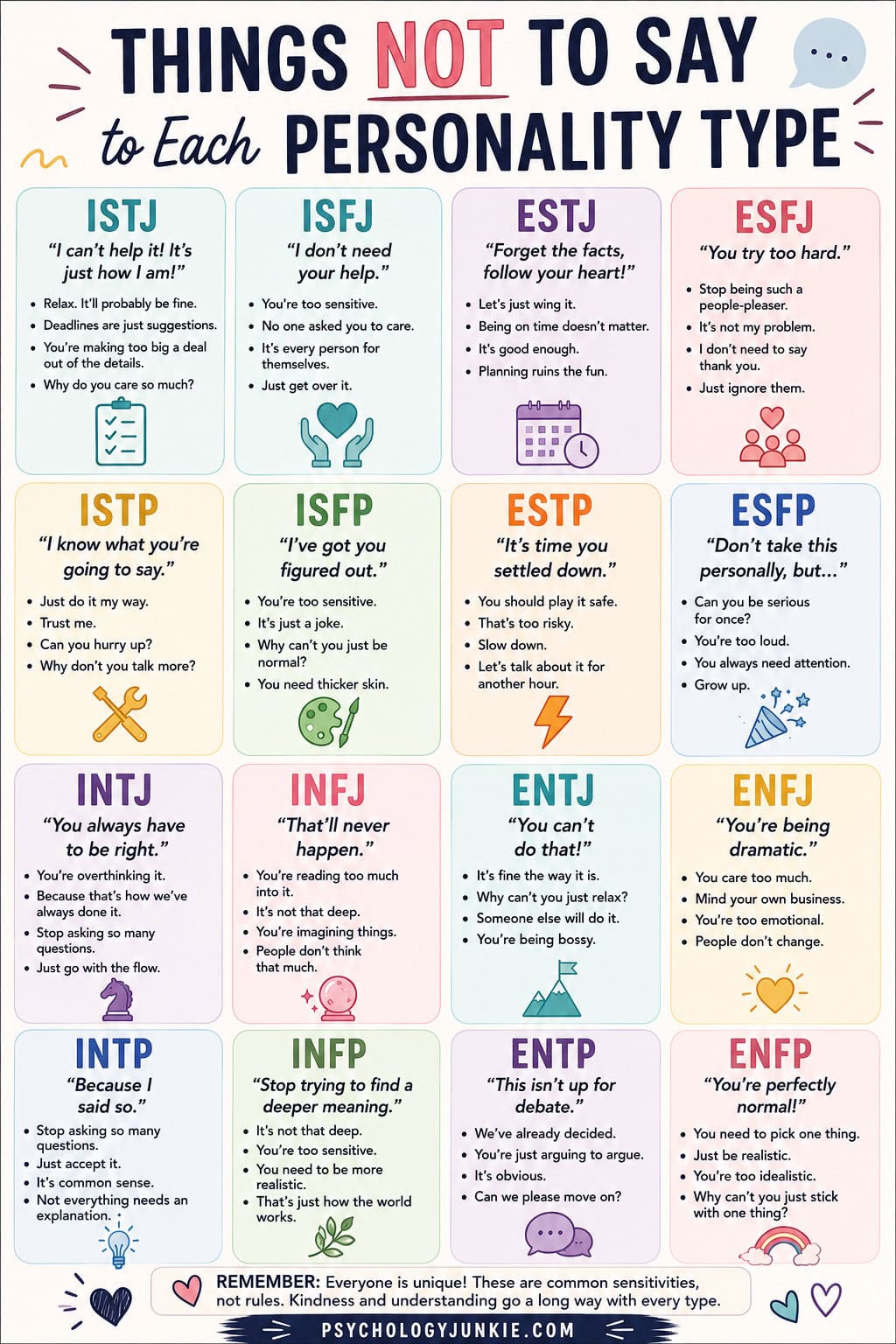
Table of contents
- ISTJ – “I Can’t Help It! It’s Just How I Am!”
- ISFJ – “I Don’t Need Your Help”
- ESTJ – “Forget the Facts, Follow Your Heart!”
- ESFJ – “You Try Too Hard”
- ISTP – “I Know What You’re Going to Say”
- ISFP – “I’ve Got You Figured Out”
- ESTP – “It’s Time You Settled Down”
- ESFP – “Don’t Take This Personally, But…”
- INTJ – “You Always Have To Be Right.”
- INFJ – “That’ll Never Happen”
- ENTJ – “You Can’t Do That!”
- ENFJ – “You’re Being Dramatic.”
- INTP – “Because I Said So”
- INFP – “Stop Trying to Find a Deeper Meaning”
- ENTP – “This is Black and White. Stop Over-Analyzing It!”
- ENFP – “You’re Perfectly Normal!”
- What Are Your Thoughts?
ISTJ – “I Can’t Help It! It’s Just How I Am!”
Refusing to be accountable for your actions because “that’s just how you are” is a major way to get on an ISTJ’s nerves. These types are all about personal responsibility, honesty, hard-work, and the willpower to do what needs to be done.
Other things that will tick them off:
- “Rules don’t matter.”
- “We’ll just make it up as we go.”
- “You’re overreacting about the details.”
- “Deadlines are just suggestions.”
- “Facts don’t really matter.”
- “I didn’t bother checking.”
- “Someone else will clean up the mess.”
Instead try saying: “Can you show me what I’m missing?” Most ISTJs genuinely enjoy helping someone avoid a mistake, especially if they feel their experience is being respected rather than dismissed.
You might also like: The ISTJ Dark Side: What It Is and How to Cope
ISFJ – “I Don’t Need Your Help”
ISFJs are known as “the defenders,” and that’s because they’re skilled at taking care of the people they love. They’re the ones who are likely to notice when you’re cold before you do. They remember your favorite meal, your allergies, the story you told six months ago, and the fact that you sounded tired on the phone yesterday. Helping isn’t usually something they’re trying to get credit for. It’s simply one of the ways they express affection.
That’s why an irritated “I don’t need your help” can sting more than people realize. To the ISFJ, it can sound like you’re rejecting the care behind their help, like you find their efforts irritating rather than loving.
The same goes for comments like “You’re too sensitive,” “You worry too much,” or “No one asked you to care.” Most ISFJs already know they invest a lot emotionally in the people around them. Hearing those qualities treated like flaws can make them wonder if they should stop being themselves altogether.
Other things that will tick them off:
- “You’re too sensitive.”
- “No one asked you to care.”
- “Just get over it.”
- “Why do you remember all that?”
- “You worry too much about everyone.”
- “It’s every person for themselves.”
Instead try saying: “I really appreciate everything you do, but I’ve got this one.” That reassures the ISFJ that you’re declining the help, not rejecting the heart behind it.
You might also like this: How ISFJs Say “I Love You”
ESTJ – “Forget the Facts, Follow Your Heart!”
To an ESTJ, the heart is a muscular organ that pumps blood through the circulatory system, NOT a decision-making tool. And of course ESTJs have feelings, and of course they know that those matter. They just don’t think feelings should be driving the bus when you’re trying to make an important decision. If the facts point one direction and emotions point another, the ESTJ is usually going to trust the evidence first.
That’s why hearing “Forget the facts. Follow your heart!” can make them cringe. It feels like someone is asking them to ignore reality in favor of whatever feels good in the moment.
Other things that will tick them off:
- “We’ll figure it out eventually.”
- “Planning ruins the fun.”
- “I know it’s irresponsible, but…”
- “Someone else will handle it.”
- “Being on time doesn’t matter.”
- “Experience doesn’t count.”
Instead try saying: “What’s your plan?” Few things make an ESTJ happier than feeling like their organizational skills are genuinely useful.
ESFJ – “You Try Too Hard”
ESFJs are often the people remembering birthdays, organizing gatherings, checking in after difficult weeks, and making sure nobody is left out of the conversation. They put a tremendous amount of energy into helping the people around them feel welcomed, appreciated, and connected.
So when someone says, “You try too hard,” it doesn’t usually sound like constructive feedback. It sounds like someone questioning the sincerity of one of the ways they express love.
Other things that will tick them off:
- “It’s not my problem.”
- “Stop being a people-pleaser.”
- “I don’t need to say thank you.”
- “You’re embarrassing yourself by being nice.”
- “I’m just going to ghost them.”
Instead try saying: “I really appreciate how much you care about people.” Few things encourage an ESFJ more than knowing their kindness has actually been noticed.
ISTP – “I Know What You’re Going to Say”
ISTPs don’t usually speak just to fill the silence. In my experience they are one of the quietest personality types out there (alongside ISFPs). They think a lot before they verbalize, and when they do speak they need the space to concisely and completely express their thoughts. Often they spend a lot more time listening than talking, and that’s one reason interruptions can be especially irritating for them. When someone jumps in with, “I know what you’re going to say,” it especially feels like a slap in the face.
Other things that will tick them off:
- “Just do it my way.”
- “Can you hurry up?”
- “You don’t need to figure it out yourself.”
- “You ask too many questions.”
- “Trust me.”
- “Why don’t you talk more?”
- “You’re being stubborn.”
- “Don’t overthink it.”
- “Let me handle it.”
Instead try saying: “I’m curious how you’d approach this.” Most ISTPs enjoy sharing what they’ve learned, especially when they don’t feel like someone is trying to take over the process.
Read This Next: 14 TV Shows You’ll Love as an ISTP
ISFP – “I’ve Got You Figured Out”
ISFPs tend to reveal themselves slowly. While they can be warm, expressive, and even adventurous, their deepest values and emotions are usually reserved for people they’ve come to trust. That’s why telling an ISFP, “I’ve got you figured out,” is rarely received the way people intend. More often than not, they’ll think, No, you really don’t.
They tend to resist being boxed into categories because they see people as far more complicated than labels can capture. Every experience changes them a little, every relationship teaches them something new, and they’re often still discovering parts of themselves. Assuming you’ve completely decoded who they are can feel dismissive rather than insightful.
Other things that will tick them off:
- “You’re too sensitive.”
- “Don’t take it so personally.”
- “Everyone feels that way.”
- “You need thicker skin.”
- “It’s just a joke.”
- “Stop being so emotional.”
- “You’re overreacting.”
- “Why can’t you just be normal?”
- “It doesn’t matter that much.”
Instead try saying: “I’d love to understand how you’re seeing this.” Giving an ISFP room to explain themselves without rushing to conclusions builds far more trust than pretending you’ve already solved the mystery.
You might also enjoy: 12 Awkward Moments ISFPs Absolutely Hate
ESTP – “It’s Time You Settled Down”
ESTPs are energized by movement, challenge, and the feeling that life is unfolding in real time. They enjoy responding to whatever the moment throws at them, adapting quickly and making decisions as new opportunities appear. That doesn’t mean they’re incapable of commitment. In fact, many ESTPs become fiercely loyal once they choose a person, career, or cause they truly believe in. They simply want that decision to be theirs.
Other things that will tick them off:
- “Be careful.”
- “You should probably play it safe.”
- “That’s too risky.”
- “Slow down.”
- “You should think longer before you act.”
- “Let’s talk about it for another hour.”
- “Don’t do anything impulsive.”
- “You’re reckless.”
- “Maybe next year.”
Instead try saying: “Let’s see what happens.” Few phrases are more appealing to an ESTP than the promise of an experience waiting just around the corner.
ESFP – “Don’t Take This Personally, But…”
Most of the time when people preface something by saying, “don’t take it personally” they’re about to get insulting or condescending. ESFPs unanimously hated this line when I spoke to them about things they hated to hear. More often than not, this phrase is followed by criticism that feels far more personal than the speaker seems to realize.
ESFPs are expressive people who invest themselves wholeheartedly in their relationships, conversations, and experiences. They tend to wear their enthusiasm openly, which unfortunately means they’re sometimes mistaken for being shallow or incapable of handling serious matters. Comments like “Can you be serious for once?” or “Not everything has to be fun” usually miss the point entirely. Most ESFPs know when a situation calls for gravity. They simply don’t see joy and responsibility as mutually exclusive.
Other things that will tick them off:
- “Can you be serious for once?”
- “You’re too loud.”
- “You’re too much.”
- “You always need attention.”
- “Grow up.”
- “Not everything has to be fun.”
- “You’re distracting everyone.”
- “Tone it down.”
- “You’re being dramatic.”
- “You care too much about having a good time.”
Instead try saying: “I love your energy, but can I share something with you?” Leading with appreciation instead of criticism makes it much easier for an ESFP to hear difficult feedback without feeling like they’re being asked to become a completely different person.
INTJ – “You Always Have To Be Right.”
If there’s one criticism many INTJs have heard repeatedly, it’s this one: “You always have to be right.” While there are certainly unhealthy INTJs who argue for the sake of winning, that’s often not what’s happening at all. More often, the INTJ is trying to understand what’s actually true, and they’re willing to keep questioning an idea until they believe they’ve arrived at the strongest conclusion.
This can easily be mistaken for stubbornness because INTJs don’t usually voice an opinion until they’ve spent a considerable amount of time examining it. They’ve probably considered counterarguments, searched for inconsistencies, and tried to poke holes in their own reasoning before saying anything aloud. So when someone dismisses them with, “You always have to be right,” it can feel as though all of that careful thought has been reduced to arrogance.
The same misunderstanding appears in comments like, “You’re overthinking it,” or “You’re making this more complicated than it needs to be.” From the INTJ’s perspective, they aren’t adding unnecessary complexity. They’re uncovering complexity that was already there. Ignoring it may feel easier in the moment, but it often creates bigger problems later.
Other things that will tick them off:
- “Just trust your gut.”
- “Because that’s how we’ve always done it.”
- “Stop asking so many questions.”
- “You think you’re smarter than everyone.”
- “You’re too cynical.”
- “Lighten up.”
- “Just go with the flow.”
Instead try saying: “Help me understand why you see it that way.” Even if you end up disagreeing, most INTJs appreciate conversations where ideas are explored instead of personalities being judged.
You might also like: Why INTJs Disappear (and Why It’s Usually Not Personal)
INFJ – “That’ll Never Happen”
INFJs have a habit of noticing patterns that other people overlook. You may not see it, but they’re constantly gathering observations over time, connecting seemingly unrelated pieces into a larger picture until they begin to sense where things are heading. The frustrating part is that they often arrive at these conclusions long before they can explain exactly how they got there.
That’s one reason “That’ll never happen” can be such a discouraging response. It doesn’t feel like healthy skepticism as much as a dismissal of the countless observations that led to their intuition in the first place. Many INFJs have experienced the strange satisfaction of watching a prediction come true months—or even years—after someone insisted they were imagining things.
Comments like “You’re reading too much into it” or “It’s not that deep” can have a similar effect. INFJs naturally look beneath the surface of conversations, relationships, and events. Depth isn’t something they force onto the world. It’s simply the lens through which they experience it.
Other things that will tick them off:
- “You’re imagining things.”
- “You’re too sensitive.”
- “You worry too much.”
- “You’re overthinking it.”
- “You’re too idealistic.”
- “Just let it go.”
Instead try saying: “What are you noticing that I’m missing?” INFJs often have remarkable insights, and even if you don’t ultimately agree with them, asking that question communicates respect instead of dismissal.
Related: How INFJs Feel About Politics
ENTJ – “You Can’t Do That!”
If you really want to motivate an ENTJ, tell them they can’t do something. These types like a challenge, which is why they tend to naturally take on ambitious projects and problems that other people assume are impossible. In many cases, hearing “You can’t do that” simply adds fuel to the fire.
That said, not every frustrating comment sounds so dramatic. Sometimes it’s the quieter statements that get under an ENTJ’s skin, like “Why can’t you just relax?” or “It’s fine the way it is.” While those comments may be well-intentioned, they can sound like an invitation to settle for less than what’s possible. ENTJs instinctively look for ways to revolutionize the world, solve problems, and move things forward. Standing still rarely feels satisfying for very long.
Other comments that tend to rub them the wrong way include:
Other things that will tick them off:
- “Calm down.”
- “You’re intimidating.”
- “Why can’t you just relax?”
- “You’re taking this too seriously.”
- “It’s fine the way it is.”
- “Someone else will do it.”
- “You’re being bossy.”
- “You expect too much.”
Instead try saying: “How would you tackle it?” ENTJs usually enjoy discussing solutions far more than defending themselves against criticism.
ENFJ – “You’re Being Dramatic.”
ENFJs often experience emotions with remarkable intensity, but that doesn’t necessarily mean they’re overreacting. More often, they’re responding not only to what’s happening in the moment but also to the emotional undercurrents they see unfolding beneath the surface. They notice changes in people’s expressions, tension in relationships, and small shifts in group dynamics that many others completely overlook. By the time they speak up, they’ve usually been processing those observations for a while.
That’s why hearing, “You’re being dramatic,” can feel so invalidating. It suggests that what they’re noticing or responding to is exaggerated rather than worthy of consideration. In many cases, the ENFJ isn’t trying to create drama at all. They’re trying to prevent it by addressing a problem before it grows into something much harder to repair.
Other things that will tick them off:
- “You can’t help everyone.”
- “You’re too emotional.”
- “People don’t change.”
- “Stop worrying about everyone else.”
- “You care too much.”
- “You’re too idealistic.”
- “Mind your own business.”
- “You’re too invested.”
Instead try saying: “Can you tell me what you’re seeing that has you so concerned?” Even if you don’t share the ENFJ’s perspective, that question communicates curiosity instead of dismissal, and it opens the door to a much more productive conversation.
INTP – “Because I Said So”
Few phrases frustrate an INTP faster than “Because I said so.” They aren’t instinctively respectful of rank unless they know the “why” behind it. They dislike conclusions without explanations. Most INTPs genuinely want to understand why something is true, and they have a hard time accepting an answer simply because it comes from a person in charge.
To the INTP, asking questions isn’t usually an act of rebellion. It’s how they learn. They instinctively pull ideas apart, looking for inconsistencies, hidden assumptions, and logical connections. If they keep asking “why,” it’s often because they’re trying to build a mental framework that actually makes sense rather than memorizing information they’ll forget tomorrow.
Other things that will tick them off:
- “You’re overthinking it.”
- “Just do what you’re told.”
- “It’s common sense.”
- “Because I said so.”
- “Stop asking why.”
- “You’re making this too complicated.”
- “Just accept it.”
- “Not everything needs an explanation.”
- “You’re being difficult.”
Instead try saying: “Here’s why I think this works.” You don’t have to convince an INTP they’re right. You simply have to give them something logical to wrestle with.
You might also like: How INTPs Feel About Politics
INFP – “Stop Trying to Find a Deeper Meaning”
INFPs have a powerful ability to see significance where other people see ordinary moments. A conversation, a song lyric, an old photograph, or even a passing comment can send their minds exploring questions about the human experience, purpose, relationships, or what it means to live a meaningful life. They’re naturally wired to look beneath the surface.
That’s why hearing “Stop trying to find a deeper meaning” can feel like someone is asking them to stop being themselves. Searching for meaning isn’t a hobby they occasionally pick up. It’s one of the primary ways they make sense of the world. You might as well ask them to stop breathing.
The same goes for comments like “You’re too sensitive” or “It’s not that deep.” While INFPs know they experience emotions intensely, dismissing those emotions rarely helps. More often, it leaves them feeling like one of the qualities they value most—the ability to care deeply—is somehow a weakness.
Other things that will tick them off:
- “You’re overreacting.”
- “You need to be more realistic.”
- “That’s just how the world works.”
- “Stop taking everything so personally.”
- “You’re living in a fantasy.”
- “You need thicker skin.”
- “You care too much.”
- “You’re too idealistic.”
Instead try saying: “What does this mean to you?” Few questions make an INFP feel more seen than one that invites them to share the deeper story behind what they’re feeling.
Read This Next: Cozy Rituals for the INFP Soul
ENTP – “This is Black and White. Stop Over-Analyzing It!”
Thanks to Extraverted Intuition and Introverted Thinking, ENTPs see everything from 100 different angles and perspectives. They also tend to question binary thinking and pre-established rules. Having to see things in black and white is limiting to them and being forced to do so goes against their very being.
Because of their natural tendencies, ENTPs have a reputation for enjoying debates, but many people misunderstand why. It’s usually not because they enjoy arguing for the sake of conflict. More often, they’re using conversation as a way to test ideas. They’ll argue one side, then the opposite side ten minutes later, not because they’re trying to be difficult, but because they’re exploring the strengths and weaknesses of each position.
Other things that will tick them off:
- “We’ve already decided.”
- “Stop arguing.”
- “Just leave it alone.”
- “Why do you always have to debate everything?”
- “You’re overthinking it.”
- “It’s obvious.”
- “Because everyone knows that’s true.”
- “You’re just being contrary.”
- “Not everything needs to be questioned.”
- “Can we please move on?”
Instead try saying: “That’s an interesting perspective. Tell me more.” ENTPs usually aren’t looking for everyone to agree with them. They just enjoy conversations where ideas are allowed to breathe.
ENFP – “You’re Perfectly Normal!”
Most people like to feel accepted, but ENFPs often have a slightly different goal. They don’t necessarily want to fit in. They want to feel free to be exactly who they are, even if that means standing out. Their imagination, curiosity, and willingness to explore unusual ideas are often sources of joy, so being told they’re “perfectly normal” can feel weirdly deflating.
Of course, most people don’t say it with bad intentions. They’re usually trying to reassure the ENFP that they aren’t as unusual as they think they are. But the ENFP may hear something entirely different: Your uniqueness isn’t really that unique.
Other things that will tick them off:
- “You need to pick one thing.”
- “Just be realistic.”
- “You’re all over the place.”
- “You need to focus.”
- “You’re too emotional.”
- “Stop changing your mind.”
- “You need to grow up.”
- “That’s never going to work.”
- “You’re too idealistic.”
Instead try saying: “I love how differently your mind works.” ENFPs don’t need everyone to agree with their ideas, but they love it when people celebrate their curiosity instead of trying to make it more conventional.
What Are Your Thoughts?
What phrases do YOU hate to hear? Let us know in the comments!
Find out more about your personality type in our eBook, Discovering You: Unlocking the Power of Personality Type.








When originally discovering personality typed as INTP, as many preferring ISTP do because of Ti dominant. After hanging out on message boards back in the day at INTP Central, I quickly realized I had mistyped. I cannot count how many times during a dialogue, I would say, “Use common sense”.
Any chance the types can be listed so it is possible to go to ones that either apply or are of interest. This happens sometimes and u
Is a very useful feature saving time scrolling through till you find what is of most interest
Thank you
I just fixed that on here by entering a table of contents 🙂 Thank you for asking!!
OMG, according to this article I’m a 100% INTP… Cool.