What Is Donald Trump’s Myers-Briggs® Personality Type? A Practitioner’s Perspective
I have strong opinions about Donald Trump. I would guess most people reading this do too. He is not the sort of public figure who inspires a shrug and a change of subject.
I’ve put off writing this article for a long time, even though the requests I’ve gotten to write it are probably in the hundreds at this point. When I decided to really get into the research, I decided that I wouldn’t make an argument about Trump’s morality, policies, legal history, fitness for office, or effect on the country. While those questions matter, of course, they’re different questions than what I’m working with today. Today I am looking at personality preferences: where he seems to direct his energy, what kind of information catches his attention, how he makes decisions, and whether he’s more structured or adaptable.
My best guess for his personality type is ESTP. And, like I always say with a profile of a famous person, this does have to remain a guess. Unless Donal Trump reaches out to me for a profiling session, I can’t really fully know, I can only guess based on public interviews, speeches, and behind-the-scenes information. This is an interpretation of a large public record, not a diagnosis stamped onto his forehead.
Not sure what your personality type is? Take our personality questionnaire here. Or you can take the official MBTI® here.
Table of contents
- E: Extraversion
- S: Sensing
- T: Thinking
- P: Perceiving
- The Cognitive Functions: How the ESTP Pattern Fits Together
- Dominant Extraverted Sensing: Read the Moment and Move
- Auxiliary Introverted Thinking: Does It Make Sense to Me?
- Tertiary Extraverted Feeling: Work the Crowd
- Inferior Introverted Intuition: The Uneasy Long View
- So, Is Donald Trump Definitely an ESTP?
- Sources
- Other Articles You Might Enjoy:
Estimated reading time: 9 minutes
E: Extraversion
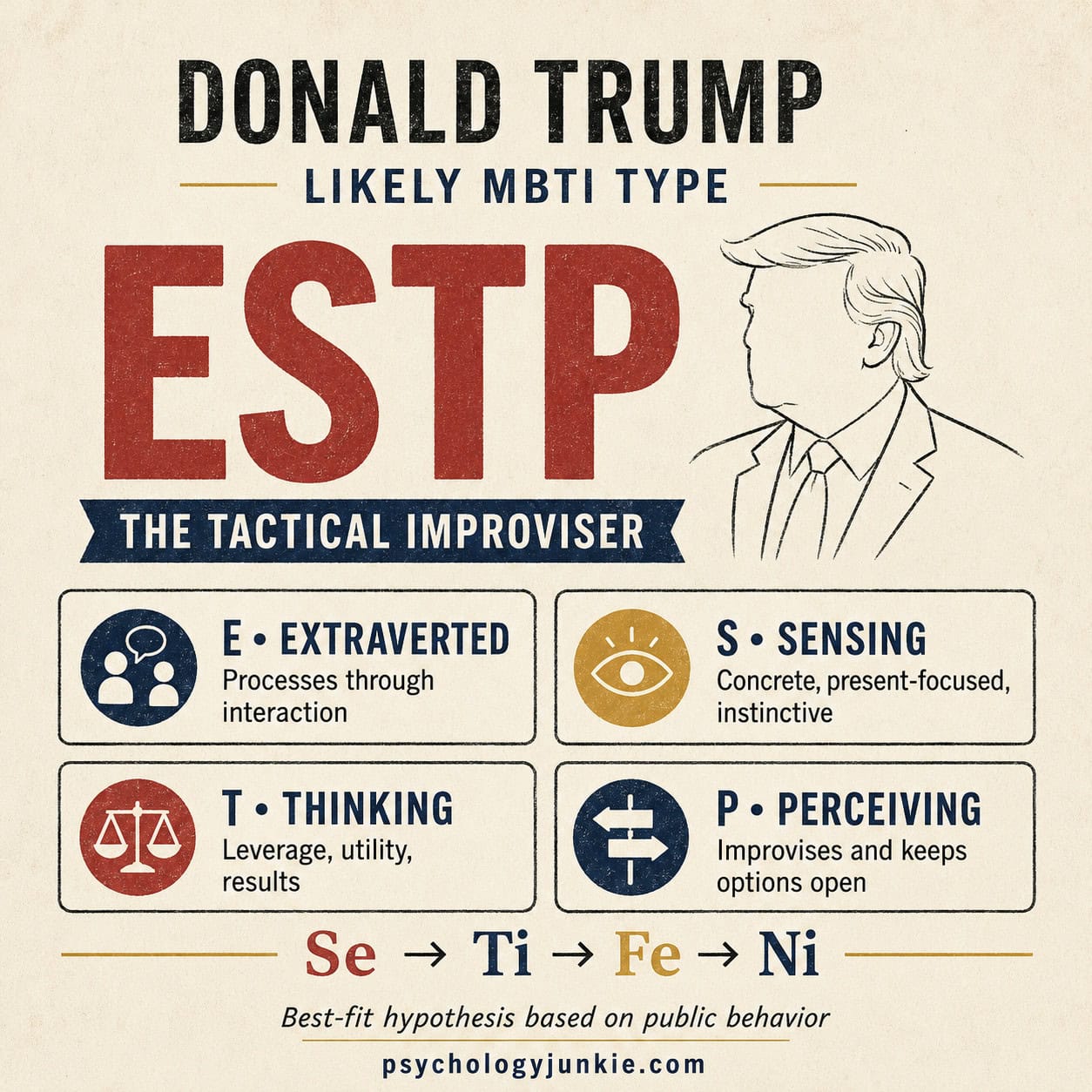
Extraversion is not the same thing as being friendly or emotionally open. It describes an orientation toward the outer world. Extraverts tend to process through interaction and engage before retreating to reflect. In contrast, introverts are likely to reflect, pause, and look inward before responding outwardly.
Trump has spent most of his adult life making himself visible. Long before politics, he cultivated reporters, attached his name to buildings and products, and turned business into a public theater of sorts. The Apprentice made his decision-making style the show: contestants presented, argued, and waited for Trump’s verdict across a boardroom table.
His rallies show the same outward orientation. He often seems more animated responding to a crowd than reading prepared remarks. He repeats a line when it lands, drops it when it doesn’t, and lets audience reaction shape the next few minutes. He’s definitely an interactive, responsive person who doesn’t pause much. When he’s got something to say, he says it, often without a filter. E is probably the least controversial letter in this typing.
S: Sensing
Sensing pays first attention to tangible reality, direct experience, and what can be acted on now. Intuition looks to abstract connections, implications, and conceptual possibilities. To clarify, neither preference tells us how intelligent someone is.
Trump’s language is usually pretty concrete and focused on experiences and tangible reality. He talks in terms of buildings, borders, crowds, prices, ratings, trade balances, ballrooms, physical strength, and visible wins. Even when describing a broad national vision, he tends to anchor it in things people can picture: factories opening, walls being built, products being made, opponents being beaten, and numbers going up or down.
His career history also matters. Manhattan real estate, casinos, hotels, entertainment, and branding are worlds of immediate leverage, presentation, competition, and physical impact. They reward noticing what attracts attention and acting while an opening exists.
Trump also speaks often about instinct. At a 2025 commencement address, he told graduates, “You have to break the system a little bit and follow your own instincts.” Whether one agrees with the results is beside the typing point. His own account begins with direct judgment of the situation, not a carefully articulated theory. That sounds like Sensing, specifically Extraverted Sensing.
T: Thinking
This letter is harder because Trump’s communication is emotionally charged. Yet Thinking and Feeling do not measure how many emotions someone has. They describe preferred standards for reaching conclusions. Thinking emphasizes logic, cause and effect, and utility. Feeling emphasizes values, human needs, and relational consequences. Everyone uses both.
Trump usually frames decisions as contests of leverage. Who has the advantage? What can be traded? What produces a win? His account of the 2018 summit with Kim Jong Un was characteristically result-focused: he called the meeting “honest, direct, and productive.”
This does not mean every Trump decision is logical or factually sound. Type describes preferred criteria, not the quality of the conclusion. I hear a preference for utility, competition, and internal calculation over moral language or interpersonal consensus. That points to T.
P: Perceiving
The final letter describes how someone meets the outer world. Judging types usually prefer advance structure and settled plans. Perceiving types keep room for incoming information and adapt as events unfold.
Trump likes options. During a 2015 Republican debate, he said, “I like to be unpredictable.” That line was about whether he carried a gun, but he immediately expanded it into a criticism of a country whose opponents always know what it will do. Unpredictability, to him, can be strategic leverage.
His public style is similarly fluid. He improvises, tests messages before audiences, revises positions, and treats disruption as a possible advantage. This can resemble Judging because he speaks decisively, but decisiveness and a J preference are not the same. An ESTP can make a forceful decision and change course just as forcefully.
This is why I favor ESTP over ENTJ. ENTJs usually organize the outer world through plans, systems, metrics, and coordinated execution. Trump cares about results, but his method looks more tactical than systematic. The live opening often matters more than the elegance of the long-term structure.
The Cognitive Functions: How the ESTP Pattern Fits Together
Someone’s cognitive functions show how the preferences interact. An ESTP’s cognitive function order is Extraverted Sensing, Introverted Thinking, Extraverted Feeling, and Introverted Intuition. In plain English: engage with what is happening, calculate how it works, influence the people involved, and deal with distant implications last.
Dominant Extraverted Sensing: Read the Moment and Move
Extraverted Sensing, or Se, tracks the live environment: reactions, opportunities, momentum, and facts that can be used now. At its best, it creates nerve and responsiveness. Overused, it can overvalue the immediate win or act before the future cost is clear.
Trump’s career is full of Se-style pivots. He reads an audience, adjusts, and understands spectacle. He knows a nickname, image, or unexpected remark may travel further than a detailed position paper. Jon Stewart described this talent well, saying Trump knows how to “read a room” and articulate its frustration back to it.
This does not mean every reading is accurate. Se is a perceptual preference, not a halo. Trump appears to trust contact with the moment. He would rather enter the arena, apply pressure, watch the reaction, and make the next move than perfect a private model first.
Auxiliary Introverted Thinking: Does It Make Sense to Me?
Introverted Thinking, or Ti, builds an internal framework for how things work. Because that framework is private, Ti users can arrive at a conclusion they find obvious without showing everyone each step. It’s personal logic, less concerned with what the majority or consensus says is logical. It needs to test and understand things for itself rather than trusting what others would call “authorities.”
Trump tends to reduce complicated situations to a few rules: strength deters opposition, leverage improves a deal, publicity creates value, and unpredictability keeps the other side off balance. It is less a policy manual than a guide to navigating a contest.
This is where he can be mistaken for an ENTJ. Extraverted Thinking usually wants an externally organized method that can be measured, delegated, and repeated. Trump seems less devoted to the system than to his own reading of what will work.
Tertiary Extraverted Feeling: Work the Crowd
Extraverted Feeling, or Fe, notices social atmosphere and emotional response. In the tertiary position, it may look performative, persuasive, or provocative rather than diplomatic.
Trump is highly attentive to approval, loyalty, crowd size, ratings, applause, and the emotional temperature of an audience. His frequent “we” invites listeners into a shared identity: “We will make America strong again. We will make America proud again.” He can flatter a room, build alliance, and turn politics into a group experience.
Tertiary Fe does not guarantee tact or empathy. It can seek connection while remaining selective about whose response counts. In Trump’s case, Fe seems to serve the Se-Ti operation: read the room, find the message, create the reaction, and keep the momentum moving.
Inferior Introverted Intuition: The Uneasy Long View
Introverted Intuition, or Ni, looks for an underlying pattern and follows it toward a long-range implication. ESTPs can have visions and plans, but one distant, abstract trajectory may take more effort than conditions directly in front of them.
Trump’s 2024 debate phrase, “I have concepts of a plan,” became famous because it sounded unfinished. I would not type someone from one sentence, and political incentives may explain it better. Still, it illustrates the broader contrast. His future language is often big and vivid, while the path from here to there remains flexible.
Inferior Ni can appear as certainty about a sweeping forecast without much visible scaffolding. It may also resist one fixed plan because early commitment closes useful options. Both fit someone whose greatest confidence lies in handling the next development as it arrives.
So, Is Donald Trump Definitely an ESTP?
No public figure can be typed with certainty from a distance. We see a persona, strategic communication, and behavior shaped by unusual pressures. Who I am when I’m giving a speech isn’t exactly who I am on my own time. When I’m giving a speech I’m more expressive, more tense, more responsive, taking less time to think things over because an audience is waiting.
Still, ESTP, in my opinion, is the most coherent explanation I have found for his personality. Extraversion accounts for the interactive processing; Sensing, the concrete language and instinct; Thinking, the emphasis on leverage and utility; and Perceiving, the improvisation and tactical flexibility. Se reads and acts, Ti calculates, Fe mobilizes the room, and inferior Ni handles the future in broad strokes that are sometimes overly vague.
That is why ESTP remains my best fit. Sure, it doesn’t tell us whether Trump is good or bad, right or wrong, capable or incapable. Personality type was never meant to answer those questions. It gives us a narrower lens: not what we should think of a person, but how that person appears to meet the world.
Sources
- Myers & Briggs Foundation: Myers-Briggs overview
- Myers & Briggs Foundation: MBTI Code of Ethics
- Myers & Briggs Foundation: Type dynamics
- White House Historical Association: Donald J. Trump
- American Presidency Project: 2024 presidential debate
- American Presidency Project: 2025 University of Alabama commencement address
- American Presidency Project: 2018 Singapore news conference
- Time: 2015 Republican debate transcript