ENFP vs. ESFJ: Which One Are You?
Let me guess. You took a personality test at 2 a.m. while stress-eating granola straight from the bag and now you’re spiraling. The results said “ENFP,” but last week you were apparently an “ESFJ,” and your frustration is peaking.
Welcome. You’re in good company.

Here’s the thing: ENFPs and ESFJs can look uncannily similar on the outside. Both are warm, people-focused, and fluent in the ancient art of reading a room. Both can cry over commercials and carry entire group chats on their backs like wounded soldiers of emotional labor.
But internally? Different universes. One is running on “What if?” and idealism, and the other is powered by duty, group harmony, and the simmering rage of being the only one who remembers birthdays.
Let’s dissect this confusion.
Not sure what your personality type is? Take our personality questionnaire here. Or you can take the official MBTI® here.
At First Glance
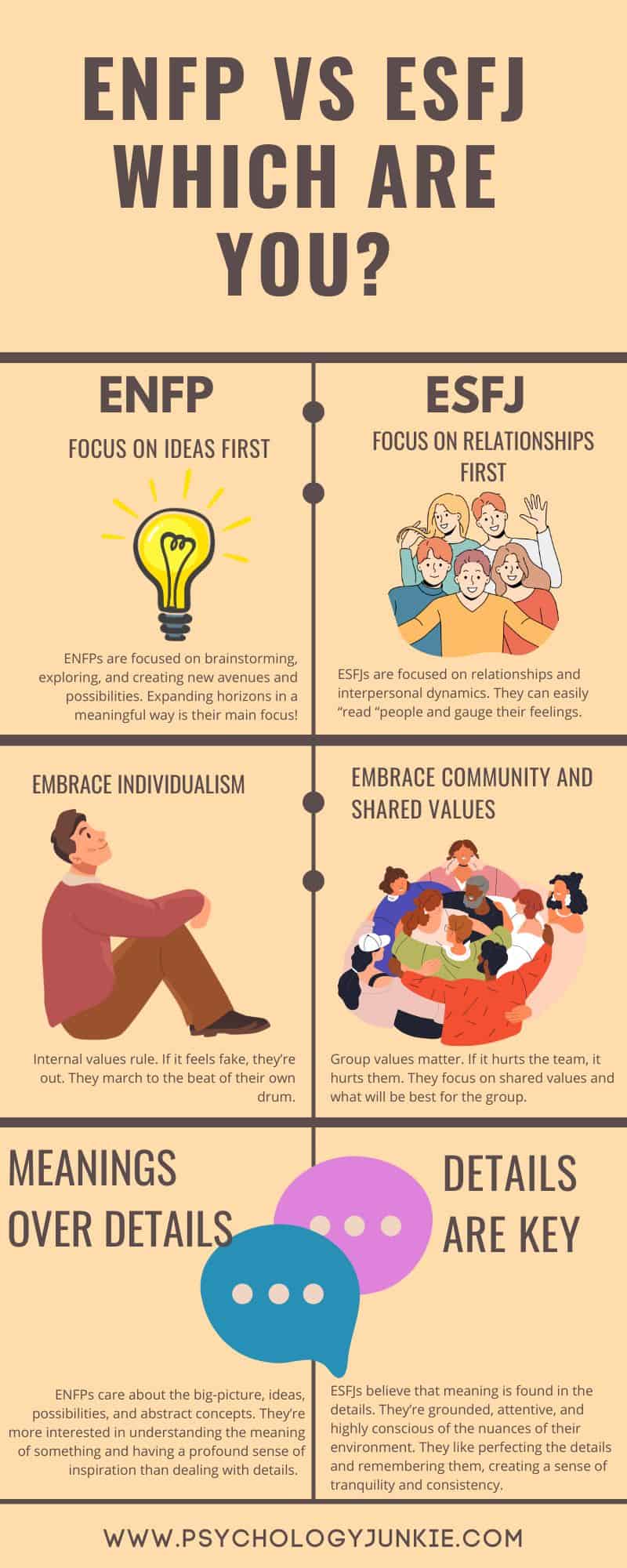
Initially, ENFPs and ESFJs are like those two dogs at the park that both run up to you, tail-wagging and tongue-lolling, and you’re like “Awww, they’re basically the same!” But then one of them brings you a stick and the other one starts reorganizing your picnic and asking about your mother’s emotional health.
ENFPs are magnetic in that mildly chaotic, “I just remembered a metaphor and need to tell you RIGHT NOW” way. They’re bursting with ideas, spontaneous plans, and surprisingly astute insights into your childhood trauma. You think they’re going to tell you about their day, but actually, they’re letting you in on their latest existential breakthrough.
ESFJs, on the other hand, have a kind of cozy warmth that makes you want to tell them your secrets while they hand you a casserole. They are nurturing, responsive, and carry this air of “everything’s going to be okay” even if their eye is twitching slightly and they haven’t sat down since 2007. They’ll remember your dog’s birthday, your dietary restrictions, and the fact that you once mentioned you liked that one obscure candle scent three years ago.
So yes, they both seem warm, expressive, emotionally intelligent. But one is fueled by novelty and the sacred call of authenticity (ENFP), and the other is fueled by responsibility and the quiet terror of disappointing people (ESFJ).
If you’re still not sure which one you are, don’t worry. We’re just getting started.
The Cognitive Function Breakdown
Let’s talk cognitive functions, a.k.a. the mental processes that come most naturally to you.
ENFPs: Ne-Fi-Te-Si
That’s Extraverted Intuition (Ne), Introverted Feeling (Fi), Extraverted Thinking (Te), and Introverted Sensing (Si). Which sounds like robot poetry, but here’s what it really means:
The ENFP Brain
Main superpower: Extraverted Intuition
ENFPs have this mental telescope that shows them all the things that could happen. They live in what-ifs. What if we started a band? What if this conversation changed our lives? It also finds connections between things that seem random to everyone else.
Moral compass: Introverted Feeling
They care a lot, but it’s inward. Their values are personal and deep, but you might not see the full extent unless you earn their trust. Or they’re having a minor breakdown and oversharing at 1 a.m.
To-do list system: Extraverted Thinking
They want to be productive, and they can be. But usually after 3 false starts, a new idea mid-way, and a snack. Their thinking voice is like a slightly frazzled coach yelling, “LET’S DO THE THING! Wait… which thing?”
Memory lane: Introverted Sensing
Their memories come in like old photos from a dream. They might forget to eat lunch but remember the exact color of the sky the day their hamster died in 1997.
ESFJs: Fe-Si-Ne-Ti
That’s Extraverted Feeling (Fe), Introverted Sensing (Si), Extraverted Intuition (Ne), and Introverted Thinking (Ti).
The ESFJ Brain:
Main superpower: Feelings radar (Extraverted Feeling).
ESFJs walk into a room and immediately know who’s upset, who’s left out, and who forgot deodorant. Their job, as they see it, is to make everyone okay. Even if they are not okay. They feel responsible for keeping up the vibe and maintaining harmony. They also care about social values (those “pleases” and “thank you’s” and propriety in general).
Stability drive: Introverted Sensing
They love a good tradition or routine. If there’s a recipe, a system, or a family ritual, they will preserve it like it’s the last known relic of human decency. It’s not about being stuck in the past — it’s about respecting what works. And not dying in chaos.
Creative brain spark: Extraverted Intuition.
Yes, they can be creative. They just want the creativity to be useful. They’ll get big ideas — but usually in the service of making life better for others. Think: “What if we made a get-well-soon basket that also includes a Spotify playlist and a handwritten poem?”
The uncertain function: Introverted Thinking
They do think deeply. They really do. But it’s buried under layers of “But what will people think?” and “Is this nice enough?” When it does come out, it’s usually during a 2 a.m. identity crisis when they’re questioning whether their whole life is just performative caretaking.
See More: The ESFJ’s Cognitive Functions In-Depth
Energy Patterns and Motivation
If ENFPs were a video game character, they’d be the one sprinting toward the glowing question mark on the map while yelling, “I’LL EXPLAIN LATER.” They don’t just want life to be fun or fulfilling — they want it to mean something. Something real. Something poetic and slightly inconvenient. Something they can cry about in a voice memo while walking barefoot in the grass because their soul told them to.
Meaning isn’t just a desire for ENFPs. It’s a compulsion. It’s that itch that keeps them up at night wondering if they’re living too small, if they’ve sold out, if they’re slowly becoming someone who uses “synergy” unironically. They don’t just want a job — they want a mission. A calling. A cause.
Meanwhile, ESFJs are out here chasing harmony. They want everyone to be okay. All the time. If someone is not okay, they feel it in their body like a stress ulcer. They’re all about preserving their communities, their values, and the traditions that give life a sense of continuity and tranquility.
They don’t just want people to get along — they want people to feel safe, seen, and ideally well-fed. They will overextend, over-commit, and bend over backwards just to make sure nobody feels left out. Because if someone is left out, that’s basically a moral failing in the ESFJ’s brain.
So the ENFP is chasing existential questions, while the ESFJ is trying to keep the entire emotional town from catching fire. Both are exhausted. Both care so much. But one is trying to rewrite the story of their life, and the other is trying to make sure the ending doesn’t leave anyone crying alone at the table.
Emotional Styles
For the ENFP, feelings come in like weather — sudden, dramatic, meaningful — and they listen. They honor the feelings. Sometimes they are the feelings.
They don’t always express those feelings right away, though. In fact, they can be fairly private about what’s going on under the surface. What matters most is what feels right to them. Not what’s popular, not what’s accepted, not what Joyce from church thinks. If society doesn’t get it? Cool. They’ll build a new society.
An ENFP would burn down a whole system if it violated their personal values. Their sense of right and wrong is deeply felt and often painfully individual. And because it comes from the inside, it doesn’t always make sense to the outside. But to them, it’s everything. You don’t get to tell them what matters. You can’t guilt them into loving what they don’t love. They’ll smile at you while internally ghosting your entire worldview.
ESFJs, on the other hand, are emotionally expressive — but they filter their emotions outwardly so that they’re still being “appropriate.” How will their emotions impact people? If it’s going to disrupt the harmony they’ll hold back, unless that’s the point.
They do have values — strong ones — but those values are tied to the world around them. They often grow from the beliefs of their family, religious beliefs, or community. They look outwards to find principles about right and wrong, and those values are usually tied to the human impact. They genuinely care about people and systems and want to uphold what keeps everyone okay. ESFJs believe in shared values. What’s right, not just for me, but for us? And when those values are challenged? It can feel like a personal betrayal and a breach of the social contract, all in one. Their entire nervous system hums with “What will this mean for the group?”
An ESFJ would die on the hill of “we don’t speak to elders like that,” even if the elder once stole someone’s casserole dish. Because it’s not just about the person — it’s about the principle and the expectation of decency.
To simplify:
- ENFPs: “I know it’s right because I feel it, deep in my marrow, and I don’t care if it’s weird.”
- ESFJs: “I know it’s right because it works — because it’s kind, it’s respectful, and my grandmother would approve.”
Both are sensitive. Both care more than they let on. But ENFPs want to understand their feelings and follow them wherever they lead, even if it means leaving the map behind. ESFJs want to use their feelings to create connection and protect the map — for themselves, and everyone else along for the ride.
Relationship Stuff: Who Checks In vs. Who Checks Out Mid-Sentence Because They Just Remembered a Life-Altering Metaphor
Let’s be clear: both ENFPs and ESFJs are emotionally available, compassionate, affectionate creatures who will absolutely send you good morning texts and memorize your favorite snack. But their style of love? Night and day.
ESFJs need to keep the connection alive. They show up. They check in. They remember what you’re anxious about, they ask how the meeting went, they remind you that you’re enough even when you look like a raccoon who lost its will to live.
They don’t just say “I love you” — they bake it into lasagna. They demonstrate care in practical, visible ways, often sacrificing their own energy to do it. And if you don’t reciprocate, they won’t necessarily yell — but they’ll radiate hurt and disappointment.
Their love language is usually something like “acts of service” or “quality time where I pretend I’m not seething that you didn’t rinse your cereal bowl.” They bond through shared traditions, reliability, and making you a better person, whether you asked for that or not.
ENFPs, on the other hand, love like a spiritual quest they just roped you into. They want depth. Intensity. Sparkle-in-the-eyes connection. If they’re into you, you will know — because things will get real. Who cares about consistency? They want to know every fear, every dream, every idea they ever had while brushing their teeth or staring at clouds. Loving an ENFP feels like being swept into a narrative arc where you’re both the co-star and the metaphor.
They want you to see them — not just the charming, bouncy version, but the weird, philosophical, slightly fragile soul underneath. And they want to see you too — but not the version you show your boss. The real you. The one who cried about a pigeon once. They bond through emotional vulnerability and shared mental expeditions into meaning, absurdity, and whatever new podcast they’re obsessed with this week.
And listen — if you’re loving an ENFP and suddenly they vanish into the mist, it’s probably not about you. ENFPs need freedom the way other people need air or Wi-Fi. Sometimes they go quiet not because they’re ghosting you, but because they’re deep in a spiral of soul-searching, unwashed laundry, and metaphorical rebirth. They’ll come back. Probably with a half-written song and three new life philosophies. Just… don’t take it personally. Unless you’re trying to cage them — in which case, do take it personally. They noticed.
One makes you tea and asks about your mom. The other writes you a poem on a napkin and forgets to text back for four days.
Work and Chaos Styles
Okay, this next part is kind of a stereotype, but it is so for a reason. It may not apply to 100% of all ENFPs, but probably 80% of them.
If you’ve ever seen an ENFP’s workspace, it looks less like an office and more like a mildly haunted art studio mid-exorcism. Post-its, notebooks, charging cables, three half-filled cups of tea, and an open tab for something they swear is “research.” Their brain is on fire with ideas — and not in the neat “I have a plan” way, but in the “I accidentally invented four businesses in the shower and now I have to decide which one is my true calling” way.
ENFPs are incredible at ideation. They can map out the first ten steps of a life-changing concept in about eight minutes. But then… something happens. A distraction. A self-doubt spiral. A sudden philosophical question about whether society is even ready for their idea. And the project quietly dies, mourned only by the half-finished Google Doc.
ESFJs, meanwhile, are out here running the world on spreadsheets and sheer emotional stamina. Their version of chaos is when someone else forgets to bring the napkins. They are detailed, people-conscious, and capable of managing six events, three relationships, and one internal breakdown — all while making sure the tablecloths match the vibe.
They don’t just do things — they complete them. Often while quietly resenting that no one else is helping. They may not love change, but they will adapt if it helps people. They’ll take your creative chaos and turn it into a printable schedule with snack breaks. And if the printer jams? They’ll cry in the bathroom, fix it, and then comfort you for being stressed.
So:
- ENFPs are idea fountains who need someone else to handle the plumbing.
- ESFJs are logistics machines who occasionally short-circuit from carrying the emotional labor of humanity.
ENFPs thrive on creative chaos. ESFJs manage functional chaos. Both get overwhelmed, both crave appreciation, and both absolutely deserve a vacation with no one talking to them for 48 hours straight.
How They Spiral
Everyone spirals. Some of us spiral quietly in the shower. Some of us spiral loudly in a group text. Some of us do both, then eat a sleeve of Oreos and pretend we’re “journaling.”
But ENFPs and ESFJs? Their spirals are very different. Let’s take a look:
ENFPs under stress look like they’re starring in a dramatic reimagining of their own lives — one in which every choice they’ve ever made is suddenly suspect, and they’re haunted by the ghost of potential futures they never lived. They start wondering if they’re a fraud, if anything means anything, and whether their creative energy is just overcompensating for deep-seated emotional emptiness.
They withdraw. They isolate. They become weirdly cranky about structure and then yell at themselves for being cranky. Sometimes they fall into hyper-productive, overly organized tunnel-vision mode — like suddenly they’re Marie Kondo-ing their trauma — but it doesn’t feel good. It feels like being puppeted by someone who doesn’t believe in joy. And when that happens? That’s not an ENFP in growth mode. That’s an ENFP in grip mode. And they need a nap. And possibly a forest.
ESFJs under stress spiral in the opposite direction: into over-functioning. They double down. They take care of everyone. They make a lasagna, clean the bathroom, re-write the budget, text their emotionally avoidant cousin to check in, and then burst into tears while folding towels because no one asks how they’re doing.
They don’t know how to stop. Slowing down feels selfish. Saying “no” feels like betrayal. And if someone does try to help? The ESFJ either micromanages them or says “thank you” with the passive-aggressive intensity of a martyr who’s already drafted their sainthood application.
But when it really gets bad — like basement-level, soul-fraying stress — ESFJs can flip into full-on critical analyst mode. Suddenly, they withdraw. The warmth dims. They start pointing out inconsistencies, poking holes in other people’s logic, and questioning everything — including themselves. They might become hyper-nitpicky, rigid, or weirdly obsessed with doing things “correctly” according to some new standard they can’t even articulate. They’ll start editing your sentences in their head while silently tearing their own choices to shreds.
This is not them being cold — this is them in survival mode. They’re not trying to be mean. They’re trying to find order. If emotions are too messy to fix, then maybe they can at least fix the way you use a semicolon.
Journal Prompts to Help Break the Tie (Or at Least Spiral More Productively)
Still not sure which one you are? That’s fine. Self-discovery is a mess. Here are some questions to help you sort through the emotional laundry:
- When I feel something strongly, do I:
- A) Wonder what it means for who I am? (ENFP)
- B) Wonder how it’s going to affect the people around me? (ESFJ)
- If I had to quit my job tomorrow, would I:
- A) Panic about losing structure, stability, and how it affects my relationships? (ESFJ)
- B) Feel weirdly excited about reinventing myself and starting a mushroom farm/art collective? (ENFP)
- What upsets me more:
- A) People not appreciating what I do for them? (ESFJ)
- B) Feeling like I’m living someone else’s life instead of my own? (ENFP)
- My memories are:
- A) Rich with sensory details and tied to tradition and past experiences. (ESFJ)
- B) Random poetic flashes that hit me out of nowhere, usually while listening to music alone. (ENFP)
- When I love someone, I:
- A) Show up consistently, check in often, and handle logistics. (ESFJ)
- B) Want to know the depths of their soul, then vanish to process my own feelings for three days. (ENFP)
- I tend to feel guilty when:
- A) I disappoint people or don’t meet expectations. (ESFJ)
- B) I abandon my own truth to make someone else comfortable. (ENFP)
- My idea of a perfect weekend is:
- A) Hosting something — a dinner, a game night, a moral intervention. Everyone’s together. Everyone’s happy. (ESFJ)
- B) Wandering alone through a bookstore, then coming home to freewrite about the nature of human connection. (ENFP)
- What makes me cry faster:
- A) A speech about love, family, or community. (ESFJ)
- B) An indie song that makes me feel like I’m dissolving into the sky. (ENFP)
- My biggest fear is:
- A) Being unneeded. (ESFJ)
- B) Being inauthentic. (ENFP)
- People have told me I am:
- A) Reliable, thoughtful, and the glue that holds everyone together. (ESFJ)
- B) Deep, intense, and occasionally chaotic. (ENFP)
Add up your answers. Or don’t. Maybe you’re both. Maybe you’re just tired. That’s okay, too.
What Do You Think?
Still stuck? Feel clearer?
Let me know in the comments! I like to know if I’m bringing clarity or just adding to the confusion.
Keep in mind, you might be something else entirely. Someone who’s grown up being one thing and is finally peeling back the layers. Someone who’s always felt “a little too much” or “not enough” and is finally starting to ask why. Someone who’s tired of labels — but still finds comfort in trying them on for size.
Wherever you’re at, you’re not alone. And you’re definitely not too weird to be understood.
Drop your thoughts below!




OMG I’m both!! Now I’m definitely more confused! I love hosting and throwing parties. I do remember (or try to) remember everyone’s birthday, and manners matter, etc, but like I’m also a chaos goblin who has 5 amazing ideas before breakfast, rarely finish what I start, is super excitable and bubbly. I care about people but I don’t know if I care quite as much as an ESFJ should. I like rules. But I get bored of routine. ARRGHH. Help!
The journal prompts seem more useful than deciding whether someone owns more spreadsheets or unfinished notebooks. For the memory question, it might help to write about a recent ordinary event before looking at the two suggested answers, then compare a few entries. Otherwise the more appealing description could quietly recruit its own evidence. Would you suggest noting the context too, such as whether someone was relaxed, rushed, or trying to meet another person’s expectations? That might give the inner chaos goblin a little less control over the verdict.