
The Enneagram 9 Subtypes (Instinctual Variants): Which One Are You?
Most descriptions of Nines are fairly one-dimensional. They’re described as easy-going, low-key types who’d probably rather fight a bear than bring up a disagreement with their spouse. And yes, that can be true for some, but it’s also overly-simplistic. In my experience, Nines have a dark side and a light side. Their lives aren’t just about keeping everything happy and peaceful, they’re about connecting with the imagination while maybe also disconnecting from their own frustration, ambition, grief, or desire.
The central struggle of the Nine is usually described as sloth, although that word can be misleading. It does not necessarily mean lying around doing nothing. I’ve known plenty of hard-working Nines. The real issue is a kind of inner disengagement. They can become inattentive to their own priorities while remaining highly attentive to the people and demands around them.

Carl Jung wrote, “The privilege of a lifetime is to become who you truly are.” That idea has particular weight for a Nine, because becoming fully themselves often requires noticing all the small ways they have learned to step aside. Often this happens through ordinary compromises that seem harmless at first. They go along with the plan, postpone the difficult conversation, accept the role everyone expects them to play, and tell themselves their own preference is not important enough to complicate things.
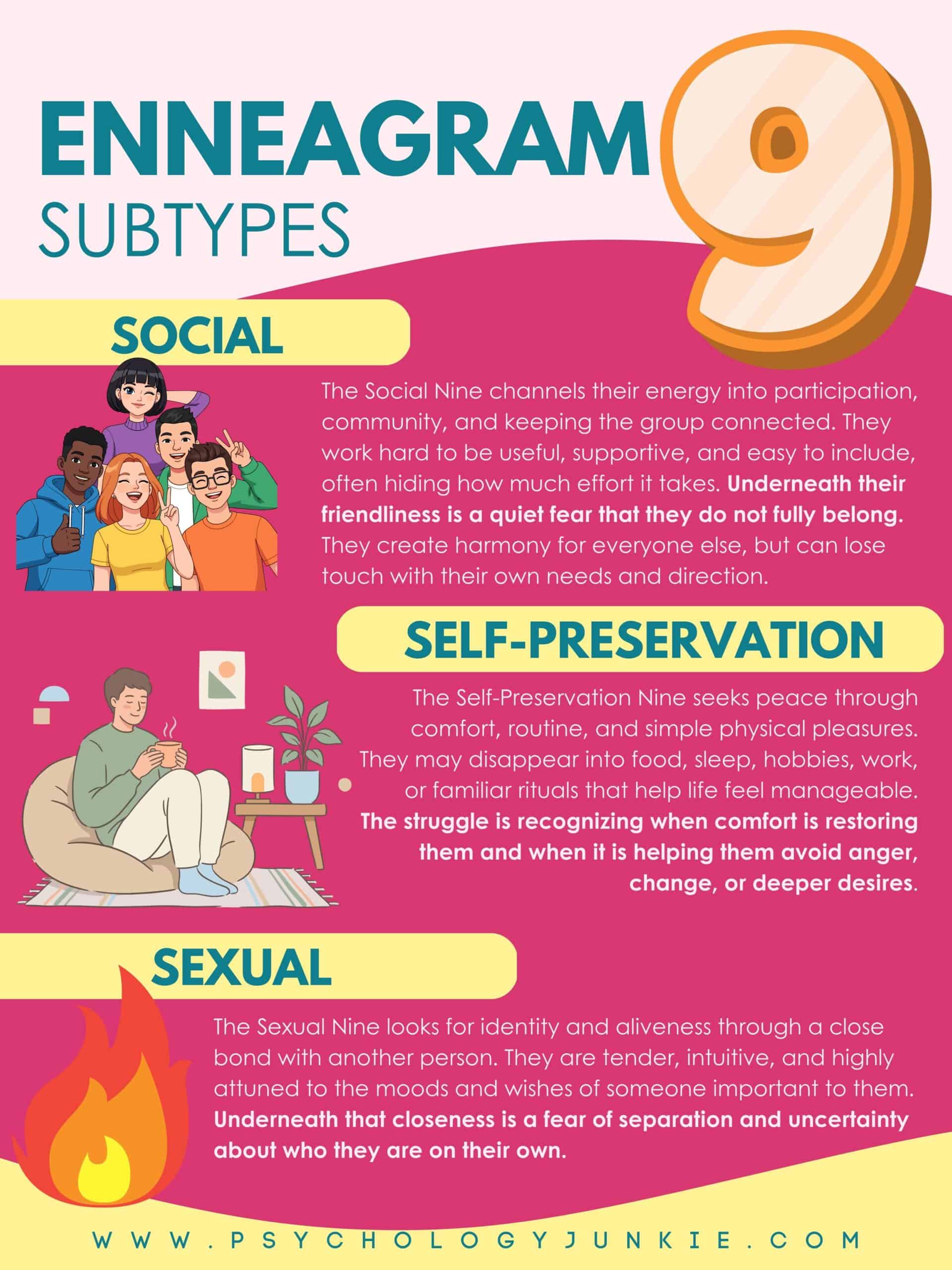
The instinctual subtypes help explain where this self-forgetting is most likely to happen. Self-Preservation Nines tend to merge with routines, comfort, and familiar physical experiences. Sexual Nines can merge with an important person and begin to live through the relationship. Social Nines merge with the group, often becoming involved in families, communities, workplaces, or causes while neglecting their own inner life.
The subtype does not change the basic Nine structure. It shows us the route the Nine takes toward comfort, belonging, and disconnection from themselves. Once that pattern becomes visible, it also becomes easier to interrupt.
The Social Nine: “Participation”
The Social Nine is the countertype of the Nine family, which means they may not look much like the relaxed, low-energy stereotype people often associate with this type. Social Nines can be busy, involved, sociable, and more Type A. They may lead organizations, coordinate family life, support a team, run a community group, or become the person everyone calls when something needs to be handled. Their version of self-forgetting is not usually inactivity. It is participation without enough personal presence.
At the center of this subtype is a strong need to belong. Social Nines often feel drawn toward groups, yet somewhere underneath that desire is a subtle sense that they are not fully part of things. They may compensate by becoming useful, agreeable, hardworking, or indispensable. Rather than assuming they belong naturally, they behave as though membership has to be earned through contribution. They help, organize, smooth things over, and carry extra weight, often without telling anyone how much effort it takes.
This can make them look unusually energetic for a Nine. They may be the person gathering everyone together, remembering birthdays, translating between people who disagree, and making sure the difficult personality in the room does not derail the entire evening. They are often gifted at reading the emotional atmosphere of a group and adjusting themselves to keep things running smoothly. That is a real strength, although it can become a problem when adaptation replaces self-expression.
I’ve noticed that Social Nines can speak very clearly about what a group needs while struggling to describe what they need personally. They may know exactly what would improve the workplace, calm the family, or support a friend, but when the conversation turns toward them, everything pauses. It is not that they have no preferences. They have just spent so much time orienting toward the whole that their own position has become harder to hear.
Beatrice Chestnut describes the Social Nine as someone who works hard to support the group while remaining disconnected from personal priorities. This explains why this subtype can be productive and still be caught in the passion of sloth. The laziness is not necessarily visible in their schedule. It shows up in the postponement of their own development, their own difficult decisions, and the parts of life that belong only to them.
The Social Nine may tell themselves that now is not the right time to pursue a personal goal because the family needs stability, the team is short-staffed, the community is struggling, or someone else is having a harder year. Sometimes those reasons are completely legitimate. The trouble is that there is always another person, another obligation, and another worthy cause waiting nearby. Years can pass this way, and the Nine may eventually wonder why their life is full but does not quite feel like their own.
These Nines are usually extremely likeable. They’re often warm, steady, and easy to work with. If they’re leaders, they’re definitely not the intimidating kind. They can hold several viewpoints in mind at once, which makes them excellent mediators. While other people are busy proving they are right, the Social Nine is often trying to understand what each person is afraid of, what has been misunderstood, and whether everyone can leave the conversation with some dignity intact.
This does not mean they are endlessly serene. Social Nines can become stubborn, controlling, or even resentful, especially when they feel overburdened or taken for granted. Because they may not voice their frustration early, other people can be surprised when the resentment finally surfaces. The Nine may also feel surprised, since they have often been telling themselves that everything is fine right up until it clearly is not.
Parker Palmer wrote, “Self-care is never a selfish act. It is simply good stewardship of the only gift I have.” Social Nines often understand this idea intellectually before they trust it emotionally. They may agree that everyone needs rest and personal space, then make an exception for themselves because somebody needs help moving furniture, solving a family crisis, or organizing an event nobody else volunteered to handle.
Strengths of the Social Nine
Social Nines create a sense of belonging for other people because they are highly aware of who is being included and who is standing at the edge of the room pretending not to care. They can listen to competing opinions without immediately turning the disagreement into a contest, and they often notice practical ways to help people cooperate.
As leaders, they’re more focused on service than status. They don’t usually like drawing attention to themselves, but people often trust them because they are consistent, fair-minded, and willing to do unglamorous work. Healthy Social Nines can be strong community builders who help people feel heard without losing sight of what the group actually needs to accomplish.
They also tend to have emotional endurance. They can tolerate complexity, absorb a certain amount of chaos, and remain steady when other people become reactive. This makes them valuable in families, teams, schools, churches, volunteer groups, and any setting where several strong personalities are trying to share oxygen.
The Shadow Side of the Social Nine
The difficulty is that Social Nines can become so involved in maintaining the group that they neglect the person doing all the maintaining. Their calendars fill up, their responsibilities multiply, and their own life begins to exist in the leftover spaces. They may feel important to many people while still feeling strangely unknown. There’s an emptiness inside that feels haunting, like they reach inside themselves and all they can sense is fog.
Because they want to preserve connection, they can avoid saying things that might disappoint the group. They may agree to plans they do not want, accept duties they resent, or keep quiet about a decision they strongly disagree with. The resentment doesn’t disappear just because they kept quiet. It usually goes underground, where it may show up as procrastination, forgetfulness, withdrawal, irritability, or a sudden inability to care about the thing they once promised to do.
There can also be an unspoken belief that belonging depends on usefulness. The Social Nine may not consciously think, “People will only want me if I contribute,” but their behavior can follow that rule. Rest may feel uncomfortable because it removes the role that gives them a clear place in the group. Saying no may feel risky because it raises the question of whether people will still value them when they are not making life easier.
The sad part is that their effort can actually prevent the intimacy they want. Other people may appreciate everything the Nine does without ever knowing what the Nine feels, wants, dislikes, fears, or hopes for. The Social Nine is present everywhere, yet still partially hidden.
Growth Work for the Social Nine
For Nines, growth work is about learning to participate without disappearing.
This begins with noticing the difference between contribution and self-erasure. Helping because you care feels different from helping because you are afraid your place depends on it. One comes from choice, while the other comes from an old bargain you may not realize you are still making.
Social Nines also benefit from becoming more honest about anger. Anger is often the signal that a boundary has been crossed, a need has been neglected, or a truth has been postponed for too long. It does not automatically mean you are becoming selfish, hostile, or difficult. Sometimes it simply means there is finally enough of you present to object.
Carl Rogers wrote, “The curious paradox is that when I accept myself just as I am, then I can change.” For the Social Nine, self-acceptance includes recognizing that your needs are not an interruption to the group. Your preferences are not minor administrative details. Your life is not the support staff for everyone else’s development.
Here are a few practical ways to work with this pattern.
Ask Yourself Before You Ask the Group
Before automatically checking what everyone else wants, take a few minutes to identify your own preference. You may still decide to compromise, but compromise is healthier when you know what you are giving up. Otherwise, it is not really compromise. It’s more like disappearance.
Practice One Honest No
Choose one request you would usually accept out of habit and give yourself time before answering. If the honest answer is no, say it kindly and without feeling like you have to give a legal defense for your decision. You are allowed to decline something even when the other person is disappointed.
Spend Time Where Nobody Needs You
Set aside a small amount of time in which you are not available as a helper, mediator, parent, partner, employee, organizer, or emotional support animal for the entire neighborhood. The goal is to help your brain realize that you still exist when you are not performing a role.
Name the Feeling Under the Cheerfulness
Social Nines often keep the mood light because sadness or anger feels disruptive. Try writing down what you are actually feeling before deciding whether it is convenient. This will help you to know what is really happening inside you.
Recover One Personal Desire
Think of something you wanted before life became crowded with other people’s needs. It may be a hobby, a place you wanted to visit, a subject you wanted to study, or a project you kept postponing. Choose one small action that treats the desire as real rather than hypothetical.
10 Signs You Might Be a Social Nine
- You’re usually the reliable person in a group, even when you did not intend to take on that role.
- You can explain everyone else’s position in a disagreement and may need extra time to figure out your own.
- You are often busy, helpful, and productive, but many of your personal goals remain in the “someday” category.
- You notice outsiders quickly and feel compelled to make sure they are included.
- You have a hard time saying no when the request benefits a family, team, community, or cause you care about.
- You may feel tired or resentful after helping, then feel guilty for being tired or resentful.
- People see you as easygoing, although there are several things you have secretly been annoyed about since 2019.
- You dislike burdening others with your problems, so you often present the edited, manageable version of how you are doing.
- You feel most secure when you know your role and how you contribute, but you may feel oddly ungrounded when nobody needs anything from you.
- You want to feel that you belong, yet part of your growth involves realizing that belonging is not something you should have to purchase with constant effort.
The Self-Preservation Nine: “Appetite”
Self-Preservation Nines crave comfort, familiarity, and a certain amount of physical peace. They often love good food, long naps, familiar books, quiet hobbies, repetitive games, favorite television shows, or a routine that allows them to move through the day without a lot of negotiation.
Claudio Naranjo called this subtype “Appetite,” but the name is broader than it sounds. It’s not just about eating, although food can be part of the pattern. Appetite describes the Self-Preservation Nine’s tendency to find a sense of solidity through concrete, comforting experiences. Eating, sleeping, reading, exercising, gardening, working, scrolling, watching television, or reorganizing the garage can all serve the same basic purpose. The activity gives the Nine something tangible to settle into when their inner life feels foggy, demanding, or difficult to access.
There is nothing inherently unhealthy about comfort. Most of us (myself included) become less charming when we are hungry, exhausted, and sitting in a plastic chair under fluorescent lighting. Self-Preservation Nines simply have a particular gift for creating small pockets of ease, and at their best, they bring a grounded, unpretentious quality to life. They notice ordinary pleasures other people overlook. A warm meal, a quiet room, a predictable evening, or a familiar trail can restore them.
The difficulty begins when comfort becomes a substitute for presence. Instead of asking what they feel, what they want, or what needs to change, they reach for an experience that lowers the volume. They may eat something, turn on a show, start another chapter, take a nap, or disappear into a practical task. None of these choices looks especially alarming on its own, which is partly why the pattern can continue for years without drawing much attention.
From the outside, the Nine can just look relaxed. Internally, though, the comfortable activity is helping them avoid contact with anger, disappointment, loneliness, or the vague sense that something important in their life has been left unattended. They are not necessarily thinking, “I would rather watch four episodes of this series than confront the fact that I hate my current situation.” It is usually less conscious than that. They simply feel drawn toward whatever asks the least of them emotionally and offers the fastest return to equilibrium.
In my work with Nines, I have noticed that Self-Preservation Nines often describe themselves as simple people. They may say they do not need much, do not want to make a fuss, and would honestly be happy if everyone would stop asking them questions for twenty minutes. Sometimes that is completely true. At other times, “I don’t need much” has become a way of avoiding the more vulnerable question of whether they believe they are allowed to need anything at all.
These Nines are usually practical people. They may be less interested in dissecting every emotional nuance than some other Enneagram types, and they can become impatient when a conversation floats too far into abstraction. They usually prefer something they can use, fix, taste, build, or experience directly. If you give them a twelve-step theory about inner transformation when what they wanted was a clear suggestion for getting through Tuesday, you may lose them around step three.
This does not mean they lack depth. Self-Preservation Nines can have a rich inner life, but they may not naturally put it into words. Feelings are often experienced more as heaviness, fatigue, irritation, restlessness, or the urge to withdraw than as clear definitions. They may know that something is wrong long before they know exactly what it is.
Psychologist Donald Winnicott wrote, “It is a joy to be hidden, and disaster not to be found.” When I read this, I immediately thought of the Self-Preservation subtype. These types often enjoy retreating from demands and being left alone with their familiar comforts, yet they also want to be known, loved, and noticed without having to fight for attention. They may secretly hope someone will recognize what they need while making themselves difficult to read.
More than the other Nine subtypes, Self-Preservation Nines often need substantial time alone. Relationships require adaptation, and adaptation is something Nines do almost automatically. Solitude allows them to stop tracking everyone else’s mood, preference, schedule, and level of irritation. They can settle into their own pace, although even then, they may merge more readily with an activity than with themselves.
This subtype is often described as the most Eight-like of the Nines. Self-Preservation Nines can have a solid physical presence, a stubborn streak, and more visible irritation than the Sexual or Social Nine. They may not seek confrontation, but they are not necessarily delicate. Once they have planted themselves somewhere, changing their direction can feel like trying to relocate an old oak tree with a polite suggestion.
Their anger often appears as resistance rather than open aggression. They may move slowly, forget, delay, dig in their heels, or do things their own way without explaining why. If pushed hard enough, however, they can release what has sometimes been called the “fury of the peacemaker.” This surprises everyone, including the Nine, who may have believed they were mildly annoyed right up until the furniture began to fear for its safety.
Strengths of the Self-Preservation Nine
Self-Preservation Nines tend to have a calming, grounded presence. They are often the people who make ordinary life feel more manageable. They know how to create comfort and they can find satisfaction in simple things that more restless personalities barely notice.
They are usually patient and steady, especially during practical difficulties. While everyone else is catastrophizing, the Self-Preservation Nine might just make a sandwich, locate the flashlight, and deal with whatever is actually happening. Their ability to remain composed can help other people regulate themselves.
These Nines also tend to be accepting. They can let people exist without turning every flaw into a development project. For those who grew up feeling scrutinized, a healthy Self-Preservation Nine can feel like a deeply restful person to be around.
Their strength is often understated. They may not advertise what they have survived, and they do not always recognize their own endurance because persistence feels ordinary to them. Yet they can carry heavy responsibilities for a long time, often with humor and very little ceremony.
The Shadow Side of the Self-Preservation Nine
The main danger for this subtype is that comfort can gradually shrink their life. What begins as a reasonable need for rest may turn into a pattern of postponing anything that creates discomfort, uncertainty, or conflict. The Nine waits until they have more energy, a clearer mind, a better week, or fewer demands. Unfortunately, life is not known for clearing its schedule.
They may remain in jobs, relationships, habits, or living situations that no longer fit because the familiar discomfort feels safer than an unfamiliar possibility. Even when they know something needs to change, taking action can feel strangely difficult. The current situation may be unsatisfying, but at least they already know where the snacks are.
Self-Preservation Nines can also confuse numbing with restoration. True rest leaves a person more present and capable of engaging with life. Numbing offers temporary relief but often leaves the original problem untouched. A restful evening may help the Nine feel clearer the next morning, while an evening spent disappearing into food, screens, sleep, or repetitive activity may leave them foggier and more disconnected.
Because these Nines tend to minimize their needs, they may not notice deprivation until it has become severe. They can tolerate emotional neglect, boredom, loneliness, or a lack of meaningful direction for a surprisingly long time. Rather than identifying the deeper hunger, they feed smaller appetites that are easier to satisfy.
There may also be a subtle assumption that love is not something they should actively expect. They can be affectionate and loyal while remaining resigned about receiving care themselves. Pleasure, routine, and comfort then become a kind of compensation. These things are dependable. They do not misunderstand you, ask you to explain yourself, or suddenly announce that the relationship needs a serious conversation.
Self-Preservation Nines may settle for comfort when what they truly need is aliveness, agency, affection, or change.
Growth Work for the Self-Preservation Nine
This subtype grows through becoming more conscious of anger. Anger tells you where you have been ignored, overrun, deprived, or disconnected from what matters. It carries information about your boundaries and desires. When you immediately soothe or suppress it, you also lose access to some of your strength.
Self-Preservation Nines may fear that acknowledging anger will make them harsh or disruptive. More often, the opposite is true. When anger is recognized early, it can be expressed clearly and proportionately. When it is ignored for months or years, it tends to emerge through stubbornness, withdrawal, passive resistance, or a sudden eruption over something that appears minor but is carrying the weight of fifty earlier frustrations.
Viktor Frankl wrote, “When we are no longer able to change a situation, we are challenged to change ourselves.” The Self-Preservation Nine’s challenge is often recognizing which situations truly cannot be changed and which ones have simply become familiar. Endurance is a strength, but it is not always the same as acceptance. Sometimes endurance is what keeps you in a life you have outgrown.
Right action for this subtype means making small, deliberate contact with what you want and acting before the desire gets buried beneath routine.
Here are a few practical ways to begin.
Notice What You Reach for When You Do Not Want to Feel
The next time you automatically reach for food, television, sleep, scrolling, work, or another familiar activity, pause long enough to ask what was happening just before the impulse appeared. You may still choose the activity, but knowing what you are soothing helps you decide whether it is actually what you need.
Separate Rest from Disappearance
Ask yourself how you tend to feel after an activity. Do you feel restored, clearer, and more able to engage with life, or do you feel foggy and vaguely irritated that the problem is still waiting? Rest helps you return to yourself. Numbing delays the reunion.
Make One Necessary Move Before Getting Comfortable
Choose one small action connected to a personal priority and complete it before settling into your favorite routine. Send the email, make the appointment, write the first paragraph, or have the five-minute conversation. You do not need to finish everything. You are simply teaching yourself that your own life gets a place in the day.
Put Anger Into Plain Language
When you feel irritated, finish the sentence, “I am angry because…” without immediately explaining why the other person probably meant well. The goal is not to accuse anyone. It is to hear your own experience before translating it into something more comfortable for everybody else.
Ask What You Are Actually Hungry For
When an appetite feels unusually strong, consider whether the deeper need is food, rest, stimulation, solitude, affection, purpose, freedom, or relief from a situation you have tolerated too long. Sometimes the answer really is food, which is convenient. At other times, the stomach has been unfairly assigned a problem that belongs to the heart.
10 Signs You Might Be a Self-Preservation Nine
- You have a handful of favorite routines, foods, shows, games, books, or hobbies that function as a portable emotional bunker.
- You genuinely enjoy being alone because it is the only time nobody is asking what you want while simultaneously making it clear what they want.
- You often know that something needs to change, but the thought of disrupting your current routine makes the existing problem seem temporarily acceptable.
- You may describe yourself as low-maintenance, although part of being low-maintenance involves meeting your own needs before anyone realizes you have them.
- When you are angry or overwhelmed, your first instinct may be to sleep, eat, watch something, or retreat into a familiar activity until the feeling becomes less demanding.
- You can be easygoing about many things, but once you have decided where you are sitting, what route you are taking, or how the dishwasher should be loaded, negotiations may close.
- You prefer practical advice to elaborate psychological theories and may become suspicious when a simple problem acquires a twelve-page emotional backstory.
- You often mistake endurance for contentment and may remain in uncomfortable situations because changing them seems even more uncomfortable.
- People may underestimate your strength because it is expressed through steadiness rather than force, although anyone who has tried to rush you knows there is considerable force available.
- Your growth involves realizing that peace is not merely the absence of disruption. Sometimes real peace comes after you disturb the routine, name what you want, and build a life you no longer need to escape from.
The Sexual Nine: “Fusion”
The Sexual Nine tends to find a sense of identity through deep connection with another person. Claudio Naranjo called this subtype “Fusion,” which is a useful word because it describes more than closeness. Sexual Nines don’t just want physical intimacy. They often become so attuned to an important person that the boundary between “you” and “me” starts to blur.
This may happen with a romantic partner, a best friend, a parent, a mentor, or anyone who becomes emotionally central. The other person’s moods, opinions, interests, and direction begin to carry unusual weight. The Nine may feel more alive, focused, or certain when they are connected to this person, while time alone can feel vague, empty, or even scary.
At its heart, this pattern is an attempt to answer a difficult question: “Who am I when I am not connected to you?”
Sexual Nines often know how the other person feels before they know what they feel themselves. They can sense a shift in tone, a flicker of disappointment, or a change in emotional temperature almost instantly. Their attention moves toward the relationship so naturally that they may not realize how much of their inner life is organized around preserving it.
This sensitivity can look like extraordinary empathy, and often it is. Sexual Nines are often deeply tender, intuitive, and receptive. They have an ability to enter another person’s emotional world without forcing it into a neat explanation. People often feel understood around them because the Nine isn’t just noticing the words, they’re noticing the pauses, the tension, the atmosphere, and the small details that reveal what is really happening.
The trouble is that this gift can become self-erasure when the Nine adapts too far. They may absorb the other person’s preferences, take on their priorities, or begin living according to a direction they did not consciously choose. This does not usually feel like a dramatic sacrifice. It feels natural. The relationship has momentum, and the Nine simply moves with it.
I have seen this pattern in coaching sessions when a Nine speaks at length about what a spouse, parent, or close friend wants, then becomes uncertain when I ask what they would choose without that person’s influence. Sometimes they genuinely do not know. Other times they know, but their preference feels less real because it conflicts with the bond.
Sexual Nines are not necessarily weak or incapable of making decisions. They may be highly competent in many areas of life. The difficulty is that separation can feel emotionally dangerous, even when the separation is as small as having a different opinion.
A disagreement may not feel like a simple difference between two people. It can feel like a threat to connection itself.
As psychologist Harriet Lerner wrote, “Only through our connectedness to others can we really know and enhance the self. And only through working on the self can we begin to enhance our connectedness to others.” Sexual Nines often understand the first half of that idea instinctively. Growth asks them to take the second half just as seriously.
They may believe closeness requires sameness, or at least a high degree of adaptation. If the other person is excited, they become excited. If the other person is discouraged, the Nine’s mood sinks with them. If the other person has a strong opinion, the Nine may feel their own position becoming less solid, particularly when conflict seems likely.
Over time, this can create a relationship in which the Nine is emotionally present but personally hard to locate. They may be loving, attentive, and involved while still withholding important parts of themselves. Their anger, ambition, disagreement, and independence stay out of view because those qualities feel risky.
This subtype is often the least assertive of the Nines, although that does not mean they have no anger. The anger tends to appear indirectly. A Sexual Nine who feels controlled or overlooked may withdraw, avoid, forget, shut down, or resist. They may agree in the moment, then fail to follow through because some buried part of them never truly consented.
This can be confusing for everyone involved. The other person believes an agreement was reached, while the Nine feels increasingly trapped by an agreement they never fully inhabited.
Sexual Nines may resemble Type Fours because they can be sensitive, romantic, melancholy, and deeply focused on relationships. The difference is that Fours usually remain highly aware of their own emotional experience, even when it is painful. Sexual Nines are more likely to lose track of their feelings while absorbing someone else’s.
They can also look like Twos because they are attentive and relationship-oriented, but the emotional movement is different. Twos often move toward others by becoming needed or appreciated. Sexual Nines move toward others by blending, adapting, and reducing the distance between two people.
Sexual Nines often long for a connection in which they can feel completely safe, known, and joined to another person. They may have spent much of their life sensing that their separate self was uncertain, inconvenient, or not quite enough on its own. Merging feels like relief from that uncertainty.
The problem is that genuine intimacy requires two people.
Fusion can look like intimacy from the outside, but it does not allow both people to be fully present. One person’s identity becomes stronger, while the other person quietly fades into the relationship.
Strengths of the Sexual Nine
Sexual Nines often bring deep emotional sensitivity to their relationships. They notice subtle changes in the people they love and can respond with warmth, patience, and very little judgment. They are often the person who understands what someone is trying to say before that person has found the right words.
They can create a sense of emotional safety because they are rarely eager to dominate or control the conversation. They allow other people to unfold at their own pace, which can be deeply healing for someone who is used to being interrupted, corrected, or analyzed.
Their loyalty also tends to run deep. When a Sexual Nine loves someone, they often invest enormous care and attention in the bond. They remember details, adapt to the other person’s needs, and work hard to preserve connection during difficult seasons.
Healthy Sexual Nines are capable of a form of intimacy that is both gentle and profound. Once they develop a clearer sense of self, their attunement becomes even more valuable because it no longer requires disappearance. They can understand another person deeply while remaining rooted in their own experience.
The Shadow Side of the Sexual Nine
The main danger for this subtype is becoming so identified with another person that their own life loses shape. They may organize their choices around the relationship without recognizing how much they have given up. Friendships, hobbies, goals, and personal opinions can gradually become less important because the central bond takes up most of the available emotional space.
This can make separation unusually difficult. Time apart may feel less like ordinary distance and more like losing access to the part of themselves that feels most alive. The Nine may tolerate an unhealthy or controlling relationship because being alone seems more frightening than remaining connected.
They may also idealize the bond, especially when the relationship offers a strong sense of direction. If the other person knows what they want, where they are going, and how they feel, the Nine can relax into that certainty. The difficulty appears later, when they realize they have been living inside someone else’s plans.
Sexual Nines can become passive-aggressive when their buried self begins pushing back. They may delay, withdraw affection, avoid conversations, or act in ways that contradict their usual agreeableness. This is often less about manipulation than about an underdeveloped ability to state a direct preference before resentment builds.
There can also be a secret fear that individuality will create abandonment. The Nine may worry that expressing anger, disagreement, ambition, or independence will make them less lovable. They become easy to be with, but not always fully known.
This creates a painful paradox. They sacrifice parts of themselves to preserve intimacy, yet the sacrifice prevents true intimacy because the other person is not relating to the whole Nine.
Growth Work for the Sexual Nine
Growth for the Sexual Nine means learning that love does not require the disappearance of difference. A healthy relationship is not one in which two people become indistinguishable. It is one in which both people can remain distinct and still choose each other.
This subtype grows by practicing separation in small, ordinary ways. That may mean spending time alone without immediately filling the space with messages, calls, or thoughts about the other person. It may mean choosing an activity based on personal interest rather than shared preference. It may simply mean noticing, “I do not agree,” and allowing that fact to exist without treating it as an emergency.
Carl Rogers wrote, “When I accept myself as I am, then I change.” For the Sexual Nine, acceptance begins with trusting that there is a self worth finding, even when that self is inconvenient, uncertain, angry, or different from someone they love.
Anger is especially important here because it helps restore psychological boundaries. Anger says, “This matters to me,” “I do not want this,” or “You have crossed into something that belongs to me.” Sexual Nines often fear that anger will damage the relationship, but unspoken anger tends to do far more damage than honest disagreement.
The goal is not to become confrontational. It is to become present.
Here are a few practical ways to begin.
Spend Time Alone Without Borrowing Someone Else’s Agenda
Choose a small block of time and decide what to do based only on your own interest. Do not ask what someone else prefers, what they would enjoy, or what would make the time more productive. The exercise may feel oddly difficult at first, which is useful information.
Practice Naming Differences
Think of someone important to you and write down five ways you differ from them. Include preferences, beliefs, habits, goals, or emotional reactions. Differences do not mean the relationship is weak. They are evidence that two actual people are present.
Pause Before Agreeing
When someone asks what you think or what you want, give yourself a little time before answering. Sexual Nines often feel the other person’s preference so quickly that it can drown out their own. A pause creates enough space for your position to emerge.
Ask, “Is This Mine?”
When you notice a strong mood, opinion, or desire, ask whether it began inside you or whether you absorbed it from someone close to you. The answer may be both, but learning to distinguish the sources helps you become more emotionally grounded.
Do One Brave Thing Without a Companion
Choose something small that you would usually prefer to do with another person and do it alone. Visit a shop, take a class, go for a walk, make a decision, or begin a project without waiting for someone else to supply courage or direction.
10 Signs You Might Be a Sexual Nine
- You often know what the person closest to you wants before you know what you want.
- You can become deeply absorbed in one important relationship and gradually lose interest in parts of life that used to belong only to you.
- Disagreement may feel more threatening than it logically should because part of you interprets difference as distance.
- You are highly sensitive to shifts in another person’s tone, mood, or level of affection, sometimes before they are aware of the shift themselves.
- You tend to adapt easily to the interests and routines of the people you love, then occasionally wonder how your life became so full of things you did not choose.
- You may describe yourself as indecisive, although the real problem is often that someone else’s preference enters the room before yours has finished putting on its shoes.
- You want deep closeness, but you may hide disagreement, anger, or ambition because you worry those things will disturb the bond.
- When you feel controlled, you may resist indirectly by withdrawing, procrastinating, forgetting, or becoming unavailable.
- You can feel more confident when a strong person is beside you and less certain of yourself when you have to move forward alone.
- Your growth involves discovering that being a separate person does not make you less connected. It gives the relationship someone real to connect with.
What Do You Think?
Do you relate to one of these subtypes more than the others? Has this opened your eyes to any patterns in your own life? Let us and other readers know in the comments!
Find out more about your personality type in our eBooks, Discovering You: Unlocking the Power of Personality Type, The INFJ – Understanding the Mystic, The ISFJ – Understanding the Protector, and The INFP – Understanding the Dreamer. You can also connect with me via Facebook, Instagram, or YouTube!











Thank you! I’m so obviously a self-preservation Nine, but I can’t figure out why it’s so easy to see my Enneagram type but I’m still struggling to identify my Myers-Briggs type after nine months of videos, online tests (most of them disagreeing with each other), and books. I’m pretty sure I’m an ISFP, but can I say that with the confidence that I can say self-preservation Nine? No!