
How to Show the Enneagram Types You Love Them
As an Enneagram 4 married to a 7 I’ve learned personally that love isn’t one-size-fits-all. What feels like a grand romantic gesture to one person might feel like emotional spam to someone else. And if you’ve ever found yourself trying so hard to love someone well, only to watch them blink at you like you’ve just handed them a slightly damp sock, you’re not alone.
Personally this can look like me trying to show my Enneagram 7 love by asking deep questions about his emotional experience, and him (also an ESTP) looking like he just swallowed something rotten.

I believe the Enneagram offers a lens into how we show up in relationships and what we really need underneath the surface. Some types really need reassurance. Others need space. Some just want to know that you see them—not the mask or the role they perform—but them. And when you love someone in the way they can actually receive it? That’s where intimacy starts to grow.
So whether you’re trying to deepen your bond, untangle some miscommunication, or just stop accidentally triggering your partner’s existential meltdown every Thursday, here’s a breakdown of how to love each Enneagram type a little better.
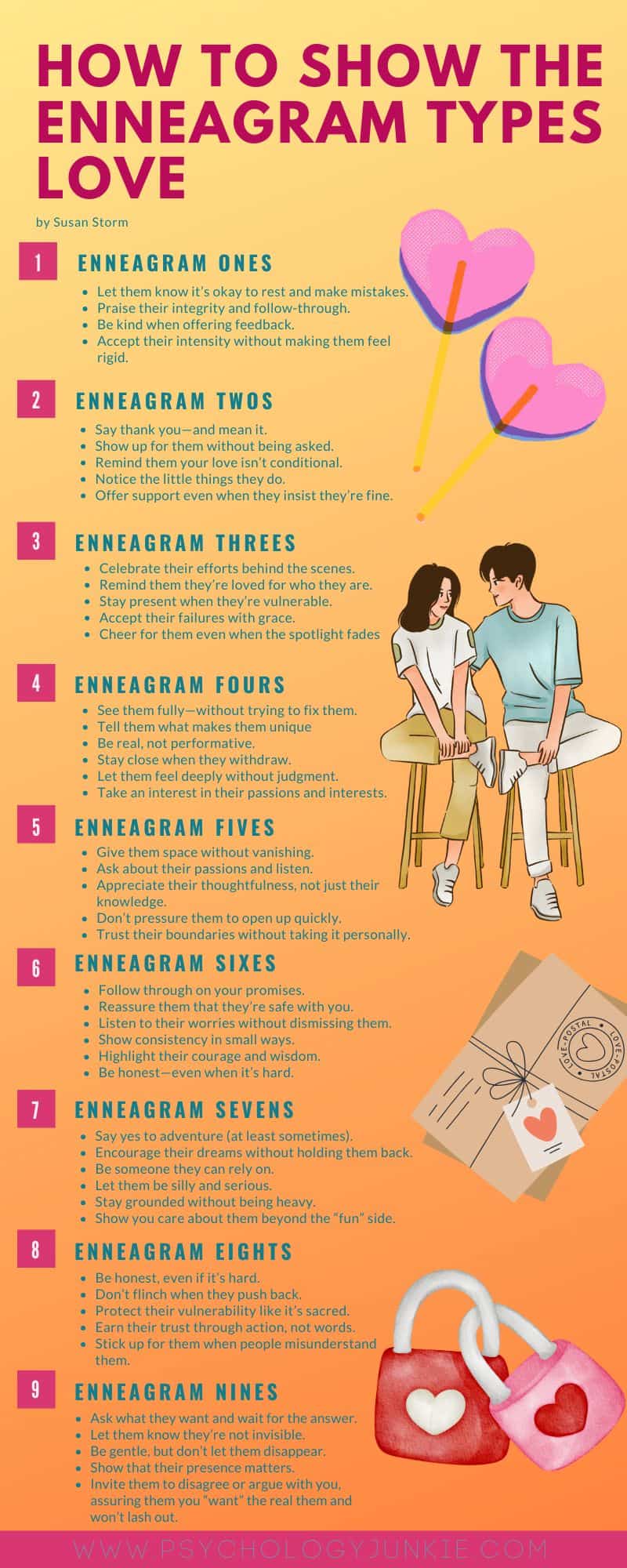
Enneagram One: The Reformer
How to love them:
Tell them you noticed.
The quiet way they stay up late making sure the bills are paid, the kids’ lunches are made, and the sink is actually clean (not just “rinsed”). Their integrity is exhausting—but it’s also how they show love. So when you acknowledge the effort behind the scenes, it means the world to them.
Let them be human.
Yes, they’ve got an inner critic the size of a megachurch. No, they don’t need yours piled on top. If you have to bring up an issue, do it with kindness and clarity, not severity. Believe me, they’re going to beat themselves up enough for this as it is. Their first reaction might be defensiveness, but underneath that is shame, and under that is fear that they’re unlovable if they mess up.
Give them rest without guilt.
Sometimes they need someone to physically pry the to-do list from their hands and remind them it’s okay to stop. Run them a bath. Make them tea. Let them know the world won’t end if they stop striving for one night, and you’ll still be there when they do.
What they need to hear (and believe):
“You don’t have to be perfect to be loved.”
“You can mess up and I’ll still be here.”
“I see how hard you try. You deserve peace too.”
Enneagram Two: The Helper
How to love them:
Be the one who gives first.
Twos are always showing up. With hugs. With kind words. With a perfectly-timed text just when you thought no one noticed. But what most people miss is this: Twos rarely ask for anything. And this isn’t because they don’t need it, but because they’re scared you won’t want to give it.
I’ve seen this time and time again with Twos I know personally. They’re all about being there for others but getting them to ask for help can feel like an exercise in futility.
So be proactive. Reach out first. Initiate the plans. Compliment the outfit. Notice when they seem tired and ask what they need. You don’t have to overcompensate or become codependent; just pay attention. And prove they don’t have to earn your love by always putting themselves last.
Appreciate them specifically.
Generic “thank yous” are fine. But what makes a Two melt is knowing that you saw the effort. “You remembered I had a hard meeting and left a note! Thank you. That meant so much,” will light them up more than flowers ever could.
Don’t let them disappear.
Twos can contort themselves into what you need without you even realizing it—and then burn out in the background when no one’s paying attention. Remind them that you want them, not just the support version of them. Give them space to express their needs, not just respond to yours.
What they need to hear (and believe):
“You’re not too much. You never were.”
“I love you for who you are, not just what you do.”
“You don’t have to earn a place in my life. You already have one.”
Enneagram Three: The Achiever
How to love them:
See who they are underneath the highlight reel.
Threes are polished. Efficient. Ridiculously good at making life look like a success story even if everything’s on fire behind the scenes. They’ll work themselves into oblivion if it means earning love, praise, or approval, especially if that’s how they were wired to get attention growing up.
So if you love a Three, remind them (often, obnoxiously if needed) that they don’t have to do anything to earn your affection. Be specific about what you admire that has nothing to do with achievement: the way they laugh when they let their guard down, the way they help their friends without making it showy, the softness they rarely show anyone.
Celebrate them, but don’t only celebrate the trophies. Otherwise they’ll keep focusing on performance rather than presence.
Let them fail safely.
One of the greatest gifts you can give a Three is the freedom to fall apart and not be abandoned. They may avoid vulnerability, but if you can gently hold space for their messiest moments without judgment, you’ll be the rare kind of partner they can exhale around.
Show up with curiosity, not performance anxiety.
Threes have a radar for pretense, and they respect people who are real. So if you’re trying to impress them by becoming some airbrushed version of yourself, they’ll sense it—and it won’t land. This is partially because they’ve played that game before. They know about wearing the mask, trying to be what everyone else wants. They don’t need more of that in a partner. Be honest about your fears and flaws. Show them that love doesn’t require a brand strategy.
What they need to hear (and believe):
“You are more than what you accomplish.”
“I love the person you are when no one’s watching.”
“You don’t have to prove anything to me—I’m already here.”
Enneagram Four: The Individualist
How to love them:
Don’t try to fix their feelings.
Fours feel deeply about everything. And while your impulse might be to cheer them up, what they usually want is to feel their feelings all the way through, and to have someone sit with them in it. They know there’s profound meaning, especially in the feelings most people rush by.
Validate their depth. Let them be melancholy without trying to slap a motivational quote on top. (They’ll see through it and hate you a little.) Empathy over advice. Presence over solutions.
Make them feel known.
Fours are often scanning the horizon for signs that you get them. That you’re not just loving the version they present but also the parts they hide. Remember the details they tell you. Ask questions about the poems they wrote in eighth grade. Compliment their weird playlists and encourage their bizarre passion projects.
They don’t want superficial love; they want soul love.
Give them space and show up.
This one’s tricky. Fours sometimes withdraw to test a fear they don’t even realize they’re carrying: “If I disappear, will anyone come find me?”
The healthiest thing you can do is honor their need for alone time without letting them feel abandoned. A quick, honest check-in—“Hey, I’m giving you space but I’m still here”—can be the anchor they didn’t know they needed.
What they need to hear (and believe):
“You don’t have to hide any part of yourself with me.”
“I see you. I love you. All of you.”
“I’m still here for you, but I’m also willing to give you space if you need it.”
Enneagram Five: The Investigator
How to love them:
Respect their space like it’s sacred.
Because to a Five, it is. Their time, energy, and attention are finite resources, and when they share those with you, it’s not as casual as it would be with another type. Instead, it’s a quiet act of trust. So if a Five opens up to you, don’t trample that by being clingy, overbearing, or emotionally explosive out of the blue.
Let them come to you. Let silence exist without panic. Don’t expect them to text back right away, and for the love of all things holy, don’t call without warning unless someone’s on fire. A gentle, “Hey, I’d love to talk! Let me know when you have bandwidth” goes a lot farther.
Engage their mind.
Fives show affection by sharing their knowledge. So if they start info-dumping about string theory or obscure medieval history or why octopuses are better than humans, don’t zone out (if you can), lean in. Ask questions. Show curiosity. You don’t have to know as much as they do (you won’t), but you do need to appreciate how their mind works.
Don’t pressure them for emotional access.
They have feelings—they just like to file them under “To Be Processed Later When I’m Alone With A Cup of Tea.” If you rush them to open up, they’ll shut down harder. Instead, build a sense of safety by being consistent, kind, and clear. They’ll start to trust you with the softer stuff once they know you won’t bulldoze them with it.
What they need to hear (and believe):
“I won’t intrude—but I’m here when you’re ready.”
“You don’t have to perform connection on a schedule. I’ll wait for the real thing.”
“I love your mind—and your heart too, whenever you’re ready.”
“You don’t have to disappear to feel safe with me.”
Enneagram Six: The Loyalist
How to love them:
Be reliable.
Sixes aren’t asking you to be perfect. They’re asking you to mean what you say and do what you promise. That’s it. They like it when everyone’s cards are on the table.
When the world feels uncertain (which it often does for a Six), consistency becomes a form of intimacy. The more you follow through, the more they’ll relax into trust.
Don’t make fun of their worry. This is a big one. I’ve known so many Sixes who were talked down to or brushed off because they were “catastrophizing.”
Even if it seems irrational to you, Sixes live in a world where their minds are constantly scanning for threats, loopholes, worst-case scenarios, and all the possible ways it could all go wrong. That vigilance is exhausting, but often accurate. So instead of brushing them off, say, “I hear you. What would help you feel safer right now?”
Validate their strength.
People forget how brave Sixes are—because they’re usually afraid and still doing it anyway. They stand by people they love even when it’s hard. They question the world to make it better. Tell them you notice that. Tell them their loyalty means something to you.
Be honest. Be real. Be someone they don’t have to second-guess.
What they need to hear (and believe):
“I’m not going anywhere.”
“You can count on me. Even when you’re scared.”
“You’re stronger than you realize, and I trust your gut.”
Enneagram Seven: The Enthusiast
How to love them:
Join in on their enthusiasm and be present with them.
Sevens have this electric joy about them, like life is one big scavenger hunt and they’ve already mapped out three different adventures you didn’t know you needed. When they love you, they want to bring you into that world; share ideas, make spontaneous plans, order three desserts “just to try them.”
So say yes. Even if you’re tired. Even if you’re introverted. Say yes sometimes, just to watch them light up. Not every time, but enough that they don’t feel like their joy is a burden.
Stick around when the fun dies down.
Here’s the part most people miss: all that brightness often hides pain. Sevens aren’t running to excitement as much as they’re running from the heaviness that lives underneath it all. If you can be someone they can cry with after they’ve laughed with you? You’ve earned their trust. (Which, for a Seven, is huge.)
Don’t try to “ground” them by clipping their wings.
They need to know that the future doesn’t have to be a trap. Help them build structure without smothering their spontaneity. Encourage them to follow through on their dreams by showing them that commitment doesn’t mean the death of joy.
What they need to hear (and believe):
“I won’t hold you back, and I won’t disappear.”
“You’re allowed to feel everything, even the hard stuff.”
“I don’t just love your energy, I love you, even on quiet days.”
Enneagram Eight: The Challenger
How to love them:
Don’t flinch when they test you (unless it’s in a mean-spirited way).
Because they will test you. Eights push to see who will push back. Ultimately, they want to know if you’re strong enough to handle them. If you collapse under pressure or betray their trust, they won’t forget it.
But if you stand your ground without disrespecting them? You’ll earn the kind of loyalty most people never get. They’ll soften, but only if they feel safe.
Match their honesty.
Eights can smell BS like bloodhounds. They don’t want you to sugarcoat things or tiptoe around their feelings. Say what you mean. Mean what you say. Be upfront, be real, and for the love of God, don’t lie. Not even a little.
Let them be vulnerable at their own pace.
Underneath that armor is a surprisingly tender heart. If they let you see even a sliver of it, treat it like sacred ground. Don’t weaponize it. Don’t bring it up later in a fight. Just hold it gently and remind them that they’re safe with you.
What they need to hear (and believe):
“You don’t have to protect yourself with me.”
“I’m not going anywhere, even if you let your guard down.”
“You’re not too much. You never were.”
Enneagram Nine: The Peacemaker
How to love them:
Make room for their voice.
Nines will often default to “whatever you want” because it feels safer than risking conflict. But inside, they have opinions, preferences, longings; entire galaxies of thought they’ve quietly tucked away. So make space. Ask them what they want, and then wait for the answer. Don’t rush in to fill the silence. They need time to trust their own voice.
Reassure them that conflict doesn’t equal disconnection.
One of a Nine’s biggest fears is that if they assert themselves or rock the boat, they’ll be rejected or abandoned. So when hard conversations come up, stay calm. Stay kind. Show them that disagreement doesn’t break love, it can actually deepen it.
It takes so much bravery and strength for a Nine to assert themselves and bring up disagreements. Everything in their psyche will be telling them to back down, numb the pain, and ignore it. Be conscious of that when they bring up a problem.
Help them come alive again.
Sometimes Nines go numb just to survive the noise of the world. They drift, distract, dissociate. If you love a Nine, be the one who gently brings them back. Invite them into experiences, notice what lights them up, go on adventures with them—and remind them that their presence matters.
What they need to hear (and believe):
“Your voice matters to me.”
“You don’t have to disappear to be loved.”
“I see you. I want you. Not just your calm.”
What Do You Think?
What makes you feel loved? What isn’t listed here that you wish was? Let us know and we can include your quotes in the article!













Just a footnote actually … I would just like to add that Nines ARE NOT pathetic. We speicalise in staying optimistic by absorbing any and all negativity and refraining from joining in the ‘fight’ and then, by silently observing the ongoing chaos, we turn pessimism and strife into peace, agreement, cooperation and harmony – everyone must be happy.
This is not just a strength; it’s a SUPERPOWER 😉
This isn’t someone talking to type sixes. This is a therapist talking to a client with clinical anxiety. Type six is not a DSM five disorder.