
When INTPs Don’t Feel Like Themselves: 7 Things That Help
What helps you feel like yourself?
For some people, the answer might involve a lively dinner with friends, an ambitious new goal, or a packed schedule that leaves no room for existential dread. My sister is probably one of these people. I look at her in awe and consider sometimes that I’d probably have a nervous breakdown living just a week of her life.

For many INTPs, feeling like themselves seems to involve being left alone long enough to investigate an idea nobody else knew needed investigating.
Recently, I surveyed readers about when they feel most like themselves, what makes them feel disconnected, and what helps them recover after a difficult day. This group included 68 self-identified INTPs. That is a small sample, and most of the respondents were over 45 so these findings cannot tell us what every INTP of every generation might need. Still, several patterns appeared so consistently that they deserve attention.
The strongest one was this: INTPs feel most alive when their minds are free to explore. When they become overwhelmed, however, intellectual stimulation alone is not enough. First, they need the demands to stop.
INTPs feel most like themselves when they are exploring an idea
When asked when they feel most like themselves, 76.5% of INTPs chose learning or exploring an idea. It was the most popular answer by a wide margin. The written responses filled in the details. One INTP felt completely like themselves while researching an art project. Another said they were “diving down a research rabbit hole.” Someone else described researching alone in order to benefit other people.
None of this will surprise anyone who has watched an INTP discover an interesting question at 9:00 p.m. and resurface at 2:13 a.m. with seventeen browser tabs, three competing theories, and no memory of why they originally opened the laptop.
As an MBTI® practitioner, I have seen this pattern again and again. INTPs aren’t satisfied with knowing that something works. They want to know why it works, whether the explanation holds together, what everyone is assuming without realizing it, and whether an entirely different model would explain the situation better. As someone who’s spent a lot of my life working with kids, I am regularly astonished by the questions INTP children ask that I never even considered in my life. There’s a multitude of “Why’s” behind every rule or fact that the rest of just took for granted.
In personality type language, this relates to Introverted Thinking, or Ti. Ti creates an organized mental world with a consistent understanding of how things fit together. It pulls concepts apart, examines their structure, and keeps refining the explanation until it makes sense on its own terms.
INTPs also use Extraverted Intuition, or Ne, which notices connections, possibilities, and alternate interpretations. Together, these processes can turn a casual question into an intellectual excavation project. Ne is like a web gathering connections and possibilities, and Ti is like a scalpel, breaking them apart to see which ones actually make sense and hold up to scrutiny.
For INTPs, this exploration is not always a means to an end. The investigation itself can feel enlivening. A good idea gives the mind somewhere to stretch.
Psychologist William James wrote, “My experience is what I agree to attend to.” He argued that the things we notice shape the experience we have. For an INTP, control over attention may be especially important because attention is where so much of life happens. If their days are consumed by errands, interruptions, and obligations, they may technically have time to think, but never enough continuity to go anywhere interesting. William James, The Principles of Psychology
Being understood mattered almost as much as being alone
The second most common answer was more surprising. Nearly 59% of these INTPs said they feel most like themselves when they are with someone who deeply understands them. By comparison, only 5.9% selected being with a group where they felt accepted.
I believe this is important to notice. INTPs are not all about general social inclusion or big groups. They want a specific kind of connection, usually with one person who could follow their thoughts without judging, rushing, or trying to make them more conventional.
One person described being with a coworker who was nonjudgmental and open to deep conversation. They did not feel pressured to prove the relationship by sharing everything. The acceptance was already there. Another said they felt most like themselves while having a meaningful conversation with someone they loved. One knew they were returning to themselves when they could “openly discuss my hyper focus.”
I’ve noticed this propensity in type clarification and coaching sessions. INTPs are sometimes described as if they are indifferent to being understood, and I’d say most are used to being misunderstood. They may expect it unfortunately, but that does not mean recognition carries no emotional weight. In fact, I’d say the opposite. They are so used to being misunderstood that when they finally find someone who gets them, that experience can be almost overwhelmingly fulfilling. These conversations can feel restorative when the INTP does not have to spend half of it translating their mind into a more socially acceptable format. They can follow the tangent, question the premise, make the strange connection, and explain the idea before someone says, “You’re overthinking this.”
Perhaps they are overthinking it. That may also be why the conversation is finally interesting.
Ralph Waldo Emerson captured this tension between independence and companionship: “Solitude is impracticable, and society fatal. We must keep our head in the one and our hands in the other.” His wording is dramatic, but the balance fits these responses. INTPs needed independence without losing meaningful human contact. Emerson, Society and Solitude
Too many responsibilities pull INTPs away from themselves
When I asked what makes INTPs feel disconnected from themselves, 52.9% chose too many responsibilities and this was the most common answer. Conflict or tension and insufficient thinking time followed at 47.1% each. Too much time around other people affected 41.2%, while 35.3% selected constant interruptions.
Pressure to perform was lower, at 23.5%. Ultimately what seemed to drain them was having their attention repeatedly claimed by responsibilities they did not choose. Whether they have too many emails, appointments, chores, administrative tasks, or requests for conversation.
As an introvert in a busy household, I understand how this can feel. There are days when I want to research or write, but my attention is broken into pieces by several perfectly reasonable requests. Nobody has committed an offense and I know I have no fair reason to be irritated, but it’s like there’s a giant vortex of ideas I want to fall into and someone keeps breaking my fall just as I’m feeling the rush. Life is happening. Yet by the end of the day, I have responded to everyone while losing track of my own internal direction.
For an INTP, that loss is especially disorienting. Their thoughts often need time to unfold. A question leads to an implication, which leads to a contradiction, which opens a completely different line of inquiry. Interrupt the process often enough and the person can spend the entire day reopening the same mental file without getting anywhere.
Responsibilities occupy the mental space where curiosity, analysis, and original thought would otherwise live. One older respondent described how people assumed they were fine because they continued contributing to others’ goals. They added that maintaining their own well-being required “self-supervision.”
Competent adults often receive less care and support because they appear to need less of it. If an INTP continues solving problems and providing useful information, people may assume nothing is wrong. Meanwhile, the person has become little more than a support system for everyone else’s priorities.
Conflict affects INTPs more than the stereotype suggests
Almost half of the respondents said conflict or tension makes them feel disconnected from themselves. This doesn’t fit the popular caricature of the INTP as an emotionally oblivious computer in a cardigan. And of course it doesn’t! INTPs are thinking types but that doesn’t mean they care any less about their relationships than any other type. INTPs often analyze conflict rather than immediately express their feelings about it, but analysis does not make the tension painless.
Interpersonal conflict can be especially frustrating for thinking types. Its rules are inconsistent. People say one thing and mean another. Emotional reactions do not always follow a logical pattern, and even a technically correct response can make the situation worse.
INTPs have an inferior process called Extraverted Feeling, or Fe. You do not need to memorize the term. In everyday life, it relates to awareness of interpersonal harmony, social expectations, and the emotional atmosphere between people. This side of the INTP can be sensitive even when it is not highly polished. Tension may capture their attention while leaving them uncertain about how to resolve it. They replay what was said, examine possible meanings, and try to identify the point where the conversation went wrong. Often they feel overwhelmed in emotional situations, worrying that they won’t say the right thing, will misread the situation, or otherwise amplify the emotional risk.
The high conflict response also helps explain why being deeply understood mattered so much. A nonjudgmental relationship allows the INTP to relax the part of themselves that expects confusion, correction, or emotional misinterpretation.
Patience and confidence disappear first
When overwhelmed, 52.9% of the INTPs said their patience disappears first. Confidence followed at 41.2%. Emotional openness and decisiveness were each selected by 35.3%, while 29.4% lost interest in other people.
This creates a recognizable picture where the INTP becomes irritable, closed off, and unusually uncertain. Decisions feel harder, conversation becomes tiring, and other people’s needs start feeling invasive before anyone has done anything especially unreasonable.
The loss of confidence is particularly interesting. INTPs often trust their ability to reason through a problem. That confidence depends partly on having enough time and information to examine it properly. When they are rushed or interrupted, their natural process cannot finish its work. They see several possibilities but cannot test them. They notice exceptions. Every answer creates another question. Someone standing nearby saying, “Can you just decide?” definitely doesn’t help things.
The result may be hesitation that looks like incompetence but comes from seeing too much complexity. Then the INTP becomes frustrated with themselves for not producing a clean answer.
A cycle develops:
- Responsibilities create more decisions.
- Lack of thinking time weakens confidence.
- Reduced confidence makes decisions harder.
- Unfinished decisions create more pressure.
- Patience packs a small bag and leaves.
Emotional openness often goes with it. When the mind is overloaded, explaining feelings may seem like another complex task with an uncertain outcome. Withdrawal becomes the quickest way to reduce incoming demands.
The strongest recovery method was being alone without demands
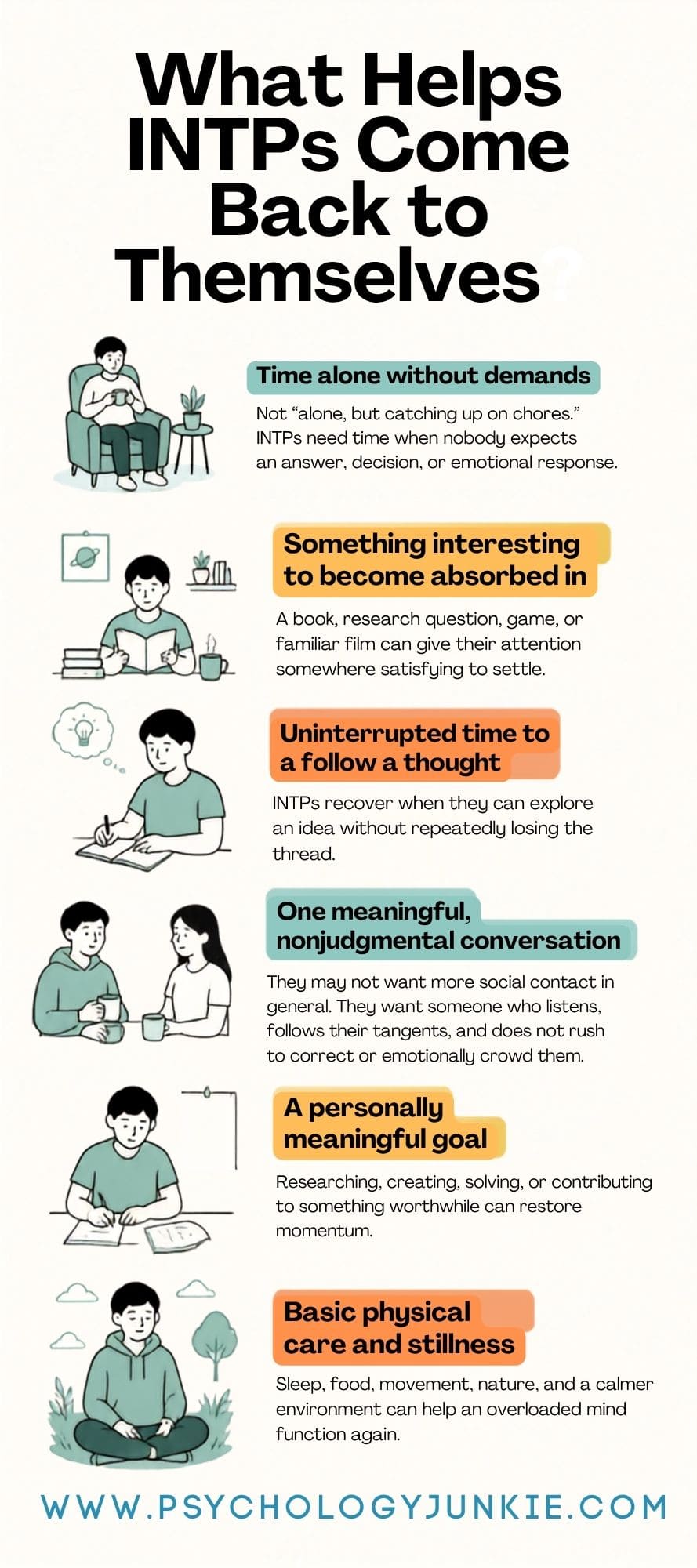
When asked what helps after a difficult day, 88.2% of INTPs chose being alone without demands. It’s important that they’re not using that time to catch up on unwanted tasks, anticipate the next interruption, or feel guilty for not being available. They need a stretch of time in which nothing is immediately required of them. No response to compose, mood to manage, or practical problem hovering at the edge of the room waiting its turn.
One respondent described feeling most like themselves “at home, no demands, stillness, alone.” Another said other people misunderstood their need to be completely alone. Someone else wrote:
“Alone time and a comfort activity like rewatching a favorite show or movie helps me get out of my head better than anything else. I’ve been told that isolating myself isn’t healthy. I argue back that the right amount of it can be perfect.”
Isolation can become unhealthy when it is prolonged, involuntary, or driven by fear. Solitude is totally different. Chosen solitude can return a sense of ownership to attention.
Seventy-six percent of these INTPs specifically said they need solitude to reconnect with themselves. Privacy, stillness, purpose, and freedom followed.
Only 5.9% chose stimulation at this stage. That may sound strange given how strongly INTPs valued learning and intellectual exploration, but it makes sense. An engaged INTP may love stimulation. A depleted INTP may need the world to become less demanding before anything feels interesting again.
Absorption gives the mind somewhere contained to go
After solitude, the second most popular recovery method was reading or watching something absorbing, chosen by 47.1%. Sleeping followed at 35.3%.
Respondents mentioned researching, reading, knitting, rewatching familiar movies, going through a movie collection, and working on art projects. One felt completely like themselves while sitting outside with tea and watching birds. Another described being silly with their dog, free from judgment.
These activities vary, but they share a useful quality: attention can settle into them without being monitored by another person. When you’re absorbed in something, there’s a sense of focus and calm that ensues. A book has rules, a research question has a structure, even knitting gives the hands something steady to do while the mind settles. This may explain why passively “doing nothing” is not always the ideal form of rest for an INTP. Their mind may continue racing in an empty room. A manageable point of focus can gather that mental energy into one place.
I relate to this through research and writing. When I am overstimulated, I sometimes need a walk or complete silence. Other times, I need to disappear into a subject that interests me. The activity looks like more mental work, but it feels different because I chose it. There is no social pressure and no one waiting for a particular conclusion.
Solitude does not mean INTPs want disconnection
Here is the most interesting tension in the survey:
- 88.2% recovered by being alone without demands.
- 76.5% needed solitude to reconnect.
- 58.8% felt most like themselves with someone who deeply understood them.
- 47.1% wanted more meaningful conversation.
- 29.4% wanted more community.
These INTPs did not seem uninterested in people, but they did want connection that was worth the energy it required. There is an enormous difference between being surrounded by people and feeling understood. Constant contact can leave an INTP lonelier than an evening alone. A meaningful conversation, on the other hand, can help them feel real again.
One respondent explained it well:
“Introverted doesn’t mean anti-social. Low energy is normal; it doesn’t mean I’m weak, I just have lower capacity.”
Another wrote:
“I need someone to listen attentively but not suffocate me with affection.”
That may sound oddly specific, but it captures something many INTPs struggle to explain. They can want care without wanting to become the center of an emotional event. They may want someone nearby who listens, respects their independence, and does not treat every pause as evidence of hidden turmoil.
The best connection often leaves room around it.
Meaning mattered, even if INTPs did not advertise it
Nearly half of the respondents felt like themselves while working toward something meaningful. About 29% wanted a meaningful goal, and the same percentage selected purpose as something they need in order to reconnect. Written responses included volunteering with prisoners, participating in a church congregation, researching to benefit others, and using knowledge and wisdom in service.
One respondent said:
“People think I want to show off my knowledge, when in fact I just want truth because it’s right.”
That is a useful correction to another INTP stereotype. Their pursuit of knowledge can look impersonal, competitive, or detached. For many, it is tied to a private sense of integrity. They want the explanation to be true because truth matters.
INTPs may not always talk about their values directly. They are more likely to argue about the reasoning behind a position, point out contradictions, or refuse to support an idea that does not hold together. The value is there, even when it arrives wearing the clothes of an intellectual objection. Meaning also seems to give their curiosity a direction and satisfaction to it. Exploration feels good on its own, but exploration connected to service, creative work, or a personally significant goal can help the INTP feel more rooted in life.
Signs an INTP is coming back to themselves
What happens when an INTP feels like they’re coming back to themselves? According to the responses, humor returns. “I have my sense of humor at peak speed,” one person wrote. Another said, “I laugh and make puns.”
This makes sense to me because humor depends on flexibility. It connects ideas that do not normally belong together and surprises us with the result. When the INTP is overwhelmed, their mind narrows around problems and obligations. When they recover, it begins playing with connections again.
Focus returned as well. One respondent knew they were coming back when their mind stopped racing and they could concentrate on reading or knitting. Another could see a way forward with goals and relationships.
Interest in people also reappeared. One person’s entire answer was:
“I enjoy others again.”
Other signs included feeling creative, becoming upbeat, looking forward to work, contemplating, serving others, and feeling less self-conscious or misunderstood. Recovery didn’t necessarily turn these INTPs into different people. Instead, it restored access to the warmer, funnier, more purposeful parts of who they already were.
What loved ones often misunderstand
When an INTP withdraws, other people may assume they are angry, depressed, antisocial, or avoiding intimacy. Any of those things could at times be true. After all, type cannot explain every retreat.
Often, however, the INTP has run out of mental room.
Pushing for immediate conversation may increase the overload. So can repeated check-ins, physical affection they didn’t request, or a sequence of suggestions about what they should do to feel better. If you really want to help, reduce the claims on their attention. Give them time without making that time feel like something they’ll have to pay for later with a guilt trip. Let them become absorbed in a book, project, game, film, or peculiar research question without demanding a practical defense of its usefulness.
When they return, ask about what has been occupying their mind. Listen long enough for the interesting part to emerge. It may take several minutes and a detour through the history of maritime navigation, but there is usually a point.
What INTPs may need to remember
If you are an INTP, your need for solitude is not proof that you are defective at relationships. Still, it’s good to know the difference between restoration and disappearance. Healthy solitude gives something back. Your humor returns. You become curious again. Your patience improves. Other people seem less irritating. You can see a path forward or become interested in an idea for its own sake.
If time alone leaves you more trapped, numb, or afraid to reenter your life, you may need a different kind of support. Personality type should explain patterns, not excuse prolonged suffering or distance. If you have kids, for example, you don’t want to be trapped in your room, avoiding responsibilities that are very much needed for the role you’ve chosen to take on in life.
It’s also worth remembering the body. One respondent made this point directly:
“I have to eat and move my body in order to feel okay. My mind has to be comfortable to sustain long sessions in this body, so taking care of this body is very important.”
INTPs can treat the body like an inconvenient transportation system for the brain. INTJs can do this too, so I understand the temptation. Unfortunately, the brain is part of that system. Hunger, sleep deprivation, pain, hormonal changes, and physical inactivity all affect thinking.
Before developing a new theory about why life has become meaningless, check whether you have eaten lunch. Then protect one stretch of uninterrupted time. Read. Research. Build something. Sit outside with tea. Follow the question that keeps tugging at you. When your mind has settled, look for the person who can meet you there without demanding that you become louder, faster, or easier to understand.
The clearest message from these INTPs
Across the survey, INTPs repeatedly described two needs that can seem opposed: independence and connection.
They wanted enough solitude to regain ownership of their minds. They also wanted conversations in which those minds could be known.
They wanted intellectual stimulation, but when overwhelmed, they needed demands and interruptions to stop first. They wanted freedom, yet many also wanted stability, structure, and a meaningful direction.
Put together, their message might sound something like this:
Give me enough freedom from demands to follow my own thoughts, and enough genuine connection that I don’t have to translate myself all the time.
This article is based on 68 survey responses from self-identified INTPs. Most respondents were over 45, and the group included more women than men. At least one respondent questioned whether INTP was their best-fit type, and another noted that being AuDHD may affect their experience. These findings should be treated as an early snapshot rather than a definitive account of every INTP.
What Do You Think?
Do you relate to what the other INTPs in this survey said? Do you have any thoughts or opinions you’d like to share with fellow INTPs? Let us know in the comments!
Find out more about your personality type in our eBooks, The Prodigy’s Journey: Harnessing Your Psyche as an INTP, Discovering You: Unlocking the Power of Personality Type, The INFJ – Understanding the Mystic, The ISFJ – Understanding the Protector, and The INFP – Understanding the Dreamer. You can also connect with me via Facebook, Instagram, or YouTube!
Sources
- William James, The Principles of Psychology, Chapter XI: Attention. Classics in the History of Psychology
- Ralph Waldo Emerson, Society and Solitude. Project Gutenberg
- C. G. Jung, Psychological Types, “The Introverted Thinking Type.” Classics in the History of Psychology