

When ISTJs Don’t Feel Like Themselves: 7 Things That Help
What helps you feel like yourself?
It sounds like an easy question until you try to answer it. Is it being around people you love? Working toward something that matters? Going somewhere new? Sitting alone in your house with absolutely nobody asking where the scissors are?

Recently, I sent out a survey asking readers when they feel most like themselves, what makes them feel disconnected, and what helps them come back after a difficult day. The first group of responses I analyzed came from 51 ISTJs.
That is a small sample, so I’m not going to pretend these numbers settle the question for every ISTJ alive. But the answers were consistent enough to reveal a real pattern, and several of the written responses put words to something I have seen in ISTJs throughout my years as an MBTI® practitioner.
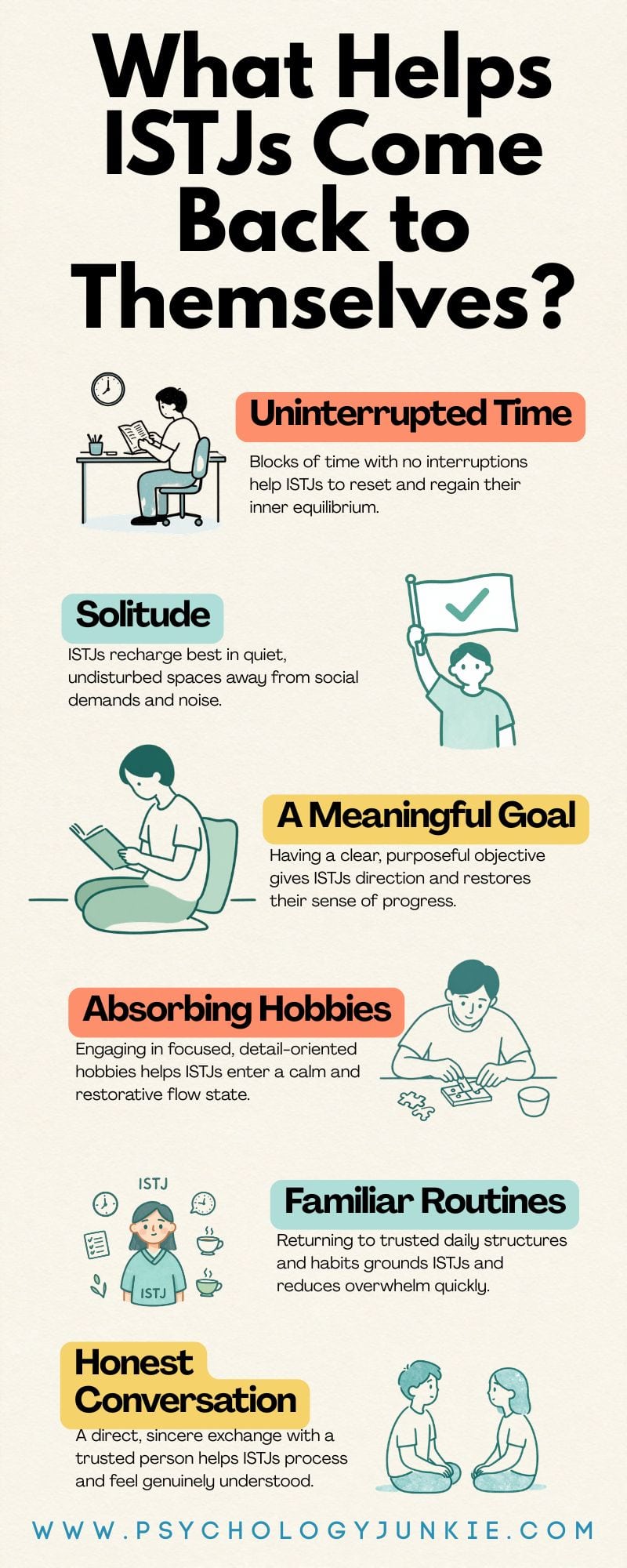
The strongest answer was solitude
When I asked what makes ISTJs feel disconnected from themselves, 70.6% chose too much time around other people.
When I asked what they need in order to reconnect with themselves, 70.6% chose solitude.
And when I asked what helps after a difficult day, 58.8% chose being alone without demands.
The phrase *without demands* is especially important here. This isn’t necessarily a wish to withdraw from human civilization and live in a cabin where no one ever speaks again. It is a need to stop responding for a while without questions or interruptions. No new tasks or emotional situations that need interpreting.
I was just talking to an ISTJ mom yesterday who was talking about her stress levels and how needing some unstructured, free time is so hard to get and how sometimes she wonders if she’s not doing a good enough job simply because she can’t be “on” all the time.
One respondent put it this way:
“ALONE TIME. Everybody thinks that what I need to ‘restore myself’ is a hug, which is necessary but not enough. I need time to ‘change speeds’ before getting involved in chores or take care for others.”
Another said:
“It’s not that I need to be alone. I just need control over my time. That could be done with other people. Although it’s harder.”
Henry David Thoreau wrote, “I never found the companion that was so companionable as solitude.” That line can sound a little dramatic if you are someone who starts calling friends the moment you have an empty evening. But for many introverts, solitude is where scattered pieces of the mind begin returning to their proper places. It feels like stepping out of the chaos and the storm and finding peace and clarity and mostly…oxygen.
I understand that personally. I’m an introvert in a busy household, and there are days when I finish working only to have several people need something from me at once. Nobody is doing anything wrong. I love them of course, but I can feel my own thoughts getting harder to locate. A walk outside with music, or a stretch of time when nobody needs an answer from me, can make me feel human again.
Interruptions were worse than pressure
Nearly half of the ISTJs surveyed, 47.1%, said constant interruptions make them feel disconnected from themselves. Another 41.2% chose not having enough time to think.
By comparison, only 11.8% selected pressure to perform or succeed.
An interruption does more than use thirty seconds. It can break the internal thread an introverted person was following. Then they have to reconstruct where they were, what mattered, and what they intended to do next. Repeat that all day and the person may still be productive, but internally they feel scrambled.
From a personality type perspective, this makes sense. ISTJs lead with a mental process called Introverted Sensing, or Si. This process compares present experience with stored impressions, notices what has changed, and builds a reliable internal understanding of how things work. It needs time to register experience. Their support function, Extraverted Thinking, or Te, helps them organize the outside world and get practical results, but Te can easily become the part everyone else sees and relies on.
So the ISTJ keeps handling things. Meanwhile, their inner world gets no breathing room and frustration and resentment build.
I also asked ISTJs which part of themselves disappears first when they are overwhelmed. The most common answer was the ability to be present, chosen by 41.2%.
After that came:
– Playfulness: 35.3%
– Interest in other people: 35.3%
– Patience: 29.4%
– Creativity: 23.5%
– Emotional openness: 23.5%
– Confidence: 23.5%
– Decisiveness: 23.5%
This is worth paying attention to because none of those changes necessarily look like a crisis from the outside. An overwhelmed ISTJ may still show up. They may still do what they promised. They may still remember that the registration form is due Thursday and that somebody needs to buy dog food.
But the more alive parts of them start going offline. They stop joking, lose interest in conversation, or become less patient and less emotionally available. They may struggle to enjoy the very routines and hobbies that usually steady them.
One respondent knew they were coming back to themselves when they started “enjoying my hobbies again.” Another said, “I smile.” Someone else wrote, “I feel motivated to problem solve.”
Sometimes recovery is the return of curiosity. You pick up the book. You care how the garden is doing. You want to solve a problem instead of wishing every problem would leave you alone.
Familiarity helps, but meaning matters just as much
The stereotype would tell us that ISTJs feel most alive when everything is familiar, orderly, and exactly where it belongs. The survey offered a more interesting picture.
Yes, 41.2% said they feel most like themselves when following a familiar routine. Stability was also one of the most common things respondents wanted more of in their lives.
But 41.2% said they currently need a meaningful goal, tying it with uninterrupted time for the top answer.
Routine can protect the mind from needless chaos, but routine by itself is not everything to an ISTJ. The strongest version of stability gives a person enough footing to pursue something that matters. It makes room for concentration, craftsmanship, service, study, or the slow construction of a goal that may take years.
This is where Introverted Feeling, or Fi, deserves more attention in ISTJs. Fi is their tertiary function. It relates to personal values, emotional truth, and the question of what really matters to *me*. ISTJs tend to be protective about this side of themselves so you may not see it immediately. Butthat does not make it weak or unimportant to them. Meaning is deeply personal for them, and they often have private goals, values, and emotions that drive them. They often want their effort attached to something real, not activity for activity’s sake.
One respondent described coming back to themselves as having time to look in a notebook for “the next thing I want to do just for myself.” Another said it happened when working on something that was interesting and helped them feel stable or balanced.
They still want connection, but not on demand
At first glance, the social answers seem contradictory. Too much time around people was the leading cause of disconnection, yet 29.4% said they need more meaningful conversation. A few respondents said they felt like themselves while offering hospitality, spending time with family, or being with someone who understood them.
This is where I think being around people constantly is not the same thing as feeling connected. A room can be crowded and still offer no meaningful contact at all. Most introverts I know hate crowds, big social events, things like weddings, clubs, etc,. Yet they may find one trusted conversation after an hour of decompression feel deeply restorative.
I have noticed this in personality sessions as well. Introverts are often told they need to “get out more” when what they really need is less frequent but more honest connection. They may want company without performance, affection without pressure, and conversation that goes somewhere deeper than filling silence.
The survey responses support that. These ISTJs did not appear indifferent to relationships. They wanted control over when and how they reentered them.
Absorption can be a legitimate form of rest
After solitude, the second most common recovery choice was reading or watching something absorbing, selected by 41.2%. Music followed at 23.5%.
We tend to divide activities into productive and unproductive, especially when we already feel behind. But absorption has a purpose. A book, film, puzzle, album, craft, or carefully organized box of baseball cards gives the mind somewhere contained to go. It asks for attention without asking for emotional management.
Here are some of the things respondents mentioned as being restorative, focused activities: Doing Sudoku alone, cooking while listening to classical music, building Lego while watching a show, working on a craft, cleaning the house, sitting on a porch with a dog, and opening and organizing a new box of baseball cards.
None of these experiences would look important from across the street. ISTJs might feel guilty prioritizing them, but it’s still deeply important. They need permission to become absorbed in the actual experience instead of focusing only on “productive” tasks. Otherwise they’ll run out of steam, resent their demands, and feel disconnected from the aliveness that gives them oxygen.
Psychologist Mihaly Csikszentmihalyi used the term *flow* for a state of deep involvement in an activity, when attention becomes so absorbed that ordinary self-consciousness recedes. Not every evening with Lego reaches a transcendent psychological state, obviously. Sometimes you are just building a tiny plastic spaceship. But focused, manageable activity can help a strained mind gather itself again.
Structure and freedom are not opposites
One of my favorite responses came from an ISTJ who said:
“Order and systems. I do need them, very much, but I need the freedom to use them.”
That is a much better description of healthy ISTJ structure than the usual idea that ISTJs want rules for the sake of rules.
Familiar methods can reduce friction and plans can protect time. Routines can prevent the whole day from becoming a series of small emergencies. But imposed structure is different from chosen structure. If someone else controls the schedule, interrupts the process, and constantly suggests a better way, the system stops feeling stabilizing. It becomes one more demand.
The ISTJ may still crave order while resenting the loss of agency. Both things can be true.
This also explains why freedom appeared repeatedly in the written responses. These respondents did not seem to want limitless novelty. Only 5.9% chose novelty as something they needed to reconnect. What they wanted was the freedom to inhabit their own lives: to choose the routine, follow the thought, finish the task, or change direction without somebody hovering over the process.
What loved ones often misunderstand
If you live or work with an ISTJ, their withdrawal may feel personal. You might assume they are angry, bored, or no longer interested in you. Sometimes they may be. Personality type does not explain every human behavior (as much as I might like it to).
But often, the need for distance is much less dramatic. Their inner bandwidth is gone.
Trying to restore them with more conversation, more plans, more questions, or a rapid stream of helpful suggestions may have the opposite effect. One respondent specifically described other people misunderstanding their need for internal processing. Another said people assumed they needed connection when they actually needed time alone. Another disliked having life filled with “noise and endless suggestions about what I should do.”
If you want to help, give them a little unclaimed space. Let them finish the thought. Do not make their need for solitude into a relationship emergency they must immediately reassure you about.
Then, when they come back, make room for real conversation that is meaningful. Avoid interrogating, drowning them with advice, or trying to get them to reveal all their deepest feelings on the spot.
What ISTJs may need to remember
If you are an ISTJ, you may be extremely good at functioning past the point when you feel like yourself. Other people may even praise you during that period because you are being so dependable.
Pay attention to the less obvious losses. Have you stopped playing? Are you unable to stay present? Do people feel irritating before they have even said anything? Have your hobbies started to seem like work? Can you hear your own opinions, or only the next obligation?
Those signs do not automatically mean something is terribly wrong. They may mean your mind has had too little privacy for too long.
You may not need to reorganize your whole life. Start with one protected pocket of time. Take the walk. Put on the music. Return to a familiar task that absorbs you. Choose one manageable problem and solve it. Sit outside with the dog. Let your nervous system discover that nobody is about to hand it another assignment.
Then ask yourself what you want to move toward. Solitude can help you return, but meaning gives you somewhere to go.
The clearest message from these ISTJs
Across the survey, 88.2% mentioned some form of solitude, privacy, or being alone without demands. More than three-quarters mentioned interruptions or insufficient time to think. At the same time, more than 70% mentioned meaning or purpose somewhere in their answers.
Put together, the message is fairly straightforward:
**Give me enough space to hear myself think, and let me use that space for something that matters to me.**
*This article is based on 51 survey responses, all from self-identified ISTJs. Because the group was small and skewed toward adults over 45, the percentages should be treated as an early snapshot rather than a definitive portrait of all ISTJs.*
Sources
– Henry David Thoreau, *Walden*, “Solitude.” [Project Gutenberg](https://www.gutenberg.org/files/205/205-h/205-h.htm)
– Mihaly Csikszentmihalyi, *Flow: The Psychology of Optimal Experience*. See also this [peer-reviewed overview of flow research](https://pmc.ncbi.nlm.nih.gov/articles/PMC7551835/).