

ESTJ Grip Stress: What It Is and How to Cope
ESTJs get a lot of flack in the type community; some are put off by their take-charge demeanor, others find them too brusque and rough. But at their best, ESTJs are the ones people lean on. They’re the people who take responsibility when no one else will. The ones who notice what’s broken, inefficient, unclear, or falling apart and step in to fix it. The ones who keep things moving when others stall, hesitate, or panic.
From the outside, ESTJs can look unshakeable, capable, and driven. And, sure, sometimes intimidating.

From the inside, there’s often a quieter story: If I don’t handle this, who will?
If I stop, everything might fall apart.
ESTJs tend to measure themselves by what they accomplish, what they build, and how reliably they show up. And for a long time, that works. It gives them purpose, structure, and a sense of worth.
But when stress becomes chronic; when responsibility piles up, control slips away, and the emotional costs of constant “doing” go unacknowledged, something very different can happen.
The ESTJ can hit a breaking point where the very feelings they’ve set aside in order to function come rushing back all at once. This is what’s known as grip stress, when the inferior function, Introverted Feeling (Fi), takes over.
Before we get there, though, it’s important to understand what ESTJs look like when they’re healthy and in balance.
Not sure what your personality type is? Take our questionnaire here!
The Healthy ESTJ: Steady Leadership With Quiet Values
At their best, ESTJs are grounded, decisive, and reliable. Their two strongest cognitive functions work together to create this effect:
- Extraverted Thinking (Te) is the ESTJ’s dominant function. It’s how they evaluate and make decisions without really having to try too hard or expend a lot of energy. It gives ESTJs their clarity, decisiveness, and drive to organize the external world. It focuses on efficiency, structure, accountability, and results. Te asks: What needs to be done? What works? What’s the most effective path forward?
- Introverted Sensing (Si) is the ESTJ’s auxiliary function. It supports their dominant function by drawing on experience, precedent, and proven methods. Si remembers what’s worked before, values stability, and helps ESTJs create systems that are reliable and sustainable over time.
When these two functions are working well together, the healthy ESTJ often looks like someone who:
- takes charge calmly and competently
- sets clear expectations and boundaries
- follows through on commitments
- keeps teams, families, or organizations running smoothly
- upholds standards that protect people from chaos or harm
- values tradition, consistency, and earned trust
Despite stereotypes, healthy ESTJs are not heartless or shallow. They often have strong values, even if they don’t talk about them much. Instead of talking about their values, however, they often show their dedication through action. They believe in fairness, responsibility, loyalty, and doing what you said you’d do. If they believe in something, they put some elbow grease behind it.
They show care by:
- working longer hours
- carrying heavier loads
- fixing problems
- protecting others from instability
And most of the time, they don’t ask for recognition. They assume that being needed is enough.
The Hidden Cost of Strength
One of the risks for ESTJs is that they can become so focused on functioning, achieving, and holding everything together that they gradually lose touch with their own emotional needs.
This doesn’t mean they don’t have them. It’s just that stopping to feel them seems impractical, indulgent, or dangerous. If they get too wrapped up in their feelings they might run out of steam, lose sight of their goals, or become biased.
However, when stress builds, ESTJs often respond by doubling down on Te:
- working harder
- organizing more aggressively
- taking on even more responsibility
- trying to force resolution through effort
This works… until it doesn’t.
And when it stops working, ESTJs often feel alone, misunderstood, and overwhelmed by everything they’ve denied themselves in the name of duty.
That’s where everyday stress can slide into something deeper, and where inferior Fi begins to surface in painful, unfamiliar ways.
What Is Inferior Fi for ESTJs?
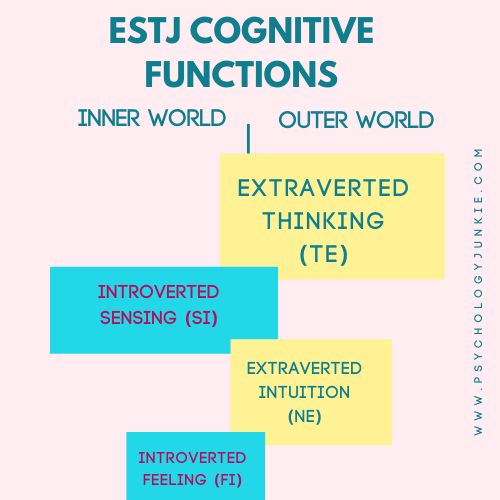
Introverted Feeling (Fi) is the function that tracks personal values, emotional truth, and inner conviction. It asks questions like:
- What matters to me personally?
- What feels right or wrong inside me?
- Am I honoring my own needs and convictions?
For ESTJs, Fi sits at the bottom of the function stack. That doesn’t mean it’s unimportant. It means it’s less conscious, less practiced, and far more vulnerable than their thinking-based strengths.
Most of the time, ESTJs relate to values through action. They live their principles by:
- doing what’s responsible
- keeping commitments
- maintaining order and fairness
- protecting systems that allow people to function
Their values show up in what they build, not in emotional self-reflection.
Because of this, Fi often feels:
- private
- hard to articulate
- inefficient
- uncomfortable to dwell in
Many ESTJs learn early on that focusing on feelings slows things down. So they set Fi aside in favor of what works: Te-driven action, productivity, and problem-solving.
And for a long time, that works just fine. But eventually it all starts to fall apart.
How Inferior Fi Shows Up Under Stress
When Fi emerges under pressure, ESTJs often experience emotions as a threat.
Suddenly:
- feelings feel intrusive and destabilizing
- vulnerability feels dangerous
- emotional needs feel embarrassing or inconvenient
- self-criticism turns inward into self-disparagement.
Instead of a steady sense of inner values, Fi shows up as:
- a painful awareness of everything they’ve sacrificed
- guilt over being too critical or too demanding
- resentment that no one notices how much they’ve carried
- a sense that “I’ve done everything right and it’s still not enough”
ESTJs in this state may feel:
- misunderstood and unseen
- emotionally alone despite being surrounded by people
- overwhelmed by personal longings they’ve postponed for years
- afraid that if they slow down, everything, and everyone, will fall apart
This is why Fi grip often includes a martyr-like quality. There’s a sense of I’ve given everything, and I’m still failing.
What Causes Stress for ESTJs
ESTJs don’t tend to crumble under pressure easily. In fact, they often thrive in demanding environments as long as things make sense and effort leads to results.
Stress becomes toxic for ESTJs when:
- effort no longer gets things into a place of order
- emotions disrupt systems
- chaos persists despite competence
Here are some of the most common stressors that gradually wear ESTJs down:
Environmental and Structural Stressors
- being in an environment that is disorganized or chaotic
- frequent interruptions that break focus and momentum
- unexpected changes to plans, roles, or expectations
- lack of control over outcomes they’re responsible for
- dealing too long with abstract or theoretical ideas without practical payoff
These situations undermine Te’s ability to fix, organize, and move forward.
Competence and Standards Stressors
- being surrounded by incompetence or unreliability
- feeling responsible for others’ mistakes
- witnessing laziness or lack of follow-through
- feeling guilty for being critical, but also unable to stop being critical
This creates an internal bind: If I don’t hold the line, everything degrades. If I do, I’m the villain.
Emotional and Relational Stressors
- being in a highly charged emotional environment for too long
- being expected to process emotions constantly instead of solve problems
- having their values dismissed or invalidated
- feeling that their hard work is taken for granted
- sensing that no one really understands the pressure they’re under
ESTJs can tolerate emotional complexity in small doses. Prolonged emotional intensity without resolution, however, drains them intensely, especially when it interferes with action.
The Breaking Point
When stress accumulates without relief, ESTJs often respond by pushing harder:
- taking on more responsibility
- becoming more directive
- tightening control
- working longer hours
But if the situation doesn’t improve, something shifts. Now they begin to feel isolated, misunderstood, and undervalued.
And that’s when the suppressed emotional weight—everything Fi has been holding back—starts to surface.
When ESTJs Fall Into Fi Grip Stress
Fi grip usually comes after a long period of endurance, hard work, and focus.
For a long time, the ESTJ keeps functioning. They organize. They lead. They take responsibility. They tighten systems, pick up slack, and push themselves harder, convinced that if they just apply enough effort, things will stabilize again. But when stress becomes chronic: when disorder persists, emotions remain unresolved, and their sense of control keeps eroding, the internal cost begins to outweigh the external results.
This is the point where Extraverted Thinking (Te) stops restoring order and starts feeling futile. It feels worn down, overwhelmed, hopeless.
And when that happens, the emotional material that’s been set aside in order to function comes rushing forward.
Inferior Introverted Feeling (Fi) emerges as a flood of unprocessed emotion. ESTJs often describe this as feeling suddenly raw, exposed, vulnerable and overwhelmed.
They may feel a powerful sense of loneliness, even if they are surrounded by people. A conviction that no one truly understands how much they’ve given, how much they’ve sacrificed, or how heavy the responsibility has been. The thought “I’ve poured myself into this, and it’s still not enough” becomes hard to shake.
Because Fi is not a familiar or well-practiced function for ESTJs, these feelings don’t arrive with nuance. They arrive all at once.
During Fi grip, ESTJs often feel out of control in a way that terrifies them.
They may notice themselves becoming more emotional than usual: tearful, resentful, wounded, or suddenly sensitive to criticism. Personal slights that they would normally shrug off can feel devastating. Old regrets, moral doubts, and buried resentments resurface, demanding attention.
My dad, an Extraverted Thinking type, would angry-clean the house and mutter about how he wasn’t understood and nobody appreciated what he did.
At the same time, their usual ability to focus, prioritize, and execute begins to falter. Tasks that once felt straightforward now feel heavy and pointless. Motivation drops. Concentration fractures. The internal message shifts from “I can handle this” to “What’s the point?”
This loss of effectiveness is particularly painful for ESTJs, because competence has always been one of their anchors. When that anchor slips, they often experience shame: shame for feeling emotional, shame for not functioning, shame for needing anything at all.
Some ESTJs respond by withdrawing, needing distance so others won’t see how vulnerable they feel. Others experience sudden emotional outbursts: sharp words, tears, or expressions of resentment that feel foreign and humiliating even as they’re happening.
A common experience during Fi grip is self-loathing mid-emotion: feeling overwhelmed by feelings while simultaneously judging yourself for having them.
Fi grip can also awaken a long-ignored inner voice: one that asks uncomfortable questions ESTJs are not used to answering:
What do I actually want?
What have I been denying myself?
Who would I be if I stopped proving my worth through work?
These questions tend to feel destabilizing in the heat of the moment. ESTJs may feel as though their entire identity is suddenly under threat.
This is where the “martyr complex” can emerge. There’s a painful mix of pride and grief: pride in how much they’ve endured, grief that no one seemed to notice, and anger that asking for support now feels impossible.
Physically, Fi grip often shows up as tension held in the body: tight shoulders, clenched jaws, headaches, or chronic fatigue. The body carries what the mind has refused to acknowledge.
Signs an ESTJ Is in Fi Grip Stress
When ESTJs are in Fi grip, they often feel like they’ve lost their footing. The person who normally feels solid, decisive, and capable suddenly feels emotionally exposed and internally unstable.
Emotional Signs
- Feeling unusually emotional, sensitive, or wounded
- Sudden waves of sadness, resentment, or grief with no clear outlet
- Feeling deeply misunderstood or unappreciated
- A sense of loneliness, even when surrounded by people
- Guilt or shame for having emotions at all
- Feeling like no one truly sees how much you’ve given
Cognitive Signs
- Difficulty focusing, prioritizing, or thinking objectively
- Ruminating on perceived personal failures or moral shortcomings
- Questioning your worth outside of productivity or achievement
- All-or-nothing thinking about relationships or life direction
- Feeling trapped in self-critical inner stories
- Losing confidence in decisions you’d normally trust
Behavioral Signs
- Withdrawal from others to avoid being seen as vulnerable
- Emotional outbursts followed by immediate regret or self-hatred
- Over-apologizing or, paradoxically, becoming emotionally closed off
- A sudden desire to escape responsibilities or “get away”
- Neglecting tasks you normally handle with ease
- Alternating between emotional expression and emotional shutdown
Physical Signs
- Chronic fatigue or heaviness in the body
- Tension headaches, jaw clenching, or neck and shoulder pain
- Trouble sleeping or feeling unrefreshed after rest
- Somatic stress responses without obvious external cause
How to Cope With Fi Grip Stress
Fi grip is not something to overpower. It’s something to stabilize and integrate.
Ultimately, grip stress represents a nervous system that has been in high-output mode for too long without adequate emotional processing or rest. Recovery is less about insight and more about regulation and self-permission.
Here’s what actually helps.
1. Stop Interpreting Emotions as a Problem to Solve
One of the biggest mistakes ESTJs make in Fi grip is treating emotions like inefficiencies. Ultimately, emotions are messages. Trying to eliminate them through logic or discipline usually intensifies them.
Instead, practice naming without judging:
- “I feel overwhelmed.”
- “I feel resentful.”
- “I feel exhausted.”
This simple act of labeling engages a stabilizing part of the brain and reduces emotional intensity. You don’t have to explain the feeling or justify it. Just acknowledge it.
2. Reduce Output Before Seeking Insight
ESTJs often want to understand what’s wrong immediately. Therapeutically, that’s rarely effective while the system is overloaded.
Before insight comes containment.
This means:
- delegating where possible
- reducing unnecessary responsibilities
- postponing non-essential decisions
- getting some time alone without any external stimulation or pressure
- creating physical order in small, manageable ways
You don’t need to overhaul your life. You need to stop adding weight to a system that’s already maxed out.
3. Use Te to Create Structure for Emotional Safety
Te is still your strength, even in grip (though, believe me, I know it doesn’t feel that way). The key is to use it to support recovery instead of self-punish.
Helpful Te structures:
- scheduled downtime (yes, scheduled)
- breaking tasks into very small, achievable steps
- time-limited work blocks followed by rest
- practical self-care routines (sleep, food, movement)
Structure creates safety. Safety allows Fi to soften instead of erupt.
4. Let Feelings Exist Without Forcing Expression
ESTJs often feel pressure to completely suppress emotions
You are allowed to:
- feel without explaining
- process privately
- take time before sharing
If you do talk, choose one emotionally grounded person: not someone who will overwhelm you with sympathy or advice. You need calm presence, not someone who is going to match your emotional intensity or pressure you to “talk it all out” immediately.
5. Reconnect With Values Through Action
Fi development for ESTJs does not come from sitting and analyzing feelings endlessly. It comes from small, values-aligned actions.
Ask:
- “What feels quietly right to do today?”
- “What am I doing just to prove something?”
- “What would respect my limits right now?”
Then find some simple, concrete ways to act out those values.
6. Release the Martyr Narrative
A core feature of Fi grip is the belief: “I’ve carried everything alone, and no one cares.”
That belief often contains real pain, but when it becomes absolute, it isolates you further.
Therapeutically, the work is not to deny the hurt, but to challenge the isolation:
- Who has noticed, even a little?
- Where can you ask for support, even if it feels wieird?
- What responsibility are you carrying that isn’t actually yours anymore?
You don’t have to earn rest. You’re allowed to need it.
7. Expect Recovery to Be Gradual (and That’s Okay)
Fi grip doesn’t resolve in a single breakthrough moment. It softens as:
- emotional pressure decreases
- competence returns in manageable ways
- self-judgment loosens
- support becomes available again
Progress looks like:
- fewer emotional spikes
- less harsh self-talk
- steadier energy
- renewed ability to focus and act
A Final Thought for ESTJs:
ESTJs are often taught either explicitly or implicitly, that their value lies in how much they carry, how much they produce, and how fast they get it all done. At the same time, they’re rewarded, often monetarily or in a status sense, for what they accomplish. So vulnerability, pause, emotional connection, and peace can get thrown by the wayside as a result.
But strength isn’t measured by endless endurance and output. Try to take a moment to think about strength as integrity and inner peace because you know you’re in alignment with what you think is right. Not just right for everyone else or the bottom line, but right for you. And it’s hard to have peace and integrity by going full steam ahead, knocking over every barrier and yourself in the progress.
Learning to say no to excessive goals, tasks, and demands isn’t a failure of responsibility. It’s an act of self-respect and a way of protecting the energy that allows you to keep showing up in ways that actually matter.
“If you want more time, freedom, and energy, start saying no.”
~ Unknown
Sometimes the most productive thing an ESTJ can do is stop and let themselves think about what really matters to them. It’s pausing to get some rest, even when the to-do list is full. It’s saying to yourself, “But what do I want that has no ROI in a monetary sense?”
If you are an ESTJ, and you’re relating or feeling clarity because of anything in this article please let me know. Or maybe you have something else to add! Let me and other readers know in the comments! We’d love to hear from you.













Oh wow, this is 100% me!! I am in the middle of years (yes, really, years) of significant work stress. My daily environment is all the things you mention that stress out an ESTJ. I have been alternating between beating myself up and trying harder – and wanting to quit on the spot (I have 10 years left before my desired early retirement). I kept wondering if my inability to handle things was a sign of the brain fog of perimenopause! Everything you wrote was completely on target as well as very encouraging (the part about how I am supposed to stop being crazy).
Thank you, thank you, thank you!!! This was incredibly meaningful.
As an ESTJ I am really amazed by your insight. The descriptions of the inner grip feelings are uncannily accurate. You are very gifted and thank you so much for your articles.