

How Each Personality Type Supports People in Pain
Have you ever wondered how you could help someone in a time of distress? Do you ever consider what unique gifts you can bring to the table to support your friends and loved ones?
You’ll probably notice that Feeling types often focus first on the person’s experience, while Thinking types naturally look for ways to solve or reduce the problem. Likewise, Intuitive types tend to look toward future possibilities, while Sensing types often focus on immediate realities and practical needs. Neither approach is inherently better. Most of us need all four perspectives at different points in a crisis.

Today I want to look at some of the ways that each of the Myers-Briggs® personality types reaches out to others and lends a helping hand during times of crisis and pain. Hopefully reading this will inspire you to make the most of your gifts and reach out to others in ways that will improve the world!
Why is this important?
Many times when we’re struggling or in pain we want people to respond to us in our style. If you’re an intuitive-feeling type, you want people to respond to you with intuition and feeling in most cases. But if someone is trying to help you through sensing and thinking means, you might misunderstand or take it the wrong way. That’s why understanding the ways that each person supports others is crucial.
Let’s get started!
Not sure what your personality type is? Take our new personality questionnaire here. Or you can take the official MBTI® here.
Table of contents
- Why is this important?
- The ENFP – “I will hold space for you and defend you”
- The ENTP – “I will create opportunities and ideas for you”
- The INFP – “I will stay with you in your darkness”
- The INTP – “I will troubleshoot for you”
- The ENFJ – “I will make your voice heard”
- The ENTJ – “I will devise a team so that your goals can be realized”
- The INFJ – “I will help you find a path through this”
- The INTJ – “I will give you the strategic advantage”
- The ESFP – “I will remind you that life is still worth showing up for”
- The ESTP – “I’ll take charge of the chaos for you”
- The ISFP – “I won’t look away from your pain”
- The ISTP – “I will help you solve what’s in front of you”
- The ESFJ – “I’ll make sure you don’t have to do this alone”
- The ESTJ – “I’ll take care of what needs to be done”
- The ISFJ – “I will help you feel safe again”
- The ISTJ – “I’ll handle the things you shouldn’t have to think about”
- What Are Your Thoughts?
Estimated reading time: 15 minutes
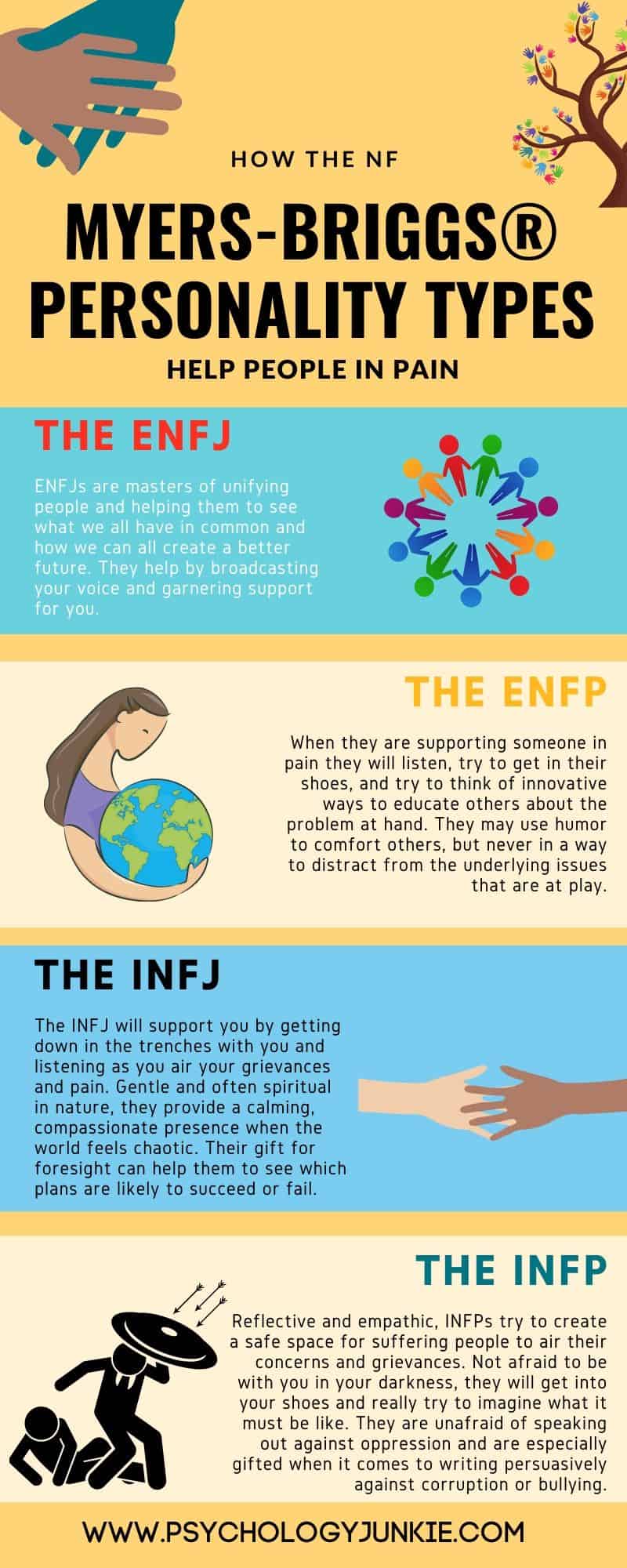
The ENFP – “I will hold space for you and defend you”
Spend five minutes with an emotionally healthy ENFP and you’ll probably notice something that, unfortunately, is unusual to find these days: they make it feel safe to be honest. They’re usually less interested in telling you what you should have done and more interested in understanding what your experience has actually been like. They’ll ask questions, listen between the lines, and try to help you feel safe enough to express your real self, warts and all.
If someone is hurting, an ENFP often becomes both encourager and advocate. They’ll speak up when they see someone being treated unfairly, especially if they think a person’s individuality or humanity is being ignored. At the same time, they’re naturally hopeful. They don’t want to leave you sitting in the pain forever. Because Extraverted Intuition naturally scans for alternatives, ENFPs often can’t help but see possibilities that someone in despair has lost sight of. And yes, they’ll probably make you laugh somewhere along the way—not to avoid the hard feelings, but because sometimes laughter gives people enough room to breathe again.
Of course, this describes emotionally healthy ENFPs. Under severe stress, any type can struggle to offer their natural gifts.
The ENTP – “I will create opportunities and ideas for you”
ENTPs rarely look at a problem and see only one solution. Even when someone feels trapped, they’re already turning the situation around in their mind, looking for another angle, another strategy, another possibility that hasn’t been considered yet. They’re all about expanding the conversation. When despair makes life feel like every door is closed, the ENTP starts pointing out the windows. They ask questions that shift perspective, challenge assumptions that may not actually be true, and often inject just enough humor to loosen the grip of the situation. Their goal isn’t to minimize someone’s pain. It’s to remind them that pain has a way of shrinking our vision—and there are usually more possibilities than we can see in the middle of it.
The INFP – “I will stay with you in your darkness”
INFPs don’t usually feel the need to rush people toward feeling better. They understand that some pain has to be experienced before it can be healed. If you’re grieving, overwhelmed, or questioning everything, they’re often willing to sit beside you without trying to fix or explain it away.
They instinctively try to understand what life feels like from another person’s point of view. Instead of assuming they know, they’ll imagine, ask questions, and carefully piece together the emotional reality someone is living through. When they see people being mistreated or dehumanized, they can become surprisingly fierce. Many INFPs have a gift for putting difficult emotions into words, whether through conversation, writing, art, or music. They help people feel understood first. Hope usually comes later.
The INTP – “I will troubleshoot for you”
If you’re looking for lots of emotional reassurance, you might initially think the INTP doesn’t care. In reality, they’re showing love by trying to solve a problem that feels unsolvable.
INTPs have a habit of pulling problems apart until they can see how everything fits together. When everyone else feels overwhelmed by the complexity of a situation, they’re often becoming more curious. They want to understand what’s actually happening beneath the surface before deciding what to do next.
When someone comes to them in a crisis, they naturally start looking for leverage points. Is there an assumption nobody has questioned? A variable everyone overlooked? A solution that seems strange but actually makes more sense than the obvious one? They don’t always offer emotional reassurance in the traditional sense, but there’s a quiet kind of compassion in the way they refuse to give someone false hope or empty platitudes. If they tell you they think there’s a way through the problem, it’s usually because they’ve spent the time reasoning it out.
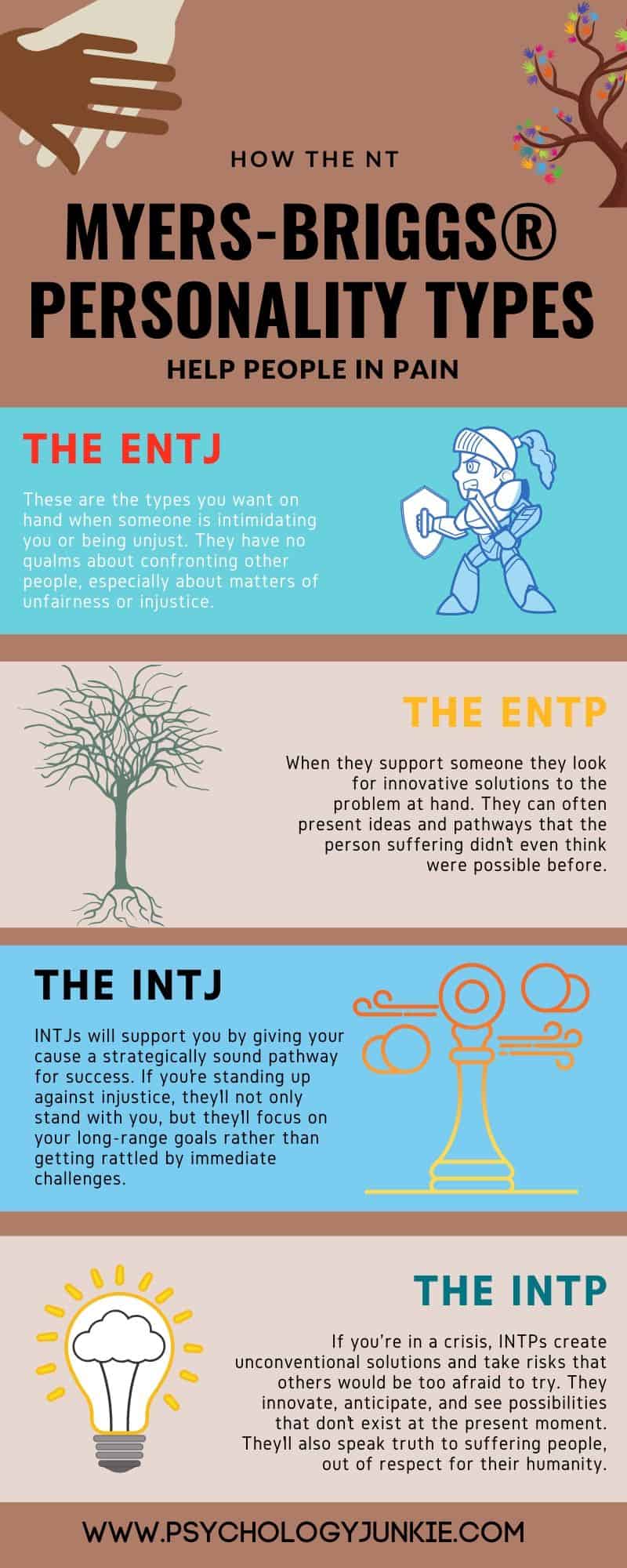
The ENFJ – “I will make your voice heard”
ENFJs have a knack for noticing what people need before they know how to ask for it. If you’re overwhelmed, they’re often already organizing help, making phone calls, checking in, or finding the right people to involve. Sympathizing with someone’s struggle isn’t enough for them, they want to do something to make you feel better. They’ll try to lift your spirits by seeing your perspective, empathizing with your struggle, and helping you feel inspired when life feels like it’s wearing you down.
When they believe someone is being treated unfairly, they can become remarkably determined. They’ll speak up, gather support, and encourage other people to care, too. One of their greatest strengths is helping people see that someone else’s struggle isn’t just their problem. It’s something a community can respond to together. ENFJs naturally bring people around a shared purpose, reminding them that real change usually happens when no one has to carry the burden alone.
The ENTJ – “I will devise a team so that your goals can be realized”
When an ENTJ cares about someone, support often looks like strategy. While everyone else is focusing on how impossible the situation feels, they tend to figure out what resources are available, who needs to be contacted, and what the fastest path forward might be.
They’re not easily intimidated by conflict or bureaucracy. If someone is standing in the way of what’s fair or necessary, the ENTJ is often perfectly willing to have the difficult conversation that everyone else is avoiding. Obstacles don’t usually discourage them. Instead, they activate them. They naturally coordinate people, assign responsibilities, and keep everyone moving toward the goal. Their care may not always sound soft, but it’s often expressed through relentless determination to solve the problem and make sure the people they love aren’t facing it by themselves.
The INFJ – “I will help you find a path through this”
INFJs have a way of sitting with someone’s pain without being overwhelmed by it. Over the years, one pattern I’ve seen repeatedly is that INFJs aren’t usually looking for quick fixes or inspirational clichés. First they want to understand. They’ll listen carefully, notice the patterns beneath the surface, and try to make sense of what you’re experiencing as a whole rather than as a collection of isolated problems.
Once they’ve done that, they naturally begin looking toward healing. Not in the sense of pretending everything will be okay, but by helping you find a direction when life feels disorienting. They often have an ability to see what is likely to move someone forward and what will only keep them stuck. Whether you’re recovering from illness, grappling with grief, or trying to rebuild after a difficult season, an emotionally healthy INFJ wants to help you find a path that feels both hopeful and realistic. They don’t just want to ease today’s pain. They want to help you build a life that isn’t defined by it.
The INTJ – “I will give you the strategic advantage”
One thing I’ve noticed after working with hundreds of INTJs is that they tend to show they care by solving problems that other people haven’t even noticed yet. When someone they love is facing a difficult situation, they instinctively begin looking several moves ahead. What obstacles are coming? Which decisions matter most? Where is everyone likely to get sidetracked?
That long-range perspective can be incredibly grounding in a crisis. While other people are reacting to today’s emergency, the INTJ is already thinking about next month, next year, and what will create the strongest outcome over time. They’re also extremely dependable in practical ways. They may not always know exactly what comforting words to say, but they’ll research options, handle difficult logistics, and maybe even take care of the chores nobody wants to do (that’s what a few INTJs I’ve known have done for others during difficult times). Their loyalty is often less visible than emotional reassurance, but it’s no less real. It shows up in consistent action, careful planning, and a determination to help the people they care about reach the other side.
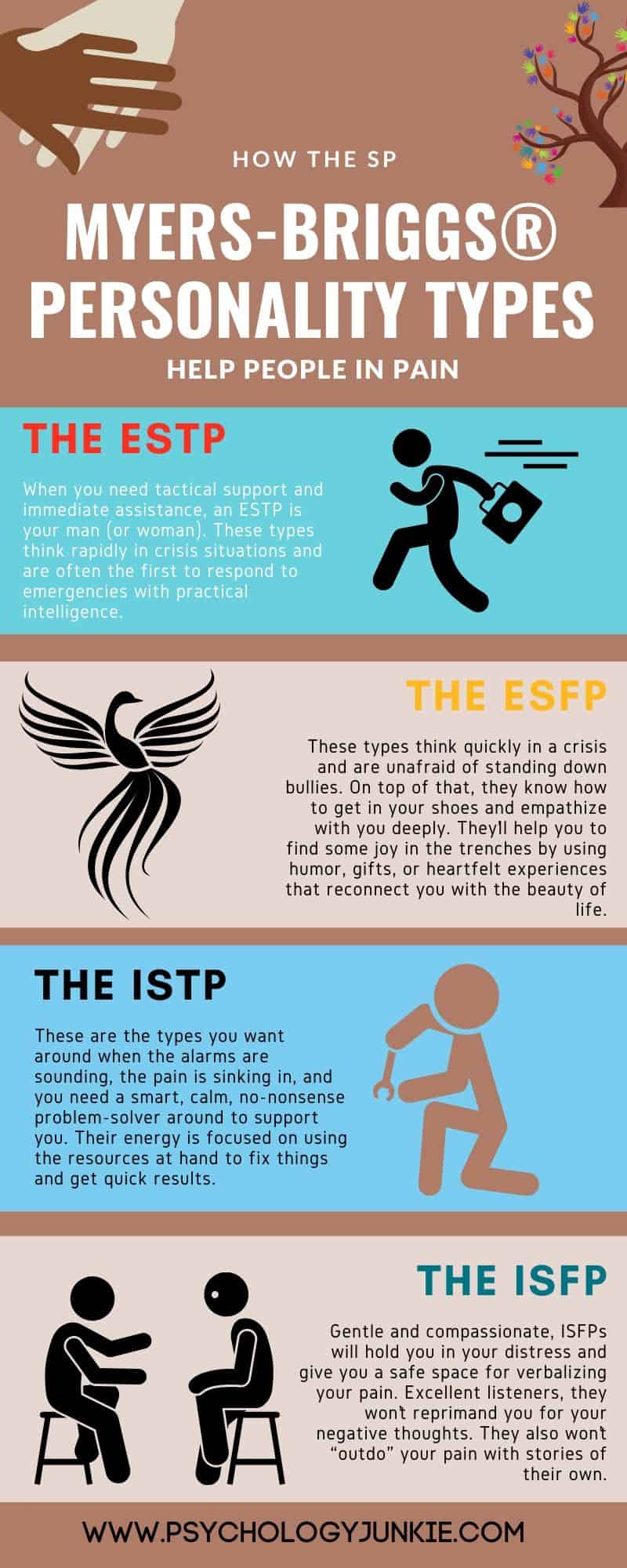
The ESFP – “I will remind you that life is still worth showing up for”
ESFPs hate watching people get pushed around. If they see someone being bullied, humiliated, or treated unfairly, they’re often far more willing to step in than people expect. They have a strong instinct to protect the underdog, especially when they can see someone else’s dignity being chipped away.
When someone they care about is hurting, they don’t usually want to leave them alone with the pain forever. They’ll sit with it for a while, but then they’ll start looking for small ways to bring life back into the room. Maybe it’s taking you somewhere beautiful, making you laugh until your stomach hurts, showing up with your favorite food, or convincing you to get out of the house for an hour. They understand that healing isn’t only about talking through suffering. Sometimes it’s about remembering that joy still exists, even if you can only feel it for five minutes at a time.
The ESTP – “I’ll take charge of the chaos for you”
When a crisis hits, ESTPs become surprisingly calm. While other people are still processing what just happened, they’re asking, “Okay…what needs to happen first?” They have a knack for cutting through panic and focusing on the next practical step.
They’re resourceful, adaptable, and rarely intimidated by high-pressure situations. If someone is causing trouble, they’re often willing to confront them directly. If something breaks, they’ll start figuring out how to fix it. If everyone else freezes, they tend to move. That confidence can be incredibly reassuring to the people around them. And despite their tough reputation, many ESTPs have an easygoing sense of humor that helps release tension when everyone is running on adrenaline. Their support doesn’t usually show up in long emotional conversations. It shows up in decisive action and the reassuring sense that someone competent has the situation under control.
The ISFP – “I won’t look away from your pain”
ISFPs have a quiet way of making people feel safe. For them it’s all about offering presence and quiet empathy rather than fixes. They give you room to feel what you’re feeling without acting like it’s something that needs to be fixed immediately.
They’re thoughtful listeners who tend to meet people where they are. Rather than making the conversation about themselves or searching for the perfect thing to say, they simply stay present. And despite their gentle nature, they’re often steadier in a crisis than people realize. They can handle difficult realities without looking away, offering practical help while still respecting your dignity and your need to make your own choices. Their compassion feels grounded. It’s less about dramatic displays of emotion and more about quietly letting you know, “You’re not carrying this alone.”
The ISTP – “I will help you solve what’s in front of you”
ISTPs are at their best when everyone else is panicking. They have a gift for staying calm, assessing what’s actually happening, and starting working on the problem one step at a time. While others are overwhelmed by the size of the crisis, they’re focused on what can be done right now.
They’re naturally resourceful and quick to adapt when circumstances change. If Plan A falls apart, they’re already experimenting with Plan B. What makes their support so reassuring is that they rarely create more drama than the situation already contains (every ISTP I know despises drama and will go out of their way to avoid it). They just get to work. Whether they’re fixing something that broke, handling an emergency, or helping someone through a practical challenge, their goal is straightforward: reduce the damage, improve the situation, and give the people around them a little more solid ground to stand on.
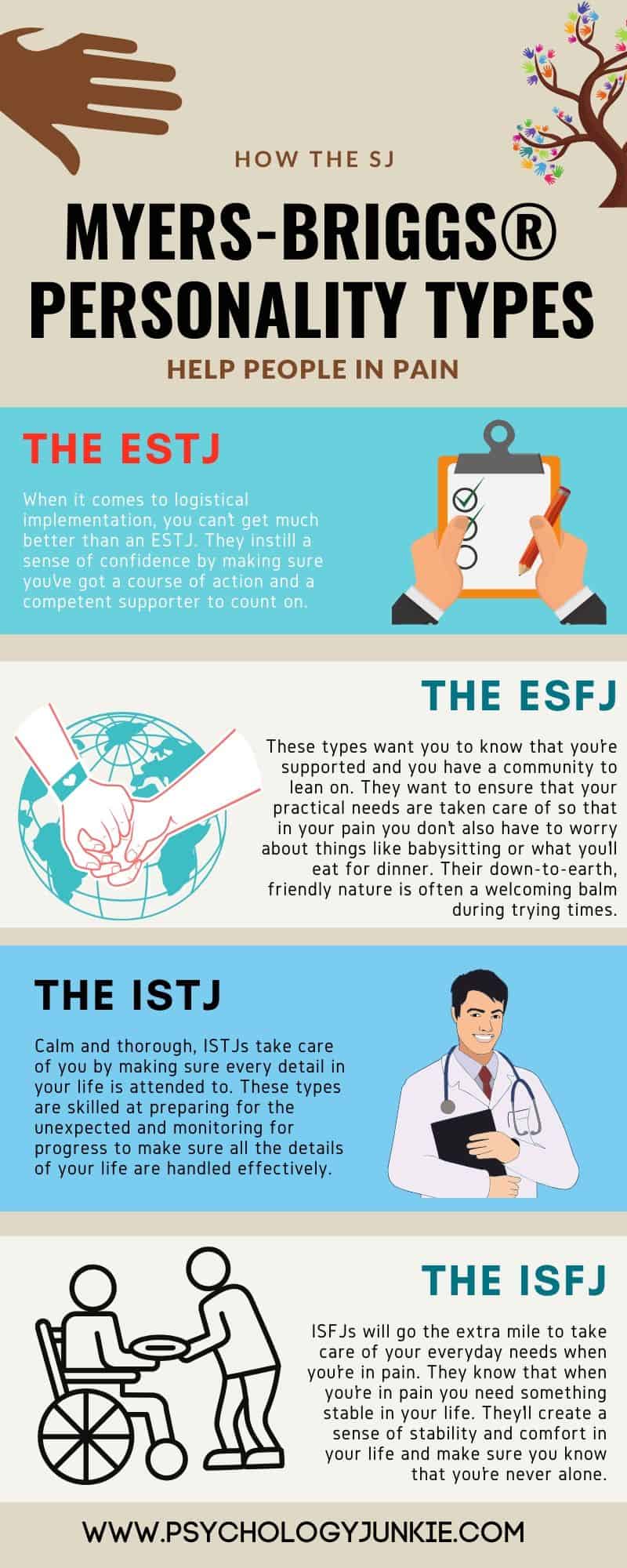
The ESFJ – “I’ll make sure you don’t have to do this alone”
If life completely falls apart, the ESFJ is probably already texting five people before you’ve finished saying, “I’m okay.” They’re the ones who are organizing the meal train, finding someone to pick up your kids, texting three friends, and somehow convincing everyone to bring different casseroles. (No small feat.)
They naturally notice the practical needs people often overlook when life falls apart. Who’s making dinner? Who’s walking the dog? Who’s sitting with you at the doctor’s office so you don’t have to go alone? Their instinct is to gather people together and make sure no one is carrying more than they have to. Just as important, they offer a warm, reassuring presence that reminds people they’re still part of a community. They don’t just say, “We’re here for you.” They make sure you actually feel it. Side note: You may accidentally end up with enough soup to feed a small village.
The ESTJ – “I’ll take care of what needs to be done”
ESTJs have a calming effect in a crisis because they immediately start bringing order to the chaos. They’re the masters of organization: They’re making a list, prioritizing it, and wondering why no one has called the insurance company yet. Their directness can sometimes sound bossy, especially when you’re emotionally raw. But underneath it is usually a genuine desire to reduce your burden.
If someone they care about is overwhelmed, they’ll often step in and take over the logistics. Appointments get scheduled. Forms get filled out. Phone calls get made. Problems get broken down into manageable pieces. They understand that when people are grieving, sick, or exhausted, even simple decisions can feel impossible. Rather than asking you to carry that mental load, they’ll shoulder as much of it as they can.
Their support isn’t usually sentimental or fussy, but it is dependable. An ESTJ wants you to feel like someone competent is at the helm, the details are being handled, and things are far less likely to fall through the cracks on their watch.
The ISFJ – “I will help you feel safe again”
When someone they love is hurting, ISFJs start paying attention to every little thing that might make life easier, safer, or more comfortable.
That care shows up in countless practical ways. They remember your favorite soup when you’re sick. They make sure you have a blanket when you’re cold, a ride when you need one, and someone to sit with you when life feels overwhelming. But if they believe someone is threatening or mistreating the people they love, don’t mistake their gentleness for passivity. ISFJs can be surprisingly courageous when it matters most. More than anything, they want to restore a sense of stability. They know that when life falls apart, even small acts of consistency can become an anchor. They just keep showing up, day after day, until you don’t have to wonder whether you’re facing it alone.
The ISTJ – “I’ll handle the things you shouldn’t have to think about”
ISTJs have a way of noticing the responsibilities that don’t magically disappear just because life gets hard. While you’re focused on surviving the crisis, they’re making sure the bills get paid, the appointments are written down, the paperwork gets submitted, and, yes…someone remembers to take the trash to the curb. Civilization must continue.
Their support is steady rather than flashy. But sometimes that’s the most comforting. They reduce the number of problems waiting for you when you wake up tomorrow. They think ahead, prepare for setbacks, and build systems that keep life moving even when everything feels uncertain. It’s an understated kind of care, but it’s incredibly reassuring. With an ISTJ around, there’s comfort in knowing that someone is paying attention to the details so you don’t have to carry all of them yourself.
What Are Your Thoughts?
One of the biggest mistakes we make is assuming everyone should support people the way we do.
One thing I’ve noticed after years of working with clients is that psychological growth often means learning to borrow from the strengths of other types. An ENFP benefits from occasionally asking, “What practical help can I offer?” An ISTJ benefits from remembering that sometimes people need empathy before logistics. None of us are limited to our preferences, but understanding those preferences gives us a valuable starting point for growth.
Sometimes you need the ENFP’s hope.
Sometimes you need the ISTJ’s steadiness.
Sometimes you need the INFJ’s insight.
Sometimes you need the ESTP to simply say, “Okay…here’s what we’re doing.”
None of these approaches is better than another. They’re different tools for different moments, and together they paint a fuller picture of what compassion can look like.
Find out more about your personality type in our eBooks, Discovering You: Unlocking the Power of Personality Type, The INFJ – Understanding the Mystic, and The INFP – Understanding the Dreamer. You can also connect with me via Facebook, Instagram, or Twitter!









I hardest part about being an INFJ is getting this intuitive insights and feeling the behind the social mask underlying current of an ancient pain, then offering up unsolicited advice. This is after doing some uninstrusive probing questions. It feels like a boundary violation towards someone not ready to face what’s bothering them, and I tend to get a backlash, and so I back off into my turtle shell beating myself up.
Easiest part is more serendipitous, that strangers open up to me and that always seems to give them comfort and peace after we are done.
“They’ll also speak truth to suffering people, out of respect for their humanity.” .. even if you don’t want to hear it to the point you’ll stop talking to me. x) I’ll take the risk if I think it needs to be heard. #INTP
“Their bedside manner may not be the best, but you can count on them to be honest in a calm and patient way.” True, except for calm and patient. I’m also an 8. It depends on circumstances, I don’t think I’m ever patient (probably have ADHD) but I can be calm.
Recently there’s my best friend and my cousin who have been thinking it’s a good idea to not give limits to their toddlers. I know raising a kid is a personal issue, and very sensitive topic. But there’s a mental health risk, here. INTP did her research a bit. So I know I don’t have kids, but I know that’s how you can become NPD or ending up needed a psychiatrist, because the child didn’t get the security of boundaries, and didn’t learn to deal with frustration or to behave around others and not be selfish all the time. So I still told the parents.. They didn’t like it, but if I believe they’re endangering their kids somehow, I will tell. For my cousin it’s quite ironic, his sister is quite likely NPD, he and his wife can’t stand her (NPD are hard to stand, even for psychiatrists), and yet they’re doing everything needed for their kid to become NPD.