What Your Enneagram Type Should Never Let AI Replace
Artificial intelligence is changing the way we live at a pace that would have seemed impossible just a few years ago. I personally have a lot of anxiety about it, but I’m going to try to put that aside for this article and maintain a neutral view. For many people, AI speeds up their efficiency massively. It can summarize books, write emails, generate meal plans, brainstorm ideas, explain complicated topics, and even act like a therapist or life coach.
But every new tool changes us a little.

The calculator didn’t just make math easier; it changed how often we do mental arithmetic. GPS has made travel simpler, but many of us no longer remember routes the way we once did. The brain adapts to whatever it practices. It also adapts to whatever it stops practicing.
Neuroscientists call this neuroplasticity: our brains are constantly strengthening the pathways we use most and allowing neglected ones to weaken over time. As the psychologist Donald Hebb famously put it, “Neurons that fire together wire together.” The reverse is also true. Skills that aren’t exercised tend to fade.
That’s why I think the most interesting question about AI isn’t, “Will it replace humans?” It’s much more personal than that.
Not sure what your Enneagram type is? Take our free Enneagram questionnaire here.
What parts of yourself are you letting it replace?
Because AI is about more than just answering questions. It can also make it easier to avoid uncertainty, difficult conversations, creative frustration, moral wrestling, boredom, grief, and all the other uncomfortable experiences that shape us into wiser, more resilient people.
Carl Jung wrote, “There is no coming to consciousness without pain.” As much as we’d like to skip the messy parts of growth, they’re often the very experiences that deepen our character. They teach us discernment, resilience, compassion, and confidence in ourselves.
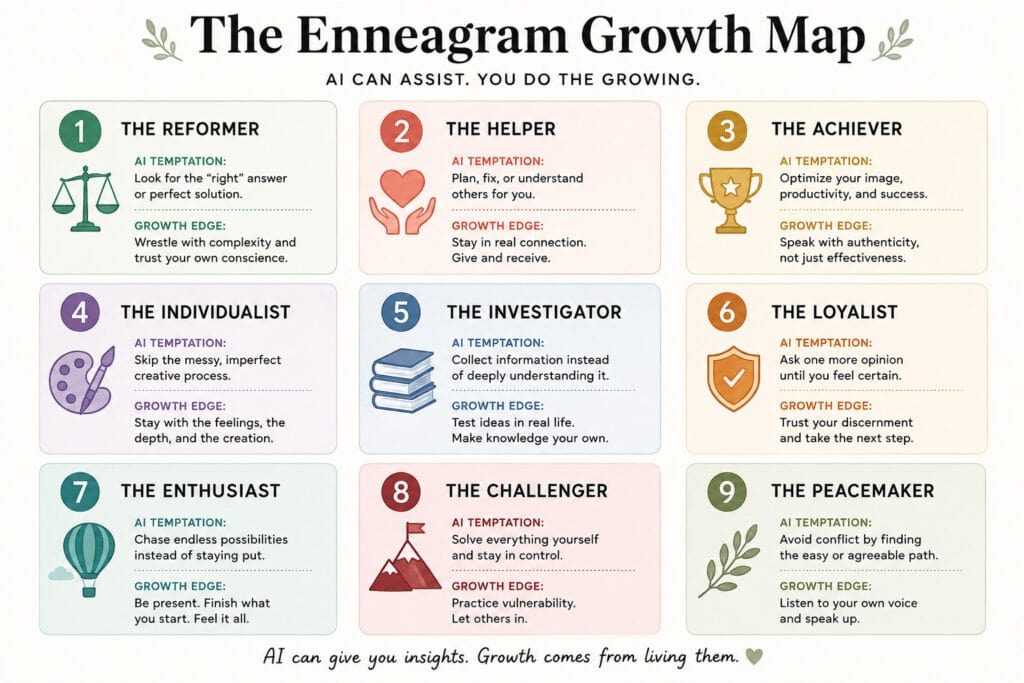
In my view, every Enneagram type has certain strengths that AI can support well. But every type also has a particular growth edge; a part of life that feels uncomfortable, yet slowly transforms us if we’re willing to lean into it. Ironically, those are often the very experiences AI can help us avoid.
Table of contents
- What parts of yourself are you letting it replace?
- Enneagram One: Don’t Let AI Replace Your Moral Wrestling
- Enneagram Two: Don’t Let AI Replace Mutual Relationships
- Enneagram Three: Don’t Let AI Replace Your Authentic Voice
- Enneagram Four: Don’t Let AI Replace Your Creative Process
- Enneagram Five: Don’t Let AI Replace Your Understanding
- Enneagram Six: Don’t Let AI Replace Your Discernment
- Enneagram Seven: Don’t Let AI Replace Being Present
- Enneagram Eight: Don’t Let AI Replace Vulnerability
- Enneagram Nine: Don’t Let AI Replace Your Voice
- What Do You Think?
Enneagram One: Don’t Let AI Replace Your Moral Wrestling
If you’re an Enneagram One, chances are you’ve already asked AI some version of, “What’s the right way to handle this?” And that’s ultimately not a bad question. AI can gather information faster than any of us. It can summarize ethical arguments, compare different viewpoints, point out potential consequences, and even help you think through a difficult decision. Those are real advantages.
But sometimes Ones might feel tempted to use AI to do their moral wrestling when they should let themselves sit with the difficult questions longer.
As a personality practitioner, one thing I’ve noticed about Ones is that they think hard about making the right decisions. They often have an inner ethical passion that’s incredibly active, constantly asking whether they’ve been responsible enough, fair enough, honest enough, or disciplined enough. That drive can make them people of extraordinary integrity, but it can also leave them searching for certainty in situations where certainty simply doesn’t exist.
Psychologist Barry Schwartz, in The Paradox of Choice, observed that the pursuit of the perfect decision can sometimes make us less satisfied with the decisions we ultimately make. I think Ones know this feeling well. When every choice carries moral weight, it’s easy to believe there’s one flawless answer waiting to be discovered if only you gather enough information.
AI can feed that instinct.
It can generate another perspective. Another list of pros and cons. Another ethical framework. Another article. Another opinion.
The difficult part is that wisdom doesn’t usually arrive as a perfectly organized list. It grows through experience, reflection, mistakes, repair, and learning to live with the fact that some situations involve competing values rather than obvious right and wrong answers.
Carl Jung once wrote, “The pendulum of the mind oscillates between sense and nonsense, not between right and wrong.” Human life is full of complexity like that. Sometimes compassion and justice pull in different directions. Sometimes honesty and kindness seem to compete. Sometimes every available choice carries some kind of loss.
No language model can resolve those tensions for you because they’re not just intellectual problems. They’re human ones.
From a neuroscience perspective, every time you wrestle with a difficult decision instead of immediately outsourcing it, you’re strengthening the very abilities that help you mature: discernment, emotional tolerance, perspective-taking, and cognitive flexibility. You’re teaching your brain that uncertainty isn’t something to escape as quickly as possible. It’s something you can survive.
That may actually be one of the hardest lessons for Ones.
You don’t become a wiser person by always finding the perfect answer. You become wiser by learning to grapple with imperfect situations with humility, courage, and compassion.
So by all means, let AI help you research. Let it explain opposing viewpoints. Let it challenge your assumptions. Just don’t hand it your conscience.
Some of the most important answers in your life won’t be found in a prompt. They’ll emerge slowly as you wrestle with difficult questions, listen to your values, remain open to correction, and accept that being a good person has never meant getting everything exactly right.
Enneagram Two: Don’t Let AI Replace Mutual Relationships
If you’re an Enneagram Two, AI can feel surprisingly comforting. It’s available whenever you need it. It listens without interrupting, remembers what you’ve shared, thanks you for your kindness, validates your feelings, and never seems inconvenienced by your questions. After a difficult day, that can feel like a relief.
There’s nothing inherently wrong with that. Sometimes we all need a place to organize our thoughts before talking to another person. I’ve certainly used AI to untangle ideas I couldn’t quite put into words. The problem begins when it starts replacing something much messier and much more important: real relationships.
Twos naturally tune into other people. They notice what’s needed before anyone asks. They remember birthdays, offer encouragement, anticipate problems, and often seem happiest when they’re making someone else’s life easier. Those gifts make them deeply caring friends and partners.
But many Twos also carry a pervasive fear that if they stop being helpful, they might become less lovable.
Psychiatrist Carl Rogers believed that people flourish when they experience unconditional positive regard; being accepted not because they’ve earned it, but simply because they exist. That’s often easier to understand than it is to believe. Twos, in particular, can spend years trying to deserve the love they’ve been hoping to receive all along, and AI can accidentally reinforce that pattern.
It never asks anything of you. It doesn’t disappoint you. It doesn’t need patience, compromise, forgiveness, or vulnerability. It gives you the feeling of being understood without asking you to risk misunderstanding.
Real intimacy doesn’t work that way.
A healthy relationship asks something from both people. Sometimes you need help instead of giving it. Sometimes you disappoint each other. Sometimes you misunderstand each other and have to repair the relationship afterward. Those moments can feel uncomfortable, but they’re also where trust grows.
Developmental psychologist Edward Deci, whose work helped shape Self-Determination Theory, found that one of our deepest psychological needs is genuine relatedness: knowing that we’re connected to other people in authentic, mutual ways. Mutual is the important word. We don’t become emotionally healthy by always giving or always receiving. We grow through the back-and-forth.
From a neuroscience perspective, real relationships are doing far more than exchanging words. Eye contact, shared laughter, physical affection, vocal tone, and even synchronized body language all activate systems in the brain that help regulate stress and strengthen attachment. A chatbot, no matter how sophisticated, can’t fully recreate those experiences because it isn’t participating in them with you.
As an Enneagram coach, I often think a Two’s deepest growth begins when they discover that people can love them even when they’re tired, imperfect, or unable to help.
That’s a frightening experiment for many Twos, but it’s also a freeing one.
So let AI help you draft an email. Let it brainstorm gift ideas or meal plans. Let it organize your thoughts before a difficult conversation. Just don’t let it become a substitute for the imperfect, beautiful work of letting another human really know you.
Because your greatest gift isn’t that you’re endlessly helpful. It’s that you’re a person worth loving, even on the days when you have nothing to give.
Enneagram Three: Don’t Let AI Replace Your Authentic Voice
No type is likely to see AI’s potential faster than the Three.
Do you need a polished presentation? Done.
A better résumé? Easy.
An email that sounds more professional? A social media post? A marketing plan? A speech?
AI can help with all of it, and that’s one of the reasons it’s such a powerful tool. Threes are naturally going to spot efficient solutions. Why spend three hours doing something that could take thirty minutes? AI makes sense in a lot of ways, although I know two Threes who have boycotted AI because of the ethical and environmental implications involved with using it.
Threes can adapt better to new technology than many other types, at least from what I’ve seen. They like to be on the cutting edge of what will make life more effective. That flexibility often makes them exceptional leaders, entrepreneurs, and communicators because they know how to connect with different audiences.
The downside is that they can become so skilled at presenting the version of themselves that works best that they gradually lose touch with what they actually think in an authentic sense.
Swiss psychiatrist Carl Jung observed that “The privilege of a lifetime is to become who you truly are.” For Threes, that isn’t usually a matter of discovering hidden talents. It’s learning that their value doesn’t disappear when they stop performing.
AI can make that journey easier to postpone.
If every email is polished by AI, every article optimized, every LinkedIn post carefully generated, every difficult conversation rehearsed beforehand, it’s possible to become increasingly successful while feeling increasingly disconnected from your own voice.
People may admire what you’ve produced without ever meeting the person who produced it.
Psychologist Donald Winnicott described the difference between the true self and the false self. The false self isn’t necessarily fake or dishonest. It’s the version of ourselves we develop because it earns approval, achievement, or acceptance. It protects us, but over time it can become exhausting to maintain. And that tension is one that I think many Threes understand well.
From a neuroscience perspective, there’s another reason to resist outsourcing your expression. The process of struggling to organize your thoughts, searching for the right words, revising an idea until it finally feels honest are part of how your brain clarifies what you actually believe. Writing doesn’t just communicate your thinking. It shapes it.
If AI always speaks for you, it becomes harder to hear your own voice.
As an Enneagram coach, I’ve noticed that healthy Threes become even more impressive than image-conscious Threes, but for an unexpected reason. Instead of trying to impress everyone, they try to figure out how to use their gifts to create a better world for its own sake. They can still work hard, still pursue excellence, still accomplish remarkable things. The difference is that they’re no longer measuring their worth by the applause that follows.
So use AI to speed up the repetitive work. Let it help with editing, brainstorming, or organizing information.
Just make sure the ideas, the convictions, and the heart behind the work are still yours.
Enneagram Four: Don’t Let AI Replace Your Creative Process
If you’re a Four, AI is probably both fascinating and a little unsettling.
On one hand, you can ask it to paint a picture in the style of Monet, write a poem inspired by Mary Oliver, brainstorm story ideas, or help you get unstuck when you’ve been staring at a blank page for an hour. It’s scary in how good it is at doing this, and scary because you start to wonder…where will human creativity go as this gets progressively better?
Am I using AI to support my creativity, or am I asking it to do the part that actually changes me?
Fours aren’t just trying to make something pretty. We’re usually trying to understand something: A feeling we can’t quite name. A memory that won’t leave us alone. An experience that doesn’t make sense yet. The painting, the song, the novel, the journal entry, even the way they decorate a room often becomes part of that search.
As a Four myself, I experimented with AI as it started to unroll years back. And while I was impressed by how quickly it could write, I felt like I’d lose myself if I adopted it very much. But my competitors started to use AI a lot, and some even told me I should use it because it could make my blog posts that take days take only 30 minutes. The temptation was strong. So I tried it, but I felt like I was betraying myself and my own love of writing. I started to doubt my own writing, feeling like it wasn’t as “good” as this robot system. My heart broke a little from the whole experience. I felt like I was crawling up a hill to create content while others were flying up the hill and showing better content anyway because they used AI while I hesitated and wrestled with the idea of it.
But here’s what I think: The messy, long, arduous process matters every bit as much as the finished piece.
Existential psychologist Rollo May once wrote, “Creativity is the process of bringing something new into being.” I love that he used the word process.
If you’ve ever tried to write something meaningful, you know it almost never arrives fully formed. I’ve heard of people getting epiphanies and having a song or essay come to them in their sleep. But for most of us, that’s not how life works. You chase one idea until it falls apart. You delete half of what you wrote. A sentence suddenly reminds you of something that happened when you were fourteen. You start writing about one thing and somehow end up discovering that you’ve actually been writing about something completely different.
AI can’t have that experience, but you can.
I’ve spent over a decade writing articles and I’ve found that some of the best ideas appear because I stayed with the wrong answer long enough to accidentally find something underneath it. Sometimes I’ll begin writing with complete confidence about what I want to say, only to realize halfway through that the article is actually about something else. That’s a frustrating process at times, because it slows things down, but I honestly don’t think I’d want to skip it.
I think that’s especially true for Fours.
Many Fours already wrestle with the fear that their voice isn’t original enough or that someone else has already said what they’re wanted to say, only better. AI can make that fear louder. If a chatbot can generate a poem, a painting, or a story in seconds, it’s easy to wonder, What’s the point of me making anything at all?
And believe me, I relate. I have this question in the back of my mind nearly every day.
But I think the better question is, What can only I make because I’ve lived my life?
AI can imitate styles, remix ideas, recognize patterns across millions of examples. What it can’t do is live through your heartbreak, your friendships, your disappointments, your strange sense of humor, or the afternoon that changed the way you looked at the world. Those experiences become part of your work in ways you probably don’t even notice.
Carl Jung wrote, “The creation of something new is not accomplished by the intellect but by the play instinct acting from inner necessity.” For us Fours, creativity doesn’t come from trying to impress people, but from feeling like, I have to make this. Even if no one else ever sees it.
Kim Namjoon “RM”, the leader of the South Korean band BTS, and also (I believe) an Enneagram Four, once said:
“For me…why do I make music? I’m not good at rapping more than Nas, not more than Kendrick, not more than Eminem, which are my heroes. Or I can’t sing like Erykah Badu, I can’t sing like Anderson Paak. Why am I making music then? Because I think I have my own one single edge that I can only spread to this world, and I feel like I’m dying if I don’t do this. I feel like I’m chasing the timelessness or the eternity.”
When I heard RM’s words, I felt a sense of relatedness as a fellow Four. Yeah, AI can perhaps create technically better writing, technically “better” lyrics. But there’s still originality inside us, something about the human experience, that only we can bring to the table, even if it’s messy.
From a neuroscience perspective, there’s another reason not to rush the process. Researchers studying creativity have found that insight often emerges after periods of reflection, experimentation, and even apparent dead ends. Your brain continues working on problems when you’re out for a walk, washing dishes, or staring out the window. Some of your most original ideas arrive because you gave them room to develop instead of demanding an immediate answer.
AI is built for immediate answers.
Human creativity usually isn’t.
So use AI when it genuinely helps. Let it help you brainstorm, organize your notes, or get unstuck if you’ve been circling the same idea for days. There’s no prize for making every creative task harder than it needs to be.
Just don’t let it steal the part that shapes you.
The awkward first draft. The painting that doesn’t work. The song you rewrite ten times. The journal entry that uncovers a burden you didn’t realize you were dragging around emotionally. Those moments may never become anyone’s favorite piece of your work, but they’re often the ones that change the person creating it.
And in the end, I think that’s what creativity has always been about. Not just making something beautiful for the world, but becoming a little more honest with yourself along the way.
Enneagram Five: Don’t Let AI Replace Your Understanding
If you’re a Five, there’s a good chance you’ve had one of those evenings where you meant to look up one thing and somehow ended up reading about the history of cryptography, octopus intelligence, medieval architecture, and whether consciousness can actually be explained by neuroscience.
I’ve always enjoyed that kind of wandering too. Some of my favorite articles have started with a question I couldn’t stop thinking about. Or a night where one interesting idea led to another, and before long I forgot what I originally sat down to research.
AI can be useful for that sometimes. It can point you toward books you wouldn’t have found on your own, summarize complicated theories, compare opposing viewpoints, and answer questions that might have taken hours to untangle otherwise. I think most Fives would be hard-pressed not to appreciate a tool like that.
You just don’t want AI to do so much of the heavy lifting that you don’t leave enough room for the kind of thinking that changes you.
The physicist Richard Feynman once said, “I would rather have questions that can’t be answered than answers that can’t be questioned.” I think that’s one of the healthiest attitudes a Five can have because understanding is less about accumulating answers but about wrestling with an idea until it becomes yours.
As an example, I’ve noticed a particular pattern in myself more than once. I’ll read a beautifully written explanation of a complicated topic and come away thinking, I’ve got it. Then I’ll try explaining it to someone else, and somewhere around the third sentence I’ll realize I don’t actually understand it nearly as well as I thought.
Psychologists even have a name for this. It’s called the illusion of explanatory depth. We tend to believe we understand familiar things far better than we actually do. It’s only when we have to explain them, apply them, or defend them that we discover where the gaps are.
As frustrating as that can be, those moments are often where real learning begins.
So AI can organize information, but it can’t do that work for you.
From a neuroscience perspective, that struggle is part of how the brain learns. We build stronger neural pathways when we gather information from memory, connect it to things we already know, explain it in our own words, and use it in real situations. Reading is important, but it’s only one piece of the puzzle. The effort of making sense of something is what helps it stick.
So by all means, use AI to explore your interests. Ask impossible questions. Chase rabbit trails. Let it recommend books, summarize dense research papers, or introduce you to ideas you’ve never considered before.
Just don’t let it become the place where your thinking stops.
Read the book instead of only the summary once in a while. Sit with questions that don’t have immediate answers. Explain what you’ve learned to someone else. Try the experiment. Have the conversation. Risk discovering that your first conclusion wasn’t quite right.
Because that’s usually where understanding begins.
Enneagram Six: Don’t Let AI Replace Your Discernment
Imagine having a well-read friend who’s awake at two in the morning, never gets tired of your questions, and can instantly compare two job offers, explain a confusing medical diagnosis, or help you think through the pros and cons of moving across the country. For someone who likes to examine a decision from every angle, it’s easy to see the appeal.
I certainly understand it. But I think there’s a question Sixes should ask themselves from time to time.
Am I gathering information because it’s genuinely helping me make a wiser decision, or am I hoping one more opinion will finally make uncertainty disappear?
Sixes care deeply about making responsible choices. They notice risks other people overlook, they think ahead, and they’re willing to ask difficult questions instead of charging ahead with false confidence. Those qualities are genuine strengths.
The challenge is that life rarely hands us perfect certainty.
I’ve coached quite a few Sixes over the years, and a pattern I see fairly often is that they’re capable of seeing the strengths and weaknesses in almost every option. It’s an impressive but exhausting ability. Every answer naturally leads to another question, and every solution reveals another possible problem. AI can accidentally feed that cycle because there’s always another article to summarize, another perspective to generate, another argument to consider. Before long, you’ve accumulated pages of information but still don’t feel any closer to making the decision.
Psychologist Erich Fromm wrote, “The task we must set for ourselves is not to feel secure, but to be able to tolerate insecurity.” I think most of us spend a huge amount of energy trying to eliminate uncertainty from our lives, but uncertainty isn’t a problem we solve once and for all. It’s part of being human. We can reduce risk, gather information, seek wise counsel, and make careful plans, but eventually there comes a moment when we have to take a step without knowing exactly how things will turn out.
That’s something no AI can do for us.
As an Enneagram practitioner, I’ve found that healthy Sixes still ask questions and prepare. But as they become more mature, they gradually learn to trust the person who’s weighing all that information: themselves. Instead of believing confidence comes from finding the perfect answer, they begin to discover that confidence grows from making thoughtful decisions, learning from the outcome, and realizing they’re more resilient than they imagined.
There’s some interesting neuroscience behind this as well. Our brains learn through experience more than analysis. Every time you make a difficult decision, tolerate the uncertainty that follows, and discover that you can adapt even if things don’t unfold exactly as planned, your brain updates its prediction about the future. Little by little, it becomes less convinced that every unknown is dangerous. That’s one reason confidence usually follows action rather than preceding it. We become more secure by practicing courage, not by waiting until all our doubts disappear.
Carl Jung once said, “We cannot change anything until we accept it.” For Sixes, I think part of that acceptance is recognizing that no amount of research can guarantee a perfect outcome. There will almost always be another variable you didn’t anticipate, another opinion you could consult, another possibility you haven’t considered yet. Wisdom isn’t found in exhausting every option. It’s found in knowing when you’ve done enough and trusting yourself to move forward.
So use AI as a sounding board. Let it explain unfamiliar ideas, challenge your assumptions, or point out blind spots you may have missed. Those are some of the best ways to use it.
Just remember that AI is a tool, not your guide, not your inner voice. The discernment you’re looking for doesn’t come from collecting endless opinions. It grows each time you face uncertainty with honesty, think things through as carefully as you can, and then have the courage to trust your own judgment. That’s a kind of confidence no technology can build for you, because it has to be lived before it can be believed.
Enneagram Seven: Don’t Let AI Replace Being Present
If you’re a Seven, AI might feel like someone designed the perfect playground for your mind.
Want to learn a new language? Plan a trip through Italy? Brainstorm ten business ideas? Find the best books on neuroscience, watch tutorials on pottery, compare hiking trails in the Rockies, and somehow end up reading about bioluminescent caves before dinner? AI is more than happy to come along for the ride.
Sevens have a natural curiosity that’s hard not to envy. Where some people see routine, Sevens see possibility. They ask questions other people never think to ask, and they have a way of making life feel bigger, richer, and more adventurous simply because they’re interested in so many things.
AI feeds that strength so well. But I think there’s a question worth asking every now and then.
Is AI helping me experience life more fully, or is it making it easier to stay in motion?
Sevens are often incredibly productive and energetic. What can be harder is staying with an experience after the novelty has worn off. Once the excitement fades, the mind naturally begins looking for the next interesting idea, the next project, the next possibility waiting just over the horizon.
That’s part of what gives Sevens their spark. It’s also part of what can leave them feeling strangely restless, even when life is objectively good.
AI can unintentionally reinforce that pattern because it offers an endless stream of fascinating things to discover. Every question leads to five more. Every answer opens another door. Before you know it, you’ve spent two hours exploring topics you never planned to think about, and while you’ve enjoyed every minute of it, you also have the sense that your attention has been scattered into a hundred different directions.
Our brains are naturally drawn to novelty. Neuroscientists have found that new experiences activate the brain’s reward system, releasing dopamine that encourages us to keep exploring. Curiosity is one of the ways we learn, but the brain also changes through sustained attention. Some of our deepest learning happens when we stay with an experience long enough for it to move beyond excitement and become understanding.
I think that’s where Sevens often discover unexpected growth.
Psychologist Mihaly Csikszentmihalyi, who spent decades studying happiness and creativity, found that many of our most meaningful experiences happen during states of deep engagement, what he called flow. Those moments usually aren’t rushed. They ask us to become completely absorbed in what we’re doing rather than constantly shifting our attention somewhere else. It’s a good reminder that fulfillment doesn’t just come from a lot of experiences, it comes from entering more fully into the one you’re already having.
So by all means, let AI fuel your curiosity. Ask impossible questions. Plan your next vacation. Learn about astronomy, sourdough baking, ancient civilizations, or whatever catches your attention this week. That’s part of the delight of being a Seven.
Just remember that some of the richest moments are the ones that slowly reveal themselves because you stayed. You stayed with the relationship long enough for trust to grow. You stayed with the creative project after the excitement faded. You stayed with the difficult emotion instead of running from it. You stayed with an ordinary Tuesday and noticed there was far more beauty there than you expected.
Enneagram Eight: Don’t Let AI Replace Vulnerability
If you’re an Eight, you probably appreciate AI for how efficient it is. It solves problems, gives you information quickly, and doesn’t require you to grapple with someone else’s emotions before getting to the point. There’s a lot to like about that.
The question I’d encourage Eights to consider is whether AI is becoming another way to avoid depending on people.
Eights often have a deeply-held belief that it’s safer to rely on yourself than to risk being disappointed, controlled, or hurt by someone else.
AI fits neatly into that mindset because it’s useful without being emotionally demanding. It doesn’t ask you to trust it in the way another person does. It doesn’t require vulnerability, compromise, or the humility of admitting that you need help. It’s a tool, and tools feel predictable.
Psychologist Brené Brown has spent years studying vulnerability, and one of her observations has always stuck with me: “Vulnerability is not weakness; it’s our greatest measure of courage.” I think that’s especially relevant for Eights. Their growth has never been about becoming less strong. It’s about discovering that real strength includes knowing when to lower the armor.
So use AI to solve problems, organize ideas, or save yourself some time. Just don’t let it replace the conversations where you admit you don’t have all the answers, ask for support, or allow someone else to carry part of the weight with you. Those moments may feel less efficient, but they’re often the ones that deepen relationships and remind you that strength doesn’t have to be a solo project.
Enneagram Nine: Don’t Let AI Replace Your Voice
If you’re a Nine, AI can be so accommodating. It will help you brainstorm ideas, weigh different perspectives, write difficult emails, or even suggest what to say in a conflict. Sometimes that’s really helpful, especially when you’re feeling overwhelmed or unsure where to begin.
The question is whether you’re asking AI to organize your thoughts or decide what you think.
One thing I’ve noticed about Nines is that they usually have more wisdom and insight than they give themselves credit for. They’re excellent at seeing different sides of an issue, understanding where people are coming from, and finding common ground. The downside is that after listening to everyone else’s opinions, they can lose touch with their own.
AI can unintentionally make that unhealthy process easier. It can generate balanced arguments, offer endless perspectives, and suggest solutions that sound perfectly reasonable. Before long, it’s possible to become so focused on finding the most agreeable answer that you forget to ask yourself what you genuinely want.
Carl Jung wrote, “The privilege of a lifetime is to become who you truly are.” For Nines, that often begins with something surprisingly simple: noticing your own preferences before they get crowded out by everyone else’s.
So let AI help you untangle your thoughts when you’re stuck. Let it offer ideas you hadn’t considered. But don’t skip the part where you sit with the question yourself, even if the answer isn’t immediately clear. Your opinions, your convictions, and your desires deserve just as much attention as anyone else’s, and they become easier to recognize the more often you practice listening to them.
What Do You Think?
Do you love, hate, or feel neutral about AI? Do you have any advice to offer others with your Enneagram type? Let us know in the comments!
Find out more about your personality type in our eBooks, Discovering You: Unlocking the Power of Personality Type, The INFJ – Understanding the Mystic, The ISFJ – Understanding the Protector, and The INFP – Understanding the Dreamer. You can also connect with me via Facebook, Instagram, or YouTube!